

Blog
Expert tips for healthy skin
Expert tips for healthy skin
As autumn sets in, you might find your cheeks suddenly flushing, your skin feeling tight after washing, or your trusty toner causing a stinging sensation. Some people notice redness appearing overnight after having clear skin. These are common concerns during fall skincare.
And if you already have a treatment booked around now, it's easy to feel torn. You wonder, "Is it okay to go ahead with laser like this, or should I push it back?" Postponing feels like a waste after finally getting the appointment, but your skin right now leaves you uneasy.
I hear this every fall in clinic, so let's walk through how to tell when it's fine to go ahead and when your skin needs calming first. The short answer: it comes down to how your skin looks today, not the date on the calendar.
Quick Overview
- In autumn, dry air and temperature fluctuations can sap moisture from your skin's barrier, making it more reactive.
- Treatment decisions aren't based on the appointment date but on whether your skin shows any "irritation signals" today.
- If there's redness, stinging, or flakiness, focus on calming your skin first. If it's just dry but stable, you might consider proceeding.
- Applying strong treatments to a weakened barrier can raise risks like pigmentation or delayed healing.
- Different treatments have varying effects, so adjusting the order and intensity instead of outright postponing is sometimes possible.
At our clinic in Myeongdong, Seoul, the first thing I check with autumn patients is how intact their skin barrier is. As the air gets drier and the gap between indoor and outdoor temperatures widens, moisture escapes faster from this barrier, so skin that felt fine yesterday can suddenly react to the same air and products.
The outermost layer of skin, the stratum corneum, is often compared to a brick wall. The corneocytes are the bricks, and lipids (like ceramides) act as the mortar. The wall needs to be well-sealed to prevent moisture loss and keep irritants out.
However, in autumn, this mortar dries out. Lower humidity makes moisture evaporate more easily through gaps between the bricks, a process known as trans-epidermal water loss (TEWL). One review that pooled seasonal measurements put autumn forehead TEWL at more than 1.7 times the summer figure (17.4 vs. 9.9 g/m²/h). Once the wall loosens, moisture leaves and irritants get in, and that is exactly when skin tips into sensitivity.
Indoor environments exacerbate this. When heating starts, indoor humidity can plummet from 60% to under 40%. The ideal indoor humidity for comfortable skin barriers is generally between 40-60%, and below that, the stratum corneum dries out faster.
💡 In simpler terms - What feels like sudden sensitivity is really a thinner barrier. That is why the products you always use, or treatments you have had many times, can feel different this season.
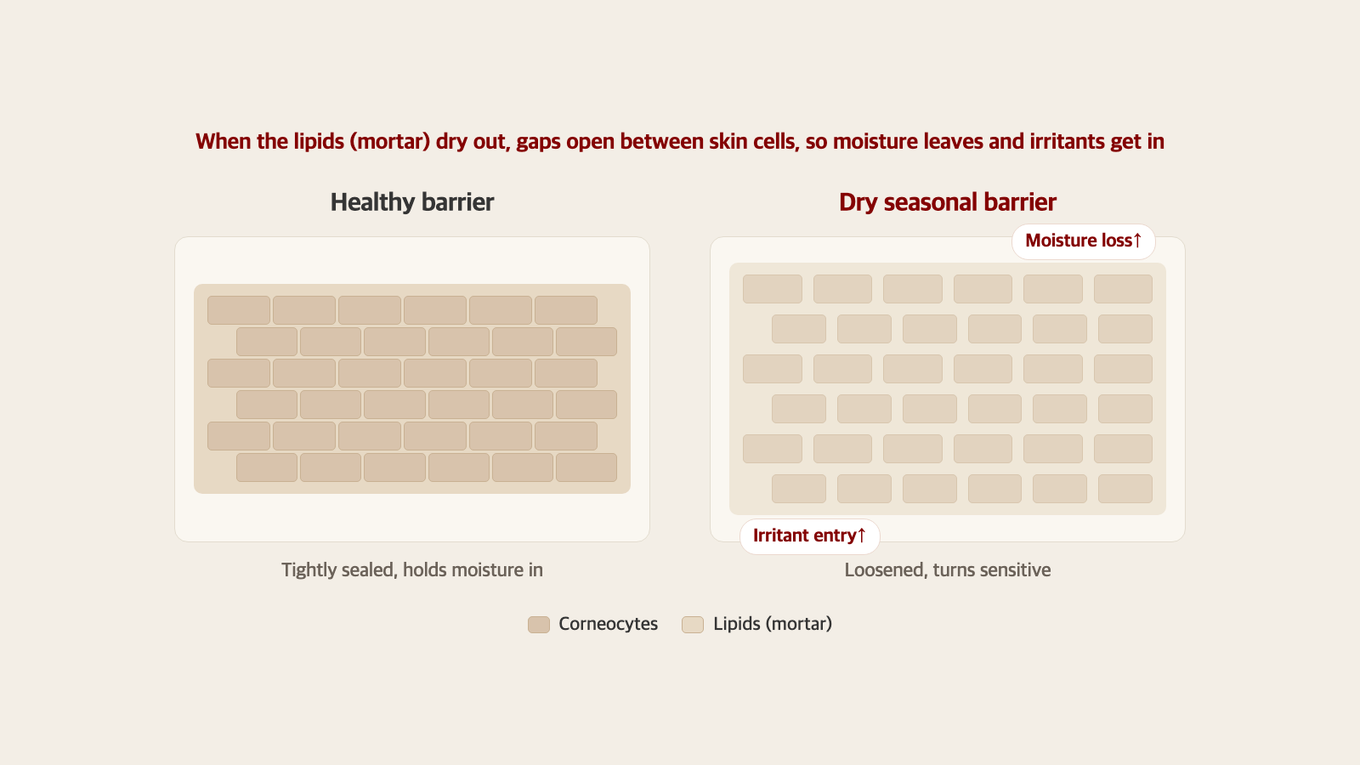
When lipids (mortar) dry out, gaps form between corneocytes (bricks), allowing moisture to escape and irritants to enter.
If there are irritation signals like redness, stinging, or flakiness today, calming your skin should come first. If it's dry but without these signals, you might consider going ahead. The key is the skin's state on the day of the treatment, not the booked date.
So at our Myeongdong clinic, even for a treatment that's already booked, we check the skin first and then decide whether to go ahead or calm it down. Your skin can look completely different on treatment day than it did when you booked. Here's how I read it, laid out as signals.
| Condition Favoring Treatment | Condition Requiring Calming |
|---|---|
| Dry and tight but no redness | Redness around cheeks/nose |
| Regular products work fine | Usual products sting or burn |
| No significant flakiness | Peeling or oozing/trouble areas |
| Comfortable without itchiness | Itchy with a feeling of heat |
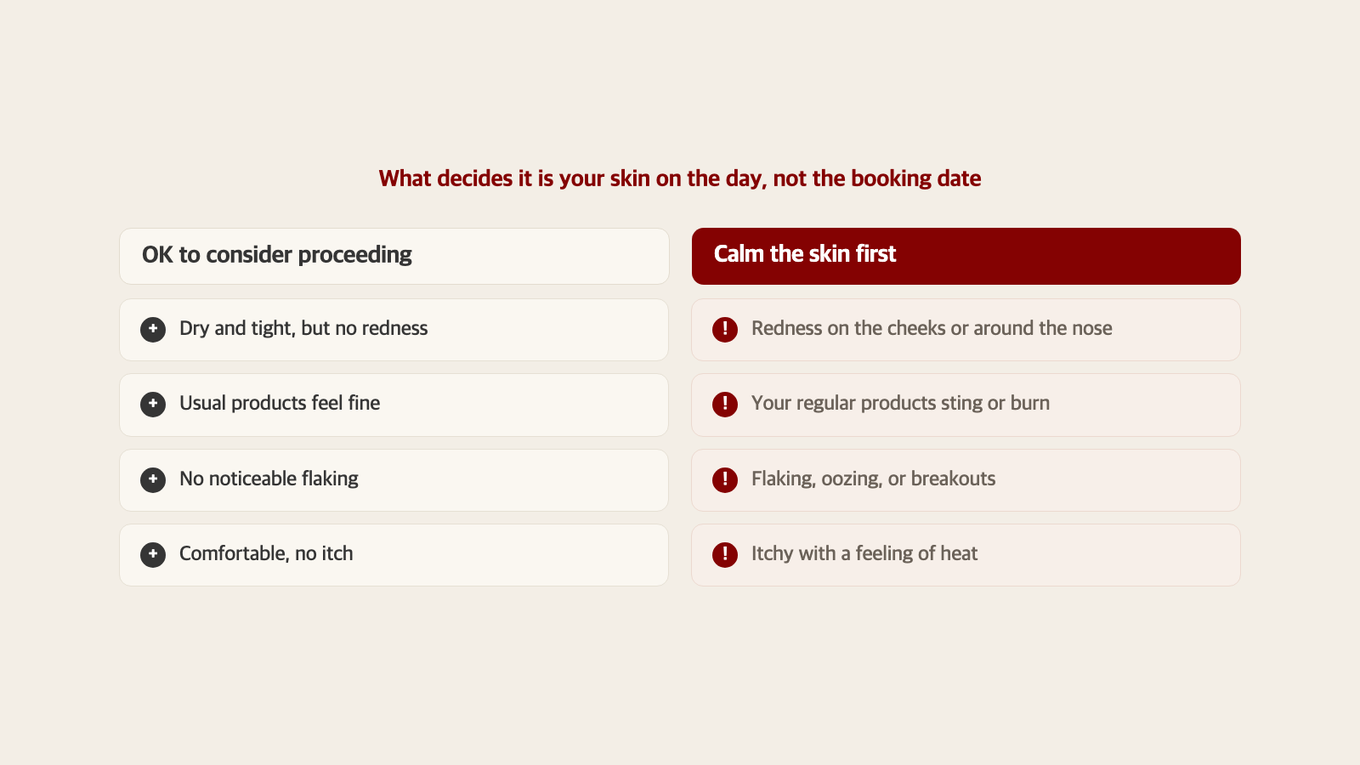
Consider proceeding if it's just dryness, but prioritize calming if there's any clear irritation signal.
Let's clarify a common misconception. Dryness and sensitivity are not the same. Dryness is a lack of moisture and oil, while sensitivity is when the skin's defenses are compromised. If it's just dryness, you can proceed with many treatments while maintaining hydration. However, if there are irritation signals like redness or stinging, it's a different story. In this case, rebuilding the wall before adding strong treatments is the priority.
Adding strong stimulation to an already weakened barrier increases the risk of post-inflammatory hyperpigmentation (PIH), prolonged redness, or delayed healing. A treatment intended to speed up results could end up taking longer to recover from.
The reason is simple. Lasers, peels, and energy treatments work by deliberately creating tiny, controlled micro-injuries so the skin improves as it heals. Healthy skin takes that in stride and rebuilds well, but skin whose barrier is already loose has little spare capacity. Recovery slows, and pigment or redness can linger.
PIH, in particular, can take months to fade once it sets in. If you push through treatment while your skin is sensitive, you might end up spending more time fixing it than you saved.
⚠️ Important to Know - "The more it stings, the better it works" is a misconception. Treatment intensity and results aren't directly proportional, and pushing past what your skin can handle just raises the risk of side effects. Timing it well, rather than gritting your teeth through it, gives your skin the best chance to respond.

Good decisions during sensitive times come from patience, not haste. Timing treatments when the barrier is stable yields better results.
Yes, they do. Treatments that exfoliate the surface, like peels and lasers, are most impacted when the barrier is weak, while energy-based (RF/ultrasound) lifting or injectable boosters can be adjusted in order and intensity.
So, the idea that "you must postpone all treatments in autumn" isn't accurate. Depending on the type, some treatments can proceed without issue, some need adjustments, and others are better delayed. Understanding this in three broad categories helps.
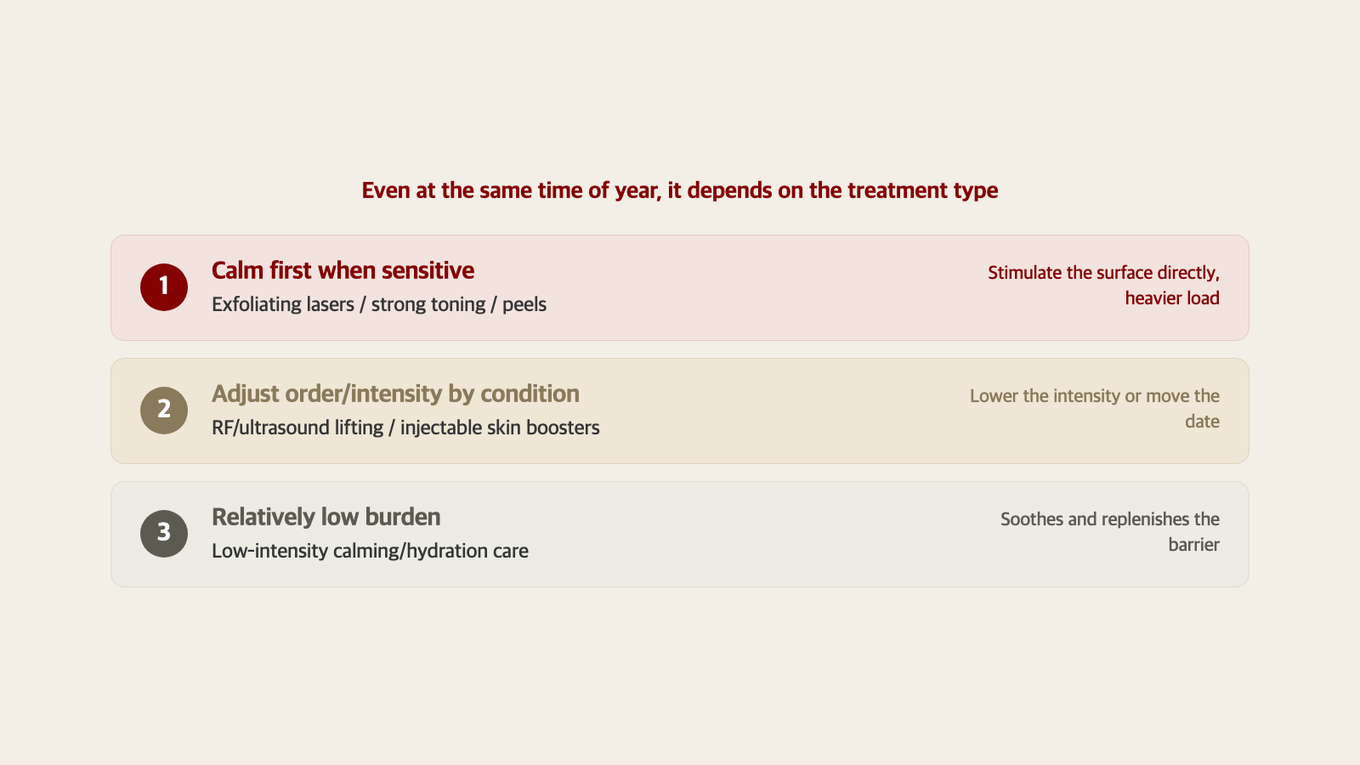
Even in the same season, whether to calm first, adjust, or proceed depends on the treatment type.
The most cautious category is surface-exfoliating types. Peels and strong toning deliberately stimulate the stratum corneum, and if the barrier is already loose, that becomes a burden. When irritation signals are present, this group is where I calm the skin first.
Energy lifting and injectable boosters are adjusted based on condition. Energy-based lifting stimulates the dermis with heat or ultrasound, with minimal surface damage, but on sensitive days, it may be safer to lower the intensity or reschedule. Boosters are similar. Collagen boosters or skin boosters typically adjust based on previous reactions, so if the barrier is unstable, absorption and recovery might differ, warranting a shift in order. If you're unsure where specific products fit, check out our post on differences between Rejuran, Juvelook, and Gouri for guidance.
Low-intensity calming/moisturizing-focused care is actually well-suited for this time. Instead of provoking, it soothes and replenishes the barrier, making it a good option when your skin is sensitive.
Restoring the barrier starts with removing irritants and replenishing moisture and lipids. Moisturize with lipid-rich ingredients like ceramides, maintain indoor humidity between 40-60%, and avoid hot water or aggressive exfoliation.
To rebuild a compromised wall, it's more about subtracting than adding. A common mistake during this sensitive time is adding a slew of new products thinking "I need something special because my skin is sensitive." It's actually the opposite. Temporarily pausing things like exfoliation, strong active ingredients, and hot cleansing can expedite recovery.
Next, replenish. Moisture alone evaporates quickly, so using moisturizers with lipids to lock it in is beneficial. Ingredients like ceramides and fatty acids help refill the wall's mortar. Maintaining indoor humidity at 40-60% slows down the drying of the stratum corneum itself.
After a few days of rebuilding, your skin will stabilize. Once calm, you can reschedule any postponed treatments. Rather than setting a fixed "2-3 weeks of adaptation in autumn," base it on whether irritation signals have subsided. Recovery speed varies widely - some stabilize in days, others take longer.
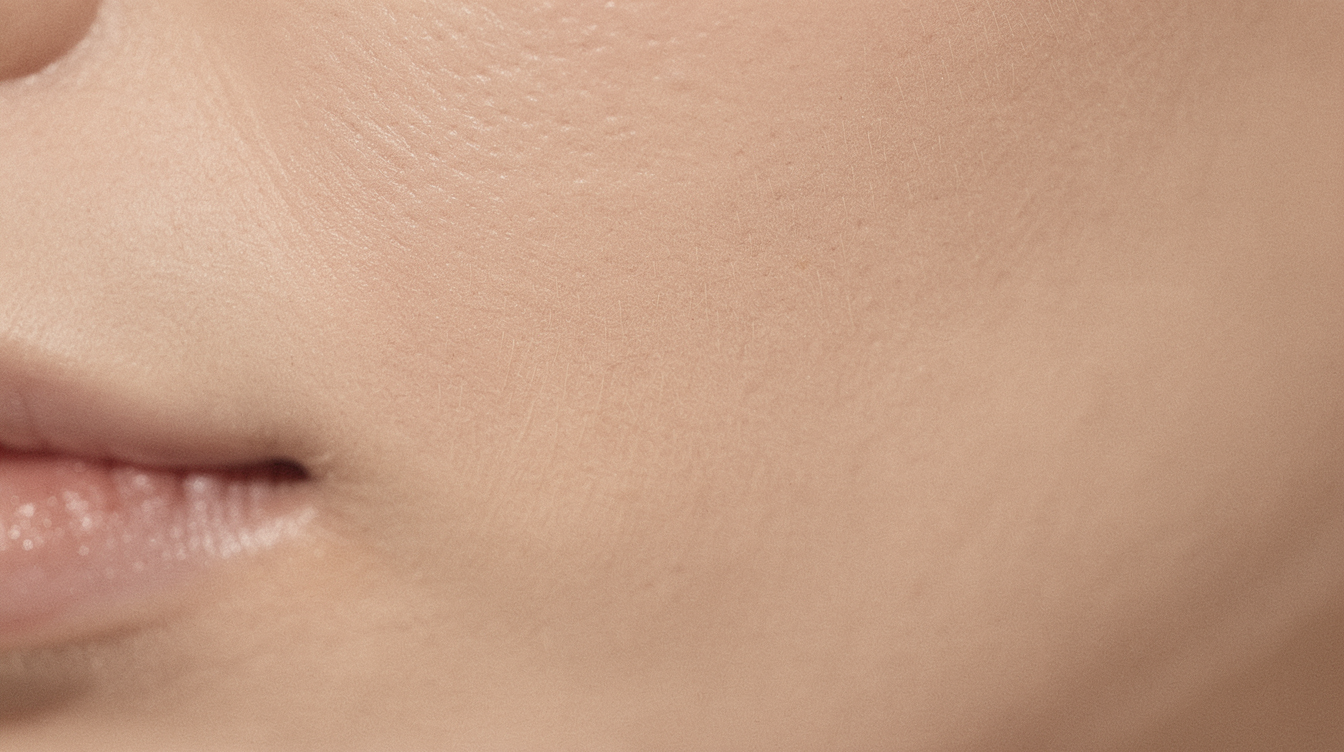
Removing irritants and replenishing lipids calms redness and smooths texture.
No. Whether to postpone depends on your skin's condition that day, not the season. Many treatments can proceed if your skin is stable without irritation signals like redness or stinging. Conversely, even in summer, clear irritation signals should prompt calming first.
Instead of outright cancellation, consider adjusting based on your condition. Depending on the treatment, you might lower intensity, change the order, or slightly delay the date, so there's no need to cancel outright. However, if irritation signals are clear on the day, it's better to prioritize calming and reschedule for optimal results.
There's no set number. Instead of locking into dates like "a few weeks in autumn," base it on whether irritation signals like redness or stinging have subsided. Focusing on removing irritants and lipid-rich moisturizing can stabilize some people in days, while others might take longer. Recovery speed varies greatly.
Low-intensity calming/moisturizing-focused care suits this season well. Conversely, exfoliating or strong toning treatments that strip the surface are better postponed if there are irritation signals. What suits best depends on your skin's condition today.
Post-treatment, focus on calming care for 1-3 days, then replenish with lipid-rich moisturizers once your skin stabilizes. During this time, it's better to pause adding new active products and focus on removing irritants. If redness or heat lasts longer than expected, it's safer to consult with the clinic where you received the treatment.
Sudden sensitivity in autumn isn't due to deteriorating skin but to a compromised barrier from dry air and temperature fluctuations. Thus, treatments can react differently during this time.
The decision should be based on today's skin condition. If there are irritation signals like redness, stinging, or flakiness, prioritize calming. If it's just dryness but stable, consider proceeding. For some treatments, adjusting order and intensity is an option instead of outright postponement.
At our Myeongdong clinic, the sequence is always the same when we look at autumn skin. Before deciding whether to keep a booking as is, we check what the barrier is doing today. Get the timing right, and that one habit alone will spare you a lot of second-guessing with sensitive autumn skin.
#AutumnSkin #FallSkinTreatments #SensitiveSkinTreatment #SkinBarrier #FallSkincare #TreatmentTiming #CalmingCare #TEWL #MyeongdongDermatology #ForeverClinic