
Blog
Expert tips for healthy skin
Expert tips for healthy skin
Ever notice how your skin doesn't bounce back as quickly as it used to when you press your cheek in front of the mirror? Many people experience this as a sign of declining skin elasticity.
At our clinic in Myeongdong, Seoul, we often hear, "What should I do first if my skin's losing elasticity?" But jumping straight to treatments without understanding the root cause can be misleading. Skin elasticity isn't powered by a single force; it's actually the result of two different proteins working together. Identifying what’s lacking helps determine the best course of action.
To put it simply, collagen and elastin, the two proteins supporting elasticity, have different roles and ways to rejuvenate. Understanding this difference also highlights why sun protection is prioritized over treatments.
Key Takeaways
- Skin elasticity relies on two pillars: Collagen provides tensile strength, while Elastin helps the skin snap back to its original shape.
- In the dermis, collagen forms about 70-75% of the dry weight, providing structure, while elastin, though only 2-4%, is crucial for "snap-back."
- Collagen decreases by about 1% per year starting in your 20s (accelerating post-menopause), whereas elastin is mostly formed in youth and doesn't regenerate much in adulthood (half-life ~70 years).
- This means collagen can be stimulated to rebuild, but protecting elastin is key, underscoring the importance of sunscreen as the primary defense.
Skin elasticity declines due to the reduction and breakdown of collagen and elastin in the dermis caused by aging and UV exposure. These two pillars weaken together.
If you break the skin into three layers - epidermis, dermis, and subcutaneous fat - elasticity is mainly about the dermis. Collagen fibers form a meshwork that provides structure, while elastin acts like tiny springs, helping the skin return to its original state.
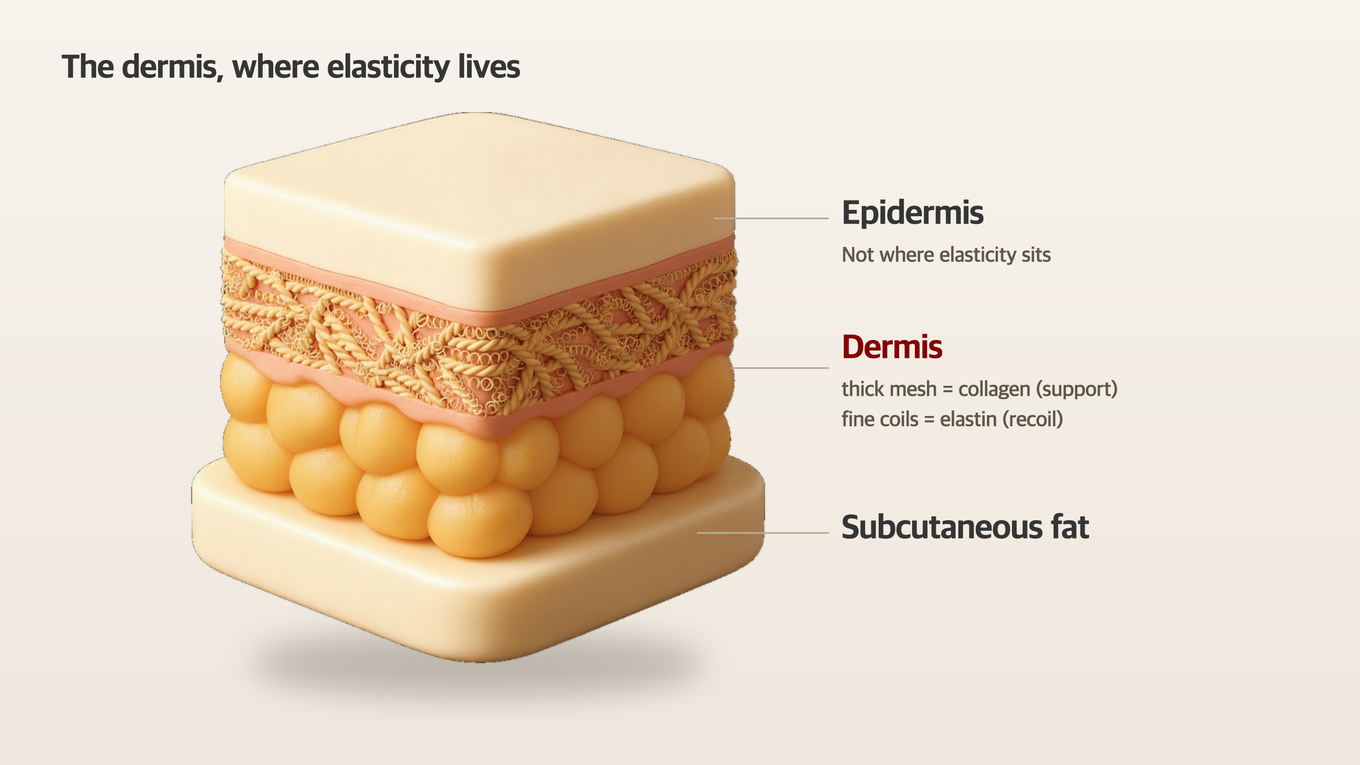
The stage for elasticity: the dermis. Collagen, like a thick mesh, supports structure, while elastin, like slender springs, helps skin bounce back.
As we age, fibroblasts that weave this mesh slow down, while enzymes (MMP) that break down old fibers increase. This reduces building speed and increases breakdown, thinning the dermis. UV exposure and glycation can accelerate this process.
In our Myeongdong clinic, the first thing we assess for elasticity is whether the problem is with the structural support (collagen) or the snap-back (elastin). Since these two pillars have different causes and solutions, lumping them under "elasticity treatments" can be misleading.
Collagen provides tensile strength, holding the skin tight under pressure, while elastin is responsible for elasticity, allowing the skin to return to its original shape. They live in the same dermis but serve different functions.
Try pinching the skin on the back of your hand. The skin's resistance to tearing is thanks to collagen, while its quick return to flatness is due to elastin. If it takes longer to bounce back, it might indicate your elastin isn't what it used to be, although dehydration can also slow this process.
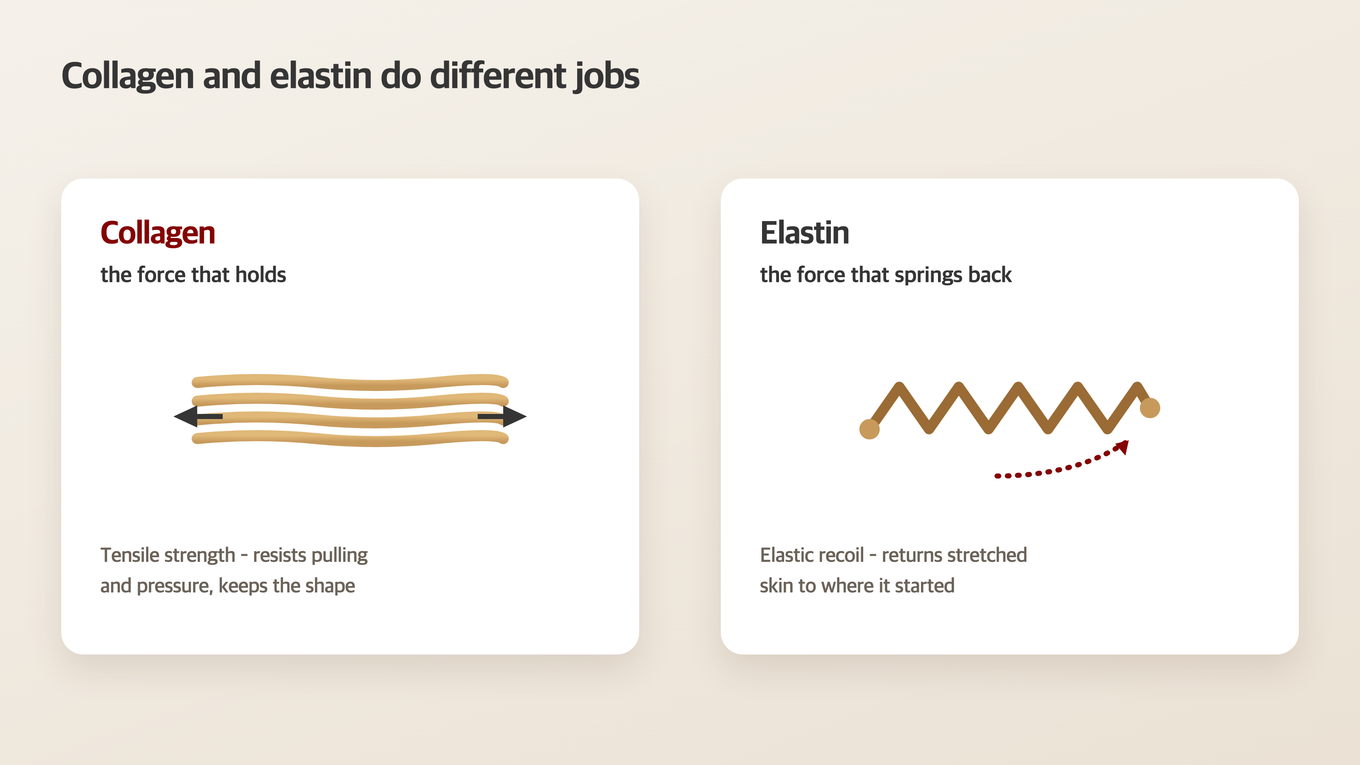
Collagen resists pulling forces, whereas elastin helps the skin return to its shape. They have distinct roles: one supports, the other restores.
Quantitatively, there's no comparison. Collagen makes up about 70-75% of the dermis's dry weight (with type I collagen accounting for 80-90%), while elastin accounts for only 2-4%, yet it's key for elasticity. When elastin is compromised, skin may feel slack even if the quantity is unchanged.
| Comparison | Collagen | Elastin |
|---|---|---|
| Function | Provides tensile strength | Restores elasticity |
| Amount in Dermis | About 70-75% of dry weight (structural) | About 2-4% (small but crucial for recovery) |
| Main Composition | 80-90% Type I Collagen | Fine elastic fiber network |
| Regeneration in Adults | Can regenerate with stimuli (varies) | Rarely regenerates |
Collagen decreases by about 1% annually from your 20s, while elastin tends to get damaged rather than renewed. Aging (intrinsic), UV exposure (photoaging), and glycation all play roles.
For collagen, classic studies like Shuster's 1975 research on inner-arm dermis show a linear decline of about 1% per year throughout adulthood. Recent reviews suggest a range of 1-1.5%. In women, menopause can lead to a steeper initial decline. However, this average varies greatly with UV exposure and lifestyle.
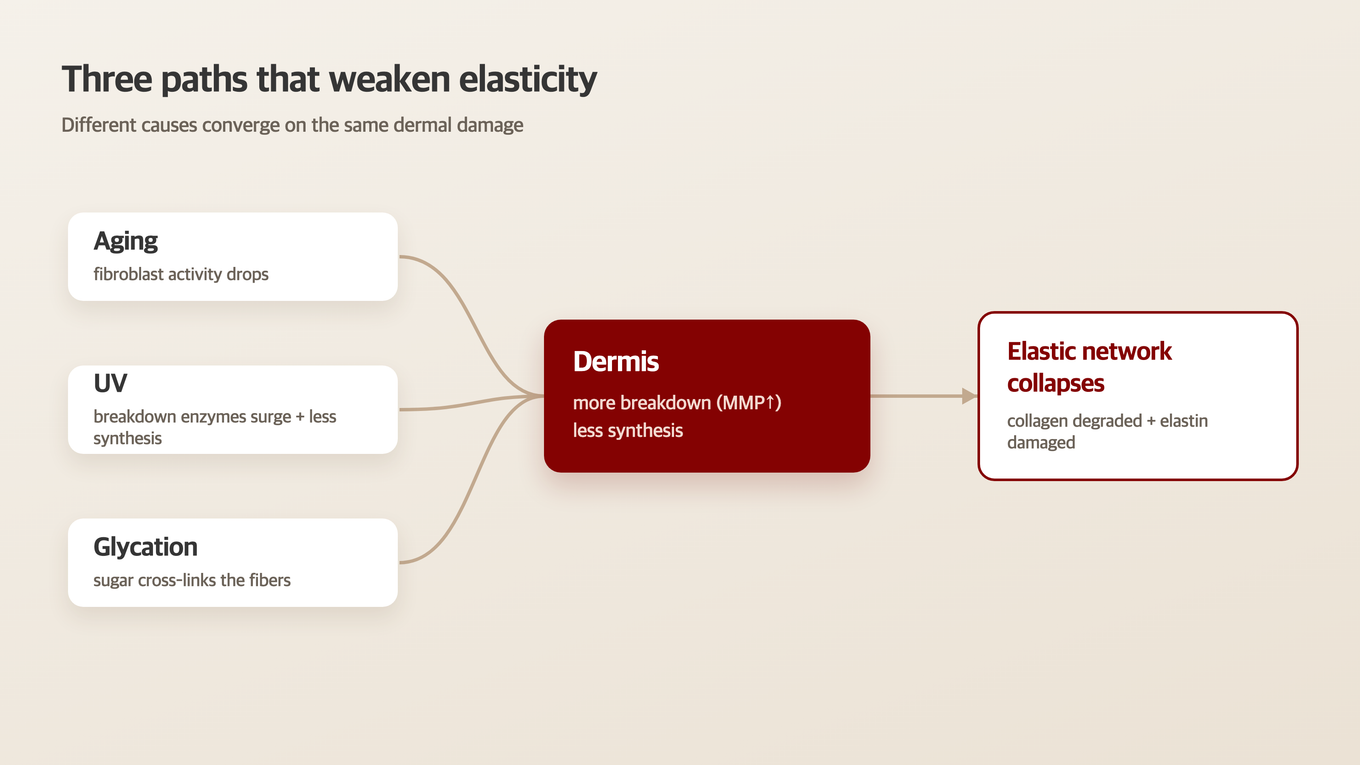
Three pathways of declining elasticity. Aging reduces synthesis, UV accelerates breakdown, and glycation stiffens existing fibers.
Elastin follows a different timeline. Most is produced from fetal development through adolescence, with production nearly halting in adulthood (half-life ~70 years). Once damaged, replenishing elastin is challenging. Chronic UV exposure can lead to solar elastosis, where degenerated elastin accumulates in the dermis, reducing function despite increased quantity. This results in sun-exposed skin appearing yellowed, thickened, and deeply wrinkled.
| Cause | What Happens in the Dermis | Impact on Elasticity |
|---|---|---|
| Age (Intrinsic) | Reduced fibroblast activity, increased MMP | Decreased collagen/elastin synthesis, dermal thinning |
| UV (Photoaging) | Rapid enzyme increase + inhibited synthesis, degenerated elastin buildup | Most rapid breakdown of elastic fibers |
| Glycation | Sugar cross-links with proteins, stiffening | Collagen/elastin become rigid, slow to bounce back |
💡 In summary - Aging reduces building power, UV accelerates breakdown, and glycation stiffens existing fibers. The more these overlap, the faster elasticity declines.
Collagen can regenerate with fibroblast stimulation in adults, but elastin's production ability is nearly dormant, hence the focus on preserving it. Realistically, collagen is for rebuilding, and elastin for protection.
Collagen boosters (such as GOURI/liquid PCL, Rejuran, Juvelook, Sculptra) or energy treatments (Ultherapy Prime, Thermage FLX, Potenza) target fibroblast stimulation. By inducing micro-injuries or introducing biodegradable substances to the dermis, the body is encouraged to generate new collagen as part of the healing process. However, these are cumulative over weeks to months, not instant changes. As each treatment varies in response and recovery, consulting with a specialist for the best approach for your skin is advisable. We've covered collagen boosters' evidence for increasing collagen in another detailed article.
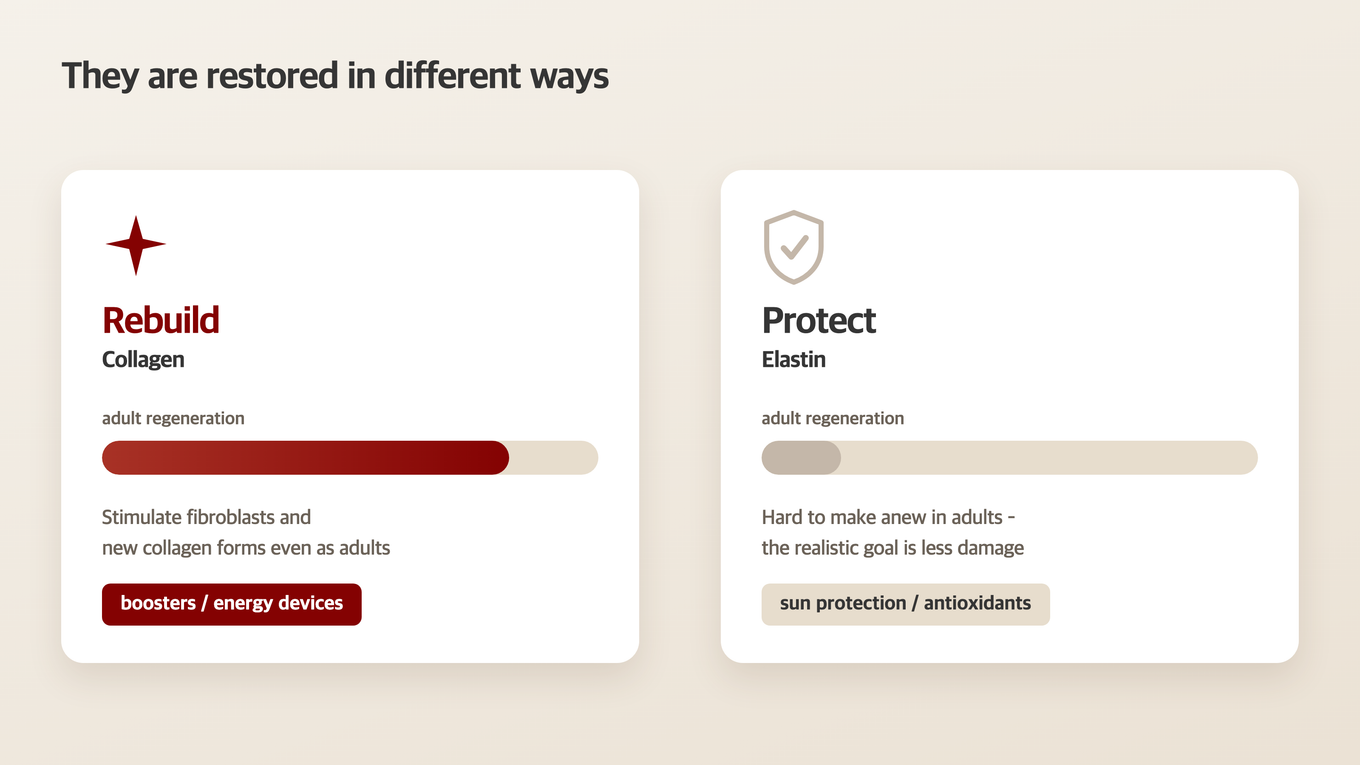
Collagen can be replenished through stimulation, whereas elastin is difficult to regenerate in adults, making protection the practical option. The methods differ.
Elastin's situation is different. Some energy devices have shown limited elastin increase, but the extent is modest and varies. Realistically, there’s no confirmed method to restore damaged elastin to its former state. Therefore, "prevent further damage" is more fitting than "restore." That's why sun protection and antioxidants precede any elasticity treatment.
In terms of order, sun protection to preserve elastin is foundational, followed by collagen-stimulating treatments to rebuild structural support. Adjust the emphasis based on your condition.
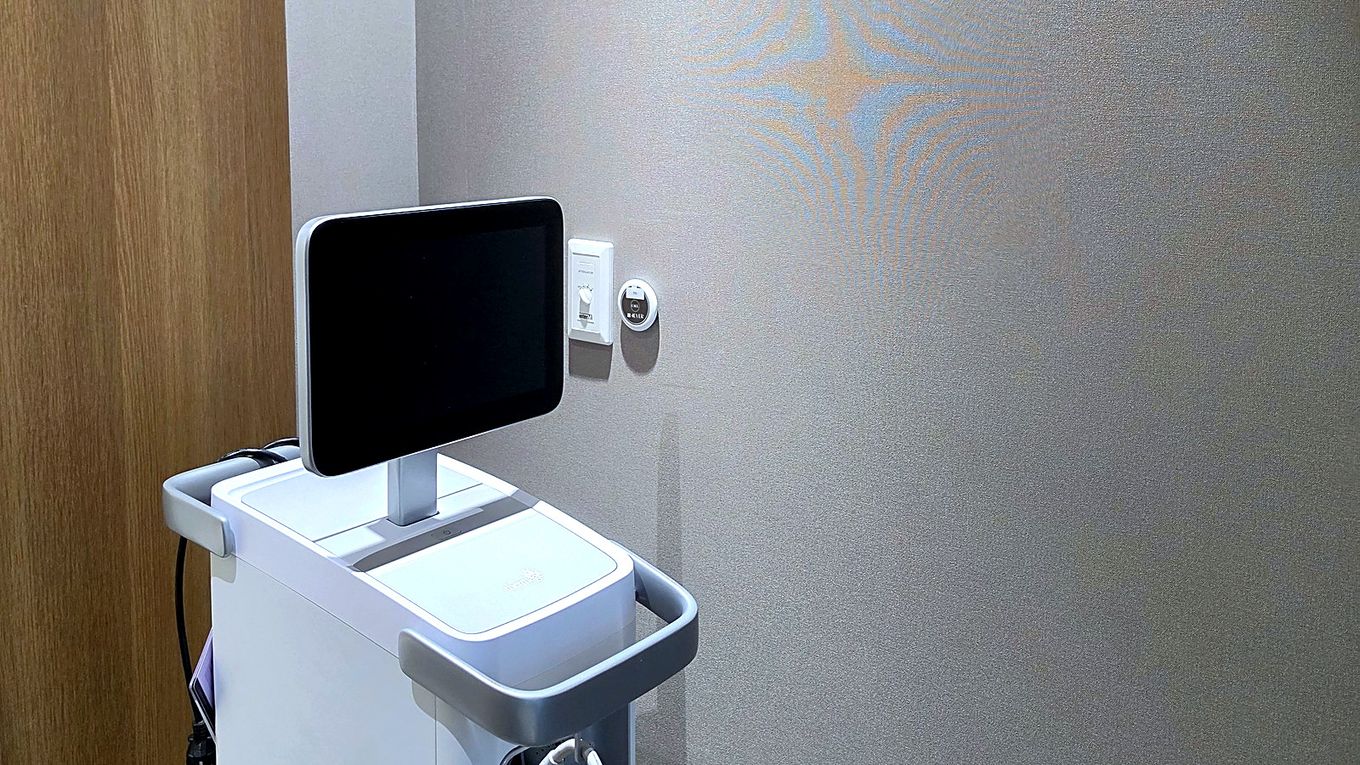
RF device in our Myeongdong clinic. Even energy treatments stimulating collagen depend on which dermal layer and intensity are targeted.
It's crucial not to reverse the order. Determine whether the issue is structural support, snap-back ability, or volume - only then can the appropriate tools be selected. Device and treatment names come afterward.
Start with what you can preserve. Once elastin is damaged, it's hard to restore, so protect it with sunscreen, while collagen can be stimulated later. Sun protection comes first.
Ingested collagen doesn't directly translate to increased skin collagen. Some studies show improvement, but results vary and evidence is mixed. It's too early to say "ingest to replenish." Sun protection and lifestyle are firmer foundations.
Some energy treatments have slightly increased elastin, but not as noticeably as collagen, and results vary widely. It's more realistic to focus on preserving elastin.
The pinch test, measuring skin's return to flatness, gauges elastin recovery. However, dehydration can also slow return, so consider it as a reference that varies with daily condition.
Information on collagen/elastin structure and aging is accessible in dermatology literature. The point about elastin's low regeneration in adults and long half-life is supported by review articles (PMC, elastin in skin).
Skin elasticity is a combination of collagen and elastin, two forces working together. Collagen supports, and elastin restores. Aging and UV damage both erode these, but the methods to rejuvenate them differ. Collagen can be rebuilt; elastin is hard to restore once lost.
Thus, the order is always the same: protect elastin with sunblock, and replenish collagen through treatments. Don't stop at "elasticity decline" - first determine whether you need to protect or replenish. That distinction sets the direction.
#SkinElasticity #Collagen #Elastin #CausesOfElasticityLoss #CollagenElastinDifferences #SkinAging #Photoaging #CollagenBooster #MyeongdongDermatology #ForeverClinic