Blog
Expert tips for healthy skin
Expert tips for healthy skin
The morning after a treatment, many of us find ourselves examining our faces in the mirror. There's some swelling around the injection site and perhaps a bluish bruise near the jawline. You were told everything was fine, but now you're wondering, "Is this really normal?" and find yourself searching online.
First, let's put your mind at ease: Swelling, bruising, and small lumps after booster treatments are generally part of the expected healing process. When a needle passes through the skin and the substance is injected into the dermis, the body starts a healing response. However, not all post-treatment signs should be brushed off. There are rare but urgent signals that require immediate attention.
Here's how to differentiate between the two. Knowing what's normal and what requires a call to your clinic can save you unnecessary worry and prevent risky neglect.
Quick Guide
- Swelling/redness typically subsides within 2-3 days, for up to a week at most (based on injection site reaction documentation; varies by individual).
- Bruising usually fades in 1-2 weeks. Initial puffiness from injections generally resolves in 24-72 hours.
- Lumps are evaluated by timing/direction/accompanying symptoms.
- Lumps appearing immediately and shrinking are usually normal; those appearing weeks/months later or enlarging require medical review.
- Severe pain with pale or mottled skin, or vision disturbances, are urgent signals requiring immediate contact.
- When unsure, the default is "take a photo and consult your clinic." Post-treatment inquiries are your right.
At Forever, our clinic in Myeongdong, Seoul, I often start by explaining that the swelling and bruising after a skin booster stem from temporary tissue reactions when a needle penetrates the skin and a substance is injected into the dermis. Most of these reactions subside on their own within a few days.
Understanding what's happening takes a lot of the worry out of it. Booster treatments (Rejuran, Juvelook, Gouri, and similar substances) differ from fillers that are injected in larger volumes into a specific area; instead, these are administered in small amounts across many sites on the face. With dozens of injection points, minor reactions around each needle mark are common.
Where the needle has been, blood vessels may temporarily dilate and tissue fluid gathers, leading to swelling and redness. If a delicate capillary is nicked, a small amount of blood may seep out, causing a bruise. Both are part of the body's initial repair process.
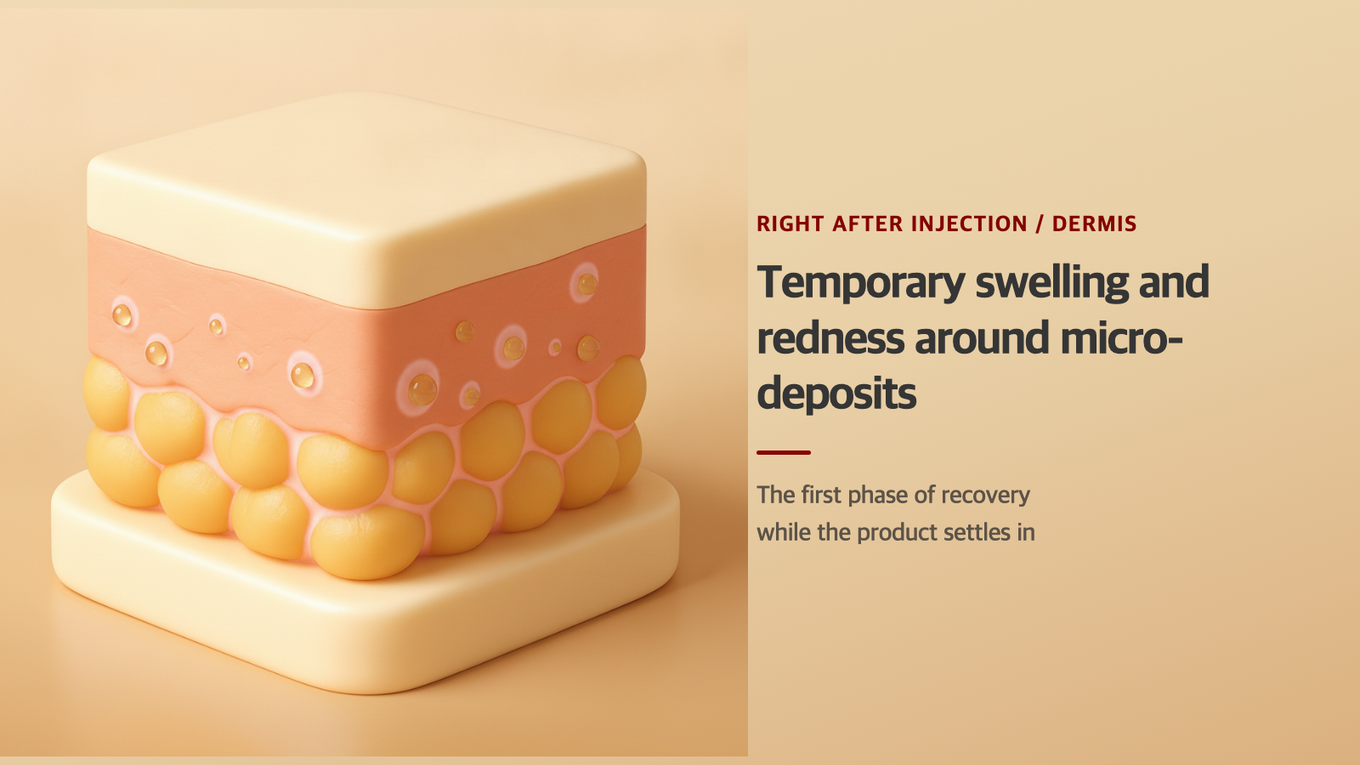
Post-injection dermis. Temporary swelling and redness around finely distributed substances are expected responses.
Let's clear up a common misconception: "The more you swell, the better it worked." This is a myth. How much you swell comes down to personal factors like the day's condition, skin thickness, and vascular distribution. Even with the same substance and amount, some people show no signs by the next day, while others stay puffy for several days. Swelling is not a measure of treatment success.
At our clinic in Myeongdong, Seoul, we usually consider swelling and redness that last 2-3 days, bruising for 1-2 weeks, and post-injection puffiness resolving in 24-72 hours as normal recovery timeframes, though this varies from person to person.
Having numbers in mind can ease the waiting. Booster treatments, ultimately, involve injections into the dermis, so they share the "injection site reaction" classification with fillers in regulatory reviews. According to US FDA review data, injection site reactions (swelling/tenderness/redness) are categorized as short-term responses disappearing in under 7 days. Bruising tends to linger slightly longer, but one filler product group (RHA) reported that over 60% of injection site reactions resolved within 7 days and over 88% within 14 days, based on patient records. Bruising generally fades within this 1-2 week range.
For substances like Rejuran injected into shallow skin layers, the immediate occurrence of small, raised bumps (puffiness) is more typical, described as a transient reaction in recent overviews. Feeling these bumps the next day isn't abnormal.
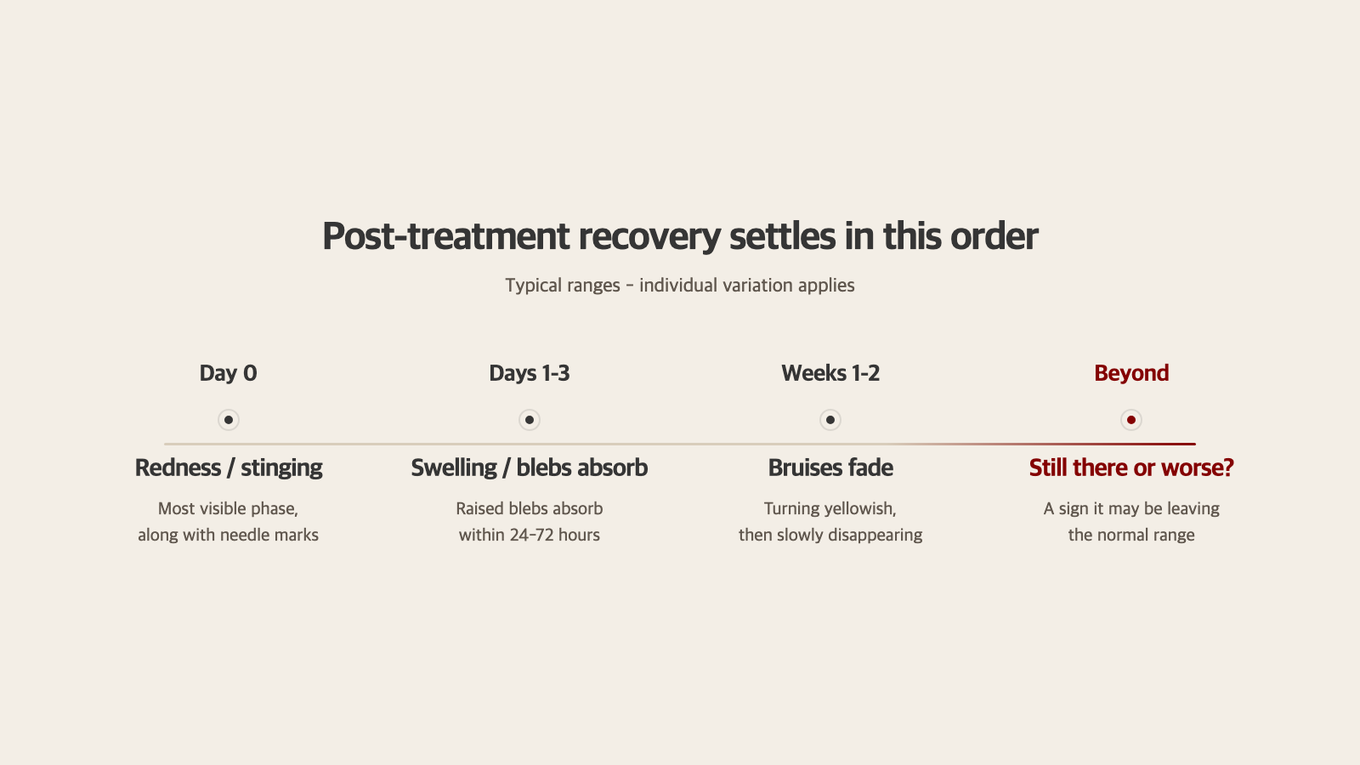
Redness on the day of treatment - swelling within 2-3 days - bruising within 1-2 weeks. If symptoms fade in this order, recovery is on track.
A few factors can slow this timeline. Medications or supplements affecting blood circulation can lead to more extensive, prolonged bruising. Areas like the eyes, where skin is thinner, may stay swollen longer with the same stimulus. Hence, if you have important events, it's safer to plan your treatment around this recovery window. The calculation for this is detailed in a separate post on timing treatments before big events.
The key is direction. If today is better than yesterday and tomorrow better than today, you're on the right track. If symptoms remain or worsen over time, it's time to refer to the criteria below.
When evaluating a lump at our clinic in Myeongdong, Seoul, the first thing I consider is when it appeared. A soft lump forming immediately post-treatment and shrinking over a few days is typically part of the substance settling process, while a lump appearing weeks to months later, enlarging, and hardening could be a nodule that requires medical attention.
The word "nodule" carries weight, leading many to assume any lump is a mishap. In reality, it depends on timing and progression. During post-treatment consultations, we distinguish with three key factors:
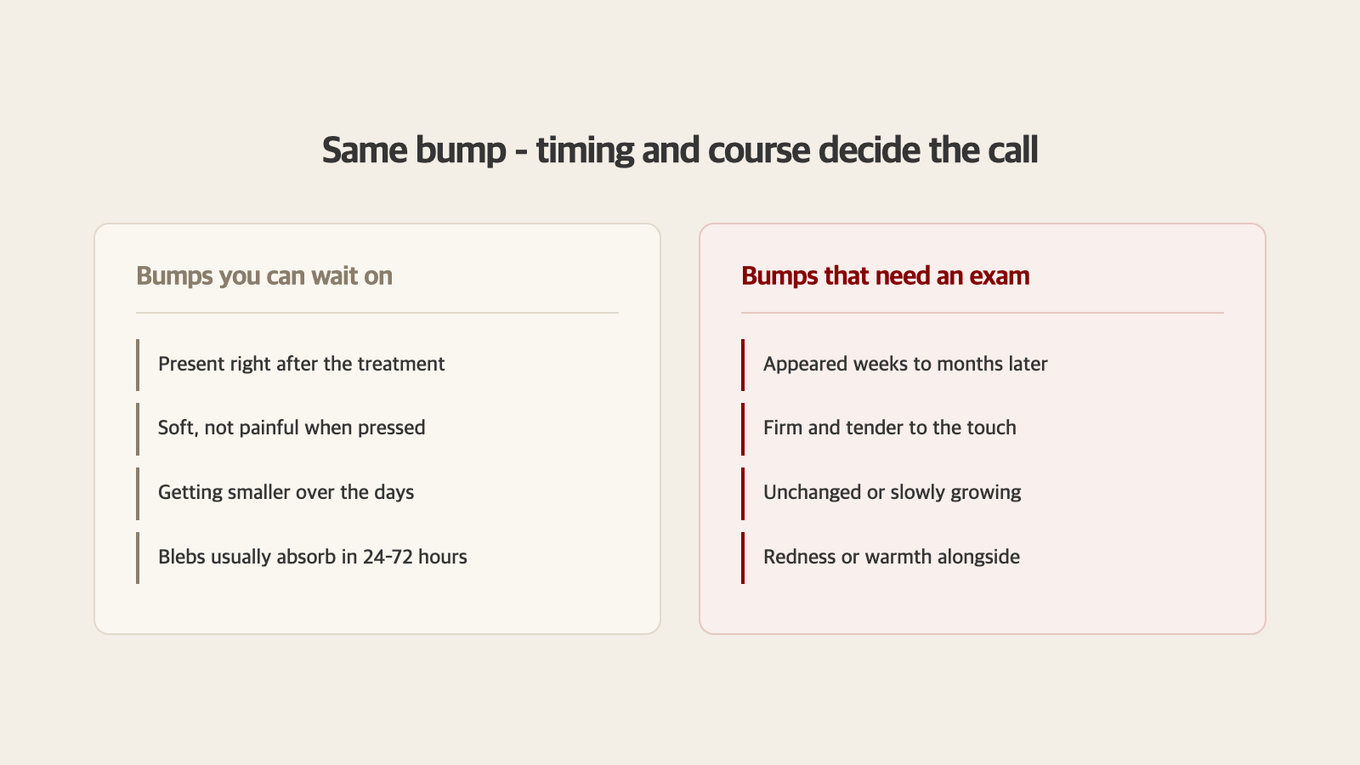
Even "lumps" require different evaluations based on timing/direction/accompanying symptoms. If it falls into the right column, it's best to get it checked.
Late-onset nodules are worth a closer look. Substances like Sculptra (PLLA) or Juvelook (PDLLA) that stimulate collagen production in the dermis can, rarely, result in nodules appearing later. Sculptra's official Instructions for Use (IFU) note that distinct nodules have been reported 1-2 months to as long as 14 months after the last treatment. Every so often, a patient comes in months later saying, "I can suddenly feel a lump" - and this delayed onset is exactly why.
As for the belief that massaging lumps will dissolve them: massage has long been advised for nodule prevention, but a randomized evaluator-blinded study in Dermatologic Surgery, 2016 found no significant difference in nodule occurrence between massage and no-massage groups post-PLLA treatment. Since recommendations vary with substances and situations, it's best not to massage intensively at home. Follow your clinic's guidance if provided; if not, avoid touching and consult first.
Severe pain with skin becoming pale or mottled, and any vision issues, are signs you shouldn't ignore. They're emergencies.
In rare cases, an injected substance might block a blood vessel (vascular occlusion), cutting off blood flow to the skin it supplies. This results in severe pain distinct from typical treatment discomfort, and skin discoloration such as paling or developing a net-like pattern. Immediate response to these signals is a common emphasis in expert consensus documents on filler complications because time is critical. Vision abnormalities are even more urgent.
Infections have a different timeline. Normal swelling and redness peak in the first 2-3 days then resolve, but infections worsen 48-72 hours post-treatment, with increasing redness/warmth/pain. If fever or pus accompanies these symptoms, immediate medical attention is necessary.
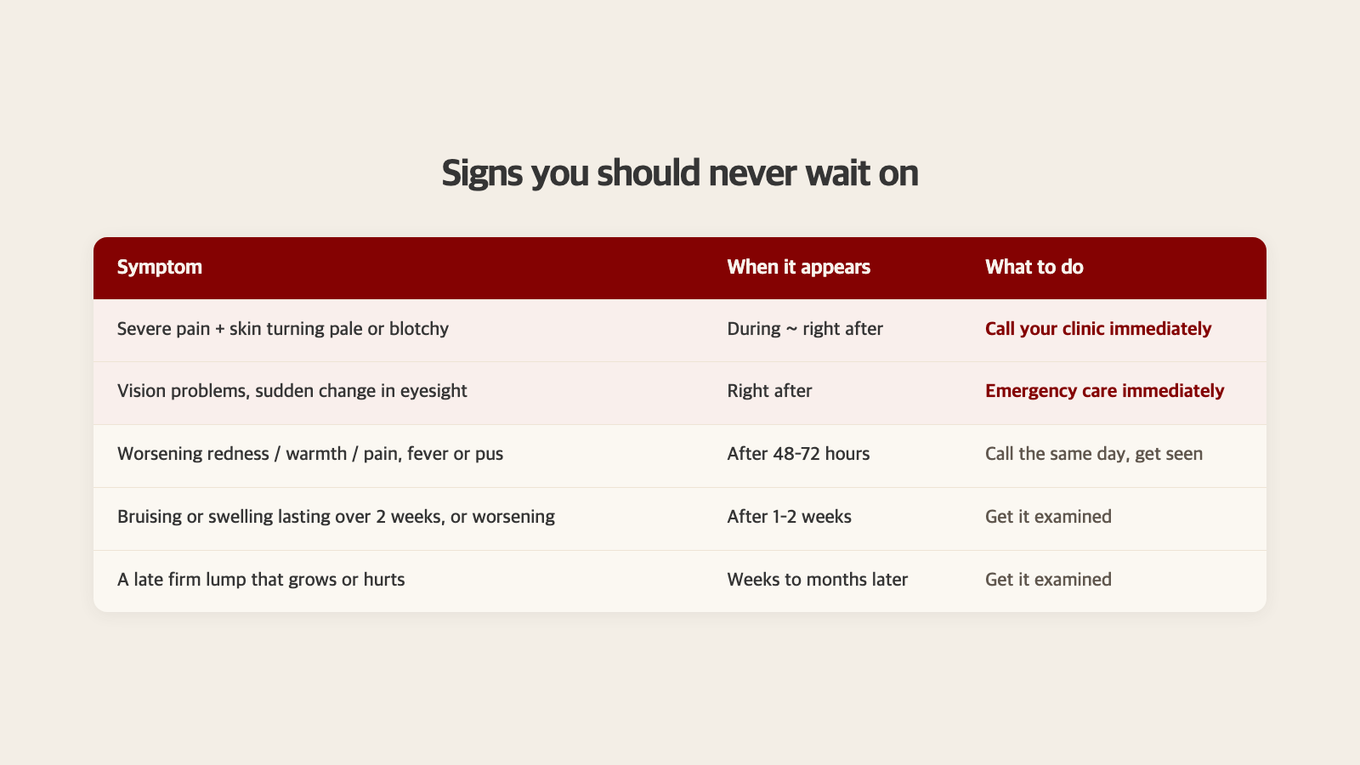
The key is when and how symptoms develop. The top two rows require immediate attention, the others need prompt medical consultation.
| Symptom | Timing | Response |
|---|---|---|
| Severe pain + skin becomes pale or mottled | During/immediately post-treatment | Immediate clinic contact |
| Vision issues, sudden vision changes | Immediately post-treatment | Immediate emergency response |
| Increasing redness/warmth/pain, fever or pus | 48-72 hours post-treatment | Same-day contact for consultation |
| Bruising or swelling persists or worsens beyond 2 weeks | 1-2 weeks post-treatment | Check-up needed |
| Late-appearing hard lump enlarges or is painful | Weeks to months post-treatment | Medical review needed |
⚠️ Note - The top two rows in this table represent rare events. They're listed because they're important to recognize. If uncertain, photograph the affected area and send it to your clinic for advice. Many patients hesitate, wondering if it's worth contacting the clinic, but post-treatment follow-up questions are a normal part of care.
For the first 24 hours, avoid touching the treated area, and for 2-3 days, avoid heat-inducing activities like saunas, alcohol, or vigorous exercise.
This aligns with the mechanisms we've discussed. Swelling and bruising are part of the body's process of resolving dilated blood vessels and leaked blood, so activities that increase body heat and blood flow can worsen and prolong them. Cooling the treated area can help, but don't apply ice directly to the skin; wrap it in a thin cloth and apply briefly, following any specific instructions from your clinic.
Makeup and cleansing routines should also follow a sequence until injection sites heal. Avoid rubbing or covering areas before they fully close, and stick to gentle care focusing on moisturizing and UV protection for a few days to avoid hindering recovery. Post-treatment home care routines are further detailed in a dedicated aftercare article.
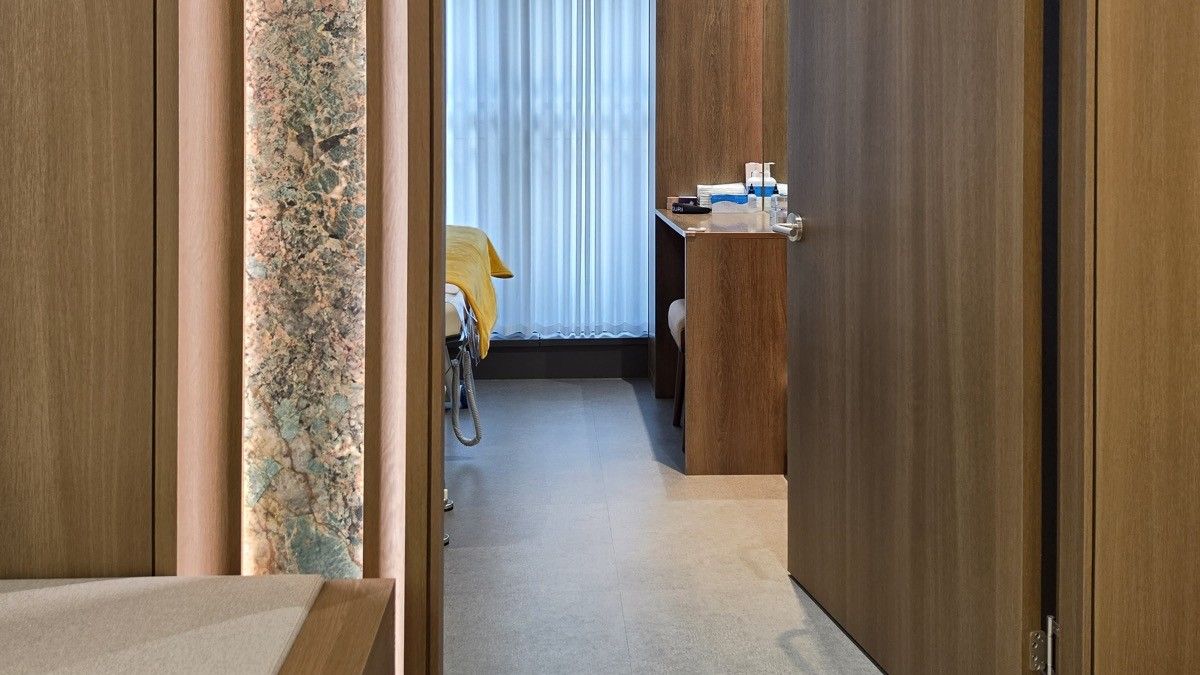
Rather than rushing out immediately after treatment, taking a moment to rest and monitor progress is part of the recovery process.
At our clinic in Myeongdong, Seoul, we don't rush patients out after treatment; we provide a recovery space to rest shortly and go over aftercare instructions before leaving. Knowing how long swelling/bruising/lumps might last and what changes warrant a call can significantly reduce surprises when looking in the mirror the next day.
They're usually absorbed within 24-72 hours. With substances like Rejuran injected into shallow layers, the raised puffiness is a normal part of the process and typically subsides visibly within a day or two. The delicate skin around the eyes might take a bit longer (individual variations apply). Avoid rubbing them to make them disappear faster; if they're still present or painful/red after three days, consult your clinic.
It's time for a check-up. Based on regulatory reports that most injection site reactions resolve within 14 days, bruises lingering or darkening beyond two weeks start to fall outside the normal range. If you're on medications affecting circulation, they might prolong bruising, so provide this information when contacting your clinic for a quicker assessment.
It's best not to do so without guidance. Whether massaging helps prevent nodules is debated, and responses vary by substance and nodule characteristics. Pressing too hard could cause irritation. If you feel a lump, document its position and size with photos and seek your clinic's advice first.
Post-treatment swelling for a few days, bruising for 1-2 weeks, and bumps for a day or two are typically signs your body is recovering as expected. Just check the trend: Is today better than yesterday?
On the other hand, symptoms appearing at unexpected times shouldn't be ignored. Severe pain and skin-color changes right after treatment, or any change in your vision, need immediate attention. Worsening redness and warmth after 2-3 days warrant a same-day call. Hard lumps appearing weeks later that grow or hurt need medical review. Remember these three lines to avoid dangerous neglect.
And when in doubt, the default is always the same: Don't leave concerns unaddressed; confirm with your clinic. Post-treatment follow-up questions are a normal part of care, so reach out to the clinic that treated you. Checking and ensuring peace of mind is far better for your recovery than worrying alone.
#PostTreatmentSideEffects #InjectionSiteReactions #Nodule #SwellingAfterTreatment #BruisingAfterTreatment #RejuranBumps #SkinBooster #CollagenBooster #SeoulDermatology #MyeongdongClinic