

Blog
Expert tips for healthy skin
Expert tips for healthy skin
At twenty-eight, patients wonder if it's already okay to start regenerative treatments. Past forty, others worry it's too late to begin. In the space of a single week in the clinic, I'll hear both. One side is afraid of being too early, the other of being too late. What's interesting is that both are chasing the same thing: the "right age to start."
But regenerative treatment doesn't have a clean starting line by age. What matters far more is that the goal shifts with each decade of life. Regeneration at twenty-eight is about protecting the collagen you still have plenty of. Regeneration at forty-five is about refilling what has thinned out. Same word, "regeneration" - different job.
Knowing what to expect at your age, and what you don't need to rush, makes it much easier to make the call on your own terms instead of getting swayed by other people's reviews. Let me walk through how the approach changes decade by decade, from your twenties into your forties and beyond.
The short version
- Regenerative treatment isn't about "from what age" - it's about goals by decade. 20s = protect, 30s = slow it down, 40s+ = rebuild.
- Skin collagen is reported to decline by roughly 1% per year (1-1.5%, with wide individual variation) starting in the mid-to-late 20s.
- In your late 20s, collagen is still plentiful, so the right approach is doing less and protecting more. There's little reason to stack strong treatments at this age.
- Around menopause the decline accelerates (reports suggest about 30% in the first 5 years), so from the 40s on we look at it through a rebuilding lens.
- In the end, age is just a reference line. In practice we look first at your current skin, your sun-exposure history, and your habits.
At our clinic in Myeongdong, Seoul, the axis I use to divide the decades isn't the starting age - it's the goal that fits each stage of life: 20s protect, 30s slow it down, 40s and beyond rebuild. The first reference line is the mid-to-late 20s, when collagen begins to decline.
Why it splits this way becomes clear once you look at how collagen changes with age. What supports your skin's firmness and smooth texture is the collagen in the dermis, beneath the epidermis. That collagen isn't fixed for life - from a certain point, it starts to slowly decline.
The evidence is a fairly consistent observation, from older studies through to recent reviews. The benchmark I use to divide the decades is this: skin collagen declines by about 1% per year (1-1.5%) throughout adult life (individual variation is large). The starting point is roughly the mid-to-late 20s. And in women, the pace picks up sharply around menopause - some reports put it at about a 30% drop in the first 5 years (American Academy of Dermatology, individual variation applies).
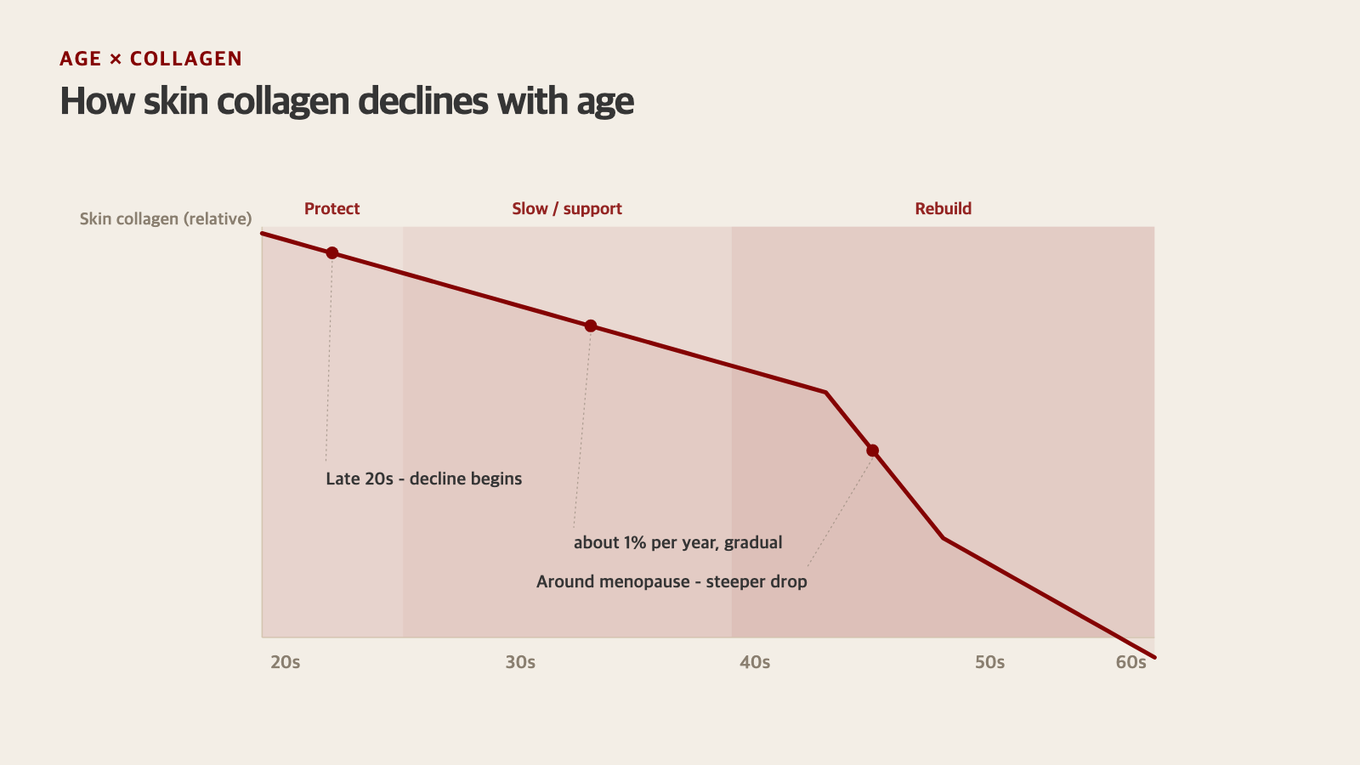
Gently from the mid-to-late 20s at about 1% a year, then more steeply around menopause - which part of this curve you're on is what sets your goal for the decade.
Keep this curve in mind and "what my goal is at my age" falls into place naturally. Still on the gentle stretch? Protect. Already well down the slope? Refill. That's why the same regenerative treatment means something different depending on your decade.
Because it's the point where collagen starts to decline, the idea is to protect it while there's still plenty. This is the preventive approach often called "collagen banking," and it's different from loading up on strong treatments in your 20s.
A few years ago, if someone in their 20s asked about regenerative treatment, the answer was simply "it's too early for you." The tone has shifted a little now. As the idea of managing early - from the mid-to-late 20s, when collagen starts to decline - has taken hold, groups like the American Society of Plastic Surgeons now suggest that late 20s to 30s is a reasonable time to start "collagen banking." The thinking is to set a little aside while the account still has a healthy balance.
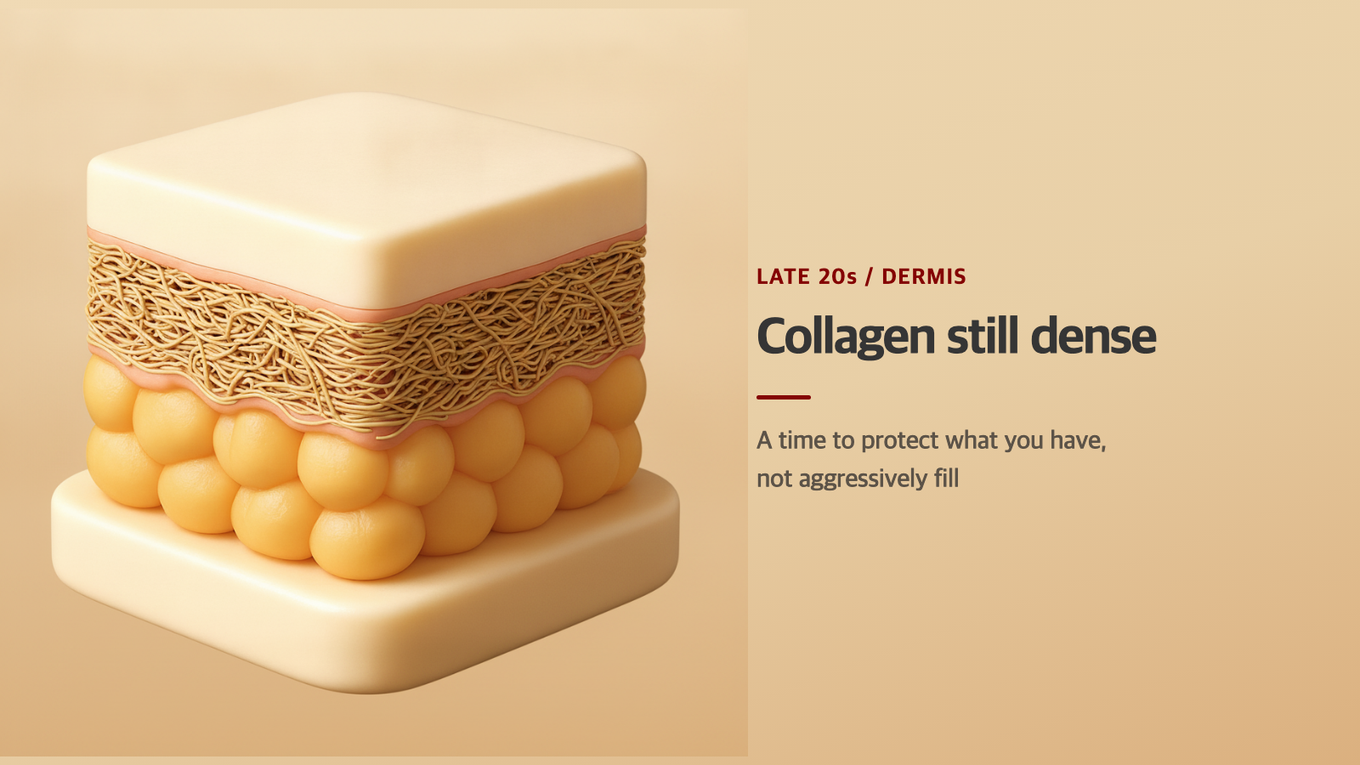
In the late-20s dermis, collagen is still dense, so protecting this state suits it better than aggressively filling.
One misunderstanding creeps in easily here: "If prevention is good, wouldn't getting lifting and boosters all at once in my 20s be even better?" That's a slightly risky line of thinking. In your 20s, collagen is usually still plentiful, so it's not a stage where piling on strong treatments fills you up any faster. If anything, the basics for this period are sun protection and lifestyle. UV is one of the biggest things that breaks down collagen, so nailing that first is more foundational than any treatment.
So regeneration in the late 20s leans toward "doing less, protecting more." There's little reason to fill aggressively while collagen is still plentiful. A light skin booster to top up texture and hydration, only as much as your skin actually needs. There's no strong reason to start with heavy lifting at this age just because everyone else is. So when someone in their late 20s comes to our clinic in Myeongdong, before adding any treatment, we go over their sun-exposure history and daily habits first.
This is the stretch where the collagen that felt plentiful in your 20s starts to noticeably drop. So the goal in your 30s shifts slightly, from protecting to slowing the pace and supporting.
Around your mid-30s, you start saying "it's not what it used to be" yourself. The tightness after cleansing, the crease from an expression that takes a little longer to smooth out, makeup that sits on top of the texture. These are changes that happen because the dermis, with less collagen, no longer recovers as quickly as it once did.
This is the stretch where it makes sense to start seriously considering regenerative options like collagen boosters. Places like the Cleveland Clinic view starting preventive treatments in the early 30s as perfectly reasonable. Because they work by stimulating the dermal fibroblasts to build new collagen, they're well suited to slowing the pace of decline while making up for what's fallen short.
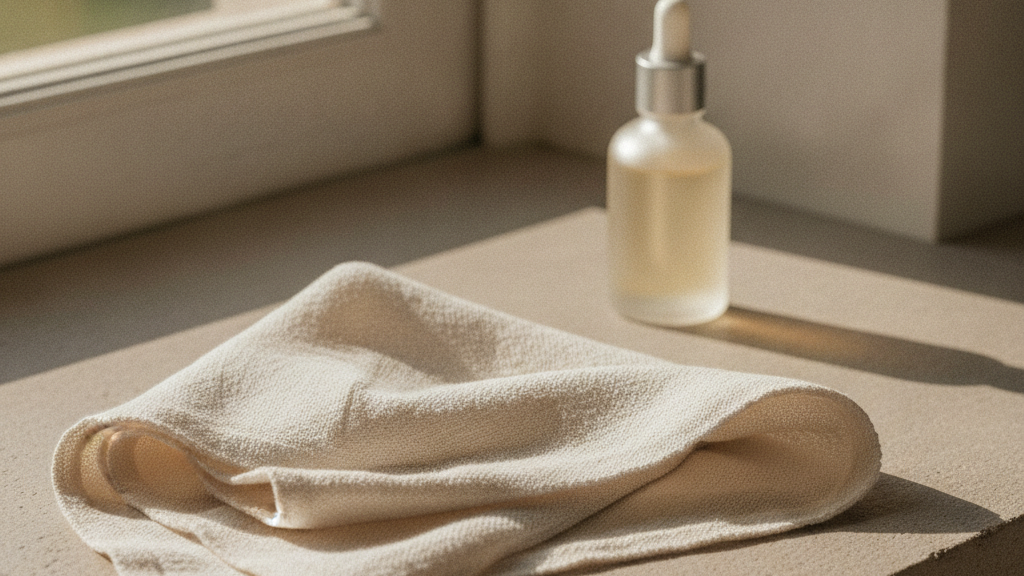
The 30s suit steady, consistent care that firms up texture and elasticity while slowing the decline - rather than rushing to fill.
The trap of the 30s is impatience. Because it's when change first shows, people get anxious and try to fix it all at once, stacking several treatments together. But regeneration builds up over time - piling it on doesn't make it faster. This is where consistency does the real work. Firming up the skin's texture and elasticity regularly, within a comfortable range, does a lot to reduce the load of your 40s.
At our clinic in Myeongdong, when I look at regeneration for the 40s and beyond, the goal I set isn't protecting - it's rebuilding. Because it's the stretch where collagen loss speeds up, we approach it by actively refilling the volume and firmness that have fallen short.
The 40s, especially around menopause, is the steepest part of the collagen curve. As mentioned earlier, there are reports of about a 30% drop in the first 5 years after menopause, so in this period "let's protect what's left from thinning" alone doesn't quite register. So the goal changes. You acknowledge what's been lost, and shift to a rebuilding view that stimulates the dermis to lay down collagen again.
In fact, in a liquid PCL (GOURI) study I co-authored, dermal thickness and type-1 collagen were reported to show a tendency to increase over time after injection (this was in a UV-aged skin model, not in human subjects - Journal of Cosmetic Dermatology, 2026). Of course, these are results under study conditions, so there's individual variation and it doesn't mean everyone sees the same degree of change. The reason I weigh this is that, for this decade, reviving the "capacity to refill" is the key.
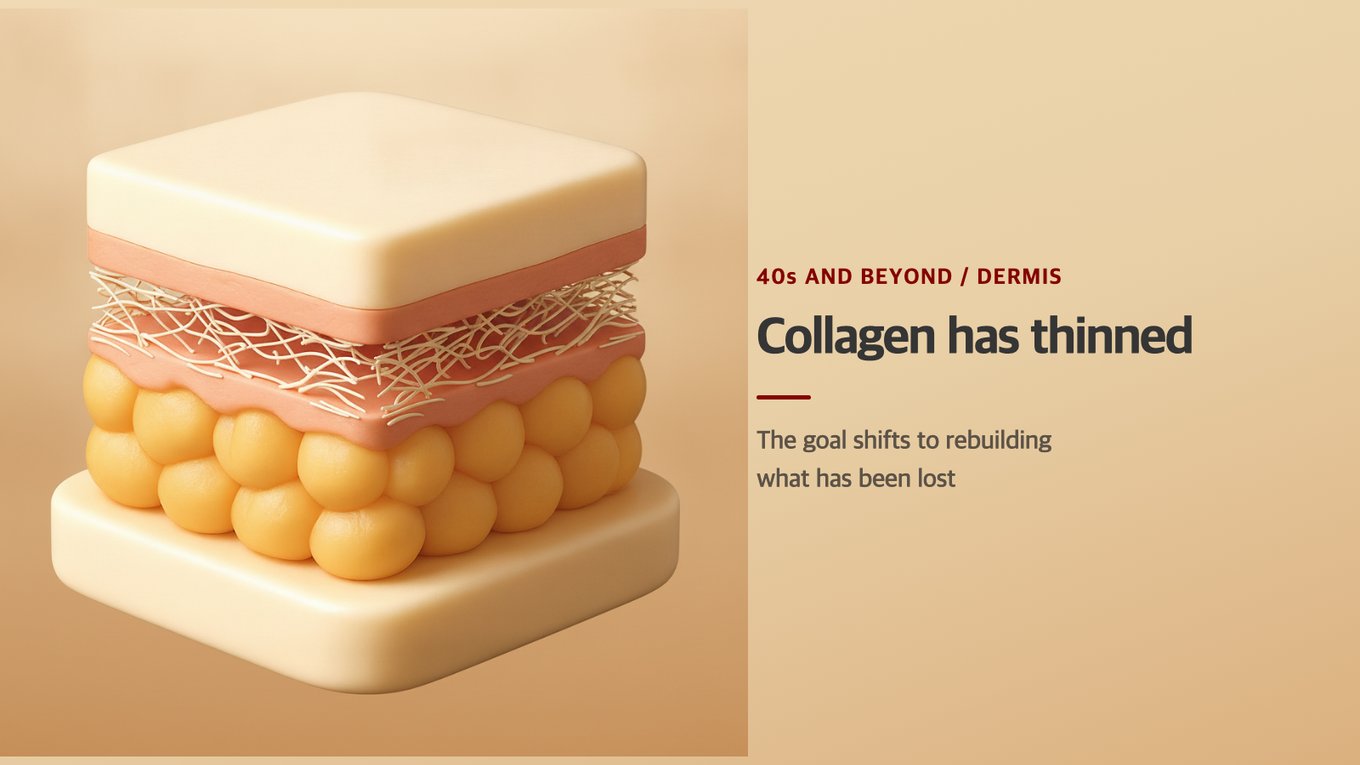
In the 40s-and-beyond dermis, the collagen mesh has thinned, so we approach it with a rebuilding view that lays down what's fallen short.
A question I get a lot here is, "So isn't 40 already too late?" It isn't. Collagen having declined also means there's that much room to rebuild. It's just that the stage where a light touch was enough, like in your 20s, has passed - so rather than solving everything with a single treatment, we often look at texture, firmness, and volume separately and in combination. And the older the decade, the wider the individual variation, so even two people at forty-five can be approached quite differently.
⚠️ Worth knowing - Regeneration and boosters generally don't carry a heavy recovery burden, but even a light treatment can bring differences in reaction from person to person, such as swelling, bruising, or injection marks. Precautions and contraindications differ by treatment, so regardless of age, checking your current skin condition and medical history first is the right order. The degree and pace of change also vary widely between individuals.
What actually sets the starting point is your current skin, your accumulated sun-exposure history, your habits, and your goals. Age is a reference line. Even at thirty-five, the starting point shifts a lot depending on these conditions.
Fixate on the number alone and it gets more confusing, not less. It's not rare for the dermis of a thirty-five-year-old with long, heavy sun exposure and a forty-five-year-old who has protected consistently to have swapped places. Collagen age doesn't necessarily move in step with the age on your ID.

Before the number that is your age, we look first at which part of the curve your skin is on right now. The order comes after.
So let me lay out a few of the criteria I keep in mind when setting direction. It's not a fixed formula - think of it more as axes for thinking you can use to judge for yourself.
Set these axes first, and instead of someone else's formula of "at my age, this," you'll see an order that fits your own conditions. If you're curious about how regeneration and boosters actually work in the dermis, reading how collagen boosters build collagen and how water-glow / skin boosters change the dermis alongside this makes the choice by decade even clearer.
It comes down to three stretches. Late 20s protect, 30s slow it down and support, 40s and beyond rebuild. Because the collagen state is different, the goal and approach change together.
The below is a general guide. As mentioned, the actual starting point depends more on skin condition than on age, so please read it only as a frame for setting the broad direction.
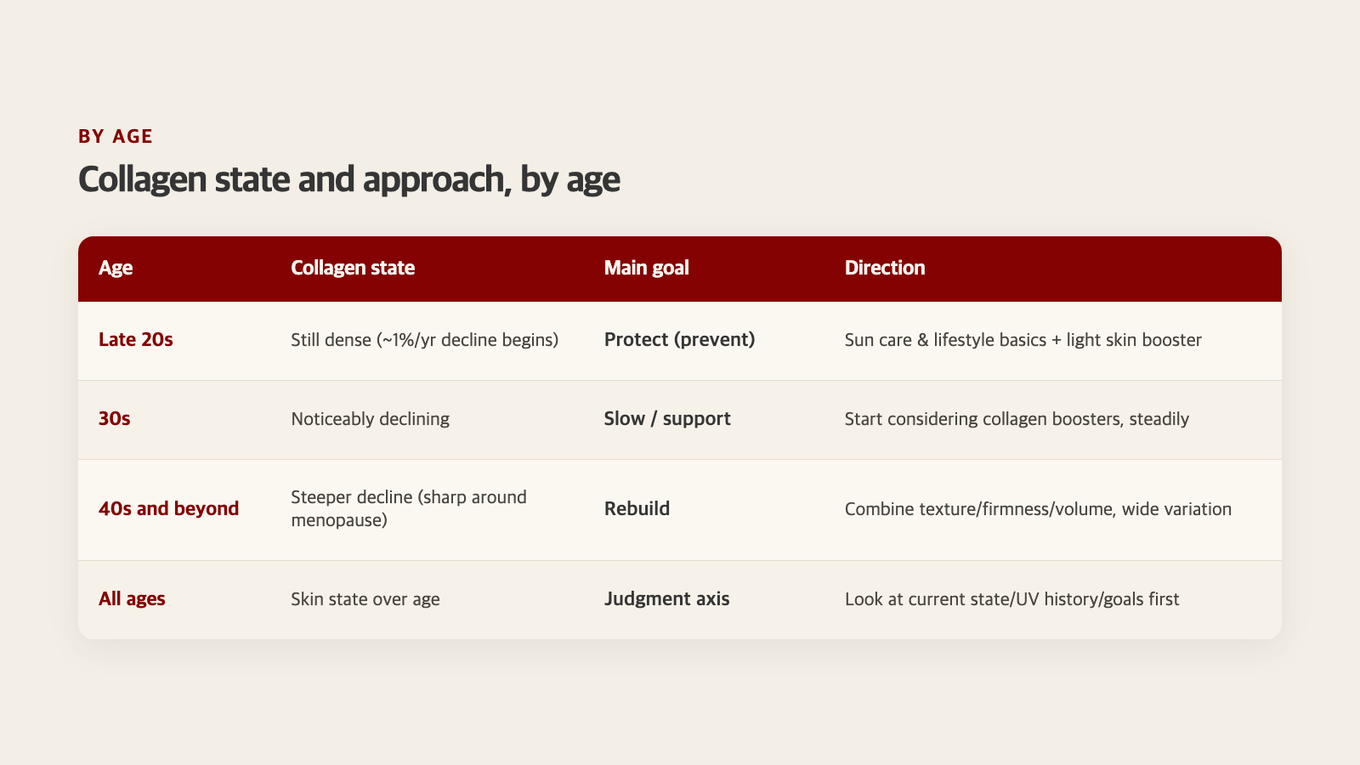
The 20s protect, the 30s slow and support, and the 40s-and-beyond rebuild - the goal splits according to the collagen state.
| Age | Collagen state | Main goal | Direction |
|---|---|---|---|
| Late 20s | Still dense (~1%/yr decline begins) | Protect (prevent) | Sun care / lifestyle basics + light skin booster |
| 30s | Noticeably declining | Slow / support | Start considering collagen boosters, steadily |
| 40s and beyond | Steeper decline (sharp around menopause) | Rebuild | Texture / firmness / volume combined, wide variation |
| All ages | Skin state over age | Judgment axis | Current state / UV history / goals first |
The table is the broad frame; the real decision goes one cell deeper. Even within the 30s, someone with heavy sun exposure might be looked at closer to the 40s approach, and someone who has managed well closer to the 20s side.
You can, but there's little need to load up on strong treatments in your 20s. This period suits protective care, because collagen is still plentiful. Setting sun protection and lifestyle as the basics, then topping up texture and hydration with a light skin booster as your skin needs, is a solid pace. Rather than starting with lifting in your 20s because others do, protecting the foundation is often the better long-term deal.
It isn't too late. Collagen having declined also means there's room to rebuild. It's just that this decade calls for a rebuilding view that refills the texture, firmness, and volume that have fallen short. Individual variation is wide at this age, so rather than finishing with a single treatment, we often look at it in parts according to condition. Do keep in mind that the degree and pace of change vary a lot depending on sun-exposure history and skin condition.
Because regeneration and boosters build collagen gradually and it declines again over time, they're usually continued at intervals rather than finished in one go. That said, it's not an obligation to "keep going for life." The maintenance interval changes with your decade and goals, so setting a pace you can keep up comfortably is what lasts. From the start, it's realistic to plan in terms of a multi-year flow rather than a single treatment.
If you're in your 20s, sun protection, lifestyle, and basic skincare alone can protect a great deal. Since UV is one of the biggest things that breaks down collagen, consistent protection alone changes the pace of decline. Treatment is a choice you add on top, not a must. That said, if there's already something about your texture or firmness on your mind, starting with light care matched to your condition is also an option.
If you go into a regenerative treatment hunting for "what age is the right answer," it only gets confusing. There's no clean starting age. Instead, remember that the goal differs by decade.
The late 20s are a time to protect the collagen you still have plenty of, the 30s a time to slow the decline and support, and the 40s and beyond a time to rebuild what's fallen short. Which part of the collagen curve you're on sets this goal, and when the goal differs, the same regeneration does a different job.
And in the end, age is a reference line. In practice, what sets the starting point is what your skin is lacking right now, how much sun you've taken over the years, and how much time you can give it. Rather than someone else's formula of "at my age, this," start by looking at which part of the curve your own collagen is on right now. Once that judgment is clear, treatment comes after.
#regenerativetreatment #collagenbooster #antiagingstart #skinbooster #collagenbanking #skintightening #inyour20s #inyour40s #myeongdongdermatology #foreverclinic