

Blog
Expert tips for healthy skin
Expert tips for healthy skin
"Is starting skin treatments now, three months before my wedding, the right timing? Is it too early, or am I already late?"
It's common to feel a rush of urgency when the wedding invitations are out or the year-end party invites arrive. When patients come into the clinic with this on their minds, they often have one question: "If I start treatments now, will everything be ready by the big day?"
But the real catch is elsewhere. Regenerative treatments and collagen boosters work over weeks as collagen builds up gradually. They don’t flip a switch the moment they’re injected. In fact, if you scramble to have them just before the day, you might end up with swelling and marks that won't fade in time. That's why, just as important as choosing the right treatment is working backward from the big day to decide when to start.
Today, let's break down which treatments to start, in what order, and when - just like you would discuss in a consultation. This isn't about recommending specific treatments. Once you understand the timeline, you'll have a clearer picture of what to prioritize now and what can wait.
Key Points at a Glance
- Regenerative treatments and collagen boosters improve as collagen builds, so start by counting backward from D-day.
- Treatments generally fall into two categories: immediate results and gradual accumulation. Tailor your timeline accordingly.
- Procedures that leave swelling or minor marks should be completed at least two weeks in advance. Focus on calming and moisturizing closer to the date.
- Rushing treatments at the last minute can lead to overlapping recovery, worsening your condition on the day.
- Priorities shift based on your remaining time and current skin concerns. There's no one-size-fits-all timeline.
Regenerative treatments and boosters require several weeks for collagen to settle. They improve over time rather than the day after the procedure, which is why you need to start early by planning backwards.
Let me go one layer deeper. The elasticity and smooth texture of our skin are supported by collagen in the dermis, beneath the epidermis. Collagen boosters (such as GOURI/liquid PCL, Sculptra) and regenerative treatments like Rejuran work by stimulating fibroblasts in the dermis to produce new collagen. However, it naturally takes time for cells to react and for collagen to accumulate and reorganize. The texture changes as the dermal environment stabilizes over several weeks.
One study on liquid PCL (GOURI) also reported a trend of increasing dermal thickness and type I collagen over time after injection (a skin-model study rather than a study in people, Journal of Cosmetic Dermatology 2026). Of course, these are findings under study conditions, so results vary from person to person and don't guarantee the same degree of improvement for everyone. The key takeaway is that changes accumulate over weeks.
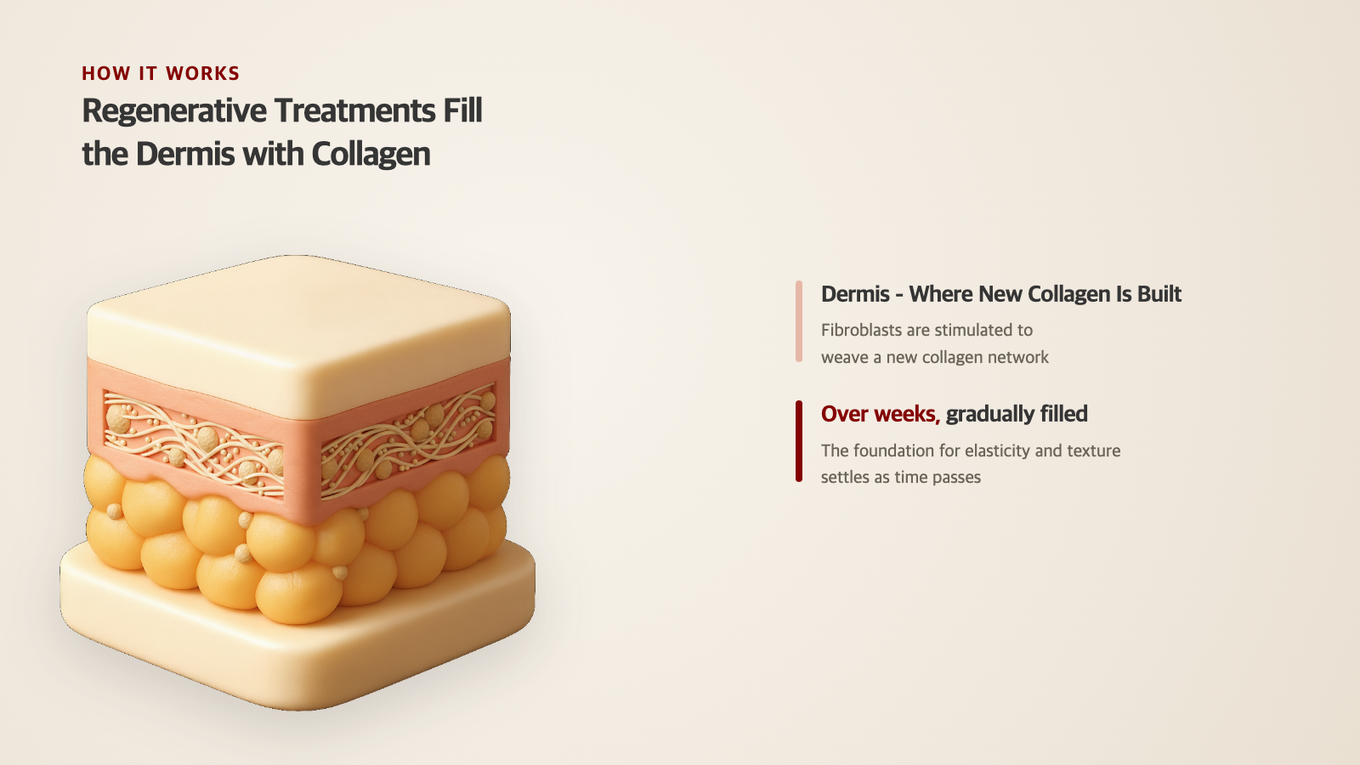
Regenerative treatments and boosters gradually fill the dermis with collagen over weeks, and the skin texture becomes more refined.
This clarifies one thing. If you get regenerative treatments or boosters right before D-day, the collagen is still building, so you won't see the full results. Conversely, if you have treatments that leave swelling or slight marks too close to the day, these won't have time to subside. Either way, you'll be short on time, so reverse calculation is essential.
Yes, they broadly fall into two categories: immediate results seen quickly and gradual improvements as collagen builds. These need to be placed differently in your timeline.
Mixing these up can derail your plans. Immediate treatments offer fast results but need time to settle, while gradual treatments pay off later, so there's little point starting them right before the day. Let's break them down by type.
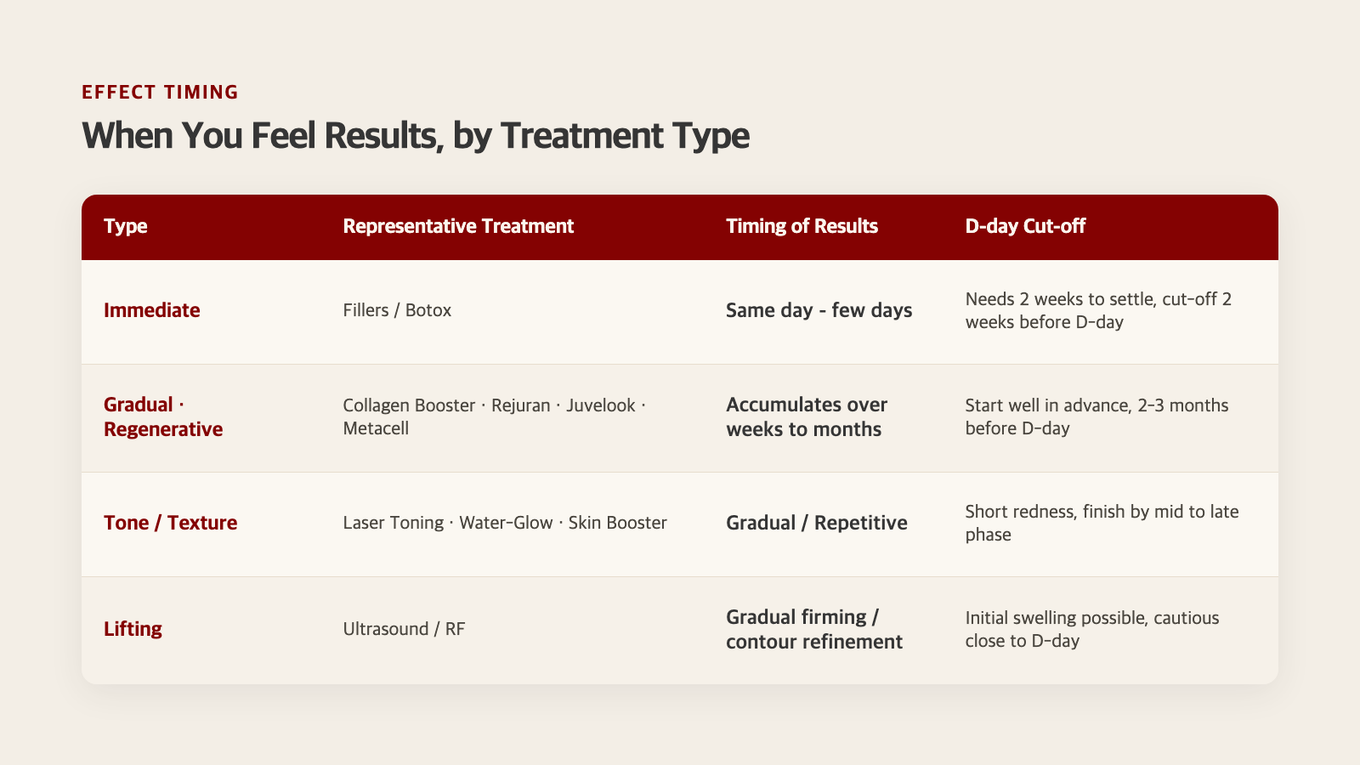
Immediate treatments need time to settle, while gradual treatments need time to build up. Each type has a different D-day cut-off.
| Type | Representative Treatment | Timing of Results | D-day Cut-off |
|---|---|---|---|
| Immediate | Fillers / Botox | Same day - few days | Needs 2 weeks to settle, cut-off 2 weeks before D-day |
| Gradual | Collagen Booster / Rejuran / Juvelook / Metacell | Accumulates over weeks to months | Start well in advance, 2-3 months before D-day |
| Tone/Texture | Laser Toning / Water-Glow / Skin Booster | Gradual / Repetitive | Short redness, finish by mid to late phase |
| Lifting | Ultrasound / RF | Gradual firming / contour refinement | Initial swelling possible, cautious close to D-day |
Immediate treatments show changes right away but take about two weeks to settle, whereas gradual treatments often require multiple sessions spaced apart as collagen builds. Hence, the general guideline is Immediate: finish at least 2 weeks before / Gradual: start as early as possible. Once you set these two pillars, the timeline naturally unfolds.
For treatments like regenerative procedures, boosters, and lifting that require time, start no later than 2-3 months before D-day. Finish any treatments that may leave swelling/marks at least two weeks before. Closer to the date, focus on refining tone/texture and moisturizing.
Here's a general guide. Depending on your remaining time, skin condition, and the type of treatment, the intervals can shift forward or back. The numbers are just examples, so use them as a framework for calculating backwards from D-day.
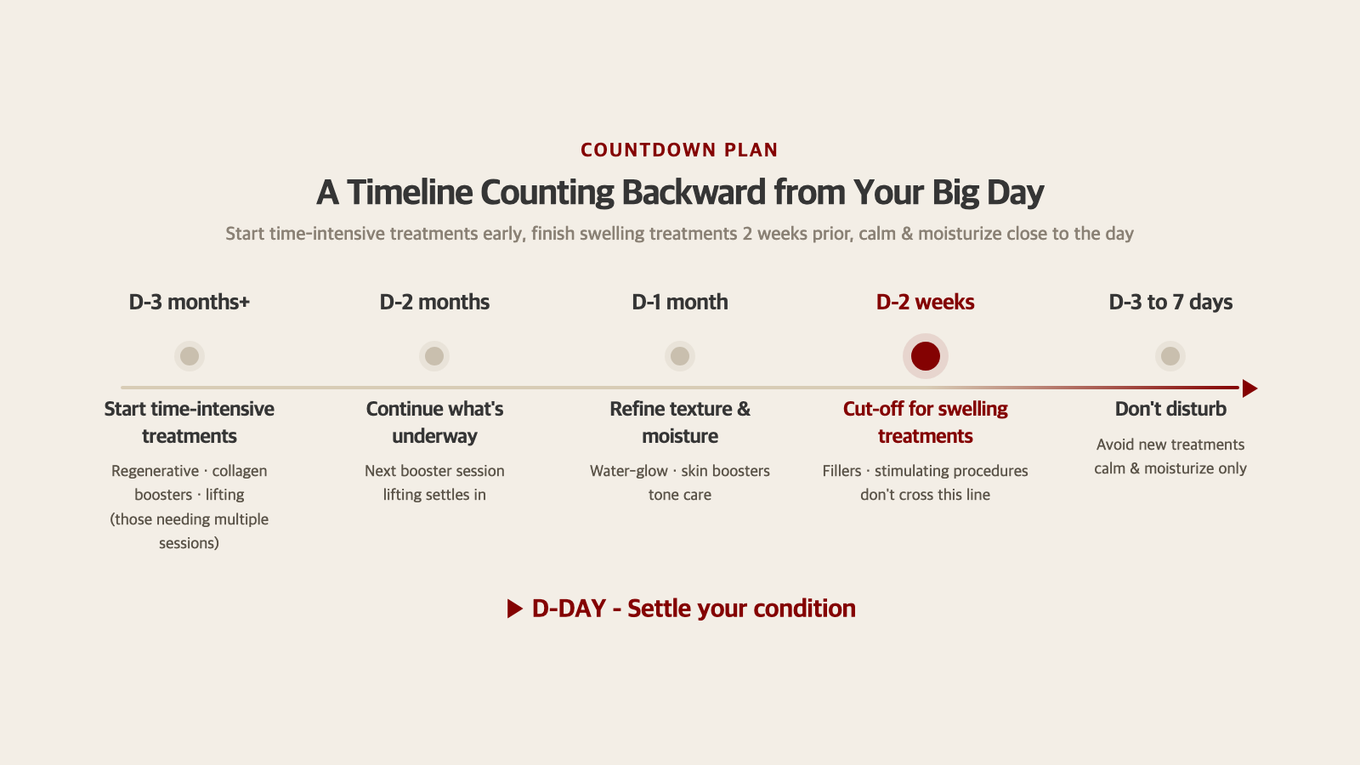
Counting backward from D-day - start regenerative treatments and lifting early, finish swelling treatments 2 weeks prior, focus on calming/moisturizing as the day approaches.
If you have more than 3 months left - This is the most ample period. Start treatments like collagen boosters, regenerative procedures, or lifting that show results gradually and may need multiple sessions. The earlier you start, the more time collagen has to build before the big day.
D-1 to 2 months period - Continue with subsequent sessions of boosters and let lifting treatments settle. Focus more on wrapping up ongoing treatments rather than starting new ones.
Inside 1 month - Treatments like water-glow and skin boosters for moisture and fine texture, along with skin-tone treatments, are ideal. This is the phase for smoothing the surface as a finishing touch.
D-2 weeks - This is the hard cut-off. Treatments that may leave swelling or slight marks (such as fillers or more invasive procedures) should not go past this point. Allow time for any traces to subside.
D-3 to 7 days - Avoid new treatments, and focus on calming and moisturizing care to maintain your condition. The goal in this period is to preserve your condition.
If you cram in multiple procedures just before D-day, the overlapping recovery from swelling/redness/minor marks can worsen your condition on the day. The more urgent it feels, the more cautious you should be.
During consultations, we often hear requests like, "I have a week left, please do everything you can now." While this sentiment is understandable, piling on multiple treatments at once triggers an accumulation of initial reactions from each. Swelling from fillers, redness from stimulating procedures, and injection marks overlap, extending recovery time. This can result in your face looking most swollen on the day.
Close to the day, focus on calming and moisturizing rather than adding new treatments to preserve the day's results.
Therefore, at our clinic in Myeongdong, Seoul, if D-day is imminent, we first consider what to omit. Postpone regenerative treatments and boosters that won't show results by then, skip swelling treatments, and focus on calming/moisturizing care. Often, the less you do, the better your condition will be on the day.
⚠️ Note - While minor swelling or marks typically subside within a few days post-treatment, individual reactions can vary, and recovery may take longer, especially when undergoing multiple treatments. If you have an important day coming up, it's best to inform us of your schedule in advance. Risks and precautions - such as infection, inflammation, or pigmentation - can differ from one treatment to another, so please be sure to check your individual risks and precautions during a pre-treatment consultation.
Your priorities change based on your remaining time and current skin concerns. With ample time, start gradual treatments; with less time, keep your skin calm and leave it alone.
Here's a framework we use when setting directions during consultations. It’s not a fixed formula, but think of it as a guide for planning.
Start by assessing whether your main concern is elasticity, moisture/texture, or just maintaining your condition for the day. That decision comes first, with treatments following. If you're curious about how regenerative treatments and boosters work within the dermis, check out The Principle of Water Glow/Skin Boosters in Changing the Dermis and How Collagen Boosters Create Collagen for more insight into planning your time.

When you start matters as much as what you get. Plan by looking at the remaining time first.
If you're considering treatments like regenerative procedures, collagen boosters, or lifting, it's generally recommended to start 2-3 months in advance. This allows time for collagen to build and for sessions to be spaced properly. Conversely, treatments that might leave swelling or marks should be completed at least 2 weeks prior to ensure safety. Since intervals can vary with your remaining time, preplanning and counting backwards is key.
They work by stimulating fibroblasts in the dermis to generate new collagen. This process is different from fillers that immediately add volume. It naturally takes weeks for cells to react and for collagen to accumulate and reorganize. Understanding that the texture improves as time goes on, rather than the next day, gives a more accurate picture. The speed of change varies greatly with age and skin condition.
Avoid treatments that could result in swelling, redness, or slight marks close to the day. Fillers or stimulating injections fall into this category. Such treatments need time for any traces to subside, so finishing them at least 2 weeks before is recommended. Within a week of D-day, it’s safer to focus on gentle moisturizing and calming care to simply maintain your condition.
If time is short, treatments that refine moisture/texture and improve tone tend to suit day-of conditions better than those waiting for collagen build-up. However, if less than 2 weeks remain, consider whether adding a new treatment is wise. Accepting the potential risks of swelling or marks with last-minute treatments isn't advisable. Often, maintaining condition with moisturizing/calming care is the best choice.
When a big day approaches, it's easy to think "I should just get something done now." However, since regenerative treatments and boosters improve gradually as collagen builds, rushing them just before means incomplete results or lingering swelling on the day.
Therefore, flip the order. Calculate backwards from the big day: start time-intensive regenerative treatments and lifting 2-3 months ahead, finish swelling treatments 2 weeks prior, and focus on calming/moisturizing as the day approaches.
When you start matters as much as what you have done. There’s no universal schedule, so consider your remaining time and what your skin needs right now. Just remembering to 'calculate backwards' is enough.
#WhenToStartTreatments #WeddingSkinPrep #YearEndSkinPrep #RegenerativeTreatments #CollagenBooster #SkinBooster #CountdownTimeline #TreatmentTiming #MyeongdongDermatology #ForeverClinic