

Blog
Expert tips for healthy skin
Expert tips for healthy skin
"Doctor, it's called a collagen injection, so does that mean they're injecting collagen directly?"
This is a common misunderstanding whenever collagen boosters are discussed at our clinic in Myeongdong, Seoul. Many people think "collagen booster = injecting collagen," but the truth is quite the opposite.
To put it simply, a collagen booster doesn't inject collagen into your skin; instead, it stimulates your skin to produce its own collagen. This means changes can appear gradually, and results can vary widely from person to person.
There are numerous types of skin boosters, which can be confusing. Among them, collagen boosters fall under the category of 'collagen-stimulating treatments' (sometimes called collagen regeneration injections). Today, we're going to explore how this is possible by looking at what actually happens inside the dermis. This is not about recommending specific products but understanding the mechanism behind collagen regeneration to see collagen injections in a new light.
Quick Overview
- Collagen boosters stimulate your skin to produce collagen rather than filling it in.
- The star of the process is the fibroblast - the cell responsible for making collagen in the dermis.
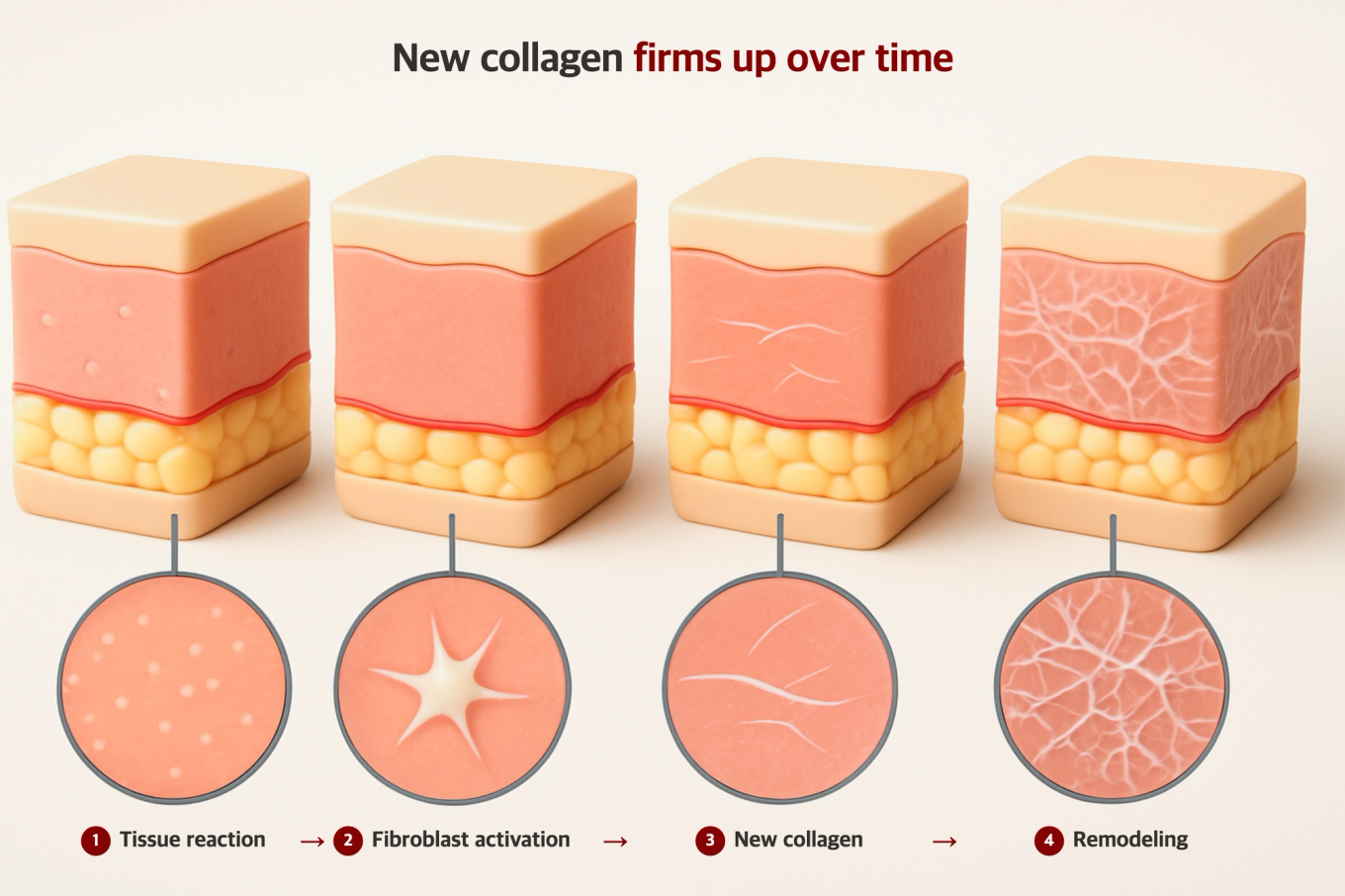
- The sequence follows: tissue reaction → fibroblast activation → new collagen creation → gradual remodeling.
- Initially, soft collagen (type 3) forms, later remodeling into firmer collagen (type 1), key to a natural texture.
- This means results develop slowly and are highly individual.
Let's clear up this common misconception first. Collagen boosters are not about injecting finished collagen into the skin.
If fillers fill in volume immediately, collagen boosters work differently. The ingredients act as a sort of 'signal' that reactivates your skin's dormant collagen factory.
"If they're not directly injecting collagen, how does the collagen increase?"
Here's the crux of dermal remodeling. Instead of supplying collagen directly, they awaken the cells that produce collagen. This leads to gradual improvements as your skin works at its own pace.
💡 Think of it this way - While fillers are like giving you a fish, collagen boosters are more about teaching you how to fish again. It takes time, but since it's collagen your skin made, the texture is more natural.
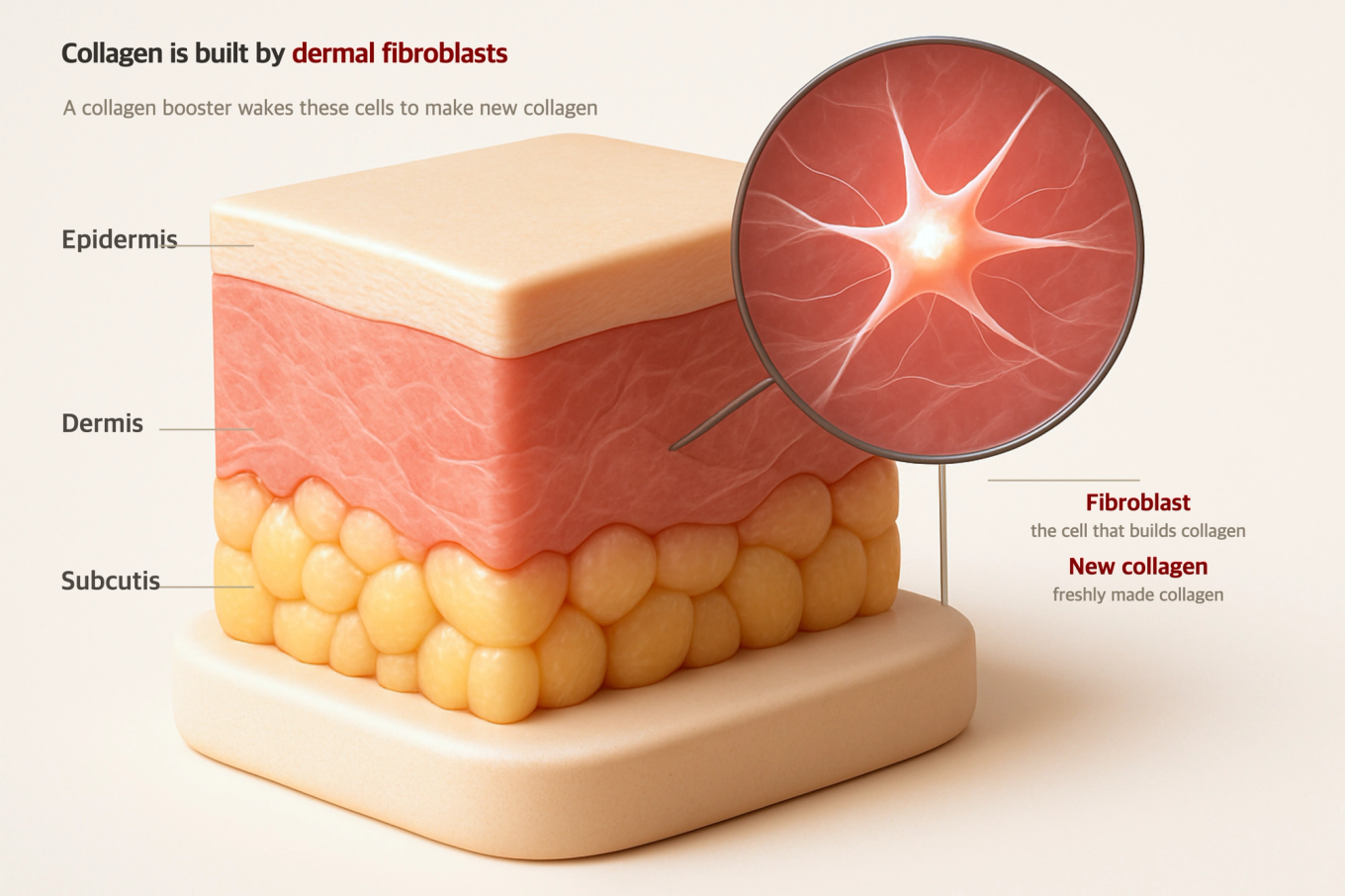
Understanding the cells that actually create collagen is key to grasping this treatment. The main player here is the fibroblast.
Fibroblasts reside in the dermis and are responsible for producing skin structures like collagen and elastin - essentially the 'builders' of the skin. In youth, these cells are active, but as we age and accumulate sun damage or lifestyle habits, they become sluggish and decrease in number. This contributes to thinning skin and loss of elasticity.
Collagen boosters target this specific point by signaling sluggish fibroblasts to get back to work.
Once you receive a collagen booster, about four key processes occur within the dermis. Recent international dermatology reviews highlight this common sequence.
When the dermis encounters the ingredient (biocompatible materials like PLLA/PCL/CaHA), a tissue reaction begins as your body recognizes it as 'foreign.' Immune cells (like macrophages) gather and send signals to surrounding cells indicating a need for reconstruction.
Don't worry, this isn't alarming. It's a natural recovery signal, similar to how new skin fills in a wound.
Fibroblasts receive this signal and become activated. Growth factors like TGF-β trigger them to start producing collagen. This is the point where the sluggish collagen factory starts running again.
Activated fibroblasts begin creating new collagen, a process known as neocollagenesis. This is when genuine new collagen is produced within the skin, which is the essence of this treatment.
Here's the crucial part - newly created collagen doesn't instantly become firm. Initially, soft and temporary collagen is produced, and over time, it becomes more structured and firm through remodeling. This refining process is key to maintaining a natural texture.
Collagen comes in different types. In dermal remodeling, type 3 and type 1 collagen are particularly important.
Initially, type 3 collagen forms first, then transitions to type 1, mirroring the natural sequence our body follows when healing wounds.
💡 To simplify - think of it like constructing a building where you first set up a temporary scaffold (type 3), then build the main structure (type 1) over it. This is why texture becomes firmer and more refined over time.
| Type | Type 3 Collagen | Type 1 Collagen |
|---|---|---|
| Timing | Early in reconstruction | Transitions over time |
| Properties | Soft and flexible | Dense and robust |
| Role | Temporary scaffold | Main structure (elasticity/support) |
| Analogy | Underpainting | Finished painting |
⚠️ Keep in Mind - This transition varies in speed and extent for everyone. Age, skin condition, and past treatments influence "when and how much" you feel it, making it hard to predict universally. Collagen boosters inherently have a slow, individualized effect.
We can now address the most frequently asked question: Why isn't the effect of collagen boosters noticeable immediately after treatment?
The answer lies in the process itself. Your cells need time to produce new collagen. From tissue reaction to fibroblast activation, collagen creation, and gradual firming - each step takes time.
"So, is there no change right after the procedure?"
You may feel a slight fullness initially, but that's often a temporary response to the ingredients or the procedure itself. Real change occurs as new collagen forms and is refined over time. Thus, collagen boosters are more about 'gradual, natural' changes rather than 'quick' ones.
This isn't a downside, but rather a characteristic. As the changes develop slowly, they refine naturally rather than appearing suddenly obvious.
Understanding the principle helps when choosing treatments. Here are some points we often discuss in consultations.
To maximize the benefits of collagen injections, it's crucial not to disrupt the 'natural collagen production process.' Rather than expecting quick changes, allowing time for this process aligns best with the nature of collagen regeneration treatments.
🩺 Doctor's Note - I often hear, "I got a collagen injection, but why isn't it noticeable?" At those times, I go over the process we've discussed today. Understanding that your cells need time to produce and refine collagen helps make sense of 'why it's gradual.' At our clinic in Myeongdong, Seoul, we guide patients to see collagen boosters as 'helping your skin work again' rather than expecting 'quick changes.'
No, they aren't. Instead of injecting finished collagen, they stimulate your skin’s fibroblasts to produce its own collagen. This leads to gradual changes, and since it's your collagen, the texture is generally more natural.
Because it takes time for new collagen to form and firm up, the changes are gradual rather than immediate. However, the speed and extent of results vary from person to person. Factors like age and skin condition play a role, making it hard to generalize.
In the early stages, soft and flexible type 3 collagen forms first, transitioning over time to denser type 1 collagen. This mirrors the natural healing process our body uses to mend wounds.
Fillers fill in volume to immediately address an area, while collagen boosters encourage your skin to make its own collagen. That's why boosters lead to gradual changes and tend to produce a more natural texture.
It depends on the ingredients and your skin condition. It can be a single session or spaced over several treatments. This is an area where we customize plans based on your skin, so it's good to discuss it beforehand.
Collagen boosters don’t inject collagen; they awaken your skin to produce collagen again. This involves fibroblasts in the dermis activating to create new collagen, which gradually firms up over time.
With the shift from initially soft type 3 collagen to firmer type 1 collagen, results develop slowly and vary widely among individuals. This isn't a drawback but a feature that helps maintain a natural texture.
By understanding the dermal remodeling process we’ve outlined today, next time you consider a collagen booster, you'll likely think, "Oh, it's the time for my collagen to rebuild," rather than wondering, "Why is it taking so long?"
#CollagenBooster #DermalRegeneration #CollagenProduction #Fibroblast #Neocollagenesis #SkinBooster #CollagenStimulation #SeoulDermatology #MyeongdongClinic