

Blog
Expert tips for healthy skin
Expert tips for healthy skin
"Doctor, I keep hearing about stem cell procedures from different places. Are they all the same? Some mention injections, others talk about cultured medium, and then there's exosome. What is all this?"
This is a common question we get at Forever Clinic in Myeongdong, Seoul, whenever the topic of regenerative procedures comes up. It's understandable. The single word 'stem cell' sits on top of everything, but when you look underneath, things with quite different natures are sharing one name. So today, let me give you a framework for how to tell them apart.
Here's the one-line version first. If you look at what's usually called a 'stem cell procedure' through the lens of 'what is being put in', it broadly sorts into three: whether you put in cells directly, the cultured medium the cells make, or only the signaling molecules (exosomes) drawn out of it. Put in something different and the mechanism changes too. And there's one more axis on top of that - 'whose is it' - which I'll come back to later.
The problem is that in advertising, all of these get lumped together as 'stem cell'. Without a framework, it's easy to be left wondering "is this really that?" So today, rather than recommending a specific treatment, I want to calmly walk you through the framework for telling them apart and the principle behind each one. Once you have the framework, you'll be able to judge any name you run into later for yourself.
Quick Overview
- 'Stem cell procedures' are not one thing. Looked at through 'what is being put in', they sort into three: cell injection / cultured medium / exosome.
- On top of that, 'is it mine (autologous) or someone else's (allogeneic)' is a separate axis. Forever's Metacell sits on the autologous side.
- What they share is that they don't fill you up with cells, but rather send regenerative signals to your own skin.
- In Korea, directly injecting cells versus using cultured medium/exosomes sit in different regulatory/approval positions - and this is where a lot of the confusion comes from.
- So rather than "which is better", the real yardstick is "which suits my situation and goals".
Let's first address why this topic is so bewildering. In short, it's because different procedures with distinct mechanisms are grouped under the same 'stem cell' umbrella.
Some clinics say they inject the cells themselves, others talk about using cultured medium, and then there's the unfamiliar term 'exosome'. From a consumer's perspective, they all sound like 'stem cell', leading to the misconception that they are the same.
"If they have similar names, don't they have similar effects?"
This is the first trap. Different materials mean different mechanisms and different expectations. So, rather than focusing on the name, you should look at 'what is being used and how'. Let's explore these three paths one by one.
Ultimately, the three categories are separated by what is applied to the skin. While the overarching goal is to send regenerative signals, the method of delivering those signals differs.
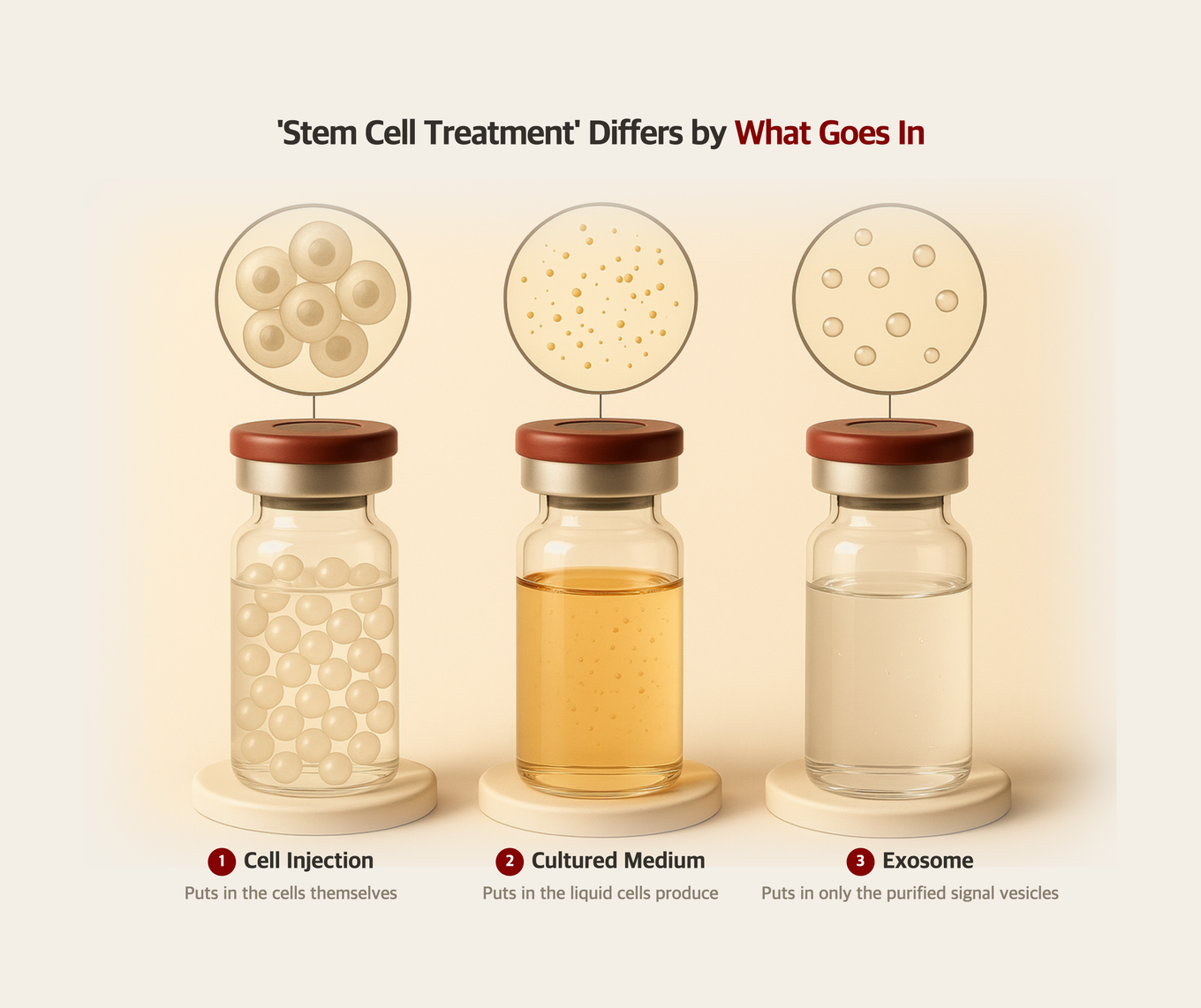
This approach literally involves injecting living stem cells directly into the skin. It typically uses cells derived from your own fat or blood.
Here's how it works: the injected cells are expected to settle in and send signals to surrounding cells, inducing regeneration. Although it's often presented as the most fundamental approach, it involves complex procedures and important safety management (infection/immunity).
⚠️ Note: In Korea, handling living stem cells is heavily regulated, and the scope of what can be done varies by medical institution. If you come across the phrase "injecting cells", make sure to check the basis and extent of what is being performed.
Instead of the cells themselves, this method uses the liquid (cultured medium/conditioned media) produced during cell cultivation. This liquid contains growth factors and signaling molecules secreted by the cells.
In other words, it doesn't inject cells but delivers the 'regenerative signals' emitted by the cells. Among the three, it is often introduced as more of a maintenance approach and can be applied or absorbed in various methods.
💡 To put it simply - If cell injection is like 'bringing in the workers themselves', then cultured medium is akin to 'delivering the instructions left by the workers'. Without the workers, you're closer to a maintenance method.
Cultured medium contains many different substances. Exosomes are the extremely small vesicles (around several tens of nanometers) isolated out of it - the ones cells mainly use for communicating with each other.
Think of them as envelopes of messages that cells use to communicate "move this way" to each other. By isolating and delivering only these messages, this approach aims to assist with skin texture, barrier, and soothing. And here the whole thing comes down to one question: how purely, and by what method, are they isolated? That single point can make or break both the result and the safety.
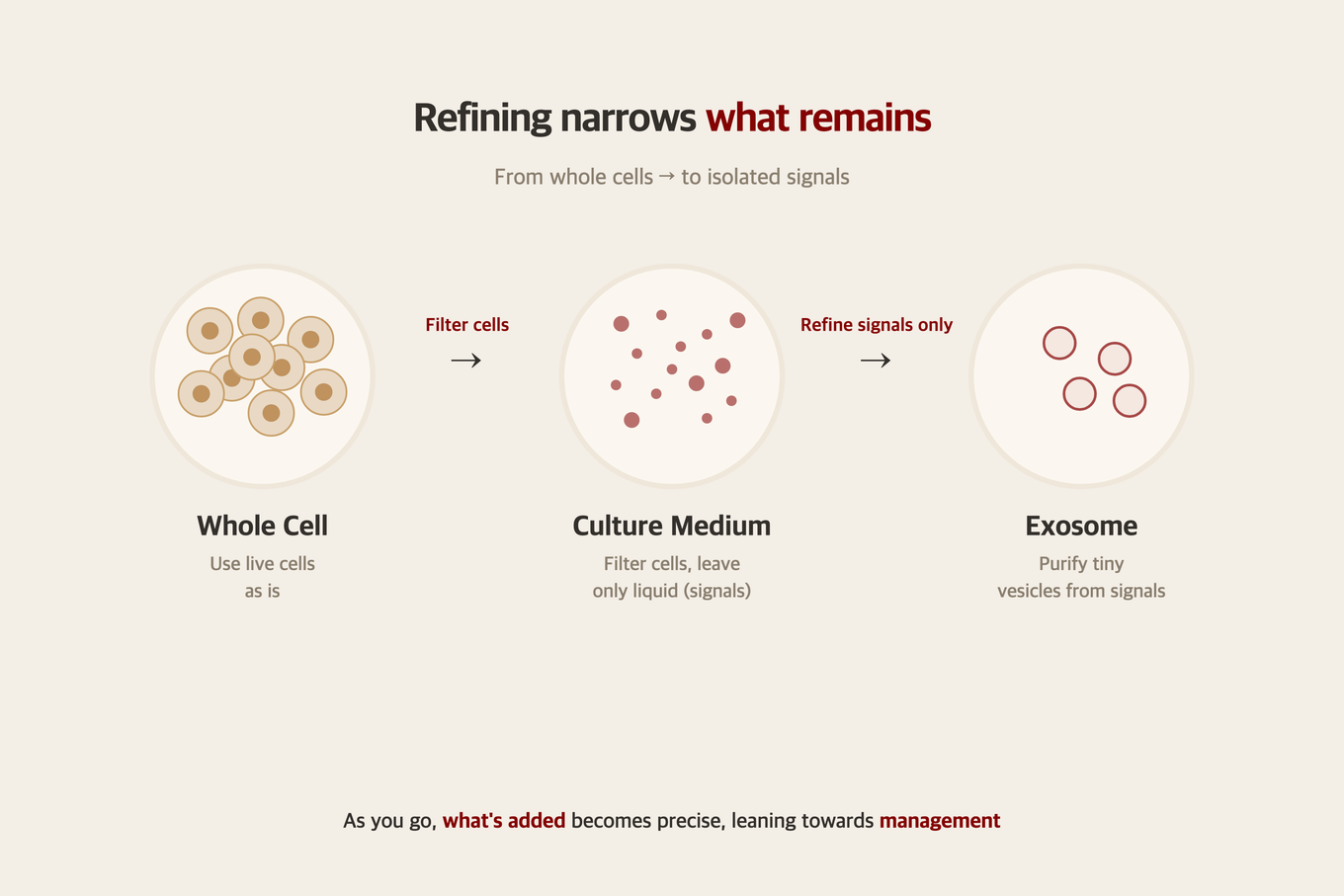
Here's a useful way to picture it. The three paths are really one continuum of refinement. Whole cells → cells filtered out, keep only the liquid → from that liquid, keep only the signaling vesicles. The further you go, the narrower and more precise 'what you're putting in' becomes.
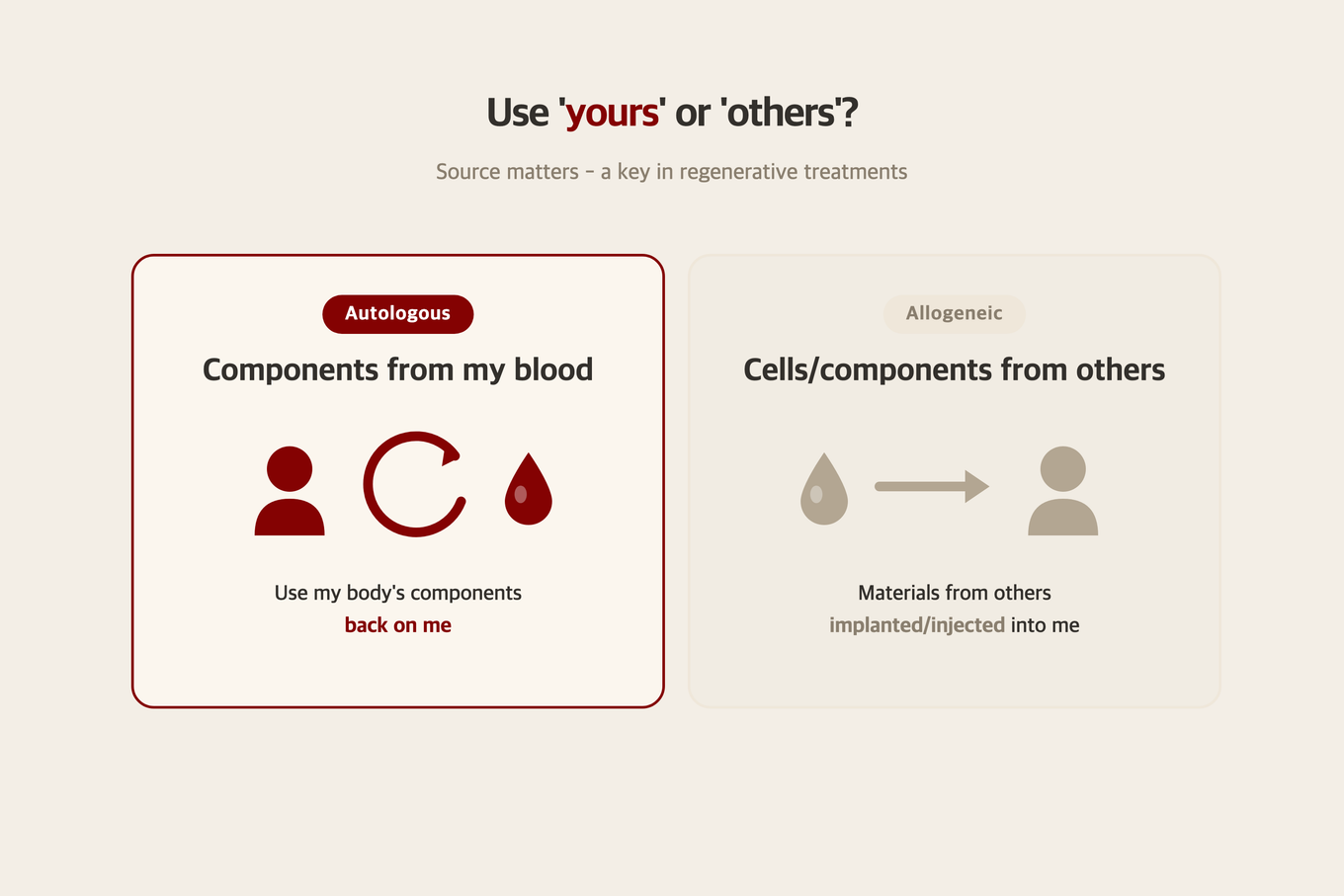
Here's one more thing to add. So far we've only looked through a single axis - 'what is being put in'. But to really tell regenerative procedures apart, there's a second axis: 'whose material is it'. Is the material coming from someone else's body, or is it something taken from your own body and reused?
Through this axis the picture shifts a little. The three paths above (cell injection / cultured medium / exosome), broadly speaking, tend to rely on material prepared in advance outside the body - someone else's cells or their culture products, what's loosely called the 'allogeneic' family. The regenerative option we guide at Forever Clinic in Myeongdong, Seoul - the Metacell (Stem Cell) line - has a different character. The key point is that it's 'autologous'. Rather than bringing material in from someone else, it draws on components taken from your own body (growth factors/signaling molecules extracted from your own blood, for example).
So rather than forcing Metacell into one of the three boxes above, it's more accurate to view it on that other axis - autologous vs allogeneic. Being autologous means the components come from your own body, so the accurate way to put it is that it's described as placing relatively less immune burden than approaches that use someone else's cells - and no further. It's not "so it's better", it's "a different kind of approach". The results still vary a great deal from person to person.
Now that you understand the principles, the more important question remains. "Which is better" isn't the question, but "which type suits my situation?" The three categories differ in nature, not in superiority.
⚠️ Be especially cautious if - You have expectations of "fundamentally changing once and for all". Regenerative approaches, by principle, don't work that way, and such definitive statements themselves can be a warning sign.
When the topic of regeneration/stem cells arises, several concerns often come to mind. Here, we'll candidly address the most frequently raised concerns in our practice.
"Isn't it just hype, am I being deceived?" - This is the most common concern and a rational suspicion. The truth is, many exaggerated claims do exist in this field. So, the more you see phrases like "complete cure/fundamental change/panacea", the more you should take a step back. Understanding the principles reveals that it's not about adding cells but about sending signals to your skin to respond, which can vary greatly from person to person.
"Is it safe, is it regulated?" - Honestly, this is the part that matters most, and it's where the most confusion lives. The name is always 'stem cell', but legally these things land in three different places. Stem cell 'therapeutics' are approved as pharmaceuticals by the MFDS, stem cell 'procedures' fall under new medical technology evaluation, and cultured-medium-based products sit on the 'cosmetics' side. They're on different tiers, as the diagram below shows.
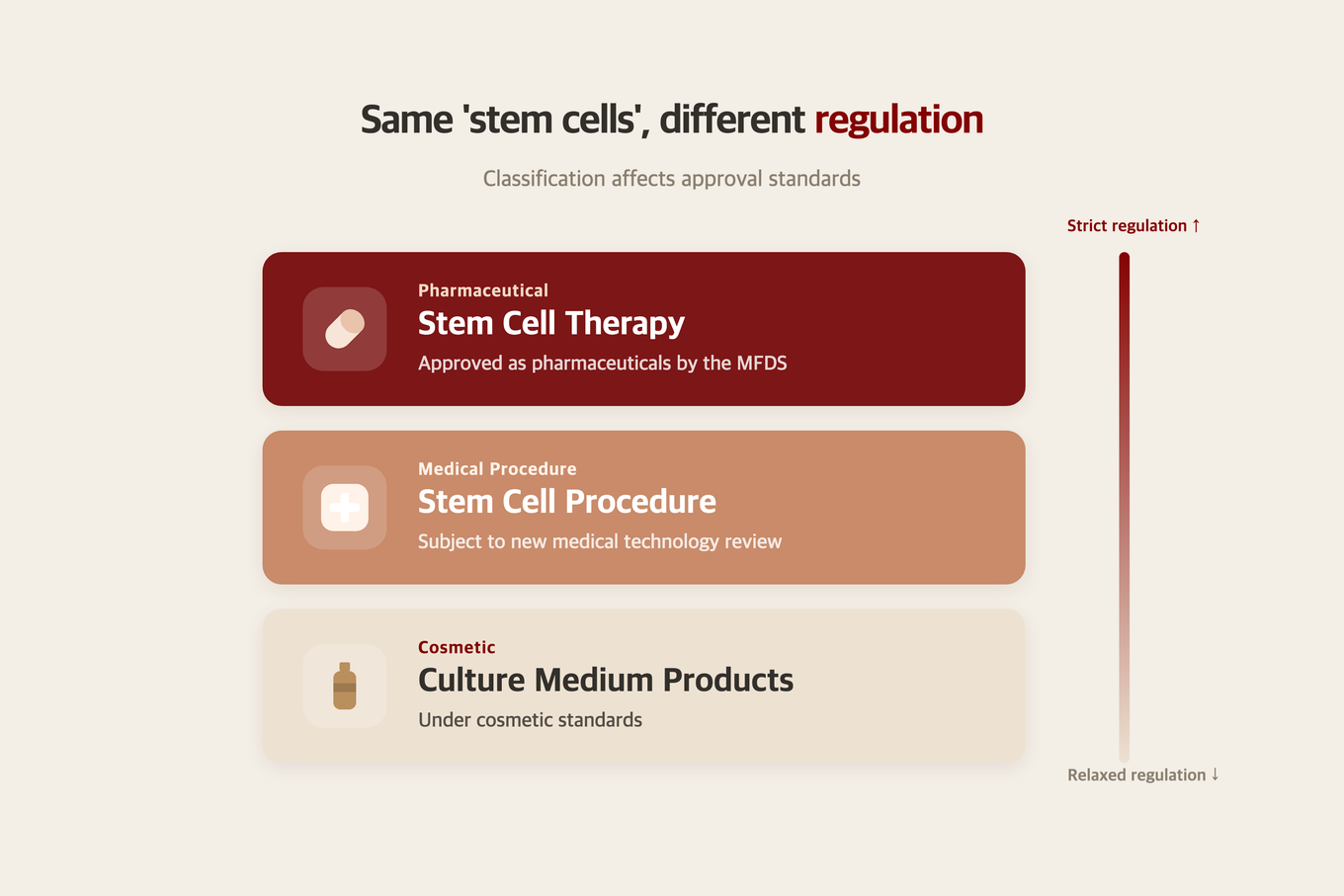
The closer a treatment gets to directly handling cells, the stricter the regulation. Cultured-medium/exosome skin boosters, meanwhile, are in some respects still catching up on safety and approval standards. Whether something is actually approved, and how it's classified, ultimately comes down to the criteria set by official bodies like the Ministry of Food and Drug Safety (MFDS) and the New Health Technology Assessment (NECA). So a 'stem cell' label doesn't make everything the same - what matters is getting transparent confirmation of which material is used, on what evidence, and within what scope. For reference, an autologous approach that uses components from your own blood is sometimes described as carrying relatively less immune burden than approaches that use someone else's cells.
"Is it worth the cost?" - The regenerative category is generally about observing progress over time rather than achieving immediate dramatic changes, so if your expectation is based on 'instant dramatic transformation', you may be disappointed. When evaluating value, it's more realistic to shift your criteria from 'one-time dramatic change' to 'how to manage your skin condition over time and in which direction'.
"Are the effects guaranteed?" - Let me be straight with you. The regenerative category is an area where it's genuinely hard to promise a definite result. The principle is clear enough. But the clinical evidence varies from one line or product to the next, and above all, people respond differently. That's why I never say "it will definitely improve". What I do say is: "we expect it to help in this way, and there's real individual variation" - and I keep my guidance right at that line.

Let's summarize what we've discussed in a table. Think of it as a roadmap to understanding the nature of these procedures, not to determine 'which is the best'.
| Category | Cell Injection | Cultured Medium | Exosome |
|---|---|---|---|
| What Goes In | Cells themselves | Liquid produced by cells | Isolated signaling vesicles |
| Positioning | Most fundamental | Maintenance | Maintenance |
| Key Factors | Cell condition/safety management | Composition of growth factors | Purity/method of isolation |
| Key Consideration | Thorough verification | Consistency | Consistency |
💡 How to Read This - From top to bottom, the approach shifts from 'fundamental' to more 'maintenance-based', while the procedural/safety burdens are greater for cell injections. There's no right answer in any category, but the key is to see which category aligns with your goals.
⚠️ Individual Differences - The above distinctions provide a broad understanding of principles, while actual responses/suitability can vary. Deciding which procedure is right for you should be based on your skin condition and objectives.
'Stem cell procedures' aren't a single entity. Looked at through two axes, they get a lot clearer. First, through 'what is being put in', there are three paths: cell injection / cultured medium / exosome. And through 'whose is it', there's mine (autologous) / someone else's (allogeneic). Lay those two axes over each other and you can see that under one name sit things of quite different natures.
They do share one thing. These approaches don't 'fill you up' with collagen or cells - they send regenerative signals to your skin so it responds on its own. That's why change comes gradually, varies a great deal from person to person, and is hard to pin down as "it will definitely improve".
So next time you run into the word 'stem cell' somewhere, rather than getting swept up by the name, first ask yourself "what is this putting in - and whose is it?" And rather than "which is the best", switch the question to "which kind suits my goals and situation?" That way you can judge for yourself instead of being swayed by advertising copy.
🩺 Doctor's Note - In consultations, I get asked "they call it stem cell, but is this the real thing?" a lot. When that happens, I walk through it together using the two axes we laid out today. Once you break down what's been lumped under one name into 'what's being put in / whose is it', it becomes clear what you need to check. When we guide the regenerative line (Metacell) at Forever Clinic in Myeongdong, Seoul, we explain it not as 'changing in one go' but as an approach that draws on autologous components taken from your own body, and with the perspective that 'it sends signals for your skin to respond, and there's individual variation'.
No, they aren't. They mainly divide into cell injections, using cultured medium, and isolating only signaling molecules (exosomes). While they all share the 'stem cell' name, the materials used differ, leading to different mechanisms.
Exosomes themselves aren't cells. They are very small vesicles used by cells to communicate signals. They are isolated from cultured medium and differ fundamentally from procedures that inject cells. The purity/method of isolation significantly affects results and safety.
It's difficult to declare a 'best' in this area. The three categories differ not in superiority but in nature, and the suitability depends on whether you seek immediate change or consistent maintenance, among other goals. Individual differences in effect are significant.
Stem cell 'therapeutics' (MFDS-approved pharmaceuticals), 'procedures' (subject to new medical technology evaluations), and cultured medium-based 'cosmetics' are regulated differently. The closer to directly handling cells, the stricter the criteria, while safety/approval standards for cultured medium/exosome-related boosters are still developing. Therefore, it's crucial to transparently verify what materials are used, on what basis, and to what extent. Autologous methods using components derived from your own blood are often introduced as having relatively less immune burden compared to methods using cells from others.
At Forever Clinic in Myeongdong, Seoul, the regenerative line we guide is Metacell (Stem Cell). Rather than being one of the three paths above (cell injection / cultured medium / exosome), it's more accurate to view it on the other axis - autologous vs allogeneic. Instead of using someone else's cells, it's an autologous approach that draws on components taken from your own body (growth factors/signaling molecules from your own blood, and the like). Being autologous, it's described as placing relatively less immune burden, but the results still vary a great deal from person to person. Which procedure suits you depends on your skin condition and goals, so I'd recommend understanding the framework first before deciding.
#StemCellTreatment #CellInjection #CulturedMedium #Exosome #SkinBooster #Metacell #AutologousRegeneration #MyeongdongDermatology #ForeverClinic