

Blog
Expert tips for healthy skin
Expert tips for healthy skin
You've had the treatment, but the results aren't meeting your expectations. Often, the issue lies not within the treatment room but outside of it.
In our consultations, we frequently hear this question:
"I received the same treatment, so why does my redness last longer?"
Even with the same treatment and practitioner, how you spend the days following a procedure can significantly impact your recovery speed and the final results. Post-treatment care is just as crucial as the treatment itself, especially during the summer when these differences become more pronounced.
At our clinic in Myeongdong, Seoul, this comes up especially often during the summer. Today, let's address some common post-treatment mistakes, focusing on UV exposure and home care during the summer. A seemingly harmless habit can delay your recovery by days.
In short, it's 'under construction.' Let's start by understanding why the days following a treatment are so important.
Whether it's a laser, lifting, or skin booster treatment, most procedures involve deliberately creating micro-injuries inside the skin. This triggers the skin's natural healing and regeneration process - that's the principle behind it.
Here's the part that's easy to overlook: during this recovery phase, the skin barrier is more fragile than usual.
💡 Think of it this way - Post-treatment skin is like a freshly painted wall. It may look fine on the surface, but it's still drying underneath. Touching or scratching it can leave marks. Similarly, recovering skin is much more sensitive to external irritants.
For this reason, during this period, focusing on 'what not to do' is more crucial than 'what more can I do.' Gentle soothing and moisturizing are key to a quiet recovery.
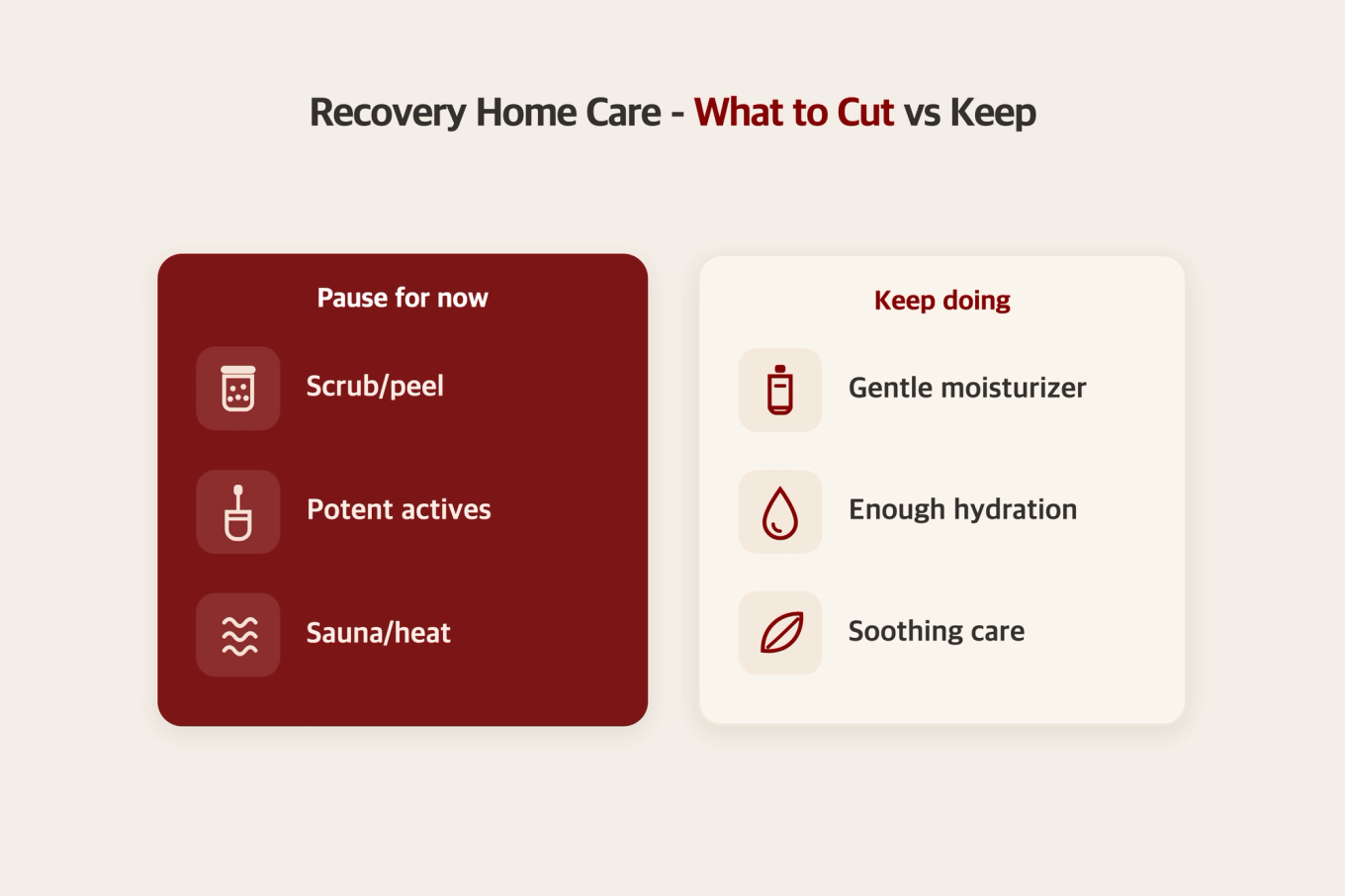
Here are some common post-treatment habits that can hinder recovery. These five are the ones to watch out for:
1. Applying Makeup/Washing Face on the Treatment Day
When the skin barrier is at its most fragile, applying foundation or vigorously washing your face can cause irritation. Depending on the treatment, it's safer to avoid these on the day and start gently from the next day. Always follow the specific guidance provided for your treatment.
2. Sauna/Steam Room/Intense Exercise/Alcohol
These four share one commonality: 'heat' and 'blood vessel expansion.' Adding heat to recovering skin can prolong redness and swelling. It can also increase the risk of hyperpigmentation. Typically, it's advised to avoid heat exposure for a few days to a week post-treatment.
3. Exfoliating/Using Peeling Products Again
Some might think, "Clearing old skin will make it smoother." However, during recovery, this can actually compromise the skin barrier. You're adding friction to already thinned skin, so it's best to pause these for a while.
4. Overusing Potent Functional Ingredients
Retinol/high-concentration Vitamin C/AHA/BHA are all great ingredients under normal circumstances. However, during recovery, they can burden the weakened barrier or cause excessive peeling. For home care during this time, it's better to keep it simple with soothing and moisturizing ingredients like ceramides and hyaluronic acid.
5. Underestimating UV Exposure
This is the most common mistake and the most critical during summer. We'll explore this in more detail.
⚠️ Note - The duration to avoid these habits varies depending on the treatment type and intensity. Some treatments may require just a day of caution, while others may need a longer period. The most reliable guide is the specific post-treatment instructions you receive.
In summary, post-treatment home care is about 'subtracting' rather than 'adding.'
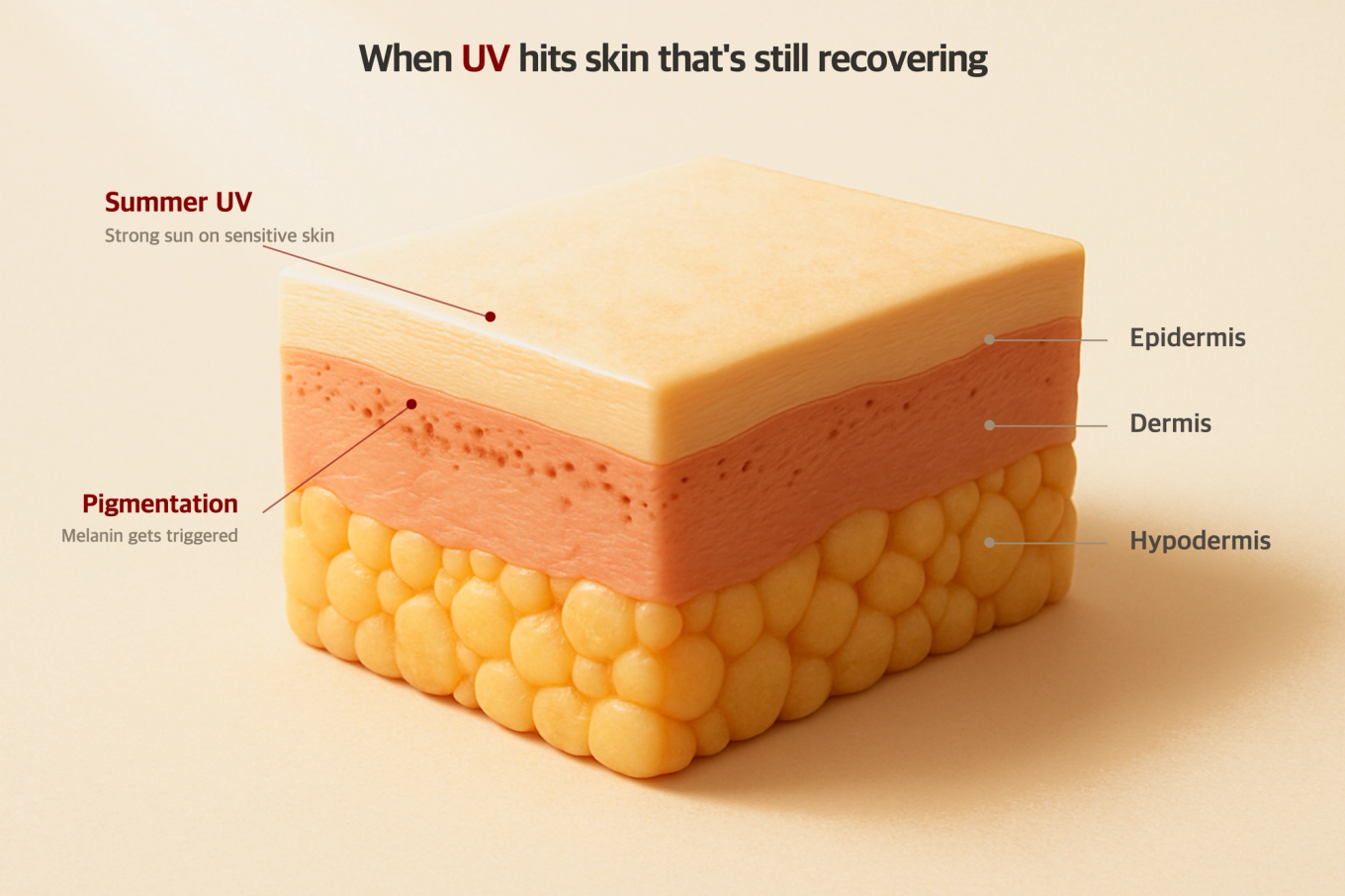
Recovering skin exposed to UV rays is more prone to developing or worsening hyperpigmentation. Sun protection post-treatment is crucial year-round but becomes even more critical in summer.
The key concept here is post-inflammatory hyperpigmentation (PIH).
The micro-inflammation from treatment can make melanocytes more reactive. When UV rays are added to the mix, melanin production can ramp up, leading to unwanted pigmentation.
Simply put, UV exposure on recovering skin is like 'adding fuel to the fire.'
Summer poses specific challenges for three reasons:
🩺 Doctor's Note - In clinical practice, we often see pigmentation issues arise not from the treatment itself but from inadequate summer UV protection post-treatment. The final step to preserving treatment results is sun protection, highlighting its importance.
The key is not 'applying well once' but 'maintaining all day.'
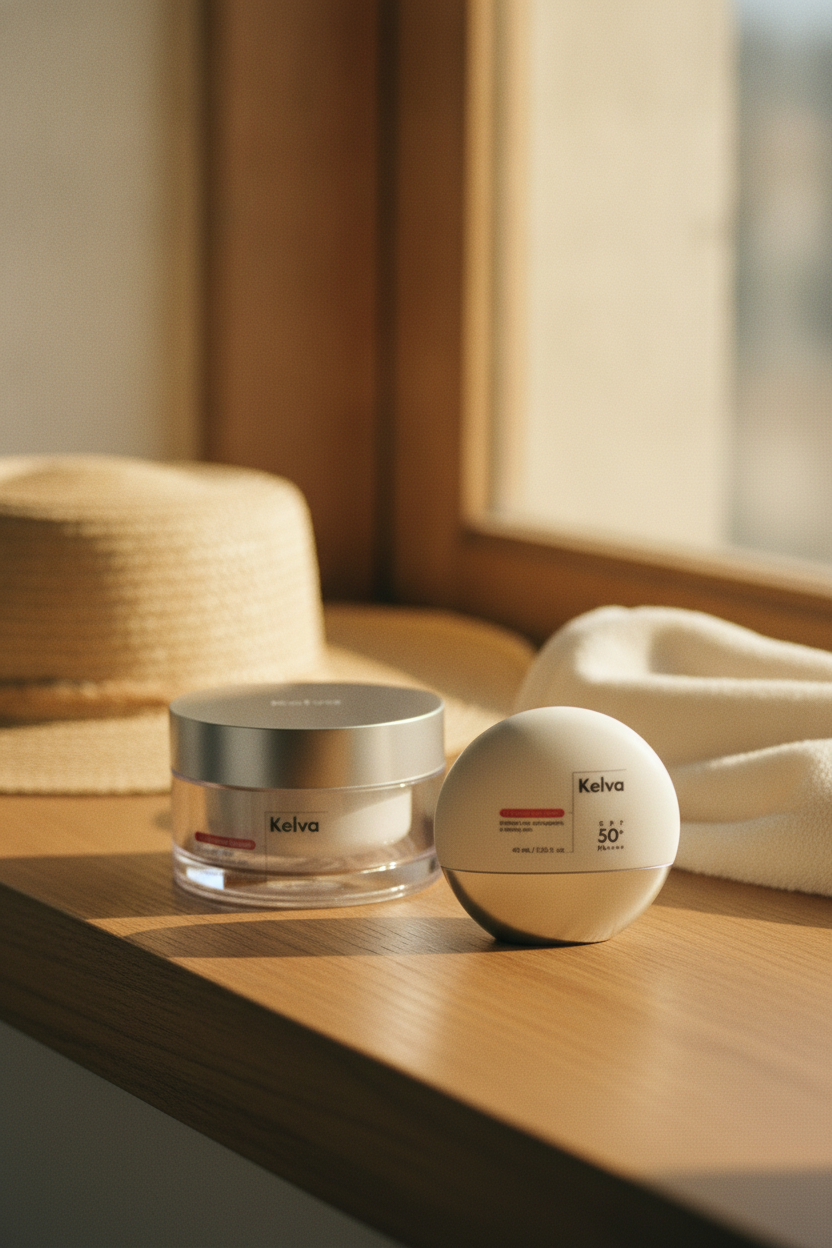
At our clinic in Myeongdong, Seoul, this is a point we emphasize, especially after summer treatments. Here are some key tips:
Here's a question we often get:
"If I'm indoors, do I still need sunscreen?"
UV rays can penetrate windows, and brief outdoor exposure adds up. Since even a little can be detrimental during recovery, applying sunscreen indoors is advisable.
Not all treatments require the same level of caution. The specific areas targeted by the treatment dictate what you need to focus on.
But first, let's visualize the typical recovery progression. The skin's needs change at each stage.
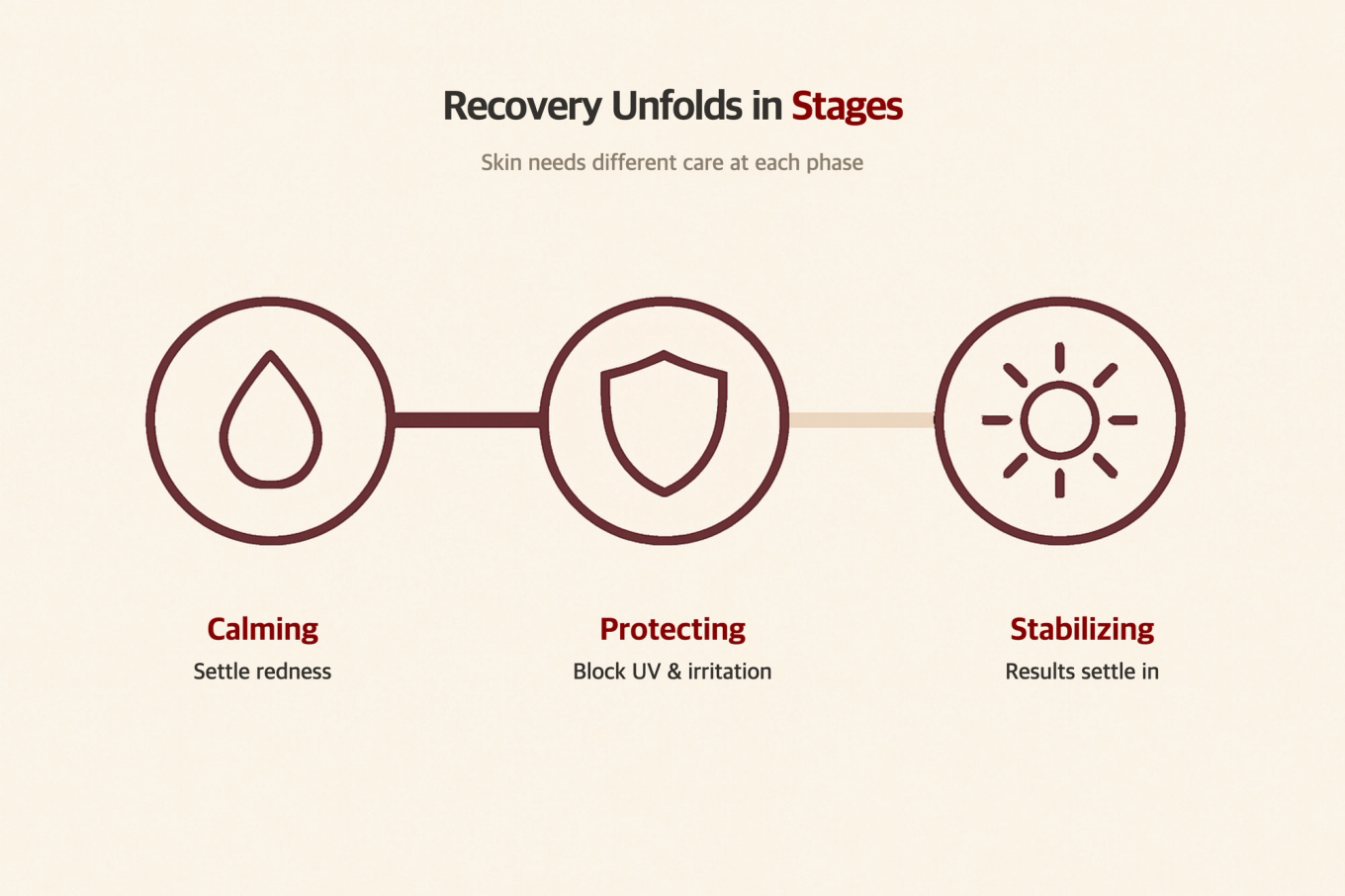
The table below offers a general guide.
| Treatment Type | Key Care Focus | UV Sensitivity |
|---|---|---|
| Pigmentation/Toning Lasers | Preventing Pigmentation Recurrence | Very High |
| Fractional/Regenerative Lasers | Avoid Picking Crust/Peeling | High |
| Skin Boosters/Injection Treatments | Avoid Pressure/Irritation on Treated Areas | Moderate |
| Lifting (Ultrasound/RF) | Avoid Heat Exposure/Saunas | Moderate |
Particularly for pigmentation treatments, sun protection heavily influences the results. It would be a shame to see pigmentation return due to UV exposure after it was treated.
For treatments like lifting that use heat, the considerations are slightly different. If you're curious about the principles, you might find it interesting to read our article differentiating Ultherapy vs Thermage.
🩺 Doctor's Note - This is why pigmentation treatments are sometimes scheduled for seasons when UV management is easier, rather than peak summer. If you must proceed in summer, it necessitates even more stringent sun protection.
Q. When can I start wearing makeup after a treatment?
It varies depending on the treatment type and intensity. Generally, it's safe to avoid on the day and start gently the following day, but some treatments like regenerative lasers may require more time. Follow the specific post-treatment instructions you received for accuracy.
Q. My redness hasn't subsided after several days. Is this normal?
Mild redness or swelling post-treatment is common during recovery. It usually subsides gradually. However, the duration varies greatly among individuals, and avoiding heat (saunas/alcohol) can help it settle faster. If it persists longer than expected or involves pain/discharge, consult the place where you received the treatment.
Q. Should I avoid treatments altogether in the summer?
Not necessarily. While pigmentation treatments might involve more UV management, other treatments like lifting, which are less related to pigmentation, can often proceed with proper sun protection. It depends on the treatment type. For criteria on choosing low-downtime summer treatments, see Choosing Summer Treatments with Short Downtime.
Q. How often should I reapply sunscreen?
Applying once a day is usually not enough. If you're exposed to sweat/water or spending time outdoors, reapply as needed. Even for indoor activities, applying in the morning is advisable. Using physical barriers (hats/parasol) can also reduce the burden during recovery.
Q. What's good for soothing home care post-treatment?
The principle during recovery is 'gentle over quantity.' Stick to moisturizing with ceramides/hyaluronic acid and a mild regenerating cream, and take a break from potent functional ingredients. If specific post-care products are recommended, prioritize those.
The outcome of your treatment is shaped by how you handle the days following it.
Especially in summer, focus on ① avoiding heat exposure ② pausing aggressive home care ③ rigorous sun protection. Adhering to these three can make recovery and maintenance much smoother.
It's the time to be cautious about 'a little won't hurt,' as these few days can significantly impact how well your treatment settles. Pay a bit more attention in the days following your procedure to help ensure the best results.
#PostTreatmentCare #SummerSkincare #SunProtection #Hyperpigmentation #SkinSoothing #MyeongdongClinic #HomeCare #RecoveryCare