
Blog
Expert tips for healthy skin
Expert tips for healthy skin
One of the questions we hear most often in consultations is this one: "So how many sessions of GOURI do I actually need?" And it's almost always followed by, "Isn't it a one-and-done thing?" or "Can't we just put a lot in at once?"
We get why people ask. It costs time and money, so of course you'd rather finish it in a single visit. But collagen boosters work the opposite way. The results tend to fill in more evenly when you space the sessions out over a few weeks, in step with the time your skin actually needs to build collagen (this varies from person to person).
Before we put a number on "how many, how often," let's look at why that number comes out the way it does. Once you understand the process, you can start to gauge what's right for your own skin.
Key Takeaways
- Collagen boosters prompt your own skin to make collagen (they work differently from fillers, which add volume directly).
- Collagen forms slowly over weeks to months after the injection, so it can't wrap up in one session.
- You usually split it into several sessions a few weeks apart, and the number and spacing depend on the product and your skin.
- Getting "a lot, often" tends to raise the risk of overcorrection, lumps, or a foreign-body reaction rather than better results.
- The point of spacing is to see how the last session settled before deciding the next dose.
- The right number depends on your skin, goals, and age, and both the result and how long it lasts vary widely between people.
A single session is rarely enough. Most people split it into several sessions a few weeks apart, and the exact number and spacing depend on the product and the state of your skin.
This is where the misunderstanding starts. A lot of people picture boosters the way they picture fillers: put it in, and that spot plumps up right away. But collagen boosters are a different animal. GOURI (liquid PCL), Sculptra (PLLA), Juvelook (PDLLA), and Rejuran (PN) - all collagen boosters, a branch of the skin-booster family - are stimulators. They nudge the fibroblasts in your dermis to build new collagen. The injected material itself doesn't stay behind as volume.
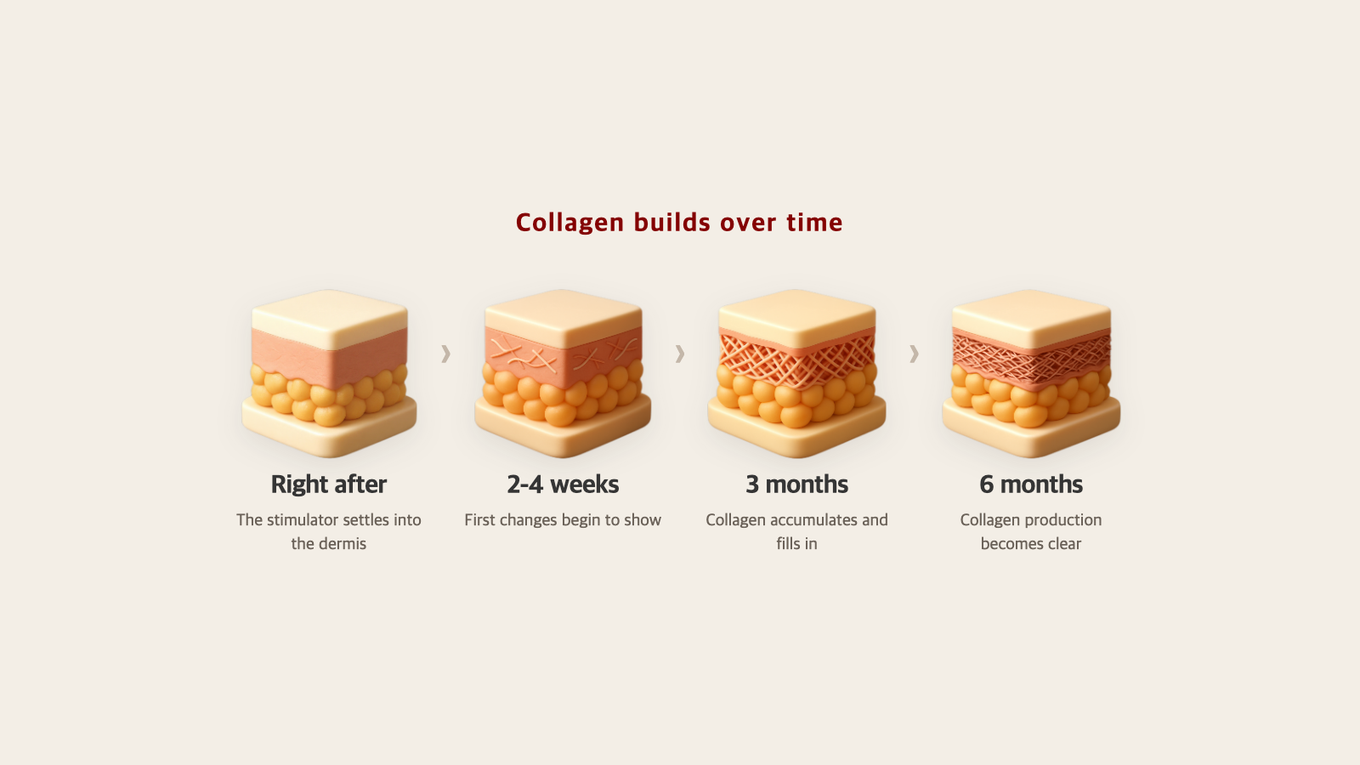
So the math of "put more in at once and it'll get better that much faster" doesn't hold up. Collagen builds over weeks and months after the injection, and there's no way to skip that time.
Because neocollagenesis happens gradually over weeks to months after the injection. It's hard to build all the collagen you want from a single round of stimulation.
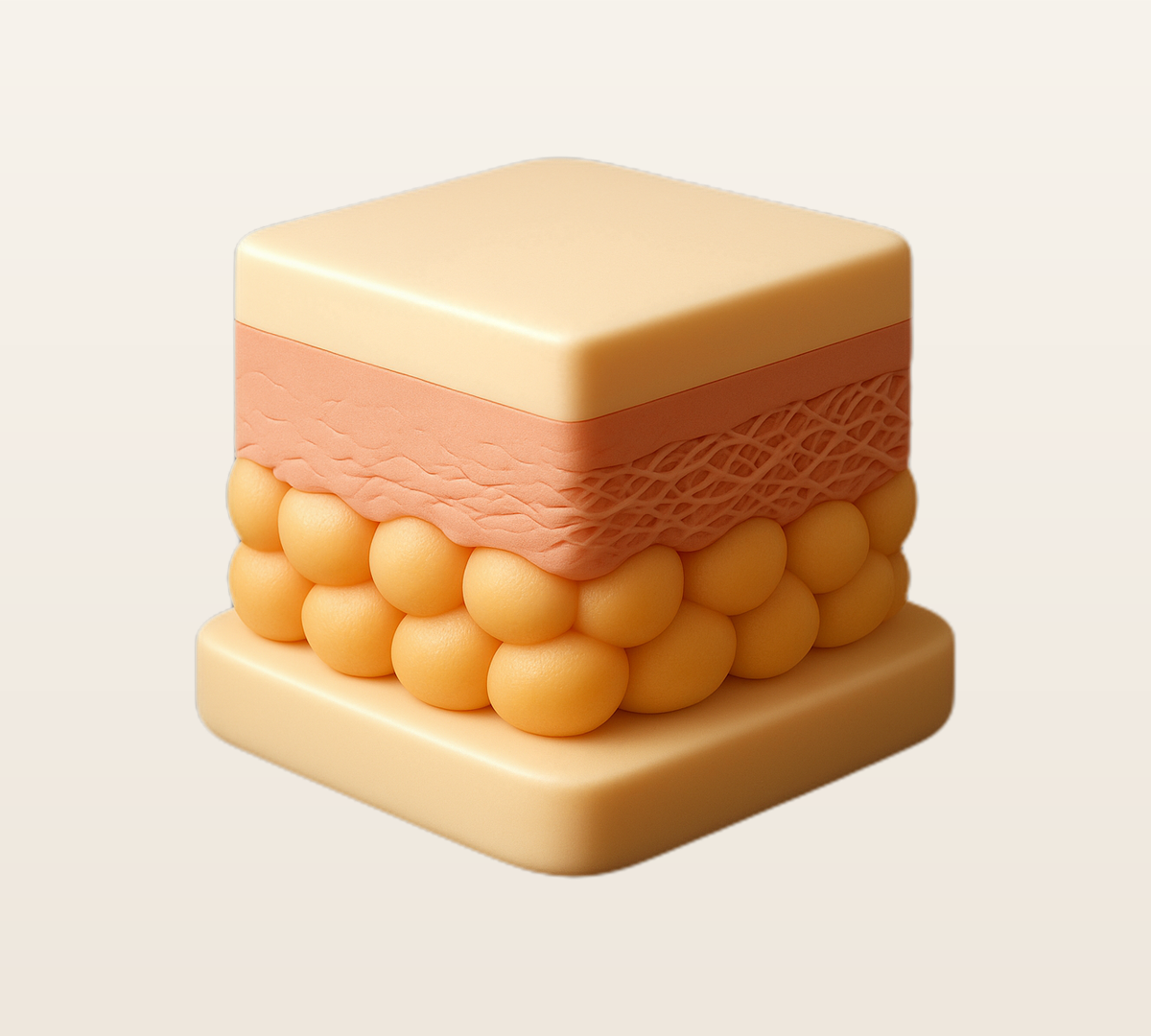
Here's roughly the order of what happens under the skin. When the stimulator reaches the dermis, your body registers it, the fibroblasts switch on, and they start laying down new collagen bit by bit. This isn't a reaction that finishes in a day or two.
In the literature, this timeline shifts a little by product. With liquid PCL (the GOURI family), the first changes tend to show around 2-4 weeks, type 1 collagen rises clearly around 6 months, and collagen activity has been observed in tissue past 13 months (based on photoaging-model and tissue studies). PLLA (Sculptra) is slower still: collagen production picks up over 3-6 months, and clinical reports describe effects lasting up to around two years. The particles themselves start to break down gradually from about 6 months.
There's a reason we lean so hard on this idea of "time" when we look at collagen boosters at our clinic in Myeongdong, Seoul. In a liquid-PCL study that Dr. Chanjong Lee took part in (Journal of Cosmetic Dermatology, 2026), injecting liquid PCL into a UVB-induced photoaging skin model significantly increased dermal thickness and type 1 collagen (p<0.001). It's supporting evidence for why collagen boosters build up over time, and the result and duration in actual people vary from person to person.
If you want the fuller picture of why boosters work down in the dermis rather than on the surface, I go into it in our piece on how hydrating skin boosters work.
No. Putting a large amount in at once, or getting it too often, tends to raise the risk of overcorrection, nodules, or a foreign-body reaction rather than improving the result.
This is the second misconception. "If it's a treatment that makes collagen, wouldn't stronger, more frequent stimulation make even more collagen?" It sounds logical, but the body doesn't work that way.
To your body, a stimulator is a foreign material. In the right amount, fibroblasts build collagen evenly. But when too much goes in at once, the material can clump in that spot and leave the surface bumpy - that's overcorrection. Stimulating more often than needed also raises the risk of delayed inflammatory nodules or a hypersensitivity reaction. This is a point the collagen-stimulator literature keeps making.
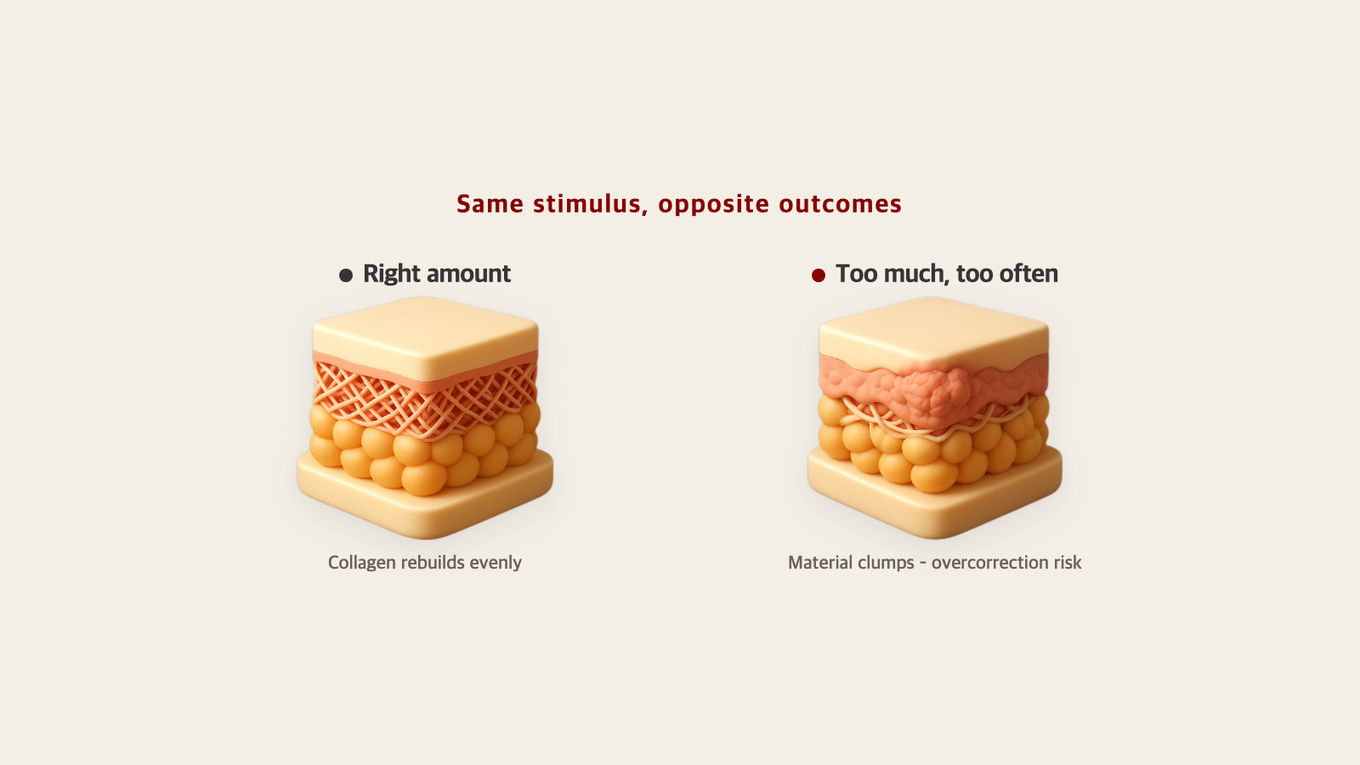
⚠️ Good to know - "The stronger the treatment and the more you put in, the better the result" is not a formula that holds for boosters. More than the dose itself, where you place it, at what depth, and at what interval often makes the bigger difference. So the yardstick for how much isn't "a lot" - it's "the right amount."
You usually leave a few weeks to a few months so you can see the collagen response from the last session before deciding the next dose. That gap is part of the plan, not a delay.
As we saw, collagen forms over time. So layering the next session on only after the first has developed a bit is what keeps you from adding to an area that's already improved and tipping it into overcorrection. That's the real reason for spacing: read the response, then decide what's next.
Since each product runs on its own clock, the intervals differ too.
| Product (Ingredient) | When collagen mainly develops (rough figures from the literature, varies by person) | Why the interval is set this way |
|---|---|---|
| GOURI (liquid PCL) | First changes at 2-4 weeks, clearer around 6 months | Check the early response, then stimulate in stages |
| Sculptra (PLLA) | Most active over 3-6 months | Response develops late, so the interval is longer |
| Juvelook (PDLLA) | Changes reported around 6 months (24 weeks) | Cumulative, so it's split across sessions |
| Rejuran (PN) | Regeneration over days to months after treatment | Aimed at texture/elasticity, planned as a series |
Don't memorize the numbers in this table as "the correct number of sessions." Even with the same GOURI, how many sessions and at what interval will shift with your skin, your goals, and your age. The interval is closer to a plan you adjust after seeing that first response.
There's no set answer. We decide by looking at your current skin, the goal you're trying to improve, your age, and how you recover, all together. These four are what drive the number of sessions.
Rather than fixing a number in advance, run through the list below yourself - the consultation gets a lot more concrete when you do.
On the other hand, in some cases we look at timing or method before adding sessions. If there's inflammation or a breakout at the treatment site, if you're expecting a dramatic change from a single session, or if a particular medical history calls for caution, it's safer to settle the skin first than to push for frequent sessions. Going in with "more must be better" can leave you disappointed instead.
For which of Rejuran, Juvelook, and GOURI fits which goal, I've laid it out in our piece on how the three boosters differ. Looking at "which product fits my goal" before you settle on a number puts things in the right order.
A single session is rarely enough; it's usually split into several sessions a few weeks apart. The exact number depends on the product (GOURI/Sculptra/Juvelook/Rejuran) and your skin, and it's often adjusted after seeing the first response - so it's most accurate to check your skin at a consultation and decide from there.
No. Collagen forms over weeks to months rather than the instant it goes in, so putting a lot in at once doesn't shorten that time. If anything, it can raise the risk of overcorrection or lumps, so we don't recommend it.
No. You need time between rounds of stimulation for collagen to form and for the response to be read. Getting it too often, with no gap, can stack the effects into overcorrection or raise the risk of delayed inflammatory nodules - a point the literature agrees on.
Liquid PCL (GOURI) is cumulative: changes start around 2-4 weeks after the injection and become clearer around 6 months, so it's usually split into sessions a few weeks apart. The exact number shifts with how much collagen you've lost and your goal, so it's safest to see the first response and then decide whether to add more.
The collagen you build also fades naturally over time, so it doesn't simply hold as is. Duration varies by product (for example, PLLA is reported in clinical studies to last up to around two years), and whether to do maintenance is a call we make by watching your individual response.
With collagen boosters, the answer to "how many, how often" ultimately comes down to the time it takes collagen to form. The reason you can't put it all in at once is simple: collagen doesn't build that fast. That's why it's split into sessions a few weeks apart, and the yardstick is "the right amount," not "a lot."
So instead of asking "how many until I'm done?", the more accurate question is "for my skin, how many and at what interval makes sense?" Put your current skin, your goals, and your first response side by side, and the number that fits you starts to show. Matching your sessions to the pace your own body makes collagen - that's how to really get the most out of a collagen booster.
#CollagenBooster #BoosterSessions #BoosterTiming #GOURI #LiquidPCL #Sculptra #Juvelook #Rejuran #CollagenStimulation #OvercorrectionRisk #MyeongdongDermatology #ForeverClinic