

Blog
Expert tips for healthy skin
Expert tips for healthy skin
If you've been researching collagen booster treatments, you've probably heard this claim: "Liquid PCL like GOURI has weaker evidence than microsphere PCL like Ellansé." When patients come in having heard that, many of them are already half-sold on the microsphere option.
Patients often ask me whether the evidence for the liquid kind is a bit thin, and whether that makes the microsphere one the better choice.
The trouble is that the question starts from the wrong place. Liquid PCL and microsphere PCL were designed to do different jobs. Asking which one is "stronger" is like weighing a volumizer against a skin-firming treatment and asking which one wins. Below I'll go through where the "weaker evidence" idea comes from, what the data actually shows, and how to tell which one fits what you want.
The short version
- Liquid PCL (GOURI) and microsphere PCL (Ellansé) are both PCL collagen stimulators. The liquid form has no microparticles and spreads evenly through the dermis; the microsphere form suspends PCL beads in a gel that stays where it's placed.
- That gives them different goals. Liquid leans toward overall skin texture and firmness; microspheres lean toward volume and contour in a specific area.
- "Liquid PCL has weaker evidence" doesn't mean it works less well. It means fewer standardized comparison studies have been published so far.
- Liquid PCL does have published regeneration data: one study found significant increases in dermal thickness and type I collagen (animal model; individual results vary).
- Don't pick by which one sounds stronger. Pick by the result and the area you're after, and plan carefully up front, because neither can be dissolved the way hyaluronic acid filler can.
I explain PCL boosters by what they look like once they're inside the skin. Both are collagen stimulators made from PCL (polycaprolactone), used for skin firming and tightening. The difference is that liquid PCL (GOURI) has no microparticles and spreads evenly through the dermis, while microsphere PCL (Ellansé) carries tiny PCL beads in a gel that settle together in one spot.
At our clinic in Myeongdong, Seoul, where we work with GOURI (liquid PCL), this is the first thing I talk patients through. The raw material is the same PCL, but one spreads out like water over a wide area and the other sits in one place as beads.
The mechanism itself is similar. As PCL slowly breaks down in the body, it stimulates fibroblasts, and those fibroblasts lay down new collagen. What differs is where that happens: evenly throughout the dermis with the liquid form, and concentrated around each bead with microspheres.
You can see this in tissue images from published papers. Here are photos from two separate studies placed side by side.
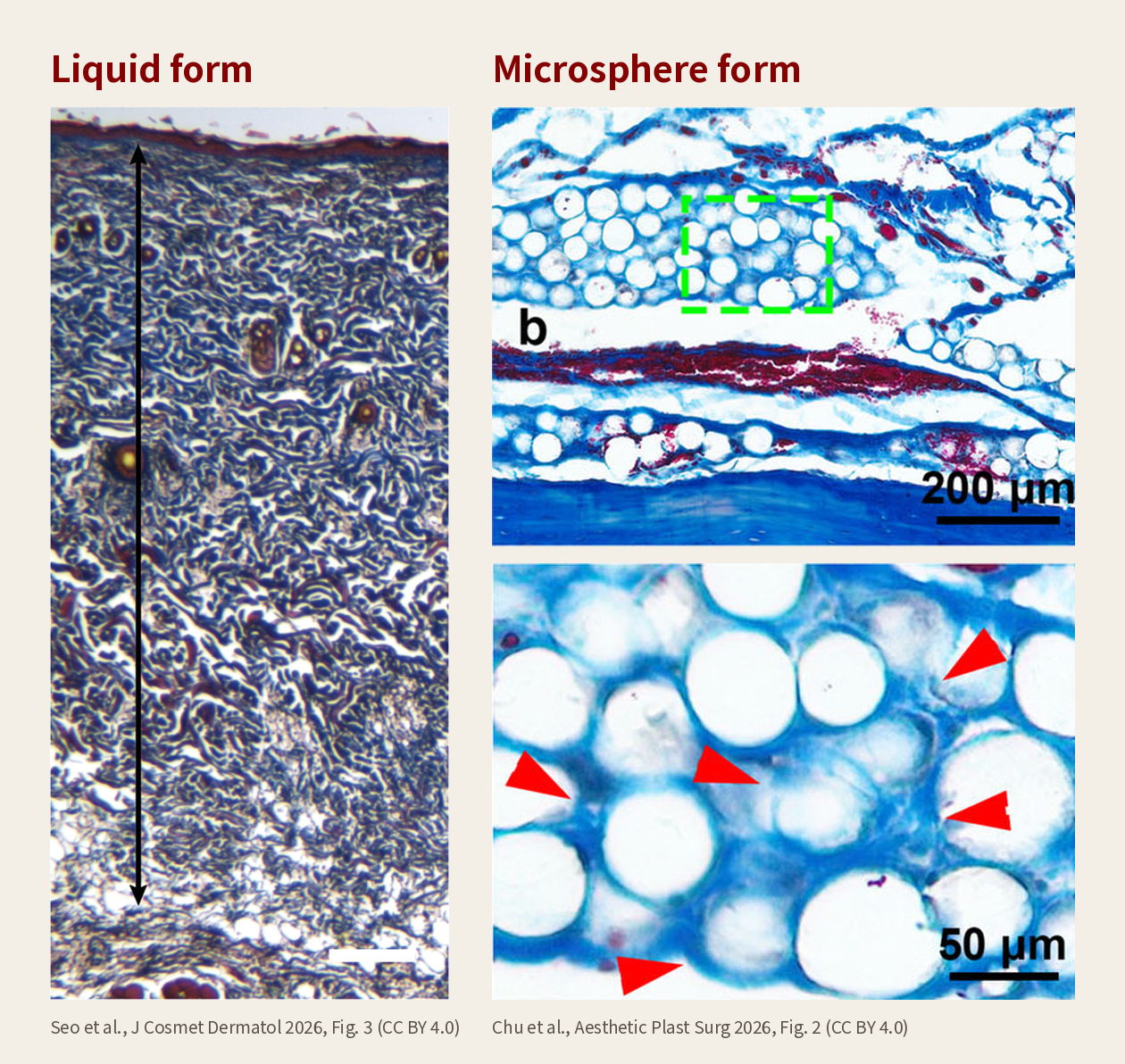
Left: dermis from mouse skin with induced photoaging after liquid PCL (GOURI) injection. No round particles are visible, and collagen (blue) appears throughout the dermis. The black arrow marks dermal thickness (Seo et al., J Cosmet Dermatol 2026, part of Figure 3). Right: tissue 4 months after a different microsphere PCL filler (not Ellansé itself) was placed over the periosteum of a rat skull. The round empty spaces are PCL microspheres, and the red arrowheads point to the collagen fibers around them (Chu et al., Aesthetic Plast Surg 2026, part of Figure 2). Both images use Masson's trichrome staining and are published under CC BY 4.0. These are separate animal studies with different sites, durations and magnifications, so they can't be used to compare results. Treat them only as a look at how PCL settles in each formulation.
💡 Put simply - The liquid form is like watering a whole field evenly. Microspheres are more like driving a stake into one spot and packing the ground around it. One works broadly, the other pinpoints.
It refers to how much data has piled up so far, not to how well it works. Liquid PCL is a relatively recent formulation, so fewer standardized comparison studies exist for it than for the older microsphere form or for other stimulators like PLLA and CaHA.
There's something I should say plainly here. PCL as a whole category still has less clinical data than other collagen stimulators such as Sculptra (PLLA) or Radiesse (CaHA). Recent reviews in regenerative medicine point this out as well. So it's more accurate to say that PCL is a newer material whose evidence is still building than to say liquid PCL alone is weak.
One more point. Studies that put liquid and microsphere PCL head to head are rare. Turn that around and it means there's also no evidence yet to say for certain that one is better. That gap seems to be where the impression that "liquid is weaker" came from.
⚠️ Worth knowing - "There are few comparison studies" and "it works less well" are two very different statements. The first means the question hasn't been answered yet. The second means it has been answered, and the answer was disappointing. Right now we're clearly in the first situation.
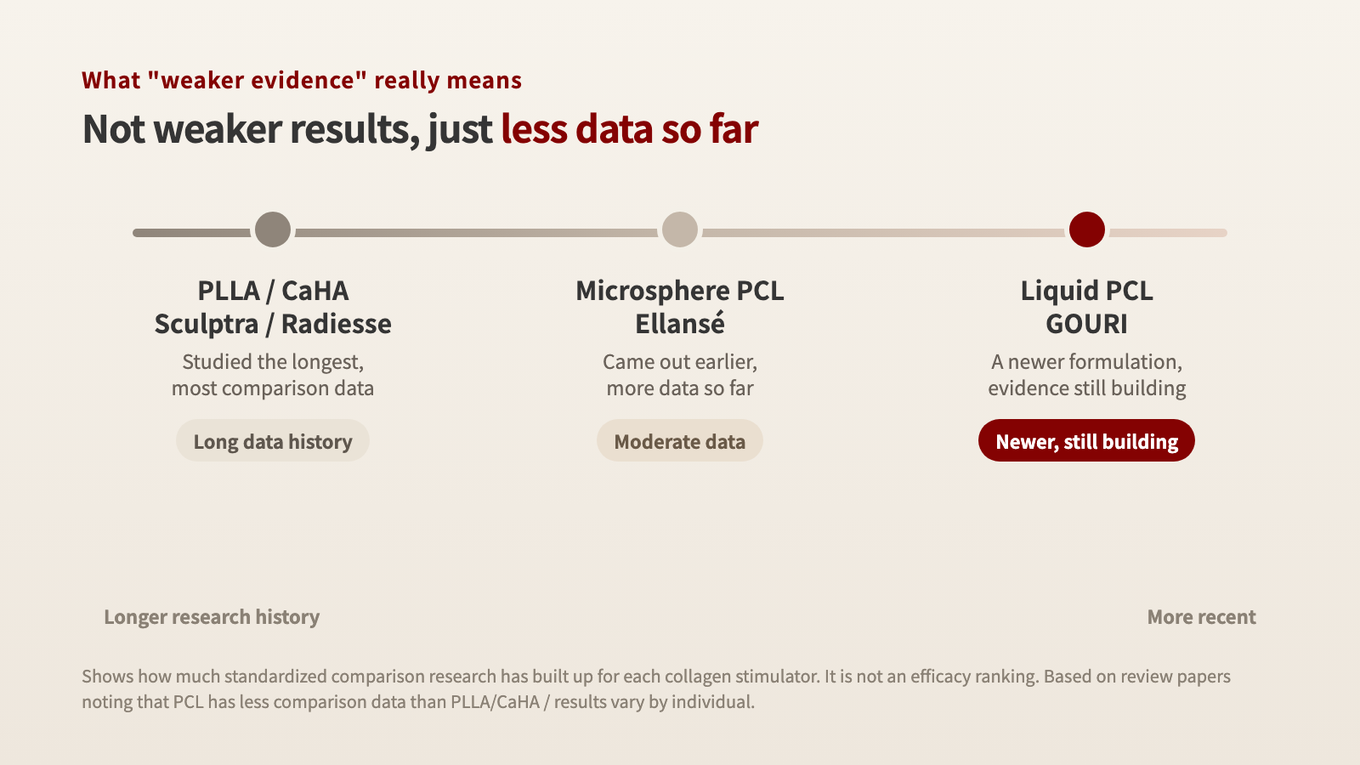
"Weaker evidence" means fewer standardized comparison studies so far, not lower efficacy. This shows how much data has built up for each collagen stimulator. It is not an efficacy ranking.
Yes, there is published evidence. In a study I co-authored, published this year in the international Journal of Cosmetic Dermatology, injecting liquid PCL significantly increased dermal thickness and type I collagen (animal model, p<0.001).
Here's what that looked like in more detail. In mouse skin where photoaging had been induced with UV light, liquid PCL brought the thinned dermis back close to normal thickness, and collagen density rose clearly. Type I collagen gene expression recovered to several times the level of the untreated group. No inflammation, foreign body reaction or granulomas were seen in the mice during the observation period. In other words, the mouse data showed the tissue itself being rebuilt rather than a space simply being filled. These are mouse results, though; in people, swelling or bruising can occur after treatment, and nodules or granulomas are rare but possible.
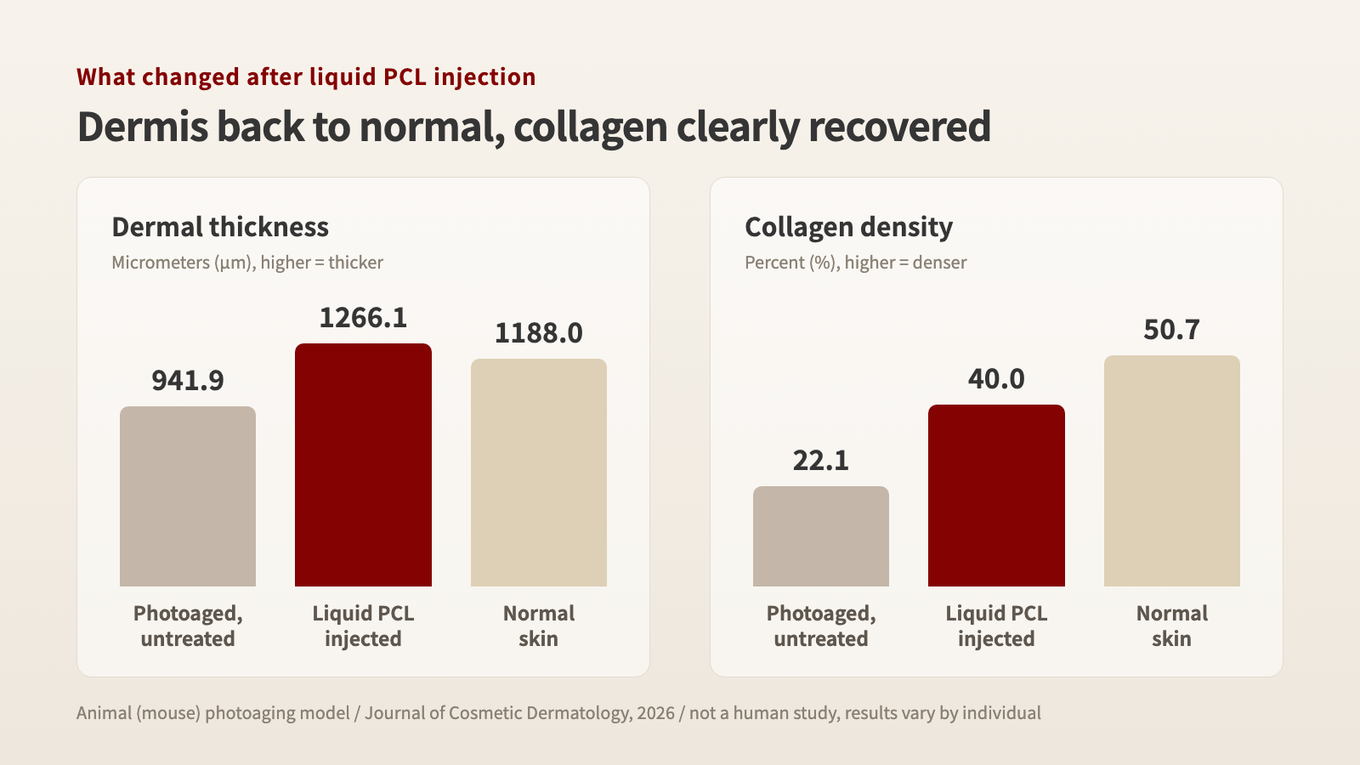
Recovery of dermal thickness and collagen density after liquid PCL injection in an animal (mouse) study (Journal of Cosmetic Dermatology, 2026). This is preclinical data, not a human study, and real-world results vary from person to person.
That said, this was an animal study, not a human clinical trial, and it didn't compare liquid and microsphere PCL directly. The paper states those limits itself. So it can't be used to claim that "liquid is better than microspheres" either. Here's the one thing I want you to take away: liquid PCL has evidence from animal research pointing toward rebuilding tissue, and that evidence is still growing. How much new collagen forms depends heavily on the product, the area treated and the individual, so results differ from person to person.
If you'd like a closer look at the dermal regeneration data for liquid PCL, I've broken it down in our summary of the GOURI (liquid PCL) dermal thickness study, and you can read the original paper in the Journal of Cosmetic Dermatology.
It comes down to whether your main concern is volume that needs filling now, or the texture and firmness of your skin overall. If one area has hollowed out and you want to restore its shape, microspheres are the closer match. If you want better texture and firmness across the whole face, liquid PCL is.
From what I see in clinic, these two do different jobs. For firming a broad surface like the cheeks with a thin, even layer, a liquid that spreads through the dermis is the natural fit. For building up lost volume in one specific spot, microspheres that stay where they're placed have the edge. For reference, our clinic in Myeongdong, Seoul works with liquid PCL (GOURI).
| Liquid PCL (GOURI) may suit you if you... | Microsphere PCL (Ellansé) may suit you if you... |
|---|---|
| want better texture and firmness across the face | want to restore lost volume or contour in one area |
| want a broad area firmed thinly and evenly | want to build up one spot in a focused way |
| prefer gradual change over instant volume | also want some volume right away |
| mainly worry about texture, tone or dermal density | mainly worry about contour and definition |
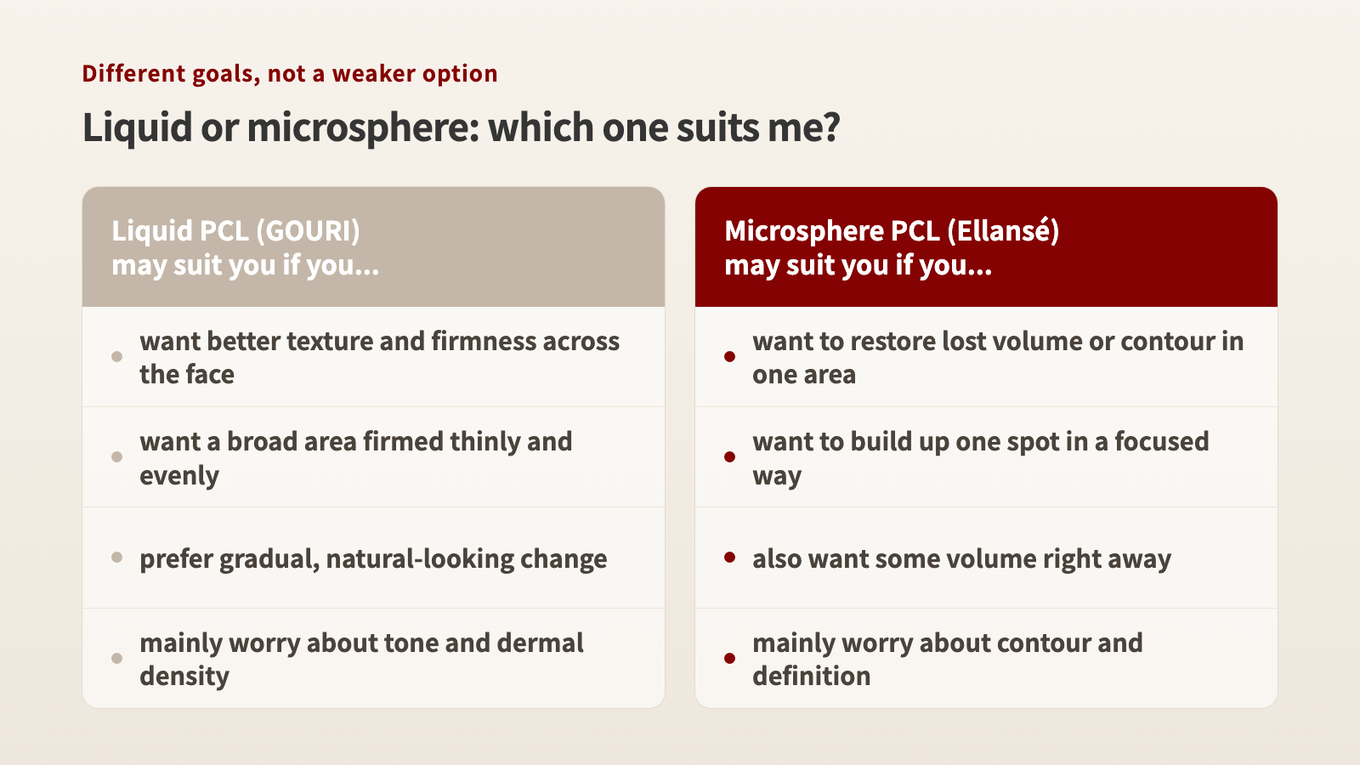
It comes down to one question: is this about skin texture over a wide area, or volume in one spot?
Two things to remember. Like other PCL products, it can't be dissolved with an enzyme the way filler can. And because the liquid form adds almost no volume at first, you may be disappointed if you expect a dramatic change in one session.
Start with reversibility. If something goes wrong with hyaluronic acid filler, it can be dissolved fairly quickly with an enzyme called hyaluronidase. Collagen stimulators such as PCL, PLLA and CaHA don't respond to that enzyme. If there's lumping or too much product, the approach is to manage it over time. Since it's hard to undo, careful planning of where and how much to inject matters even more at the start.
Next, expectations. The liquid form adds almost no volume at the time of injection. Collagen takes time to build, so when you look in the mirror right after treatment you may think "not much has changed." That's simply how it works: collagen takes weeks to build. On the flip side, "more is better" is also a misconception. Over-stimulating the skin doesn't produce proportionally more collagen, so I'd rather split treatment into stages and watch how your skin responds than put it all in at once.
Liquid or microsphere, the goal is skin that looks natural, not overdone.
They're aimed at different things. The liquid form is aimed at texture and firmness over a wide area; microspheres are aimed at volume and contour in one spot. When people say "liquid is weaker," they usually mean there are fewer comparison studies so far. Head-to-head studies are rare, so there's also no evidence yet to say for certain which one is better.
There's almost no immediate volume at the time of injection. Instead, firmness and density build up gradually as collagen forms. If your goal is clearly defined volume in one specific area, the liquid form on its own may fall short.
They can't be dissolved with an enzyme the way hyaluronic acid filler can. PCL, PLLA and CaHA products don't respond to hyaluronidase, so any problem is managed over time. That's why choosing the right indication and amount carefully from the start matters.
Some people combine them by splitting the work by area and goal: the liquid form for a broad area that has thinned out, and a volumizing approach for a clearly sunken spot. That describes the general approach; at our clinic in Myeongdong, we offer liquid PCL (GOURI). Whatever you choose, it's usually safer to space treatments out and decide the next step after seeing how your skin responds than to do everything in one go.
The dermal thickness and collagen study mentioned above is preclinical data from an animal (mouse) model. It shows the direction of the effect (tissue regeneration); it doesn't mean the same numbers will appear in people. Human data is still being gathered.
Liquid PCL and microsphere PCL aren't a question of better or worse. They use the same material, PCL, but they're different formulations: the liquid form spreads evenly through the dermis to target texture and firmness, and the microsphere form settles in one spot to target volume and contour.
And the "weaker evidence" claim, looked at closely, turns out to mean that the data hasn't built up yet. Liquid PCL does have evidence from animal research pointing toward rebuilding tissue, and more is coming in.
At our Myeongdong clinic, we approach GOURI (liquid PCL) the same way. First we decide whether this is an area to firm broadly or a spot to build up, and then we choose the approach that fits the result and area you want. Because these products are hard to reverse, judge them by whether they fit your goal, not by which one sounds stronger. That one question is enough.
#LiquidPCL #GOURI #MicrospherePCL #Ellanse #CollagenBooster #CollagenStimulator #Polycaprolactone #CollagenRegeneration #SkinTightening #KoreaDermatology #ForeverClinicMyeongdong