

Blog
Expert tips for healthy skin
Expert tips for healthy skin
In the last post, I split summer pores into two tracks: the sebum track, where oil fills the opening, and the elasticity track, where the walls give way. And I wrote that for the sagging type, we look at rebuilding dermal collagen.
That prompted a question in the consultation room.
"Doctor, that RF microneedling that supposedly rebuilds the dermis. Does it actually work? Is there any evidence?"
A fair question. Pore treatments aren't a one-and-done, and they aren't cheap. A decision like that calls for evidence, not a pretty explanation. So today I'll dig into the research and tell you plainly what the data on RF microneedling and pores actually shows.
Key Takeaways
- RF microneedling works by reorganizing dermal collagen to support sagging pore walls from the inside, which in turn makes pores less noticeable.
- A 2026 systematic review (pooling 20 studies) consistently reported improved skin texture, tightening, and high satisfaction.
- A study looking at pores specifically also found pore scores dropped by a statistically significant margin after three sessions.
- That said, pain is moderate, reactions like swelling and redness occur, and it takes sessions and time. This is not a one-and-done treatment.
- "The evidence is good" and "it's the right fit for me" are two different things. Keeping those two apart is the whole point of today.
A word on the phrasing. People often say a treatment "tightens" pores, but what RF microneedling does is a little different.
RF microneedling inserts very fine needles down to the dermis, and from the needle tips it delivers radiofrequency (RF) heat into the dermis. When that heat gives collagen a subtle stimulus, the skin repairs the spot and begins reorganizing collagen and elastic fibers. This is where the "supporting sagging pore walls from the inside" I mentioned last time actually happens.
So it isn't physically cinching the opening shut. When the dermis that props up the walls grows dense again, the pore that had drooped downward stands back up and reads as less prominent. The support underneath is what changes.
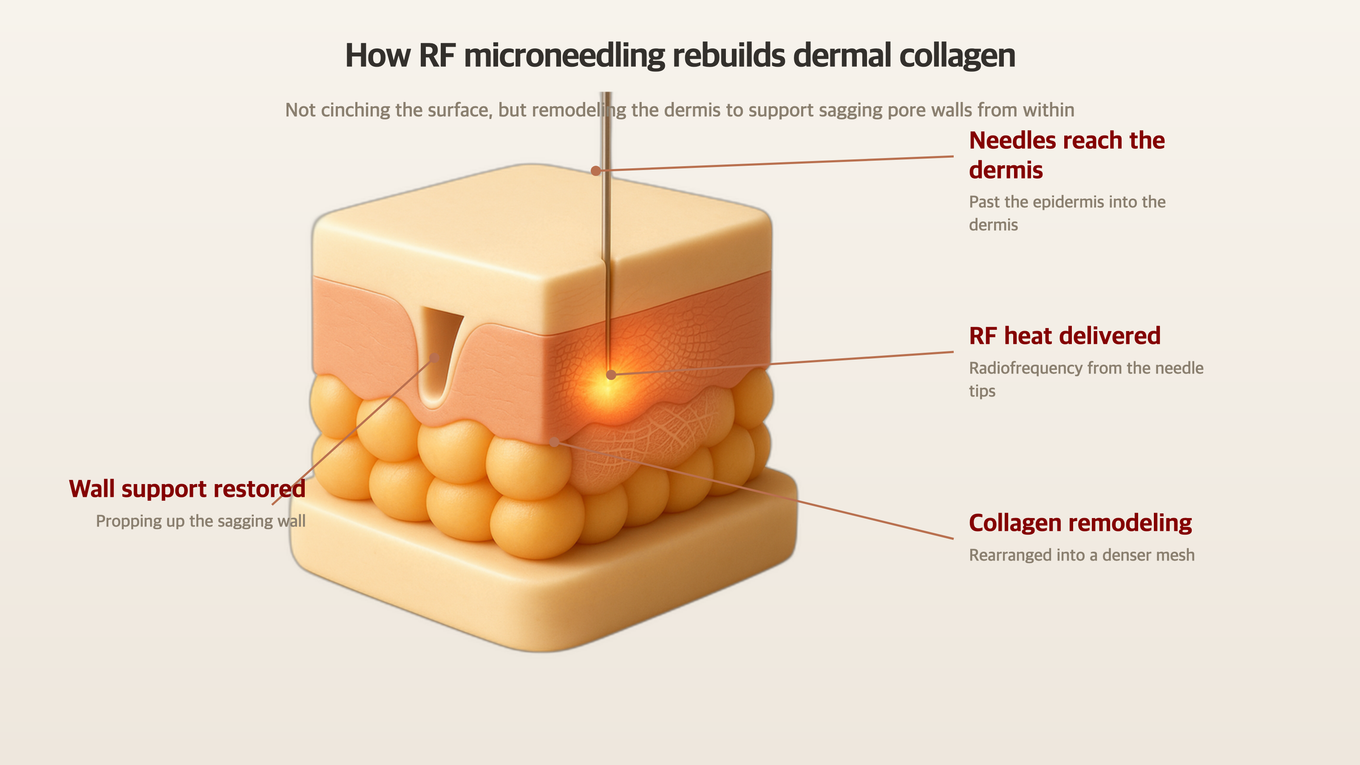
RF microneedling rebuilds dermal collagen to support sagging pore walls from the inside.
I unpacked this mechanism in detail last time. If the split between the sebum track and the elasticity track feels fuzzy, read Why Do Pores Look Bigger in Summer first and today's post will connect more smoothly. And if the idea of rebuilding dermal collagen is new to you, How Collagen Boosters Rebuild the Dermal Collagen Environment is a helpful companion.
Short answer: yes, there's real data, and it leans one way. Across the studies, RF microneedling improved skin texture and pore appearance.
This is where today's real topic begins. A plausible mechanism is one thing; a body of accumulated data is another.
In 2026, a systematic review of the facial benefits of radiofrequency microneedling (RFMN) was published in the Journal of Cosmetic Dermatology. It's a comprehensive review that gathered scattered individual studies into one place and evaluated them. In short:
You can check the original on PubMed (Kumar N, et al. J Cosmet Dermatol. 2026).
But that review looks at "overall facial outcomes," so you might want something aimed squarely at pores. So I brought one more study that looked at pores alone.
A team at a university hospital in Nanjing, China (the dermatology hospital of the Chinese Academy of Medical Sciences) treated 22 patients with enlarged cheek pores with three sessions of RF microneedling and looked at the results (Lasers Med Sci. 2024). Two dermatologists scored the photos independently and blinded. Pore scores dropped significantly, from an average of 3.55 before treatment to 2.59 after three sessions (P<0.05). That's a difference hard to write off as chance.
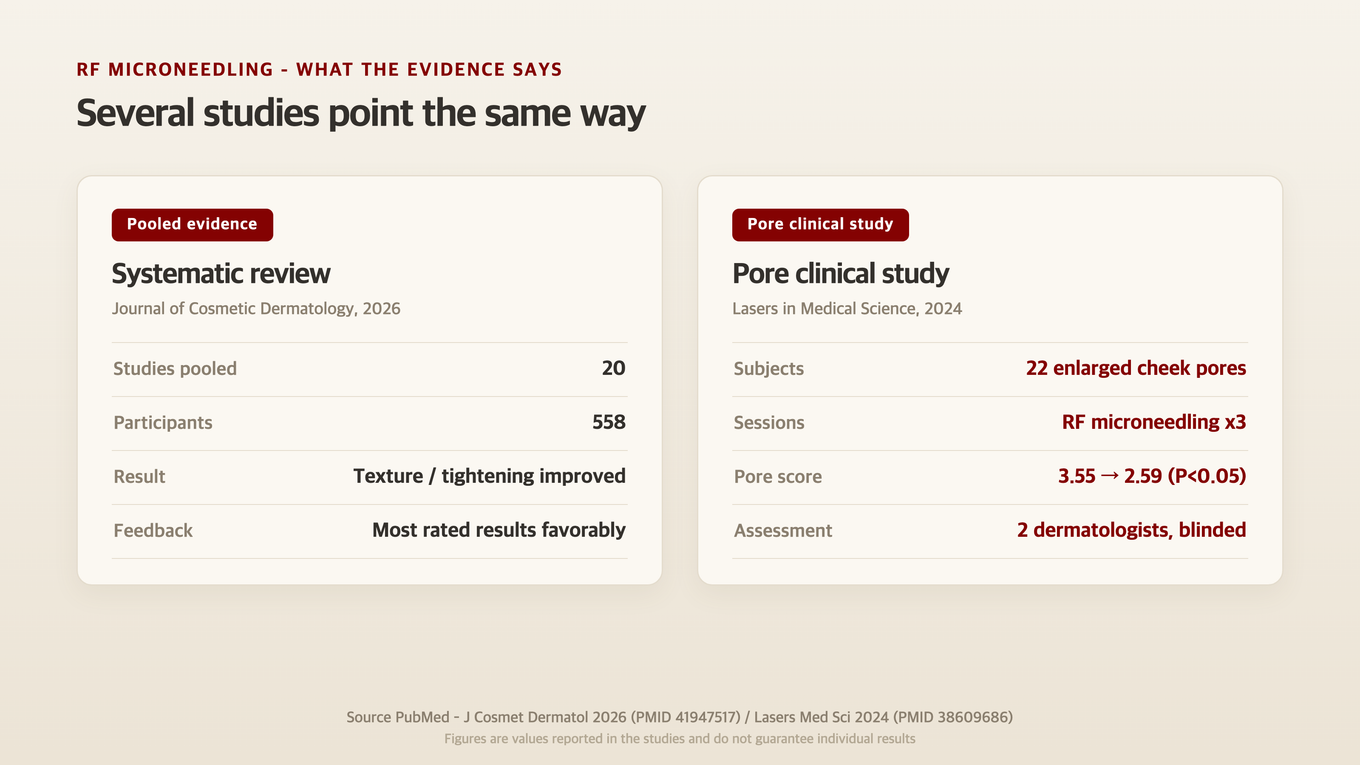
The weight of the evidence at a glance - a systematic review pooling many studies and a clinical study looking at pores directly point the same way.
Put the two lines of evidence in one sentence and it comes out like this.
| Study | Scale | Key result | Source |
|---|---|---|---|
| Systematic review | 20 studies / 558 people | Texture/tightening improved, most participants rated results favorably (study participants) | J Cosmet Dermatol 2026 |
| Pore clinical study | 22 people / 3 sessions | Pore score 3.55 → 2.59 (P<0.05) | Lasers Med Sci 2024 |
The two studies differ in scale and method, but they point the same way: stimulate the dermis with RF microneedles and pores tend to improve. It isn't mechanism alone; the data stands behind the mechanism. That's what I wanted to get across today.
Let me pause here for a beat. Solid evidence and "this is right for my pores now" are two separate questions.
Back to the two tracks from last time. The evidence for RF microneedling is aimed squarely at the dermal elasticity track. So it applies most to people like this:
At our clinic in Myeongdong, Seoul, we use RF microneedling devices like Potenza and Sylfirm X for this dermal elasticity track. The core principle is the same; the way the needles and radiofrequency are delivered differs a little. So it's less about which one is "better" and more about choosing based on your own skin - whether pores are the main concern, or pigmentation and redness overlap too.
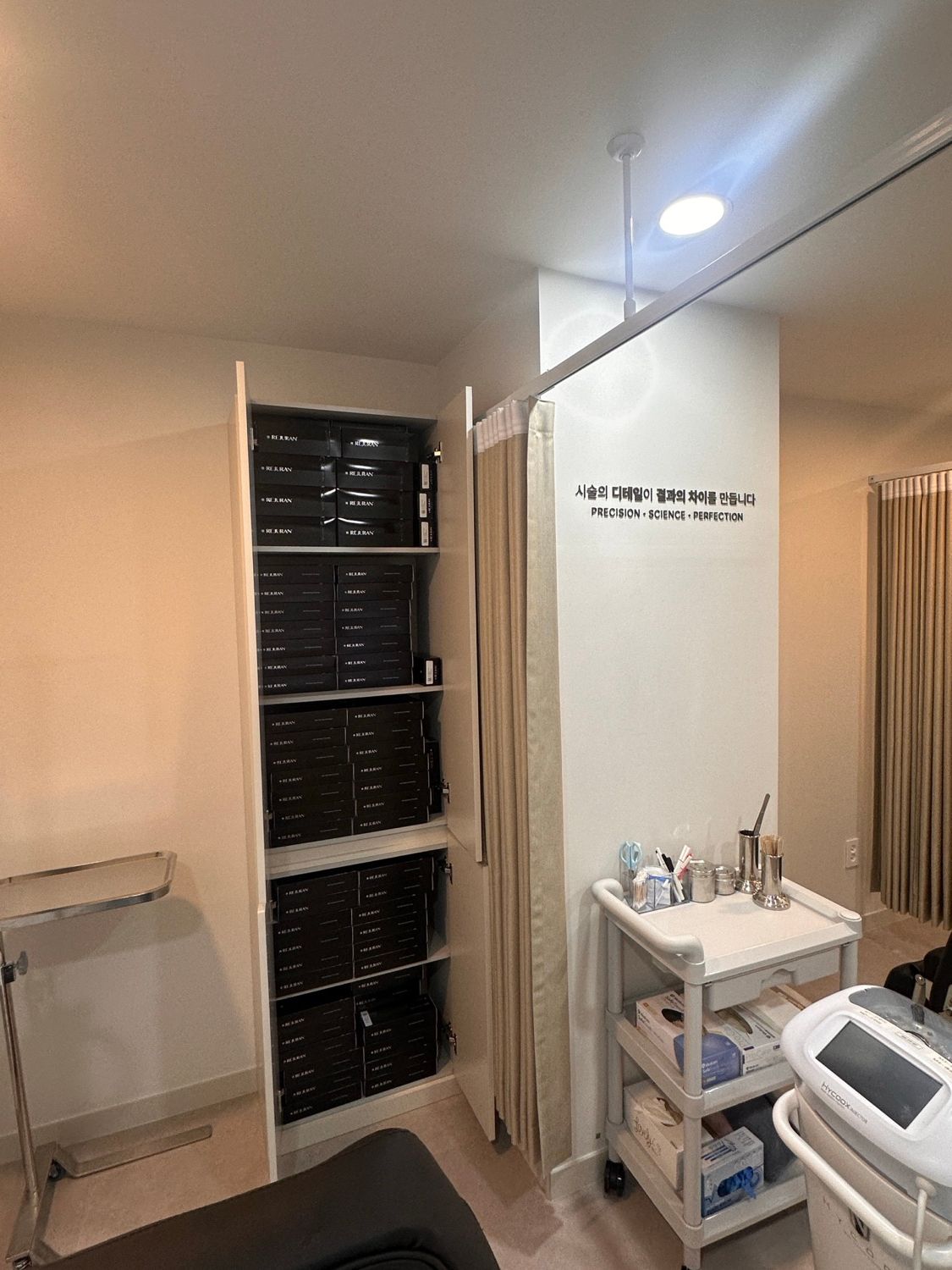
Weighing the evidence means looking not only at the research but at the device, genuine supplies, and hygiene too. At our Myeongdong clinic, we use a new genuine tip for RF microneedling.
A word on genuine supplies. RF microneedling uses a tip (needle cartridge) in direct contact with the skin, so whether the tip is new and genuine ties directly to hygiene. At Forever Clinic in Myeongdong, Seoul, we use a new genuine tip for every treatment. Reactions like swelling or marks vary from person to person, so results can differ with your skin condition.
That favorable-rating point, the one I said I'd revisit. Here it is. Reading the evidence honestly is the real purpose of today's post.
"Most participants were satisfied" does not mean you, too, are guaranteed to be. That's the response of the people who were in the studies. Their treatment conditions, skin, and goals all differed. So the honest way to read it is "this treatment isn't meaningless," roughly that much weight. Read it as a guarantee of your own outcome, and it's more likely to disappoint.
Pain and reactions are real. In the pore study above, the pain score (0-10) averaged about 6.4. People call it bearable, but that means it isn't "painless." Redness or slight swelling after treatment are common reactions too. They usually settle within a few days, but it depends on your skin, and marks can rarely remain, so a pre-check matters.
It takes time and sessions. The pore study also split treatment into three sessions. Collagen takes time to rebuild, so rather than dramatically cinching in one go, it tends to settle gradually over a cycle. Approaching it as a plan over several months, rather than expecting "one shot," eases the impatience.
The studies have limits too. The pores-only study was a retrospective study of 22 people, looking at before-and-after without a control group. The review is large but bundles studies with different devices and conditions, so results span a range. So "there is evidence" doesn't mean "it's guaranteed to work" - the honest reading is that the direction is supported.
Truly knowing the evidence means taking its limits and its recovery just as seriously as its promise.
Less "erasing the structural size itself" and more "the prominence fading." Studies report skin texture and pore scores improving, but individual variation is large and it takes sessions. Set your expectations at "make them less noticeable" rather than "make them disappear," and the direction fits.
The pore study spaced out three sessions. Collagen needs time to resettle, so it's often done across several sessions rather than just one. The exact number depends on your skin condition and goals.
In the study above, the pain score averaged about 6.4 out of 10. It's on the bearable side, but it isn't painless. In practice we ease the discomfort with methods like topical numbing cream. Pain sensitivity varies from person to person, so it's best to discuss it beforehand.
Both are in the family that uses micro-needles to deliver RF heat into the dermis and stimulate the collagen environment. The core principle is the same; the way the needles and radiofrequency are delivered, and their strengths, differ a little. So rather than "which is better," it's better to choose by your skin condition and goal (mainly pores, or pigmentation and redness overlapping).
If you were wondering about the evidence before a pore treatment, two things today are enough.
One. RF microneedling works by rebuilding dermal collagen to support sagging pore walls from the inside. And this direction is backed by both a review pooling 20 studies and a clinical study that looked at pores directly.
Two. "There is evidence" is not "it's guaranteed to work." The favorable ratings belong to the study participants, there's pain and reaction, and it takes sessions and time. Knowing the evidence means taking its limits just as seriously.
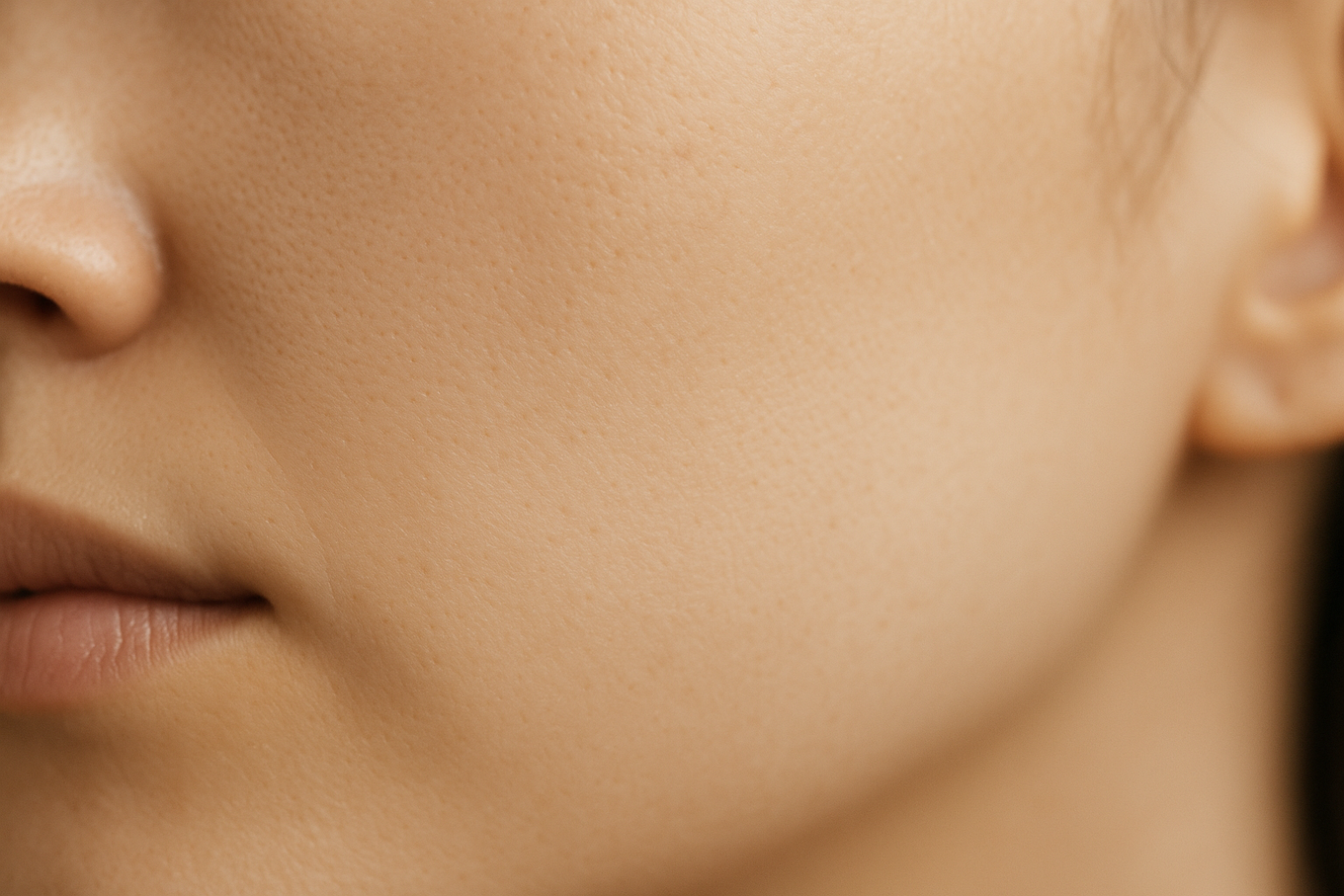
When the dermis supports it again, a pore that had drooped reads as less prominent. The goal is less "erase" and more "less noticeable."
So make the decision in this order. First check whether your pores are on the dermal elasticity track; if they are, see how the evidence supports that direction; then weigh the real-world side - pain, sessions - on the same scale. Evidence won't build your certainty for you. But it does give you the material to build that certainty yourself.
#Pores #PoreTreatment #RFMicroneedling #Radiofrequency #Potenza #SylfirmX #DermalCollagen #PoreEvidence #MyeongdongDermatology #ForeverClinic