

Blog
Expert tips for healthy skin
Expert tips for healthy skin
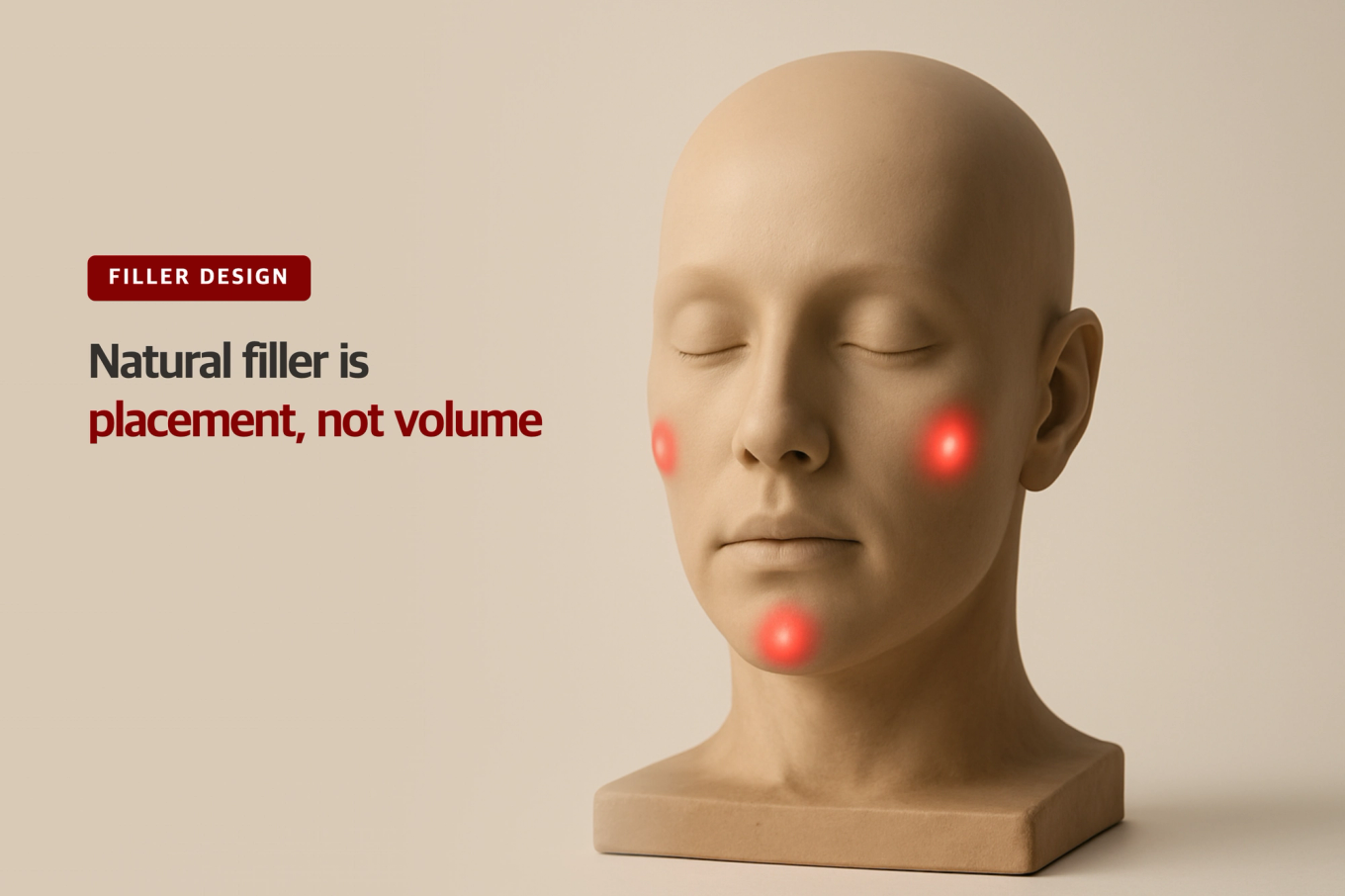
"Won't my face look puffy if I get too much filler?"
This is a common worry we hear at our clinic in Myeongdong, Seoul. People often picture celebrities whose faces look swollen or cheeks that bunch up awkwardly when they smile. Consequently, many request "just a little, please" from the outset.
We hear this concern a lot in consultations. However, what makes fillers look natural isn't the amount but the design. Even the same 1cc can yield drastically different outcomes depending on where, in which layer, and in what direction it's applied. More often than not, a swollen appearance stems from misplaced or misdirected fillers rather than an excess volume.
Today, let's shift the focus from "how much filler" to "how is it designed?" This isn't about advocating for specific products, but rather understanding how natural aesthetics are achieved through facial anatomy.
Key Takeaways
- Unnatural-looking fillers often result from misaligned placement/layer/direction rather than quantity.
- Even for the same area, the results change based on whether it's applied to the dermis / subcutaneous fat / above the bone.
- Volume vectors - the direction in which the tissue is lifted and supported, shape the contour.
- The face has support points that, when accurately targeted, can achieve a lifting effect with minimal filler.
- It's not about 'more', but 'in the right place' - that's the essence of discreet filler.
Let's clear up a misunderstanding first. The reason fillers can be noticeable isn't solely because of excessive volume.
Of course, too much can be problematic. But when we examine faces that appear "swollen" or "bunched when smiling," it's often due to fillers being placed in the wrong position or layer. Something that should have been placed superficially went too deep, or volume was added in the wrong spot, not a supportive point.
"So, isn't using less always more natural?"
Not necessarily. If the necessary support points aren't enhanced, even minimal filler can leave you looking saggy or awkward. What matters is not the sheer amount but whether the right amount lands in the right spot.
💡 Think of it this way - fillers aren't about pouring paint over your face; it's more like pitching a tent again. You can't just throw more fabric on a collapsing tent; it's about where you place the poles.
While fillers immediately add volume and support, they operate differently from collagen boosters that stimulate your skin to produce collagen. Today's discussion is about where the natural look is won or lost within 'filling' fillers.
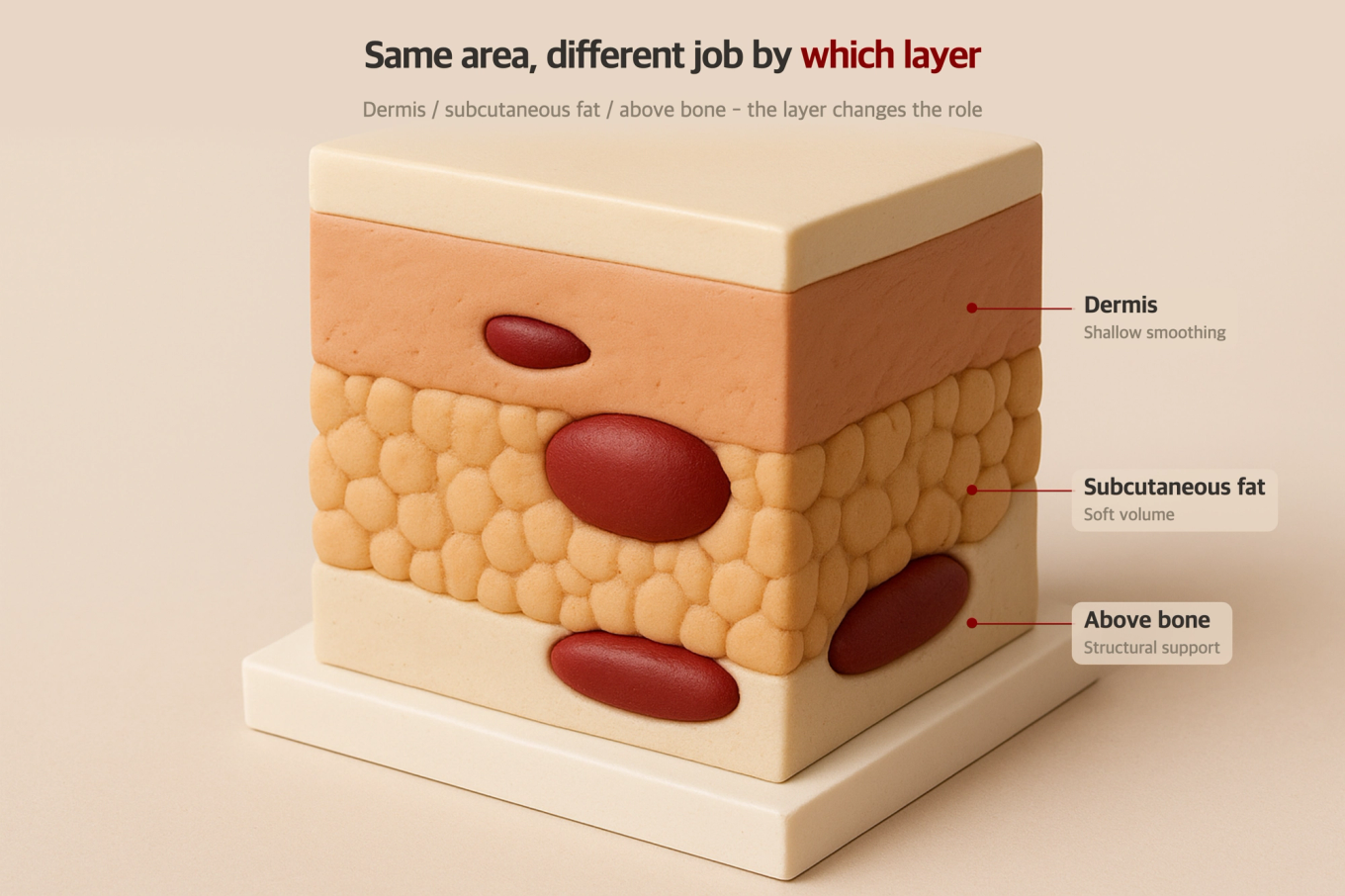
Fillers don't just sit as a single layer on the skin's surface. The skin has layers, and what you do depends entirely on which layer you apply to. Let's break it down into three main layers.
The key is, if deep support is placed too superficially, the surface looks swollen, and if something meant to be superficial is placed too deep, the desired contour doesn't form. So, even for the same area, "which layer" is a primary consideration.
⚠️ Note - Designing by layers isn't just about depth; it involves choosing the appropriate filler consistency (hard or soft) for each layer. That's why the approach varies for each area.
This is the second axis that defines naturalness. Fillers not only add volume to a spot but also consider which direction to lift and support the surrounding tissue. This is called the volume vector.
While the term may sound complex, it's quite practical in treatment. For instance, when filler is applied to the cheekbone, it doesn't just make that spot protrude; it also subtly lifts the sagging cheek tissue above. Depending on where and at what angle volume is applied, the lifting direction varies.
"Why did my nasolabial folds seem lessened after cheek fillers?"
The same principle applies. While nasolabial fold fillers might seem to involve directly filling the line, it's often more effective to add volume to the upper support area, which lifts the sagging tissue and softens the fold. Directly filling the fold vs. supporting it from above are different approaches, with the latter generally looking more natural.
💡 An easy analogy - It's like when curtains sag; instead of adding fabric to the sagging part, you lift the rod and re-hang them. Vector design is akin to the latter.
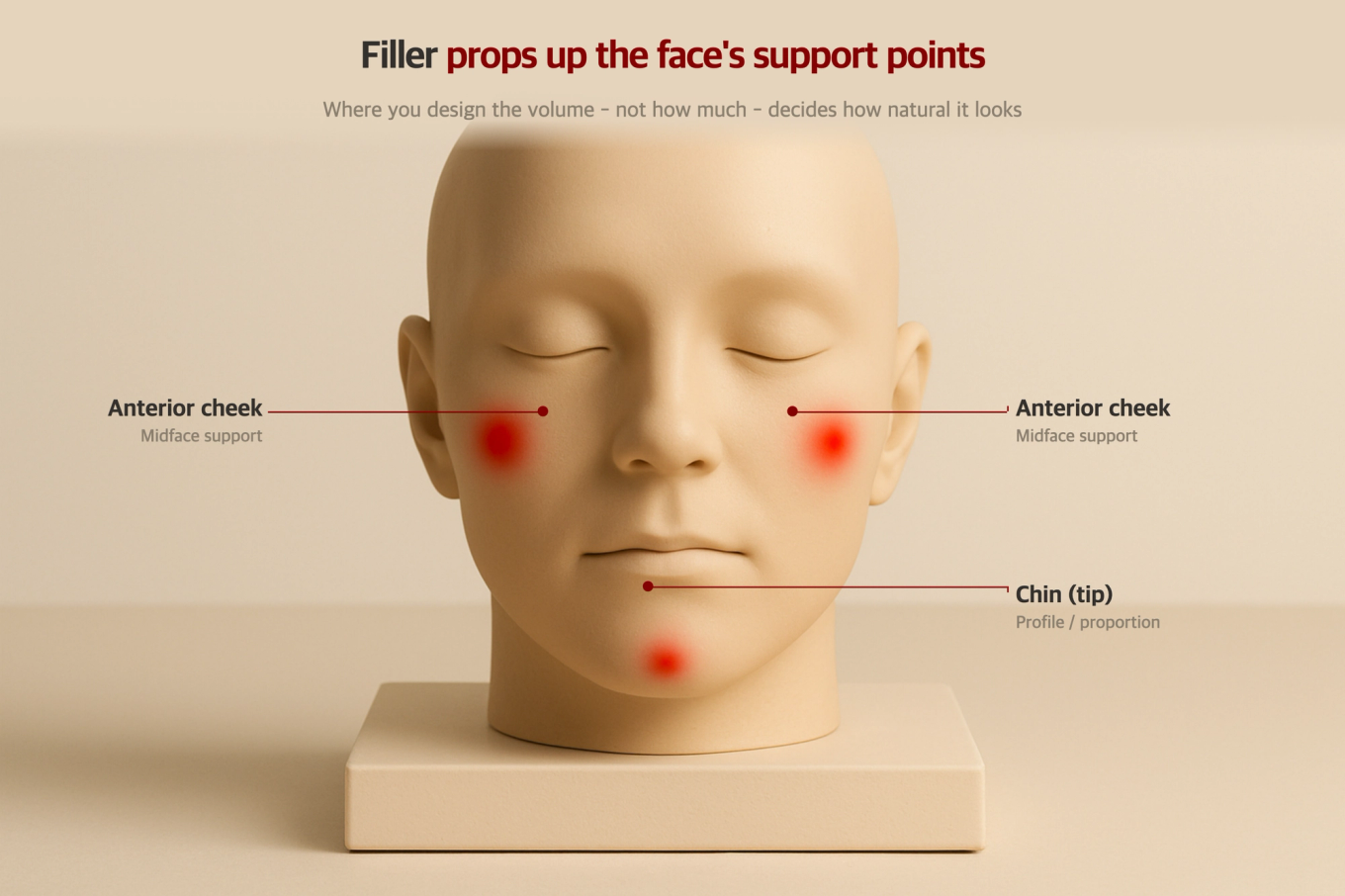
Facial volume isn't uniformly distributed everywhere. Fat is divided into compartments, with key support points that hold the face up.
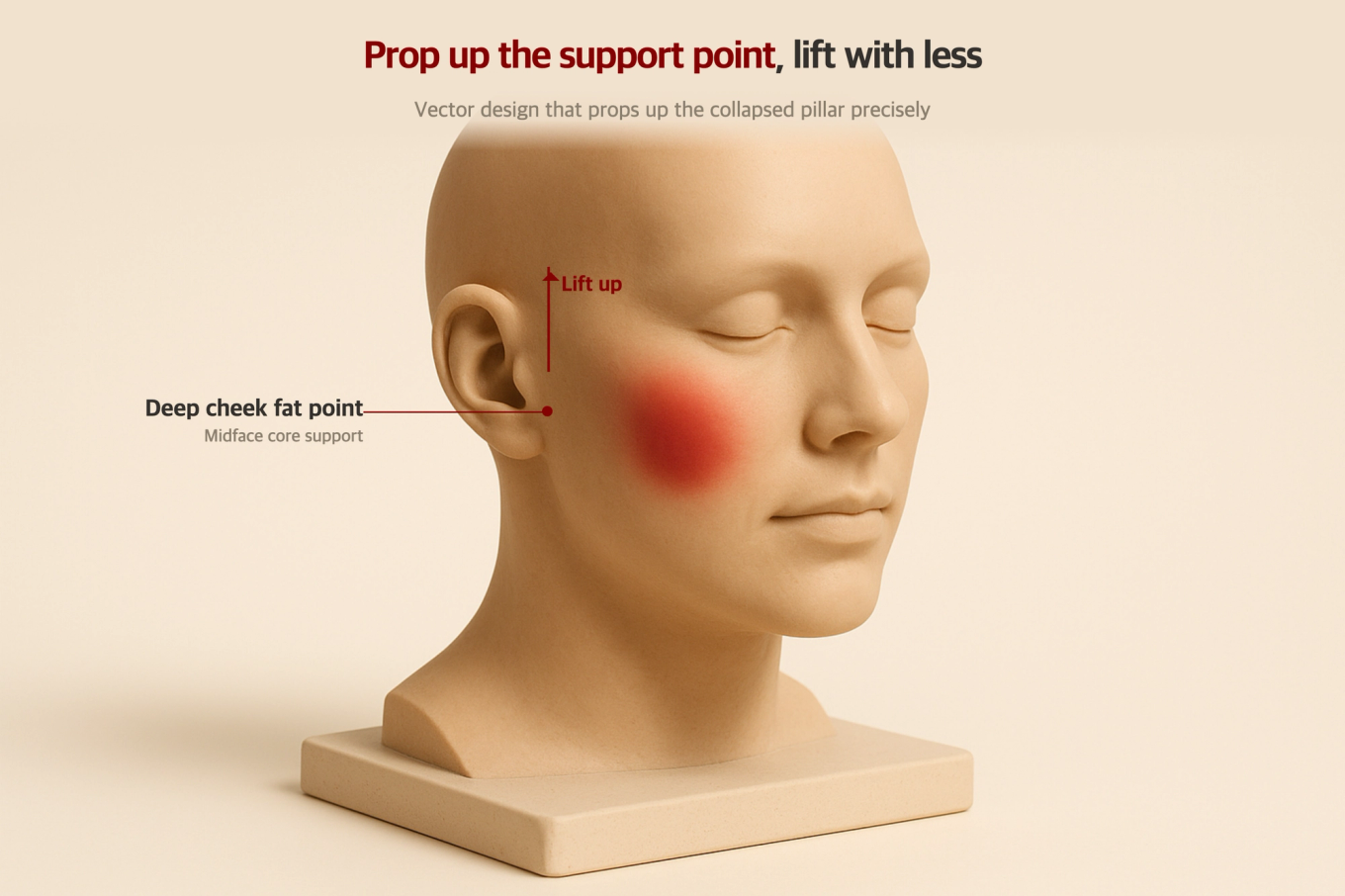
A primary example is the deep medial cheek fat. As we age, these supportive fats decrease and sag, leading to hollow cheeks, deepening nasolabial folds, and an overall saggy appearance. Filler design is about selecting these diminished support points to reinforce.
Targeting support points precisely offers a significant advantage. You can achieve a lifting effect with less filler. Broadly filling sagging areas requires more volume, but accurately propping up the collapsed columns subtly lifts the entire face. When people notice "my face looks brighter without much filler," it's often due to designs that enhance these support points. Even popular cheek fillers can look much more natural when approached from this midface support perspective.
Understanding the axes of layer, direction, and support point clarifies why approaches differ by area. Let's highlight a few examples.
| Area | Primary Layer | Design Focus |
|---|---|---|
| Cheekbones | Above bone - subcutaneous | Establish support to lift the midface |
| Chin (tip) | Above bone | Structural support for profile line and proportion |
| Nasolabial folds | Upper support area | Support from above rather than direct filling |
| Forehead | Above bone - subcutaneous | Gentle curve, avoid surface lumps |
| Lips | Dermis - mucosa | Delicate and subtle, avoid over-volume |
Even for the same face, the layer and direction vary by area, so instead of "how many cc for the whole face," it's more about why and how much for each specific area that leads to natural results.
⚠️ Note - This table summarizes general trends. In reality, facial structure, fat distribution, and sagging vary per individual, so the layer/direction/amount is personalized. Even with the same design, results and perceptions can differ per person. It's challenging to apply a one-size-fits-all approach in filler design.
Knowing the principles can clarify concerns and judgments. Here are frequent points discussed in consultations.
In summary, the naturalness of fillers comes from 'how it's designed in terms of placement, layer, and direction,' not 'how much is used.' When considering fillers, it's less about the amount and more about understanding "which support points on my face, and why they're being reinforced." If you're considering fillers for the first time, I recommend exploring fillers from a perspective of area-specific design.
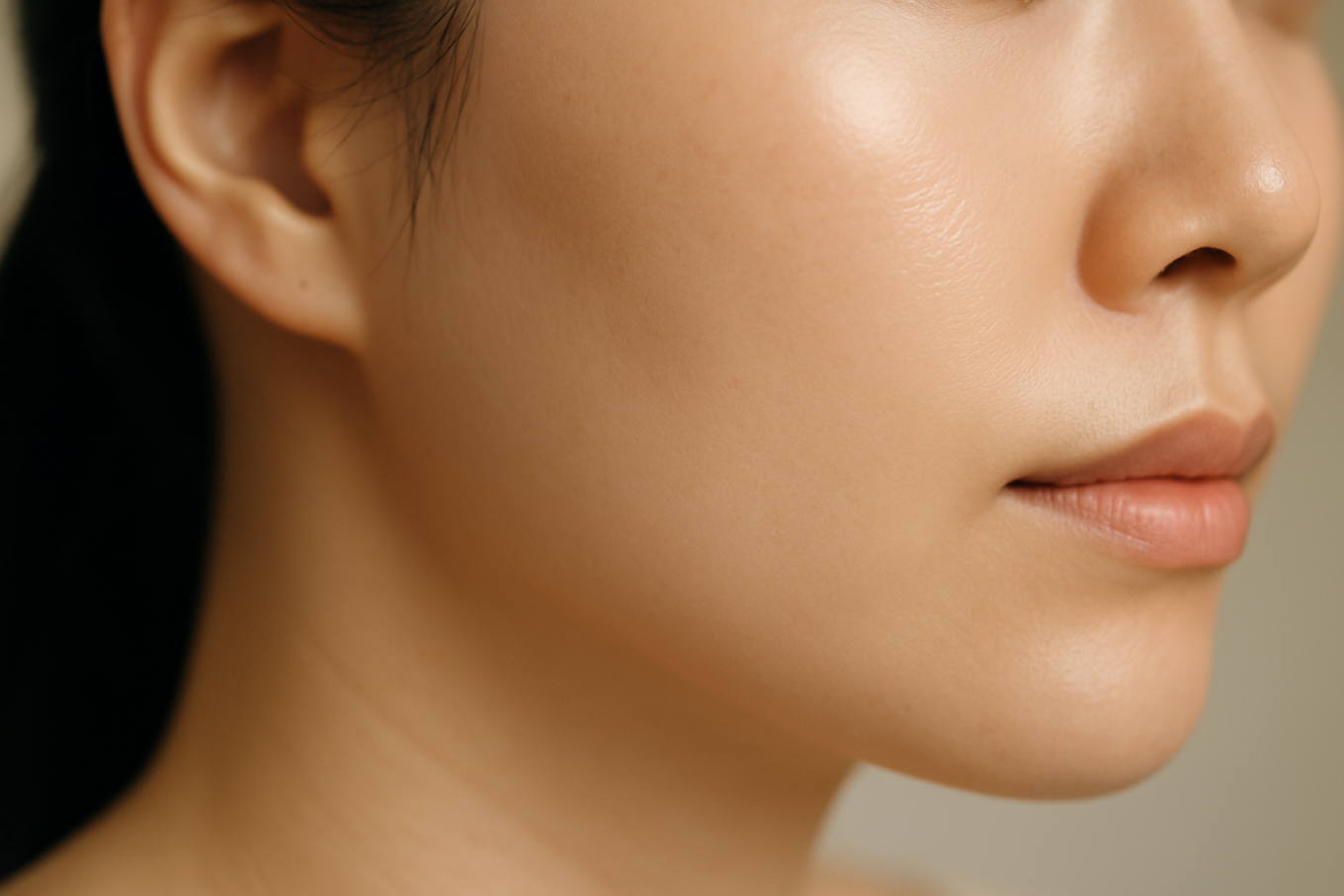
While more filler can increase risk, puffiness often stems from poor planning - like incorrect placement, depth, or angle. Even a small amount can look unnatural if not properly positioned.
It's all about individual differences in facial structure, fat distribution, and sagging. The amount, depth, and angle of filler placement need to be tailored to each person, so there's no one-size-fits-all solution.
This happens because the filler adds volume to the support structures above the nasolabial folds, lifting the sagging tissue. It's often more natural to support from above rather than directly filling the fold.
Yes, if you accurately target key support points, like the deep cheek fat pads, a subtle lift can be achieved with less filler. It's more about precision than quantity.
Not necessarily. Gradually building up the filler over multiple sessions can be more effective and reduce the risk of looking too puffy. It's best to plan based on individual needs.
The secret to natural-looking filler isn't about how much you use, but where, at what depth, and in what direction you place it. Whether it's 1cc or more, results differ based on whether it's injected into the dermis, subcutaneous layer, or above the bone, and whether it correctly supports weakened areas.
A puffy appearance usually results from poor design, not excess filler. Conversely, accurate support can brighten your appearance even with less product.
🩺 Doctor's Note - In consultations, many patients pre-emptively request "just a little, please," out of fear of looking puffy. In such cases, I focus on identifying which support points need attention. Natural results come from proper support, not just less filler. At our clinic in Myeongdong, Seoul, we focus on 'area-specific design' rather than 'cc numbers'.
When pondering filler, shift your question from "How many cc?" to "Which parts of my face need support, and why?" And you're already on the path to natural-looking results.
#Filler #FillerDesign #NaturalFiller #CheekFiller #FillerRisks #FillerLayers #FacialAnatomy #SeoulDermatology #ForeverClinic