

Blog
Informasi khusus untuk kesehatan kulit
Informasi khusus untuk kesehatan kulit
Through the summer, everyone was chasing glowing skin: glass skin, highlighter, glow serums, frequent exfoliation. Then the cold wind picks up, the heating goes on, and the same routine leaves your cheeks stinging and your makeup flaking.
The data shows "barrier" rising as a concern in reviews, too. In an analysis Korean beauty retailer CJ Olive Young released on September 29, 2026, review keywords for dermocosmetics centered on breakouts and acne in 2023-2024, then widened in 2025 to barrier, pores, sebum and refined texture, with "daily" showing up as well. Market research firm Mintel also named long-term skin health and barrier resilience as a core trend in its 2026 Asia-Pacific report (Mintel APAC Beauty and Personal Care Landscape 2026, reported August 2026).
Add the fact that summer glow routines start to sting at this time of year, and I read it as "barrier over glow." Glow is what you see when light comes back evenly from the skin's surface and from deeper inside, and that depends on two layers: the skin barrier and the dermis.
I think of "healthy skin" as two layers, because the phrase "barrier care" actually mixes two layers together. There's the stratum corneum, your skin's outermost layer and the barrier itself, which your daily products and habits look after, and the dermis, which creams can't reach, so treatments handle it. Split it that way, and what to do at home and what to do at a clinic sort themselves out.
The short version
- According to CJ Olive Young's September 2026 release, dermocosmetic review keywords moved from breakouts and acne to barrier, refined texture and "daily." Sales have grown an average of 24% a year since 2020, and Q1 2026 sales were 205% higher than in 2020.
- Skin that reads as glowing has high surface reflection and high reflection scattered back from within. When only surface reflection is high, it looks greasy.
- The light coming from within depends on collagen in the dermis. That's why brightening only the surface with oils or highlighter can only go so far.
- The skin barrier (under 0.1mm thick) is the job of moisturizing and habits; the dermis (1-2mm) is the job of treatments. Their timelines differ too: hours to weeks versus weeks to months.
- If your skin is red and stinging right now, calm it down first. If you've had a dermal treatment, go straight back to barrier care afterward.
Two things overlapped. Consumer data shows the focus moving from treating breakouts to protecting the barrier every day, and people feel their glow routine start to sting once cold wind and indoor heating arrive. Both point the same way: before adding more shine, people want skin that doesn't sting.
Start with the data. The CJ Olive Young release I mentioned has numbers attached. Dermocosmetic sales have grown an average of 24% a year since 2020, and Q1 2026 sales were up 205% compared with 2020. It's one retailer's data, so it can't speak for the whole market, but it shows fairly clearly what people are looking for.
The skin itself gives us reasons to talk about the barrier this season, too. A study in Seoul, run in January and February, kept participants indoors at 25°C with humidity below 20% for more than six hours. Facial redness and roughness rose significantly, and transepidermal water loss (TEWL) measured on the arm went up (20 people for the face, 12 for the arm, Skin Research and Technology 2023). Six hours is about one office day.
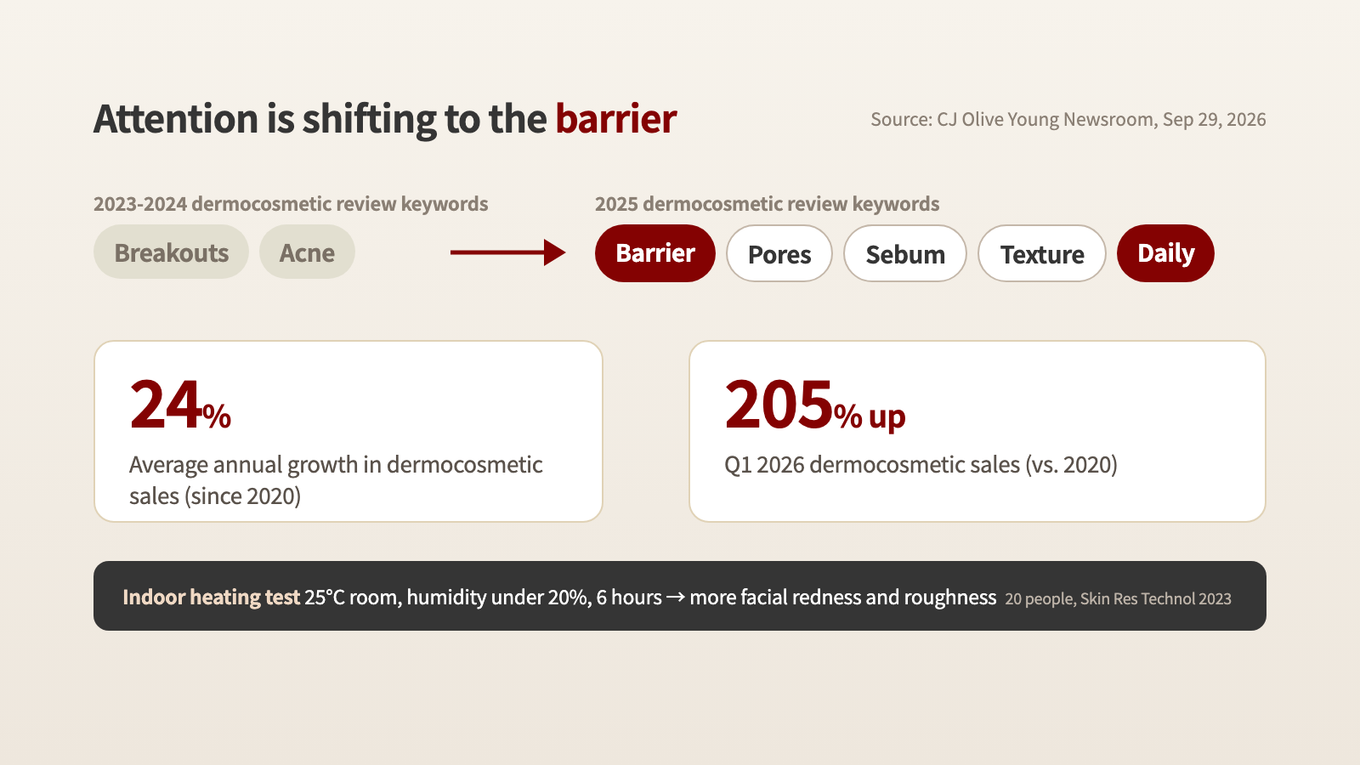
Dermocosmetic review keywords moved from breakouts to barrier and daily care. Keywords and sales figures come from one retailer's release.
So I don't see this as a passing buzzword. Still, using a lot of products with "barrier" on the label is one thing, and actually having a stronger barrier is another. Below, I'll go through that difference layer by layer.
You see glow when light comes back evenly from two places. At our clinic in Myeongdong, Seoul, this is how I explain it: some light bounces straight off the skin's outer surface, and some travels down to the collagen in the dermis and scatters back out evenly. When both are strong enough, you see glow. When only the surface reflection is strong, it looks greasy.
There's research behind this. In a study that adjusted the reflection components of facial images, skin with both high specular reflection (light bouncing off the surface like a mirror) and high diffuse reflection (light that goes in and scatters back out) was rated "radiant," while skin with high specular and low diffuse reflection was rated "oily and shiny" (Ikeda et al., Int J Cosmet Sci 2021).
A 2024 paper in the Journal of Cosmetic Dermatology that set out to define glow (Goodman et al.) goes a step further. It defines glow as "uniform reflection from an undisrupted dermal collagen layer," and says it only appears when nothing like redness or rough texture is breaking up that even reflection.
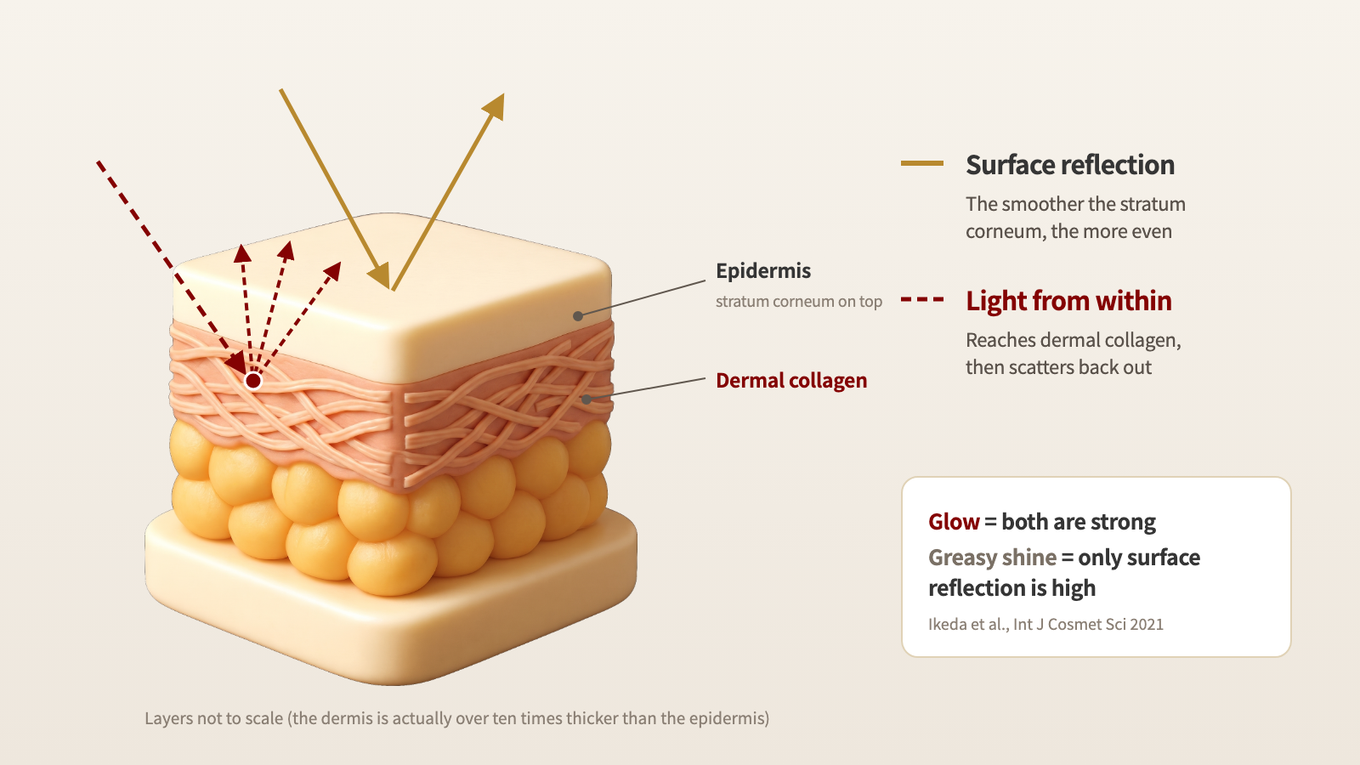
Glow comes from surface reflection plus light scattered back from dermal collagen. Brightening only the surface tips skin toward greasy.
So glow is really two layers showing up on your face.
Oils and highlighter add surface reflection on top of that first layer. As makeup, that's perfectly worthwhile. They just won't make the barrier any stronger or change the dermis.
The skin barrier is the layer your daily habits handle: moisturizer, cleansing, the air in your room. The collagen structure of the dermis sits deeper than creams can reach, so that layer is for treatments. The two differ a lot in thickness and in how long they take to recover.
By thickness, facial epidermis is under 0.1mm and the dermis is 1-2mm. But the difference you actually notice when you're looking after your skin is the timeline.
| Skin barrier (outer layer) | Dermis | |
|---|---|---|
| Thickness | Whole epidermis about 80-95µm | About 1-2mm |
| Signs it's struggling | Tightness, flaking, burning, redness | Skin feels thinner, fine lines, less firmness |
| Mainly handled by | Moisturizing, cleansing habits, indoor humidity | Treatments such as collagen boosters and skin boosters |
| Time to see change | Hours to weeks (epidermal turnover around 28-40 days) | Weeks to months |
| First move this season | Cut irritation, add moisture | Consider once the barrier has calmed down |
The barrier responds fast. One study found that transepidermal water loss, which spikes right after treatments like microneedling that open tiny channels in the skin, usually came back close to baseline within 1-3 hours, with only some measurements staying slightly raised for 24-48 hours (measured at several body sites, PMC7671250). Dermal collagen is a different story. It has been measured declining by around 1% a year in adulthood (Shuster 1975, forearm skin), and after a collagen booster, any change shows up over weeks to months and varies from person to person.
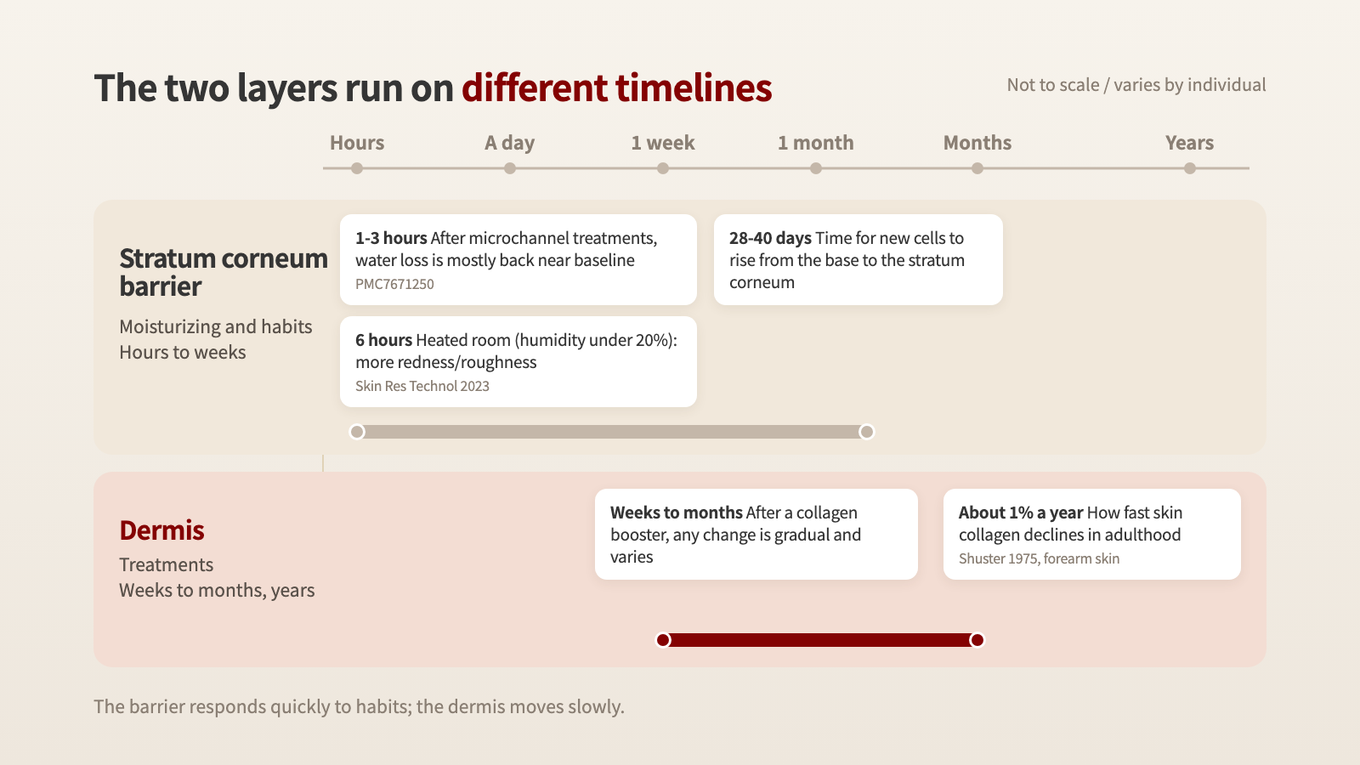
The two layers run on different timelines. The barrier responds quickly to habits; the dermis moves slowly.
The same split works for dry skin. I've written up three questions that tell you whether your dryness sits in the outer layer or the dermis in Why a collagen booster for dry skin.
In fall and winter, three habits behind a damaged skin barrier come up most often. Using exfoliants and acids as often as you did in summer, layering oil and highlighter because you're mistaking shine for glow, and choosing a barrier cream by checking for ceramides alone. All three put strain on the barrier while trying to brighten the surface.
Acids and exfoliation - The same glycolic acid can give very different results depending on strength and frequency. In one study, 4% glycolic acid applied twice a day for three weeks didn't change transepidermal water loss (Fartasch et al., 1997). In another, 70% glycolic acid, a peel-strength concentration, was left on the inner arm until mild irritation appeared (25 minutes on average), and water loss stayed raised for up to 48 hours (PubMed 27333579). A single low-strength product for home use is usually fine. Stack an exfoliating pad, an acid toner and a retinol serum in one routine, though, and it's a different picture.
Oils and highlighter - As we saw above, they only raise surface reflection. And when the barrier is lifting, light catches on the flakes, which can make rough texture stand out even more.
Checking for ceramides alone - The lipids in the skin barrier are ceramides, cholesterol and fatty acids layered together. In mice whose skin barrier had been deliberately damaged, applying only one or two of the three actually slowed recovery; it took all three mixed at an equal molar ratio to bring recovery back to normal speed. Mixes that raised any one of them up to threefold worked even faster (Man et al., J Invest Dermatol 1996). It's an animal study, so it doesn't carry straight over to people, but it's a good reason to look at the ingredient list once more for cholesterol and fatty acids.
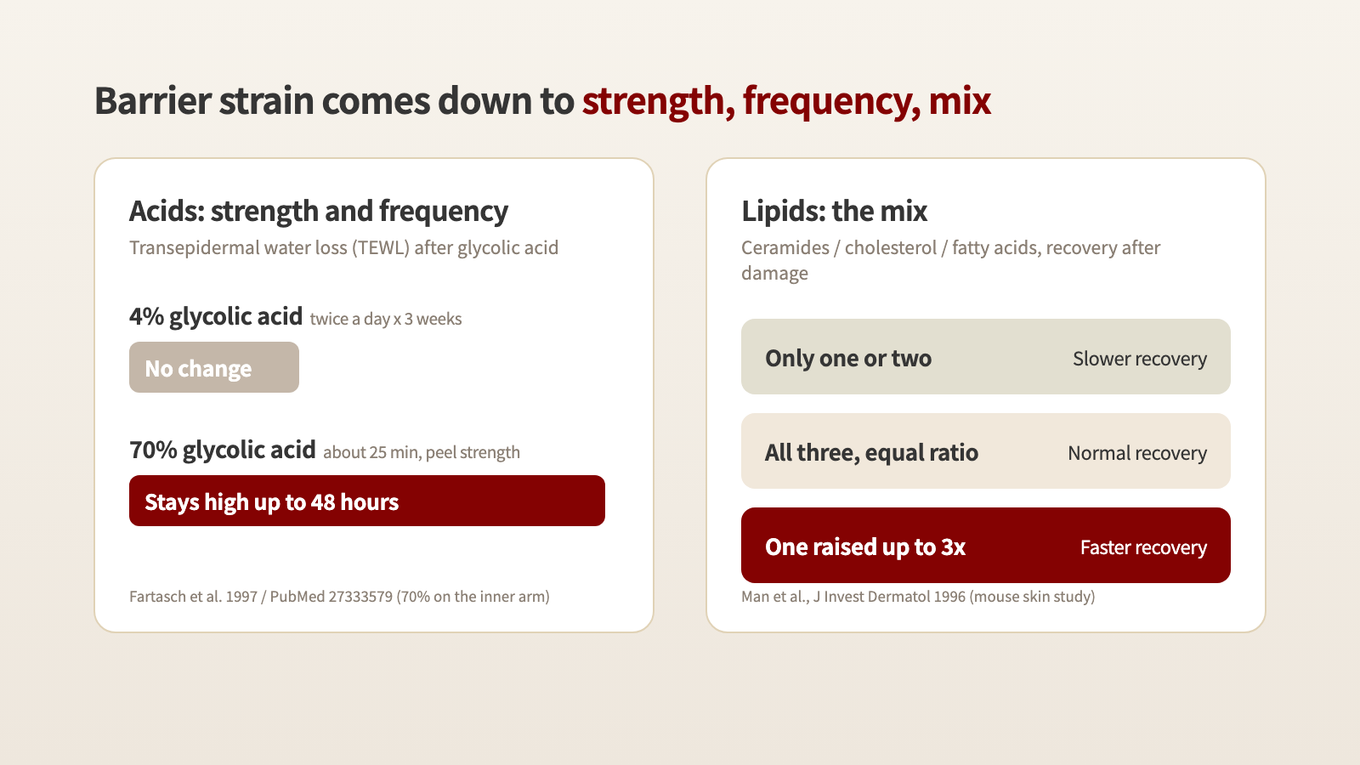
How much strain the barrier takes depends on strength, frequency and lipid mix. Figures reflect each study's conditions.
⚠️ Good to know - There are reports that much older skin recovers more slowly after barrier damage (a review of aging skin characteristics, PMC3840548). You can't apply that finding directly to people in their 30s and 40s, but it's worth knowing that the same routine can feel different from one year to the next.
That's why home care this season starts with taking things out.
At our Myeongdong clinic, I check that the barrier has calmed down before I look at the dermis. Collagen boosters are designed to stimulate fibroblasts in the dermis to support new collagen production, and skin boosters place ingredients in the dermis that help with hydration and texture. Creams don't reach the dermis, so from this point on, I think treatment is the right tool.
Here's one piece of evidence. In a study I co-authored, published in the Journal of Cosmetic Dermatology in 2026, liquid PCL (GOURI) was injected into mouse skin photoaged with UV light. Dermal thickness went from 941.9µm to 1266.1µm and collagen density from 22.1% to 40.0% (p<0.001, DOI 10.1111/jocd.70950). This was a preclinical study in mice, so these numbers don't promise the same degree of change in people. It didn't measure glow directly, either.
It doesn't contradict the glow research above, since the light that scatters back from within depends on dermal collagen. That link just hasn't been tested directly in people.
The downsides first. It's an injection, so bruising and swelling can last a few days. Rarely, small nodules can form under the skin. Results, and how long they last, vary a lot from person to person. And because injected treatments leave tiny puncture marks in the skin, the barrier is briefly open right afterward.
So here's how I decide who it suits and who it's too early for.
Once the treatment is done, the focus goes back to the barrier. While those tiny punctures close up, home care takes the lead again.
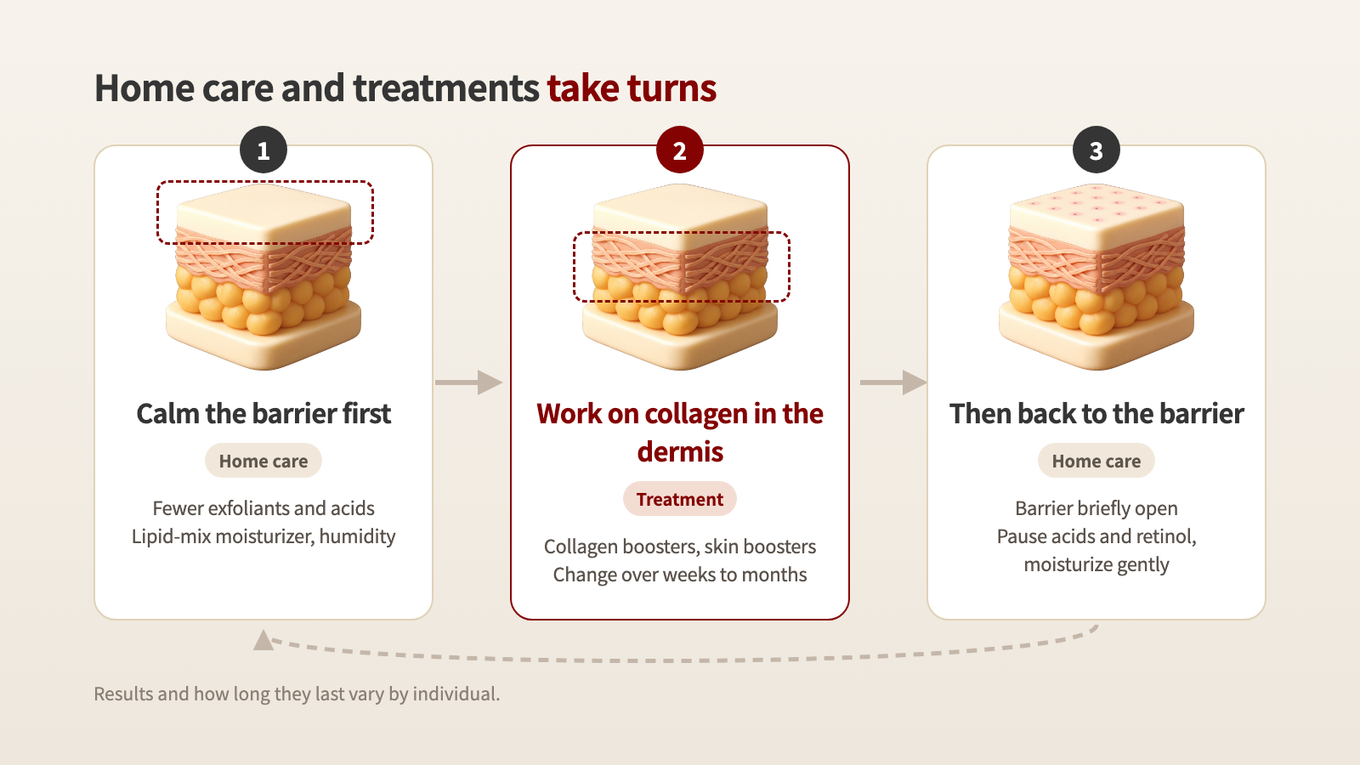
Home care and treatments take turns supporting each other. The barrier is where you start, and where you return after treatment.
What to apply and what to pause during the first three days after a treatment is laid out step by step in The first 72 hours after a procedure.
The word has caught on, but the skin barrier itself is a function we can actually measure. It's quantified through transepidermal water loss, and a good body of research shows it changes with lipid mix and exfoliation frequency. Before you buy one more barrier product, count how many acid or exfoliating products overlap in your current routine.
No. Skin boosters like Rejuran or Juvelook aim to help improve hydration and texture in the dermis, a different layer from the one barrier care looks after. If your barrier is sensitive, though, calm it down first, and keep up barrier care after the treatment.
That's not something to count on. A moisturizer's job is to fill in and protect the outer layer; it doesn't reach the collagen structure in the 1-2mm of dermis below. What is true is that once the barrier settles and your skin reacts less, you're in a better position for a dermal treatment.
Start by exfoliating less often. If you're still going at your summer pace, cut way back this season. Your barrier usually responds to less irritation pretty quickly, which makes it an easy first step toward repairing a stressed skin barrier.
Glow is what you see when light comes back evenly from the skin's surface and from collagen in the dermis. I think the current "barrier over glow" trend is best read as a reminder to look after the two layers that glow depends on.
The barrier at home, the dermis with treatments. This season, cut back on exfoliants and acids and calm the barrier with a moisturizer that has the full lipid mix. Then, if thinning or fine lines are still there, look at the dermis. And if you've had a treatment, come back to the barrier afterward.
#SkinBarrier #SkinBarrierRepair #BarrierCare #HealthySkin #KBeautyTrends #KDermaTrends #FallSkincare #WinterSkincare #GlowingSkin #Ceramides #Exfoliation #CollagenBooster #Dermis #SkinClinicSeoul #ForeverClinicMyeongdong