

Blog
Expert tips for healthy skin
Expert tips for healthy skin
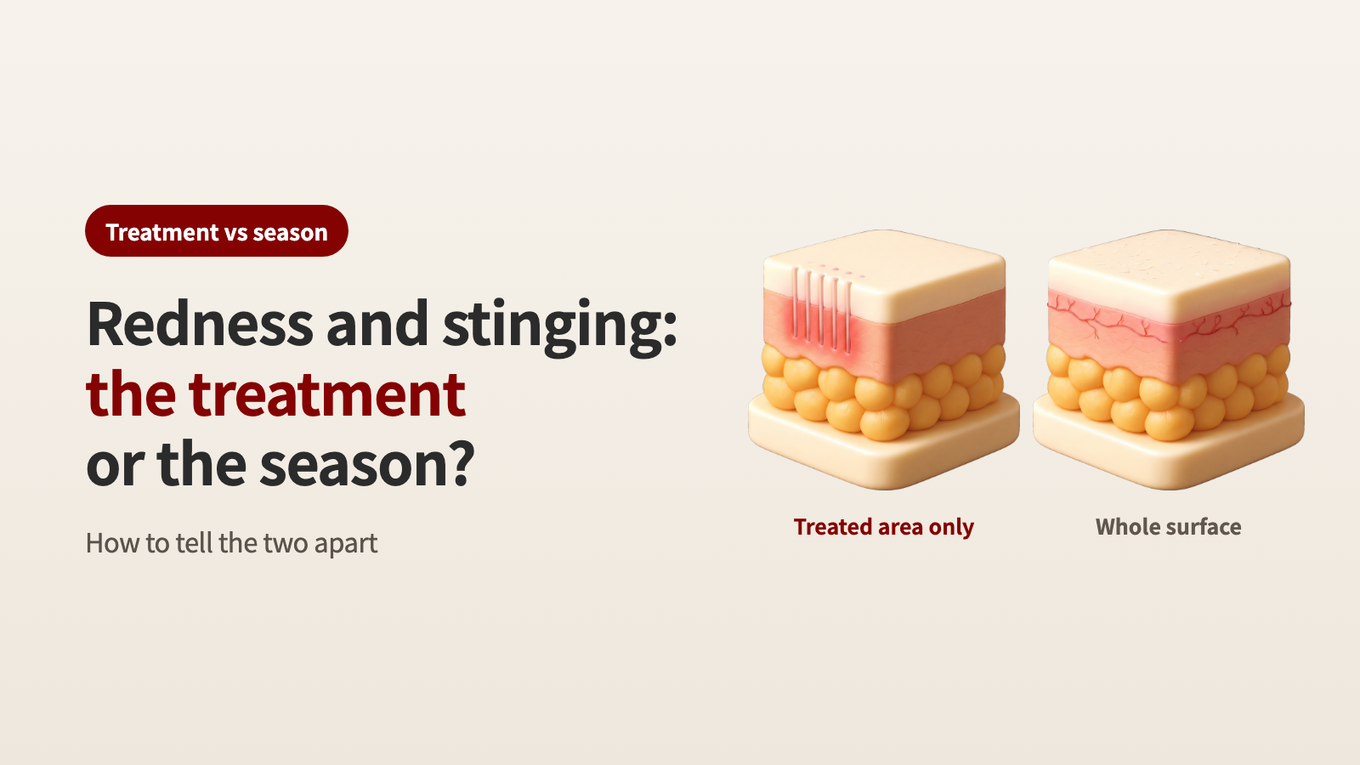
About ten days ago you had a laser or radiofrequency treatment. Now it's a cold, windy morning, and after washing your face and putting on toner, your cheeks feel hot and sting.
When skin turns red and stings after a treatment, many people worry that something went wrong, or that a side effect is only showing up now.
When a treatment coincides with the change of season, the two are hard to tell apart. Both look red, and both sting. Where they differ is how they play out over time. In short: redness that starts right after the treatment, stays on the treated area and fades a little each day is likely a treatment reaction. Redness that shows up a few days later, spreads to untreated skin and rises and falls with the weather is more likely seasonal.
When I see redness after a treatment, I sort it into three buckets: a reaction to the treatment itself, a seasonal barrier reaction, and something else entirely (a skincare product you just switched to or, rarely, an infection). Each bucket calls for something different, so the first job is figuring out which one you're in.
The short version
- After non-ablative lasers and RF microneedling, redness is strongest right after the treatment and eases from there. Studies report it usually lasts 2-4 days after non-ablative fractional laser and anywhere from 12 hours to 3-5 days after RF microneedling.
- Ablative lasers such as CO2 are the exception. Redness typically lasts around two weeks, so don't hold them to the same timeline.
- If the redness appears fresh a few days after treatment, shows up on untreated skin too, and keeps flaring after cold wind, indoor heating or washing your face before settling again, look at the season first.
- If you start itching and turning red one to three days after using a new product, consider allergic contact dermatitis. It usually appears 24-72 hours after exposure.
- If pain and redness get worse day by day, or you notice pus, blisters or a fever, contact the clinic where you had the treatment right away.
In the medical literature, redness and stinging after a non-ablative fractional laser usually settle within 2-4 days, and after RF microneedling within 12 hours to 3-5 days. It varies from person to person, and ablative lasers such as CO2 take longer, around two weeks. At our clinic in Myeongdong, Seoul, when I look at redness after RF microneedling with a device such as Potenza or after a non-ablative laser, the first thing I check is whether it peaked right away and has been coming down over the following days.
Post-treatment redness (erythema) is the skin recovering from the tiny heat injuries a laser or energy device creates. Those injuries happen at a single point in time, so the reaction is strongest at the start and eases from there.
Here's what the evidence says. Pain, redness and swelling after a non-ablative fractional laser generally improve within 2-4 days (StatPearls). For RF microneedling, one review reports redness lasting from 12 hours to 3-5 days and occasionally longer (PMC7869810), and in one prospective study the stinging was gone within a few hours while the redness lasted 1-4 days (PMC13421117).
⚠️ Ablative lasers run on a different timeline - With treatments like CO2 laser that remove the skin's surface, redness typically lasts about two weeks (StatPearls). In a fractional CO2 study, the median duration of redness was 11 days (range 8-14) (PMC12709358), and in rare cases it can go on for several weeks or longer. With these treatments, still being red on day ten can fall within the normal course.
Injectable skin boosters are a different story, since the main issues there are needle marks, swelling and bruising, so I track them separately. I've covered that in how much swelling, bruising and lumpiness is normal after booster injections.
So before counting days, I look at direction. If it's better than yesterday, a treatment reaction is the likely explanation. If it's day three and the skin is redder and more painful than on day one, that doesn't fit a normal recovery.
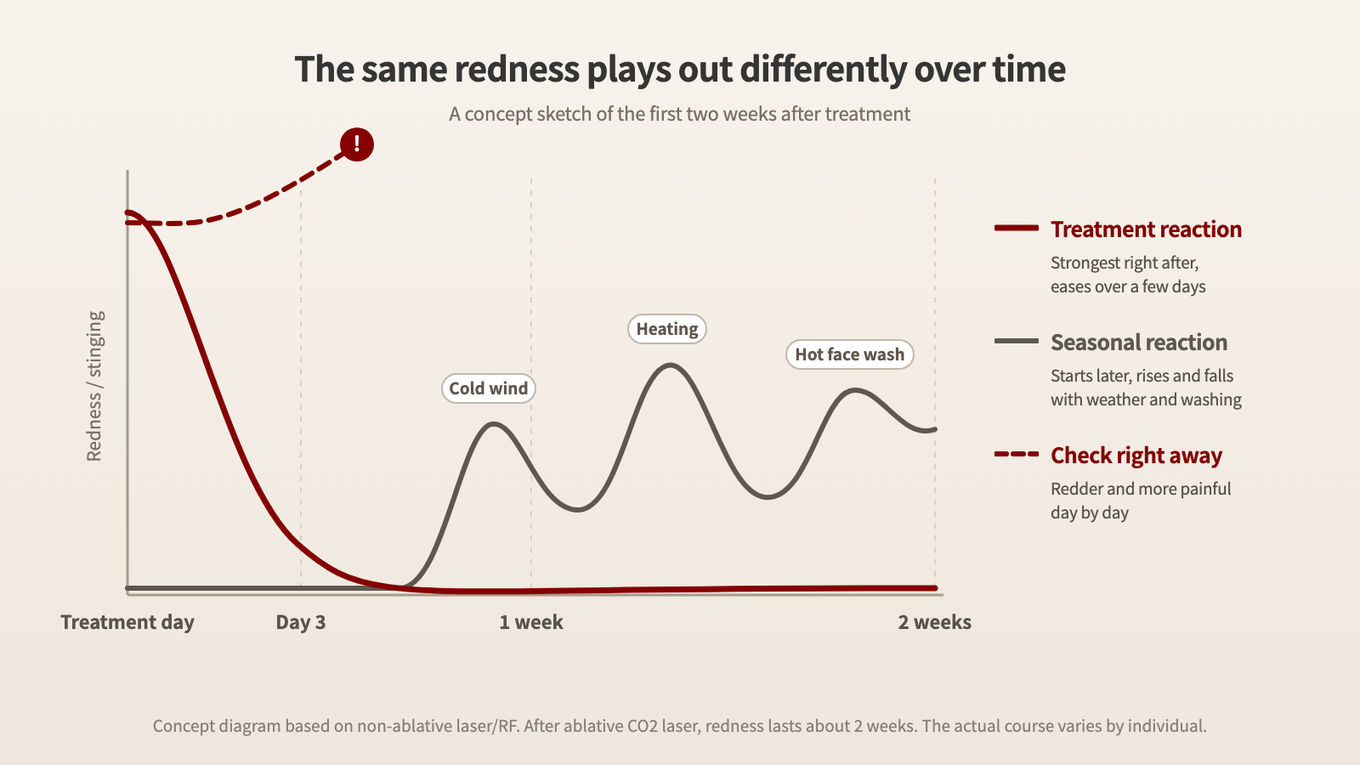
The same redness traces a different shape over time. Concept diagram based on non-ablative laser and RF; ablative lasers take longer.
If the redness and stinging reach beyond the treated area, the first thing I think of is a seasonal barrier reaction. Skin with a weakened barrier tends to sting more with the same products, and because it involves the whole barrier, it shows up broadly regardless of where you were treated.
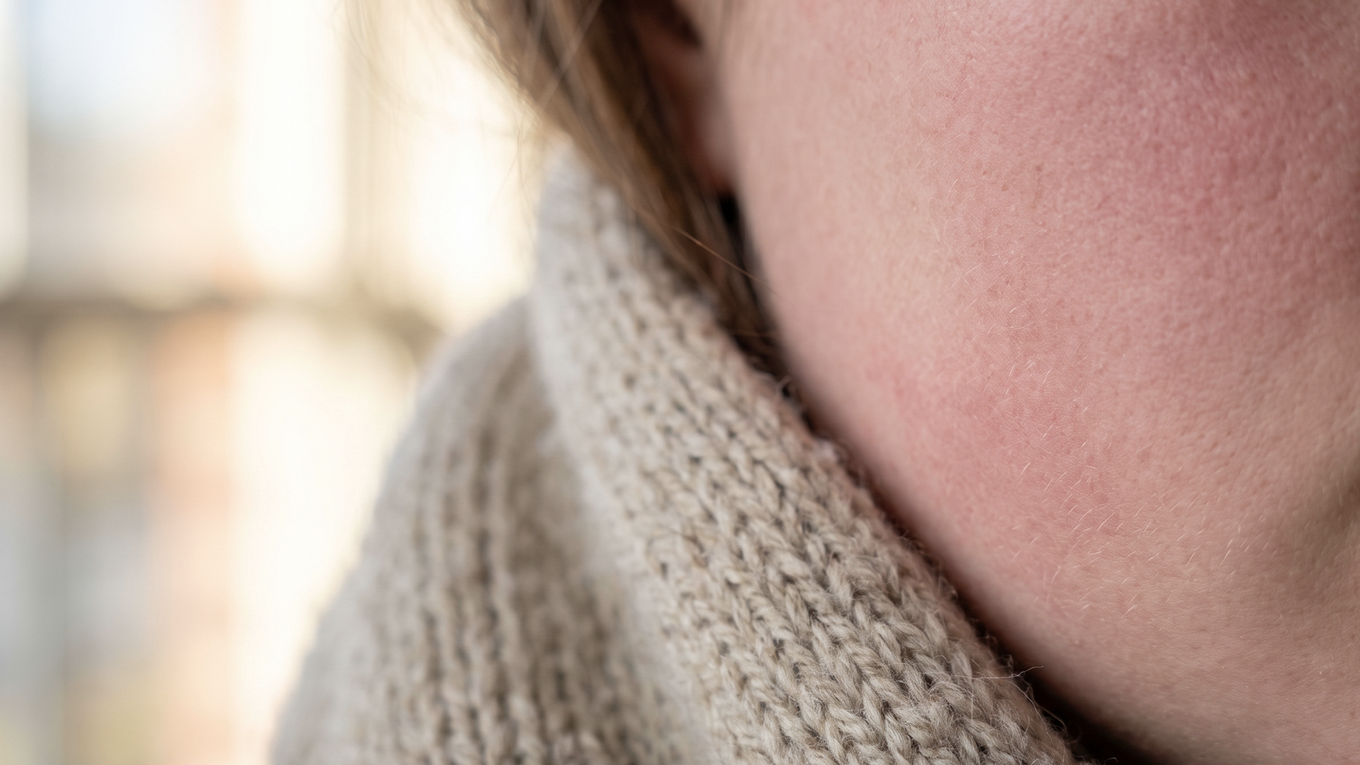
Redness spread evenly across the cheek and jawline, not just one treated spot, points toward the season.
The amount of water that evaporates through the outer skin layer is called transepidermal water loss (TEWL). One study found that in sensitive skin, the higher the TEWL, the stronger the stinging on a lactic acid sting test (PMC6851893). The evidence on seasons is mixed. A study measuring Korean men's foreheads actually found higher TEWL in summer, while a study of 206 Chinese women found it higher in autumn, at 17.4 versus 9.9 g/m²/h in summer (reviewed in PMC9168018). I've written about barrier care for this time of year separately in whether to get a treatment now when your skin turns sensitive in autumn.
Blood vessels are part of the redness, too. In the cold, skin vessels narrow to hold on to heat; in the warmth, they widen to release it (StatPearls, thermoregulation physiology). That's why your cheeks flush when you come in from the cold wind to a heated room. In a survey of 1,066 people with rosacea, a condition with frequent facial flushing (US National Rosacea Society, published 2002), wind (57%), cold weather (46%) and indoor heating (41%) were all named as triggers.
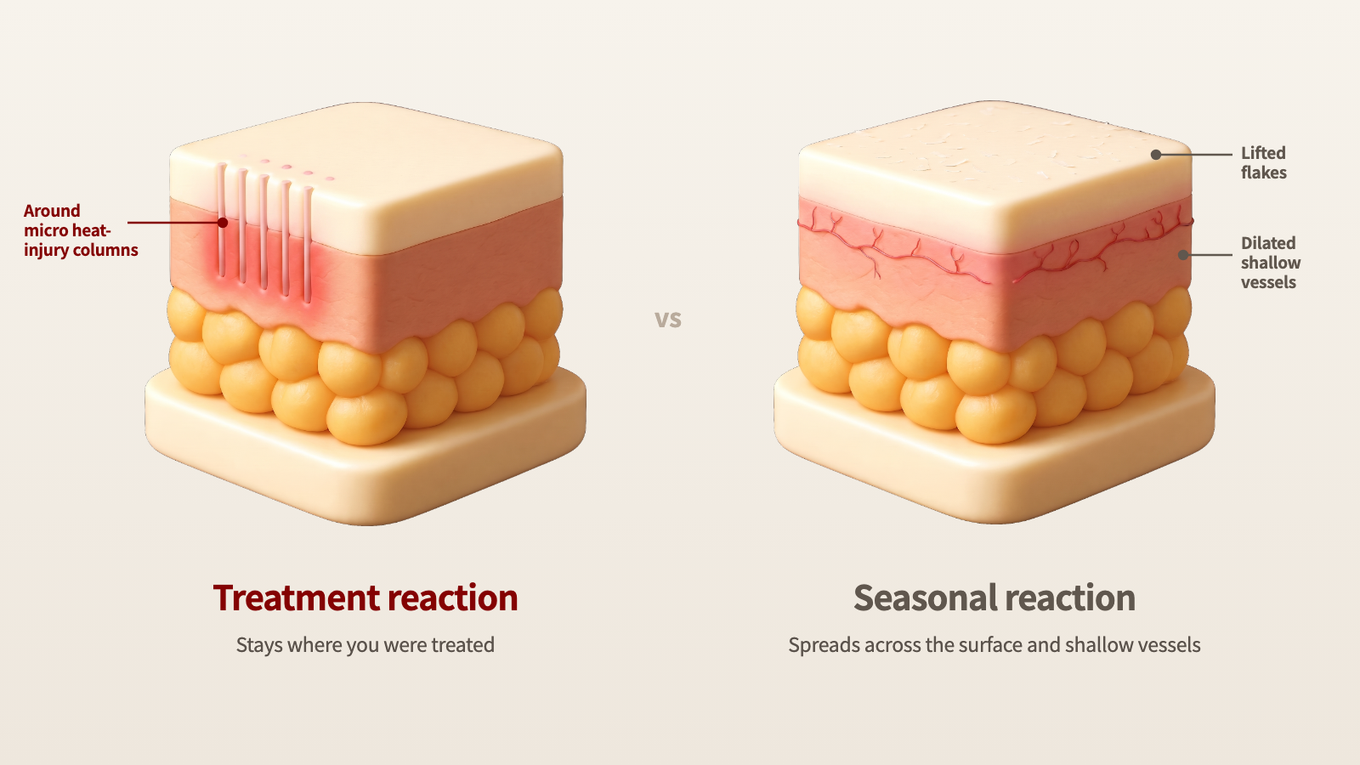
A treatment reaction stays where you were treated. A seasonal reaction spreads across the whole barrier and the shallow blood vessels.
Sometimes the treatment and the season overlap. Right after a laser or energy treatment, the epidermis is still recovering, so the barrier is weaker than usual. Add dry wind and indoor heating, and the stinging can hang around longer than expected. In that case, start with calming and moisturizing, and just watch whether day three is worse than day one.
At our clinic in Myeongdong, I look at redness after a treatment from five angles: when it started, where it is, how it changes, what makes it worse, and what the stinging is like. If it started right after treatment, stays on the treated area and fades each day, it's most likely a treatment reaction. If it started a few days later, spreads widely and rises and falls with the weather, it's more likely seasonal.
| What to check | Points to a treatment reaction | Points to a seasonal (barrier) reaction |
|---|---|---|
| When did it start? | Right after the treatment | New, days to weeks after treatment, or already there before |
| Where is it? | Within the treated area | Spreads to untreated neck, front of the ears or forehead |
| How does it change? | Less each day | Gets better, then worse, then better again |
| When is it worse? | Doesn't flare with triggers, it just fades | Right after washing, after cold wind, in heated rooms |
| What's the stinging like? | Mostly heat; in RF studies it fades before the redness does | Stings when you apply products, with a tight feeling |
Honestly, one look in the mirror won't settle it. The last three rows (how it changes, what makes it worse, what the stinging is like) only become clear after a few days. I can't always call it on day one myself. So when it's unclear, I suggest watching for another day or two and keeping notes.
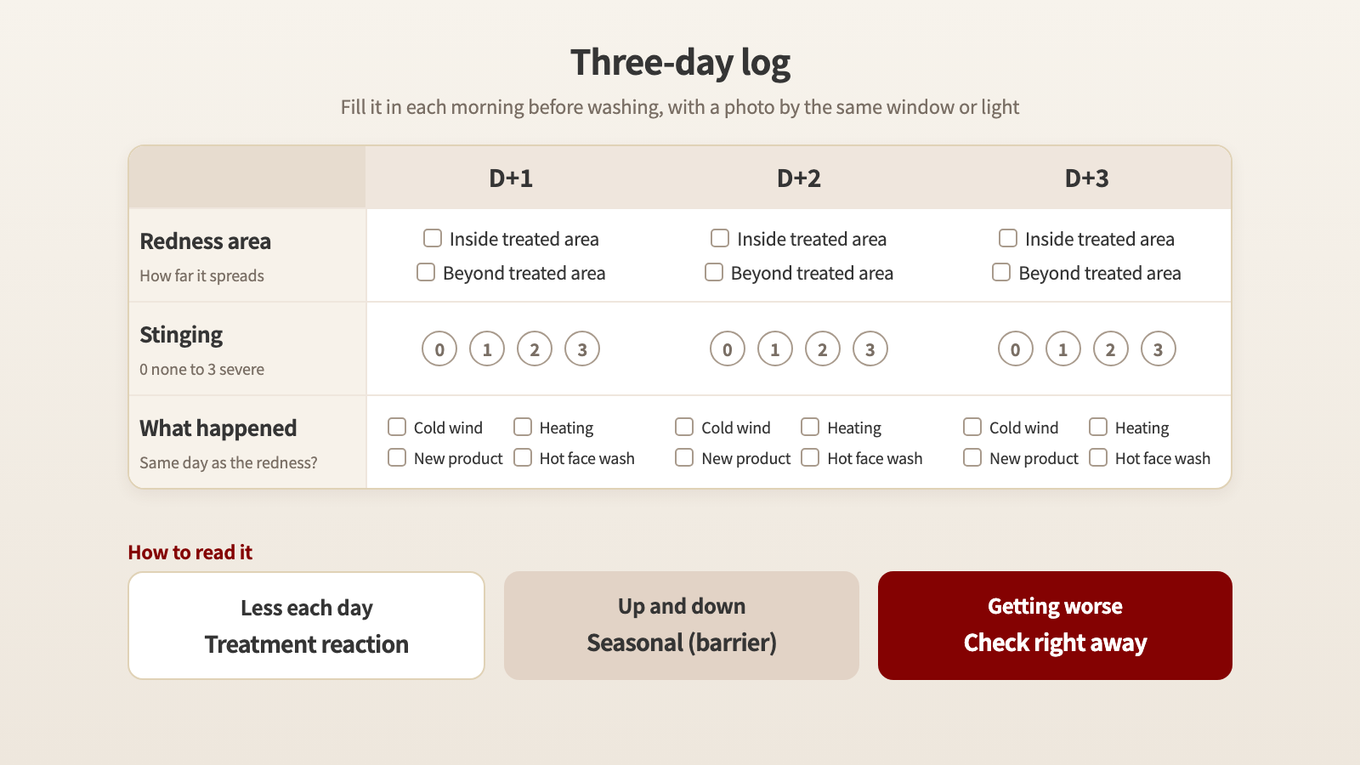
Three days of notes show which way it's heading. They also help when you check in with the clinic where you were treated.
While you're working out the cause, the priority is not adding more irritation. For now, set aside anything that's hard on the barrier, such as exfoliants, retinol and acids, and keep face washing short with lukewarm water. Cut your moisturizers down to the single gentlest one you already use, and wear sunscreen during the day.
If you started a new product after the treatment, consider contact dermatitis first. Rarely, it can be a bacterial infection or, after ablative laser resurfacing around the mouth, a herpes simplex flare-up. Pain and redness that get worse by the day, pus, blisters or a fever are not signs to wait out.
A skincare product you just switched to - With a harsh ingredient, the burning starts within minutes to hours of applying it. Even a mild ingredient can start to sting gradually if you apply it every day. Allergic contact dermatitis usually shows up as itching and redness 24-72 hours later and peaks at 72-96 hours (StatPearls). Even if it felt fine yesterday, a product you switched to two days ago could be the cause. If itching stands out more than stinging, I lean further toward this.
Bacterial infection - This is rare. But if pain and redness get worse rather than better in the days after treatment, and yellow crusts or pus appear, infection is the first thing I consider. Cases of bacterial infection within 1-7 days of non-ablative fractional laser have been reported (PubMed 25586939).
Herpes simplex flare-up - If you had ablative laser resurfacing around the mouth, watch for small, tingling blisters or raw spots within a week (StatPearls, laser complications).
Flushing that outlasts the season - If the season has changed and the redness still hasn't cleared, with burning that keeps coming back for weeks, it could be another skin condition such as rosacea. That's a separate issue from the treatment and needs its own medical evaluation.
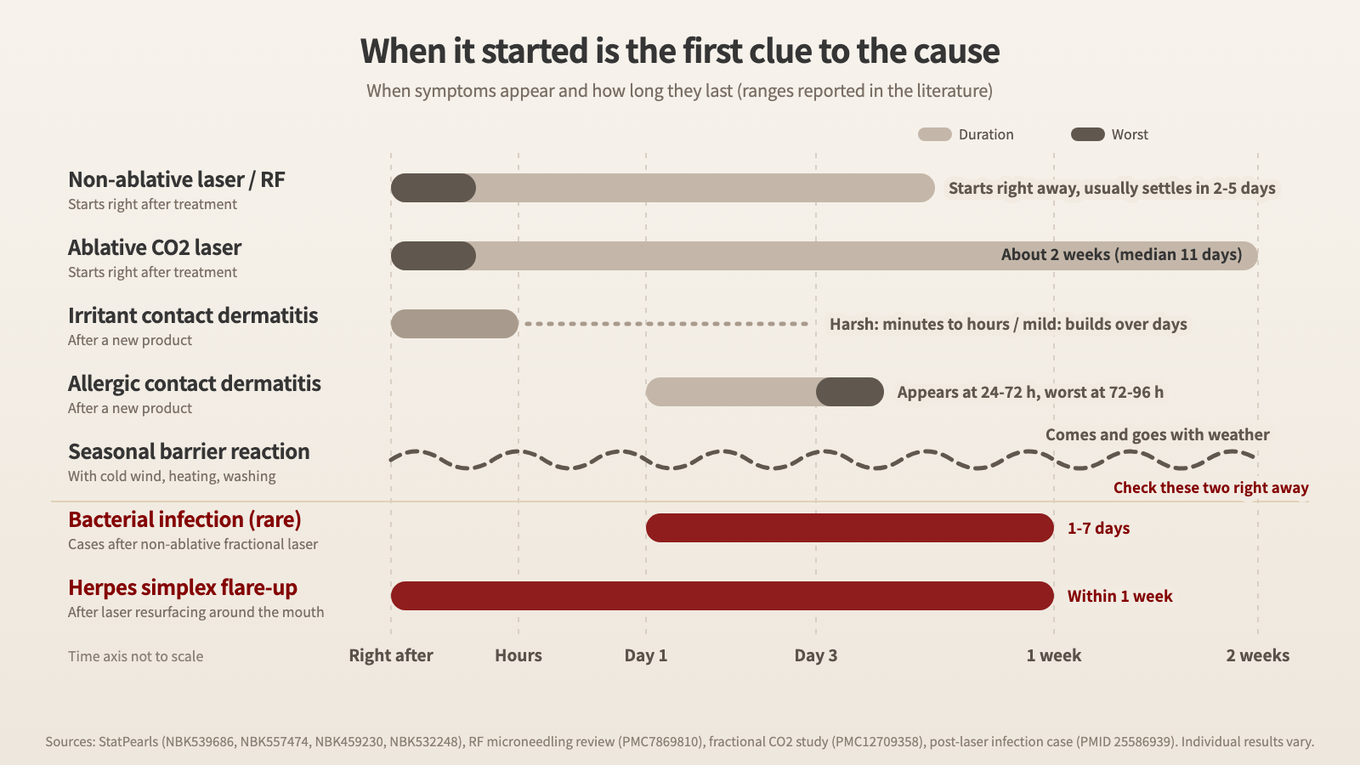
When it started is the first clue to the cause. Figures are ranges reported in the literature and vary by individual.
⚠️ Don't wait if - it's day three and the skin is redder and more painful than on day one / pus, yellow crusts or blisters appear / you have a fever / the red, painful, warm area keeps spreading. If any of these apply, contact the clinic where you had the treatment right away.
Reactions to non-ablative laser and RF treatments are strongest at the start and ease from there. If everything settled and then turned red again two weeks later, first check whether it has spread beyond the treated area and whether it lines up with the weather, washing or a new product. That said, injectables such as fillers can cause delayed reactions more than two weeks later. If there's a lump, warmth and pain at the injection site, don't wait; contact the clinic where you were treated right away.
It could. Right after a treatment, the barrier in that spot is still recovering, so that area may react first to things like cold wind or indoor heating. The rule is still direction. If it fades each day, it's healing. If it rises and falls with the weather, a seasonal trigger is layered on top. If it keeps getting darker, call that same day.
While you're figuring out the cause, it's better not to bring in anything new. Allergic reactions show up one to three days later, so a new product just adds another possible culprit. Cut back to the single gentlest moisturizer you already use and watch how it goes.
One photo isn't enough. Three days of photos taken under the same conditions show the direction, and if you also note how far the redness spreads and what happened each day, the clinic where you were treated can assess it faster too.
A treatment reaction is strongest right after the treatment, stays where you were treated and fades a little every day. A seasonal reaction shows up a few days later across a wider area and rises and falls with cold wind, indoor heating and face washing. If itching stands out one to three days after a new product, I suspect contact dermatitis first.
Ablative lasers such as CO2 usually leave redness for around two weeks, so I don't judge them by the same yardstick. Whichever it is, three days of notes will tell you whether to keep watching with moisturizing and calming care or to get in touch right away.
#RednessAfterLaser #SeasonalRedness #StingingSkinAfterTreatment #PostTreatmentRedness #SeasonalSkinSensitivity #SensitiveSkinCauses #SkinBarrier #ContactDermatitis #LaserSideEffects #RFMicroneedling #ForeverClinicMyeongdong