

Blog
Informasi khusus untuk kesehatan kulit
Informasi khusus untuk kesehatan kulit
If your under-eyes look hollow or your cheeks have lost their fullness, the consultations you go to can start to blur together. One clinic pushes filler, the next recommends a booster, and a third tells you to do both. The names are different, but they all describe it the same way - "we fill in the sunken area" - so it is easy to see why patients get confused.
So what actually sets them apart? It is one of the questions I hear most in the room: "Doctor, aren't these basically the same thing?"
They are not, because they are aiming at two different destinations. One method puts a substance in place to hold the space open, and the other coaxes your own skin into making new collagen. Once you understand that difference, it becomes much clearer which one fits you. Let me walk through how volume filling and collagen regeneration actually work, starting from the mechanism.
The short version
- Filler (hyaluronic acid) is a gel that physically occupies the space between tissues and draws in water, filling a hollow the moment it goes in.
- A collagen booster or regenerative treatment uses the injected material to stimulate your fibroblasts, so your own skin builds new collagen.
- That is why the timing differs. Filler is immediate; regeneration comes up gradually over weeks to months.
- Reversibility differs too. Hyaluronic acid filler can be dissolved with an enzyme, but collagen stimulators like PCL/PLLA cannot.
- If a hollow is obvious and you need volume now, go with filling. If you want to restore overall firmness, skin tightening and texture, go with regenerating. Plenty of people combine the two.
At our clinic in Myeongdong, Seoul, I split these two by a single question - what is left in your skin once the treatment is done? With a filling treatment, the injected material itself is what takes up the space. With a regenerating treatment, the material eventually goes away and what stays behind is collagen that your own body has made.
So whenever someone asks about volume or hollowing, I sort the options into two camps: does the thing we inject fill the gap, or does it get your own tissue to rebuild?
The reason this distinction matters is that the two approaches are chasing completely different targets. Filling goes after "the empty space you have right now," while regenerating goes after "the thinned skin tissue itself." So even for the same under-eye hollow, filling is the answer for one person and regenerating for another.
Put simply - filling is like pouring water into a sunken pit, and regenerating is like packing the floor of that pit back up. One fixes the space you can see today; the other works on the ground underneath it.
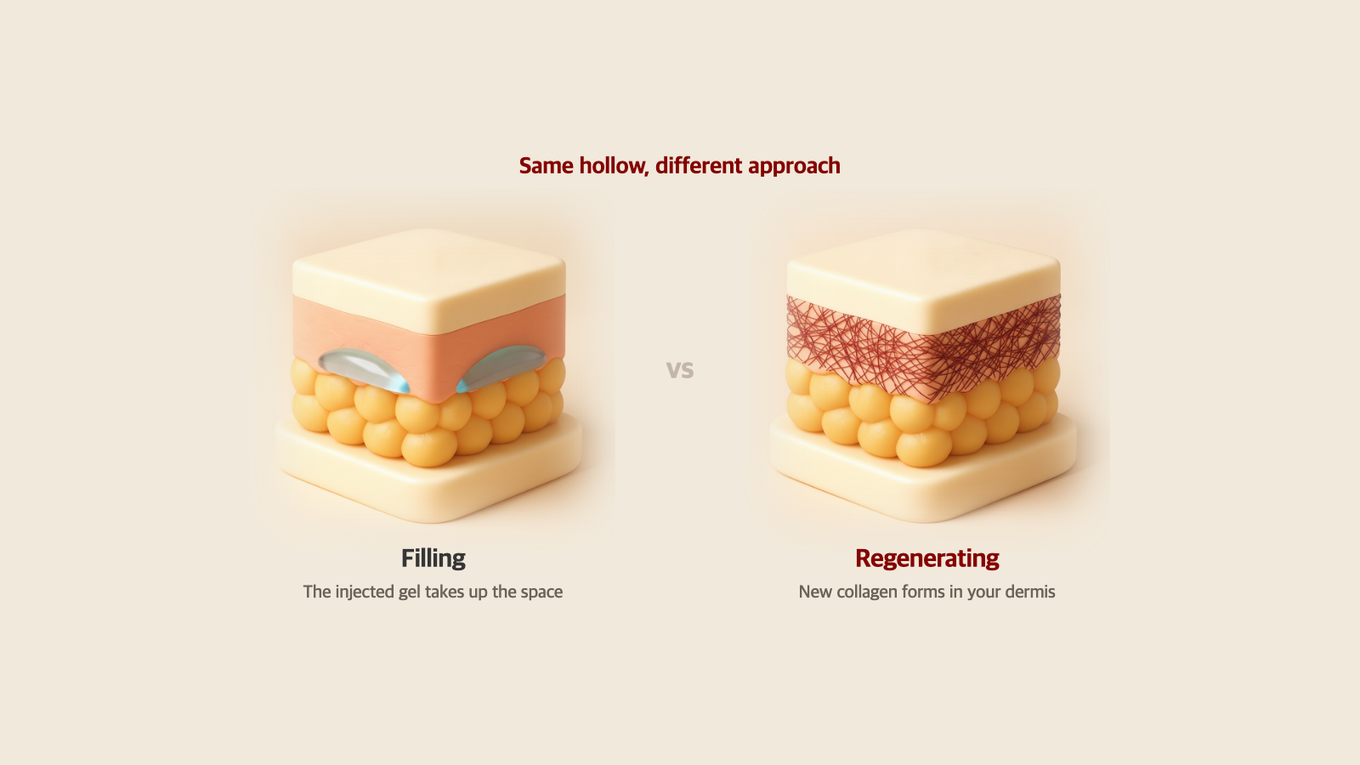
Left (filling) - the injected gel takes up the space. Right (regenerating) - new collagen is woven into your own dermis.
When I inject filler at our Myeongdong clinic, I am after one thing - getting the hyaluronic acid gel to settle between the tissues and physically take up the hollow space. Because the gel also pulls in water, the area feels firm and cushioned, and since it fills the moment it goes in, you see the result right away.
Hyaluronic acid is something your skin's dermis already contains. It is hydrophilic, meaning it likes water and holds onto the moisture around it. The hyaluronic acid used in filler is cross-linked so the gel does not scatter easily, which lets it hold its shape and keep filling the space where it was placed.
Here is a common myth worth clearing up. You have probably heard that "hyaluronic acid holds a thousand times its own weight in water." That is an exaggeration that stuck around from cosmetics advertising. When it is measured under conditions closer to real skin (Skin Research and Technology, 2016), the figure comes out around 20 to 30 times. It does hold water - just not as dramatically as the ad number suggests.
In short - a filler's volume comes from two things: the bulk of the gel itself, plus the water that gel pulls in. That is what makes it immediate and predictable, filling in proportion to how much you place.
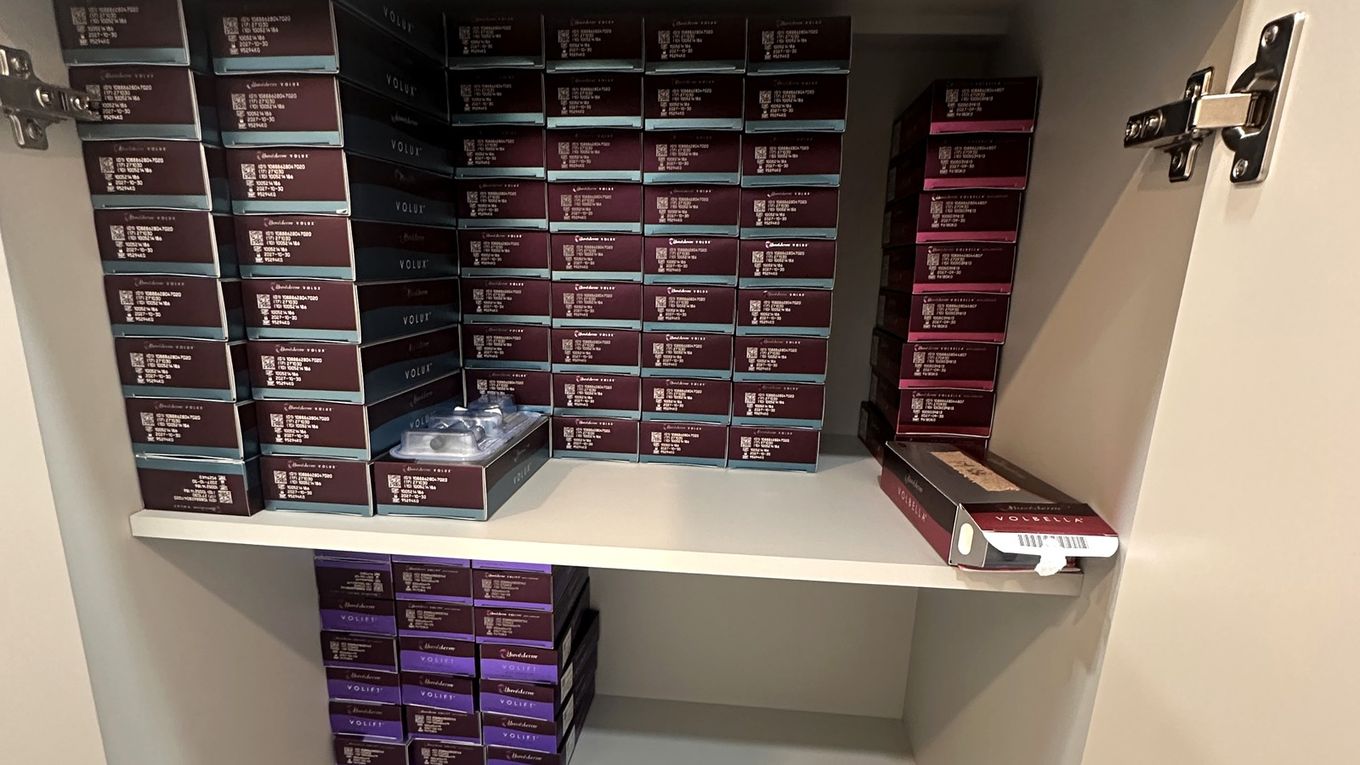
Genuine hyaluronic acid filler kept at our Myeongdong clinic. This gel fills the hollow space directly.
Honestly, the biggest upside of filler is "right now." Place as much as the hollow needs and it shows the same day. The catch is that the gel is gradually absorbed by the body, so keeping the volume means topping it up on a schedule. That is something I always flag upfront.
When I look at regenerative treatments at our Myeongdong clinic, this mechanism is my reference point. A collagen booster or stimulator works by having the injected material prompt your fibroblasts, so your own skin makes fresh collagen. The volume does not come straight from a gel; it rises slowly, out of the new collagen you have built over time.
Let me unpack the principle a little. Collagen stimulators such as Sculptra (PLLA), Radiesse (CaHA) and liquid polycaprolactone (PCL) - GOURI - act as a kind of scaffold once they are in the dermis, and as your body recognizes and responds to the material, your fibroblasts switch on. Those fibroblasts are what lay down new type I collagen. Dermal skin boosters like Rejuran (PN) and Juvelook (PDLLA) follow a similar logic - they send a skin-regeneration signal that firms the tissue up from the inside.
That is why the timing is different from filler. It does not show the instant you inject; it builds gradually over the weeks to months it actually takes to make collagen. In return, the collagen you make outlasts the material, so it tends to hold longer (this varies by product and by person).
Patients often ask whether this regeneration is real - whether there is evidence behind it. In a study I co-authored, we looked at exactly this. In a paper on liquid PCL (GOURI) published in the Journal of Cosmetic Dermatology (2026), liquid PCL significantly increased dermal thickness and type I collagen production (p<0.001). That is data confirming these treatments rebuild the tissue itself rather than just plugging a gap. How much collagen forms still varies widely by product, area and individual, so the same treatment gives different results from one person to the next. If you want to see where each material fits, our Rejuran vs Juvelook vs GOURI comparison is worth a read. And if you want to dig deeper into how collagen stimulators regenerate, this polycaprolactone (PCL) review paper is openly available.
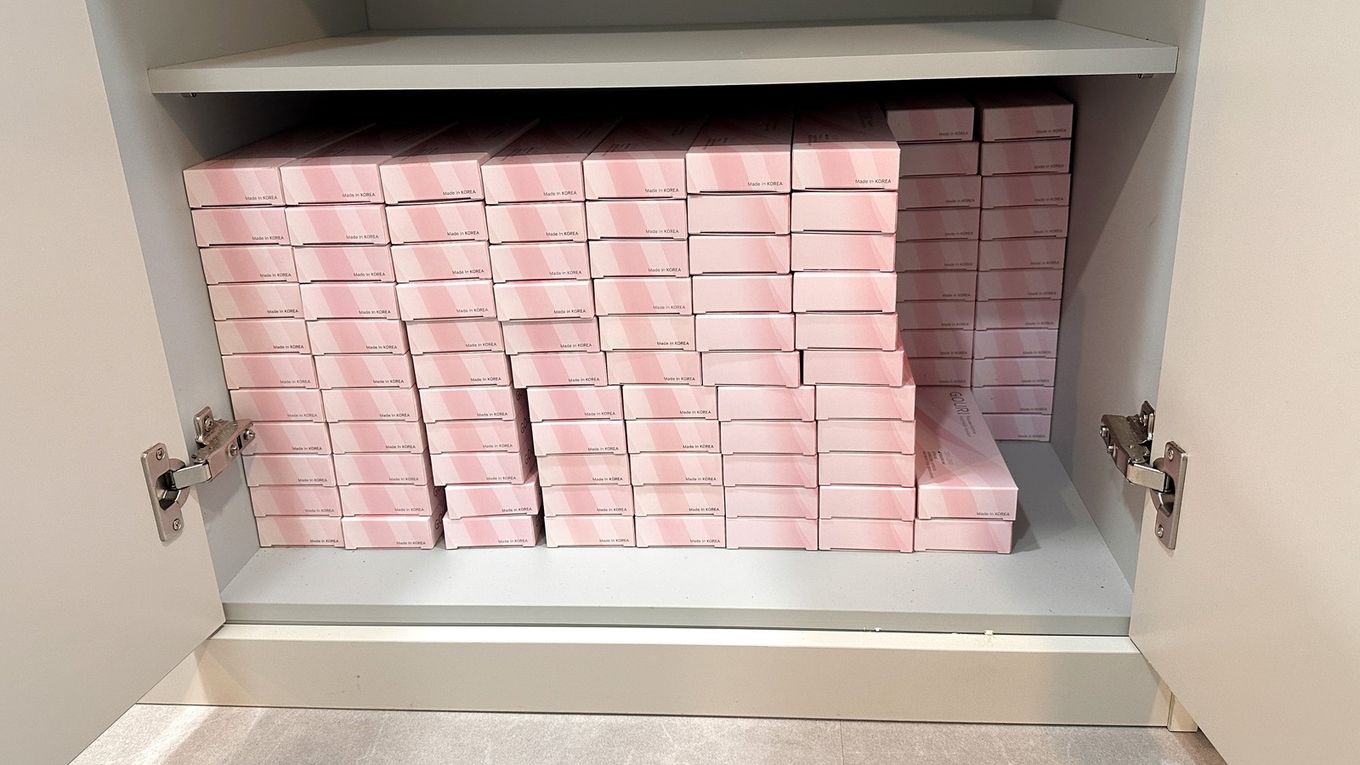
Genuine liquid PCL (GOURI). Rather than filling with a gel, it stimulates fibroblasts to rebuild your own collagen.
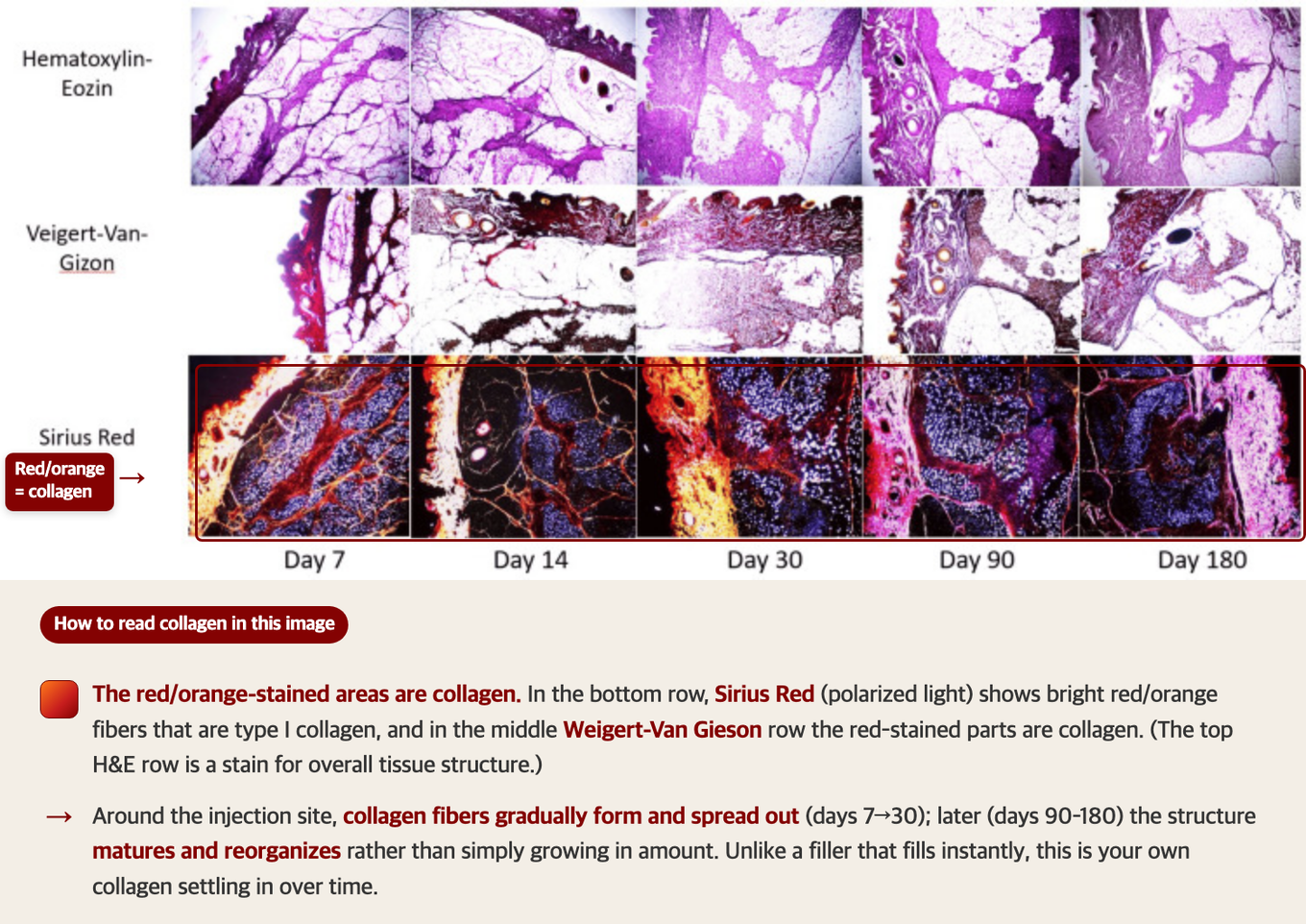
Histology of PLLA-injected skin biopsied from day 7 to day 180 and stained for collagen. The red and orange stained areas are collagen - in the bottom Sirius Red (polarized) row, the bright red-orange fibers are type I collagen, and in the middle Weigert-Van Gieson row the red-stained parts are collagen. Collagen gradually forms and spreads around the injection site (days 7 to 30), and after that (days 90 to 180) the structure matures and reorganizes rather than simply increasing in amount - it settles in over time instead of filling instantly like a filler (animal-tissue study; individual variation applies). The red highlight boxes and labels were added for clarity; the original image is unchanged. Source: Sulamanidze et al., Cureus (2026), CC BY 4.0.
When I decide this at our Myeongdong clinic, I look at whether the problem is the space right now, or the tissue itself. If the hollow is well defined and you need volume immediately, filling fits. If it is less about one spot and more that your firmness, skin tightening and texture have slipped overall, regenerating is the better match.
In practice, these two are usually not rivals - they play different roles. A sharply defined hollow, like the inner under-eye, is easy to predict with filling, while a broad area that has thinned out, like the whole cheek or the facial contour, comes up more naturally with regenerating. So rather than committing to one, it is better to read the area and the condition separately.
| Go with filling (filler) | Go with regenerating (booster/stimulator) |
|---|---|
| A specific area is clearly sunken | Your whole face feels thin and less firm |
| You need volume right now | You want it to come up slowly and naturally |
| You want a predictable, adjustable result | You want to improve skin texture and firmness too |
| You want room to reverse it | You want the longer-lasting option |
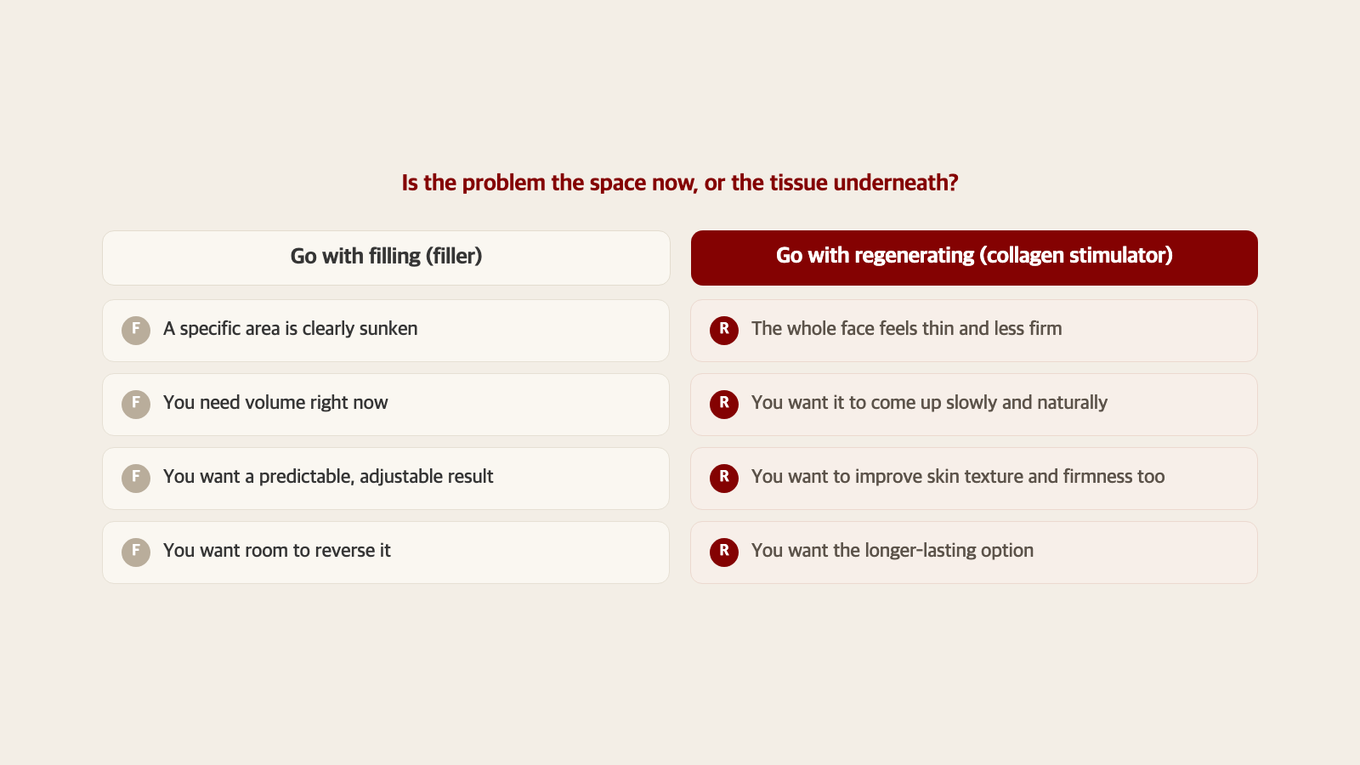
It comes down to "is the space the problem now, or the tissue underneath?" If it is both, we mix them.
In reality, a lot of people do both. Filler handles the clearly sunken spots, and a booster firms up the broad, thinned areas. That said, rather than doing everything in one sitting, splitting it up by area and watching the response before the next step gives steadier results.
This is something I always raise in consultation at our Myeongdong clinic, because the two approaches split sharply here. Hyaluronic acid filler can be dissolved and reversed with an enzyme called hyaluronidase, but collagen stimulators like PCL/PLLA/CaHA cannot be dissolved by an enzyme. Duration also tends to run longer on the regenerating side.
Start with reversibility. If a hyaluronic acid filler result is not what you wanted, or it clumped, or there is an emergency such as a vascular issue, it can be dissolved relatively quickly with the enzyme. That is a big advantage of filler. Collagen stimulators, on the other hand, do not respond to that enzyme, so if something comes up we manage it over time. That is exactly why, with regenerative treatments, choosing the right indication and dose carefully at the start matters even more.
Longevity just follows the mechanism. Filler is gradually absorbed and fades, so it needs periodic top-ups; regeneration leaves behind the collagen you made, so it lasts relatively longer (with wide variation by product, area and person, it is hard to pin to an exact number of months).
One thing to know - "more is better" is a myth. With filling especially, placing more than you need can look puffy or unnatural, and with regeneration, over-stimulating in one go does not produce proportionally more collagen. For both, the right amount is what makes or breaks the result. That is why I favor building up gradually while watching the response, rather than overcorrecting.
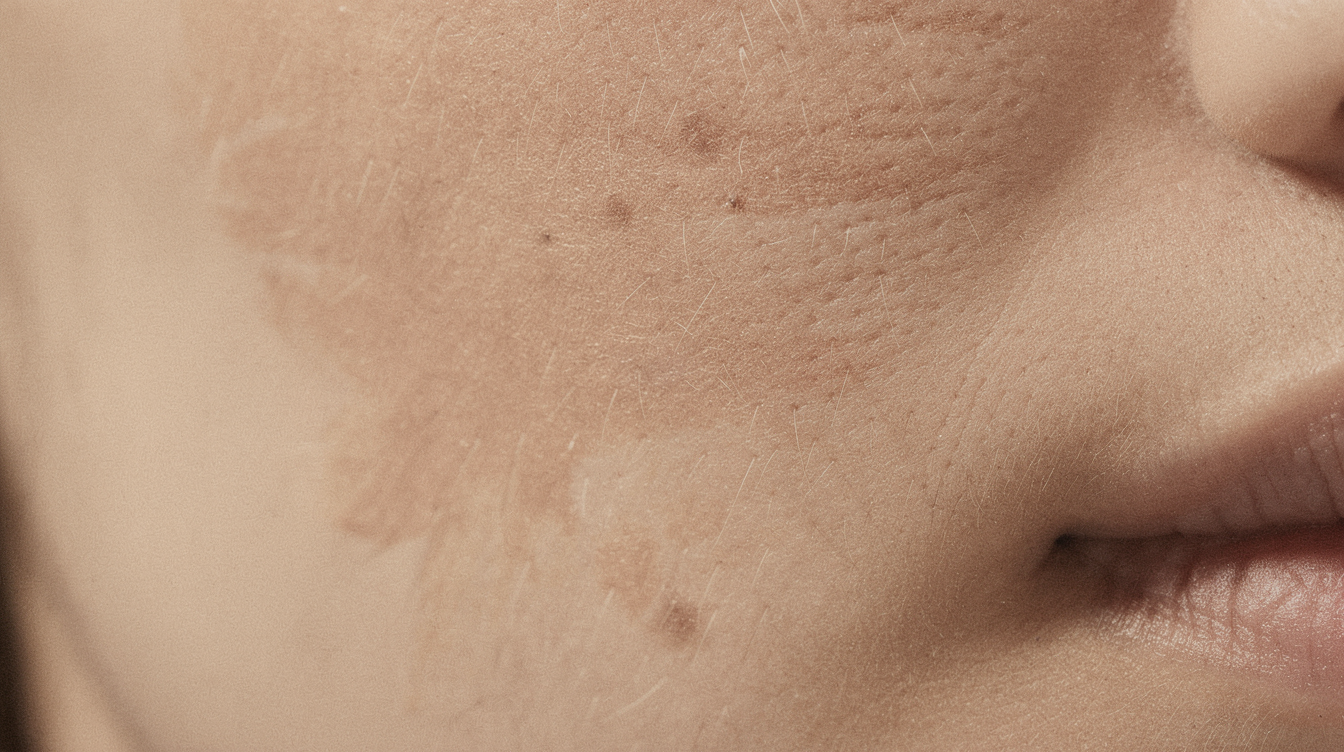
Whether you fill or regenerate, the goal is the same: a natural look that does not call attention to itself.
No. They are aiming at different destinations. Filler (hyaluronic acid) uses gel to physically fill the space, while a collagen booster or regenerative treatment stimulates your fibroblasts to make new collagen. So both the timing of the result and the way it is maintained are different.
Filler is faster. The gel fills the space the instant it goes in, so you see the result immediately. Regenerative treatments come up gradually over the weeks to months it takes to actually make collagen. If "right now" matters most, go with filling; if "slow and natural" matters more, go with regenerating.
Yes - the mechanism is that the injected material stimulates your fibroblasts and prompts collagen production. A study on liquid PCL (Journal of Cosmetic Dermatology, 2026) reported significant increases in dermal thickness and type I collagen (p<0.001). How much forms does depend on the product, the area and the individual, so results differ from person to person.
Hyaluronic acid filler can be dissolved and reversed with an enzyme (hyaluronidase). Collagen stimulators like PCL/PLLA/CaHA, on the other hand, are not dissolved by that enzyme, so any issue is managed over time. That is why setting the indication and dose carefully at the start matters for regenerative treatments.
Doing both is common. Clearly sunken areas get filled, and broad, thinned areas get firmed up with a booster. Rather than doing it all at once, though, splitting it by area and deciding the next step after seeing the response is more stable.
Filling and regenerating treatments only sound alike; what they aim for is different. Filler uses gel to occupy the spot and fill the hollow you have now, while a collagen booster or regenerative treatment stimulates your fibroblasts to build new collagen and firm up the tissue itself.
So the choice comes down to one question: is the visible space the problem, or the thinned tissue underneath it? Need volume now, go with filling. Want to bring back overall firmness and texture, go with regenerating. Want both, split it by area and mix them.
Whenever I assess volume and hollowing at our Myeongdong clinic, the order is always the same. First I decide "is this a spot to fill, or a spot to rebuild," then I pick the method that fits. Keep just that one distinction in hand and your consultations, here in Korea or anywhere, will feel a lot less confusing.
#FillerVsBooster #CollagenRegeneration #VolumeFilling #SkinBooster #CollagenStimulator #LiquidPCL #GOURI #SkinTightening #KoreaDermatology #ForeverClinicMyeongdong