

Blog
Informasi khusus untuk kesehatan kulit
Informasi khusus untuk kesehatan kulit
When you start exploring lifting treatments, you might expect that a single treatment will lift your entire face. But during consultations, you'll often hear recommendations like "This for the forehead, that for the jawline, and something else for the neck," which can seem like overkill.
There's a good reason for this. The forehead, eyes, jawline, and neck all have different causes for sagging. Some areas might sag because the deep support layers have dropped, others because the skin is very thin, and some because muscle movement causes sagging. Different causes mean different methods and target areas.
Today, we'll break down "how lifting is categorized by area." Understanding this will clarify why various suggestions come up during consultations.
Quick Overview
- Lifting varies by area because sagging has different causes, so we start by identifying which layer has dropped.
- Forehead - Issues with facial muscles (frontalis) and eyebrow height. Balance muscle/volume instead of just pulling.
- Eye area/Under-eye - Thinnest skin. Focus on regeneration/skin boosters rather than strong energy.
- Jawline/Lower face - Deep support layers (SMAS) and fat sagging. Look at deep-reaching energy or thread lifting.
- Neck - Thin skin + vertical muscle (platysma) bands. Requires methods tailored to the neck, separate from the face.
- Instead of aggressively pulling with one method, tailoring to each area's underlying cause helps protect both safety and results. Results vary per individual.
The face has different layers and causes of sagging in each area, so we first work out where and why it's sagging. Even if we call it lifting, addressing the forehead and neck means solving different problems. This is the groundwork behind any real skin tightening plan.
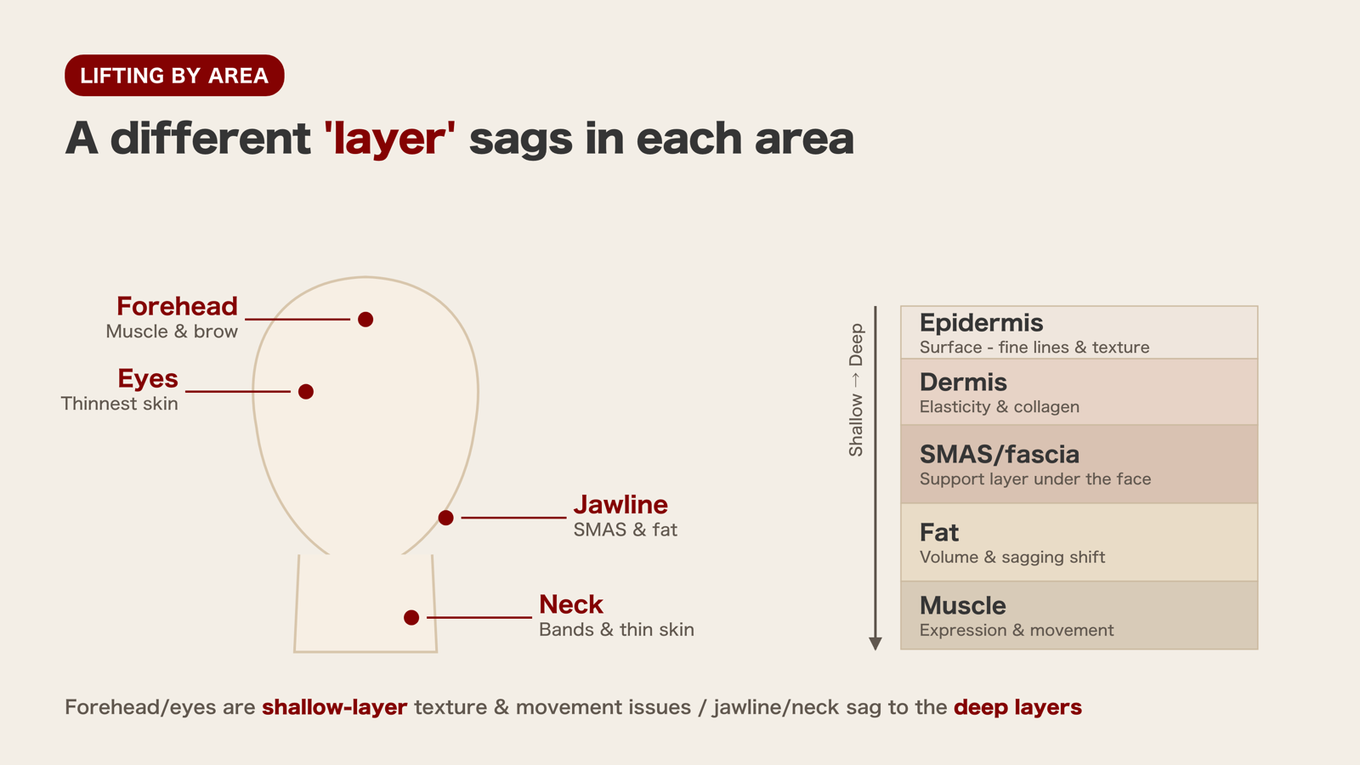
The skin isn't a single layer; it's composed of multiple layers. From the surface, you have the epidermis, dermis, and beneath them, fat and the supporting fascia layer (often referred to as the SMAS, a mesh-like support layer), along with the muscles that create expressions. As we age, these layers thin, loosen, and sag at their own pace.
Thus, sagging characteristics vary by area. The jawline might sag due to deep support layers and fat, the eye area might show sagging due to thinning skin texture, and the neck might show prominent vertical muscles. The primary consideration when choosing a lifting method is which layer is problematic.
At our clinic in Myeongdong, Seoul, we follow this order when considering lifting treatments. We first determine which layer has sagged in each area, and then match the method to reach that depth. That's why we don't just push the entire face with a single method.
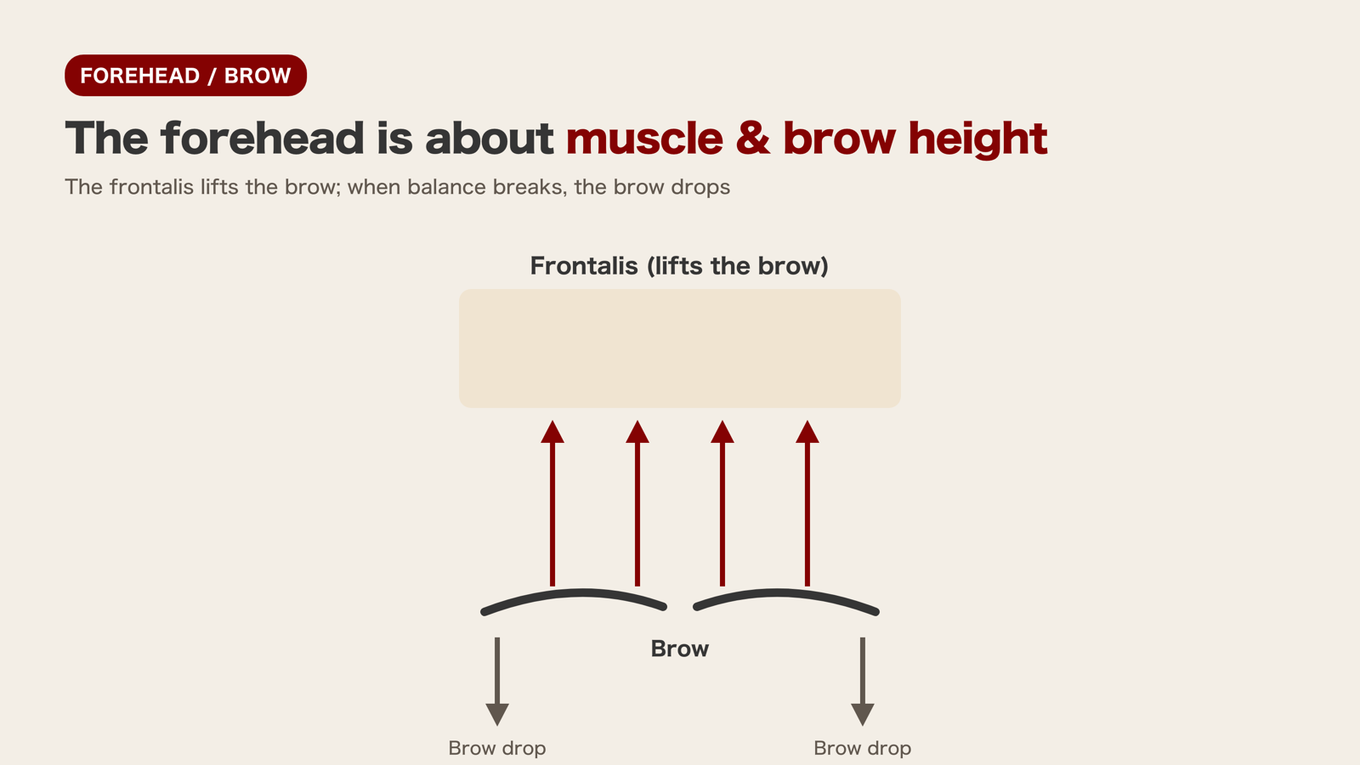
The forehead involves the muscle (frontalis) and eyebrow height, so we balance muscle strength and volume rather than just pulling. Forehead wrinkles and heavy eyebrows often come hand in hand.
The frontalis muscle lifts your eyebrows. As this muscle works hard to lift your eyebrows, horizontal wrinkles form, and if the balance with muscles that pull the eyebrows down is lost, the eyebrows can sag heavily. Sagging eyebrows can give a droopy look.
For the forehead, focus on movement and balance rather than merely pulling the skin.
⚠️ Note - Forcefully lifting the forehead and eyebrows can result in a surprised look due to overly elevated eyebrows. The key for the forehead is not "how much you lift," but "how naturally your expressions remain." Muscle strength and eyebrow height vary by person, so suitable approaches and outcomes differ.
The skin around the eyes is the thinnest on the body, so the focus should be on enhancing skin texture and regenerating rather than using strong energy. Its thinness makes it sensitive to stimuli.
The eyelids and under-eye skin are much thinner compared to other facial areas. Hence, even a slight reduction in collagen can quickly show fine lines and hollowness. The issue is, this thinness makes it vulnerable to strong heat or excessive stimulation. This is why the intensity suitable for thicker areas like the cheeks or jawline cannot be directly applied to the eye area.
Thus, the approach for the eye area is different.
Even when using lifting devices specifically adjusted for the eye area, the principle is to lower the intensity to suit the area. At our clinic, we prioritize regeneration/collagen boosters for thin areas like the eye area. Securing thickness from within by restoring the lost texture is often safer and longer-lasting than forcefully pulling thin skin.
The jawline and cheeks (lower face) sag as the deep support layer (SMAS) and fat drop together, so we consider energy lifting or thread lifting that reaches those depths. Simply tightening the surface won't effectively lift these areas.
As you age, a blurred jawline and sagging cheeks occur because the SMAS layer, which supports the face, stretches and the fat on top shifts downward. Such sagging cannot be resolved by merely addressing the dermal surface. You need to tighten and lift the support layers themselves to redefine the jawline.
Hence, for the lower face, depth is what matters most.
💡 Simply put - Jawline sagging is more about "sagging support" than "loose surface." Thus, methods that reach deep layers are the criterion. However, the depth and extent of sagging vary per person, so equipment choice and intensity are tailored individually.
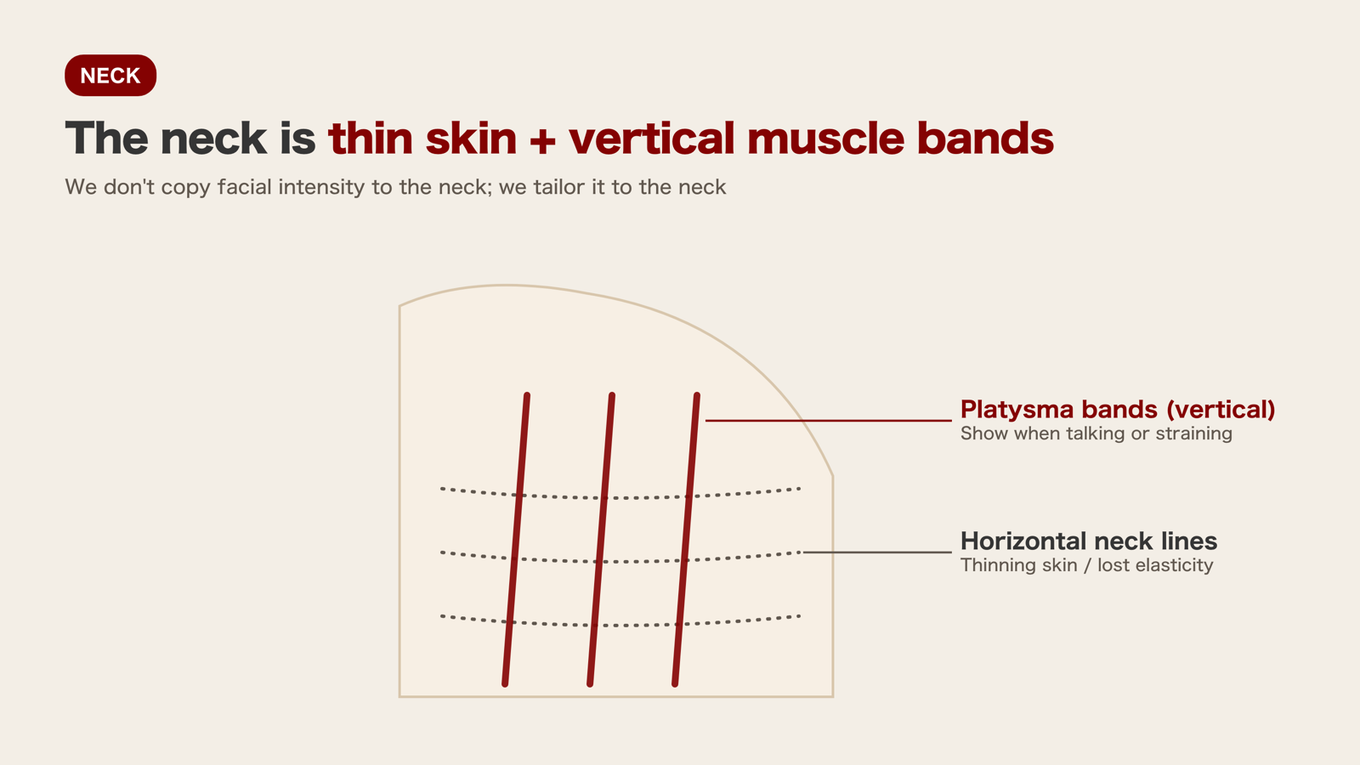
The neck involves thin skin and prominent vertical muscle (platysma) bands, so it requires methods tailored specifically to the neck, separate from facial lifting. Lifting only the face can highlight the boundary with the neck.
Neck sagging occurs in two ways. One is horizontal wrinkles from thinning and loosening skin (neck lines), and the other is the prominent platysma muscle bands that show vertically when talking or straining. Different causes require different approaches.
The neck has thinner skin and more movement than the face, so facial lifting intensity shouldn't be carried straight over to the neck. That's why the neck needs its own plan, not just an extension of facial lifting. The approach and results vary significantly per individual, emphasizing the need for a tailored approach.
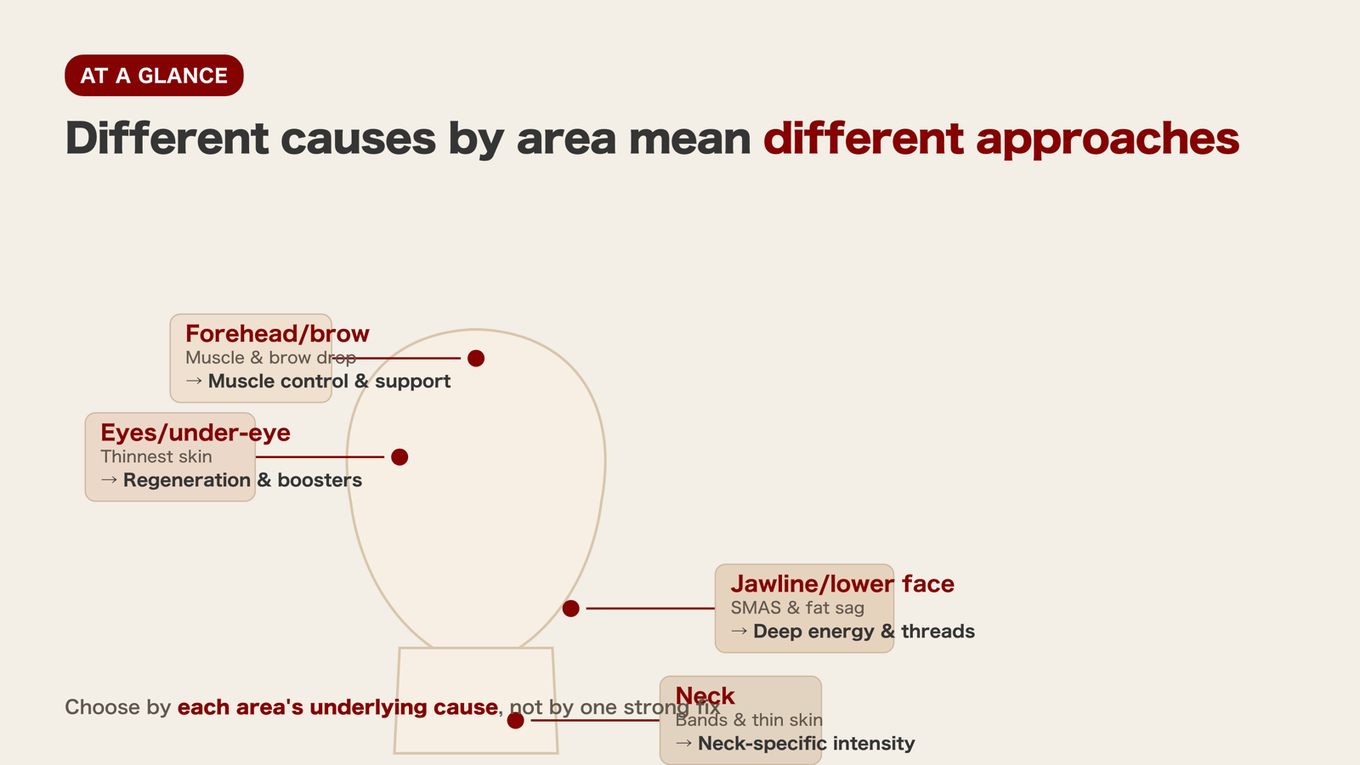
Lining up the criteria makes it clearer. Each area has different problematic layers, leading to varied approaches.
| Area | Main Cause of Sagging | Primary Approach Considered |
|---|---|---|
| Forehead/Eyebrows | Muscle movement, eyebrow droop | Muscle control, forehead/eyebrow support |
| Eye area/Under-eye | Exceptionally thin skin, texture/volume | Regeneration/skin boosters, delicate volume |
| Jawline/Lower face | SMAS sagging, fat shift | Deep-reaching energy/thread lifting |
| Neck | Thin skin, platysma bands | Neck-specific intensity, muscle control |
As shown in this table, lifting means solving a different layer's problem in each area with its own method. That's why several areas of concern lead to several methods. The clinic isn't upselling; there are simply several separate causes to address.
Identifying "the most noticeable change" on your face and which layer's problem it is can help set the order. It's better to focus on the area with the most significant cause rather than trying to tackle everything at once.
Standing in front of the mirror, you can break it down like this:
And there's one common misconception to remember. "Stronger is better" is often not true. For thin areas like the eye and neck, excessive energy can lead to fat atrophy or unnatural results. The outcome is determined by the method and depth suited to the cause, not by using the strongest option. Rather than searching for "the strongest one," choose what fits each area for your lifting needs.
If you're curious about area-specific approaches or safety standards, you can also refer to resources like the Korean Dermatological Association. However, the extent of sagging in your skin layers must be assessed in person, as it significantly varies per individual.
Different areas have varied sagging layers and causes, so one method won't uniformly lift the entire face. The jawline involves deep support layers, the eye area has thin skin, and the neck includes muscle bands, requiring different approaches. Multiple concerns naturally lead to multiple methods.
They are interrelated. The frontalis muscle that lifts the forehead and the height of the eyebrows are connected, so drooping eyebrows often accompany forehead wrinkles and heavy eyelids. However, horizontal wrinkles are about muscle movement, while eyebrow droop concerns support layers, thus the approaches are distinct.
Under-eye hollowness is more about filling or regenerating the thin texture than pulling it up. The eye area, being the thinnest, often benefits more from skin boosters or delicate volume approaches, and results vary by individual.
The neck has two primary causes. Thin skin and horizontal wrinkles can be addressed with energy lifting tailored for the neck or skin boosters, while vertical bands are managed through muscle control approaches. The key is not to carry facial intensity straight over to the neck, but to adjust it specifically for that area.
No. The outcome depends on the method and depth suited to the cause rather than strength alone. For thin areas like the eye and neck, excessive energy can cause fat atrophy or unnatural results. Therefore, intensity and methods are tailored for each area.
The reason lifting differs by area is that the forehead, eyes, jawline, and neck have different layer issues. The forehead involves muscle and eyebrow balance, eyes involve notably thin skin texture, jawline involves deep support layers and fat, and the neck involves thin skin and muscle bands. Different causes mean different target areas and methods.
Therefore, lifting is about assessing which layer on your face has sagged first and matching it accordingly. This is why a "one-size-fits-all strongest approach" doesn't work well. Identifying which change stands out in the mirror first helps you determine what to address. Once you make that assessment, it becomes easier to understand why various suggestions were made.
#NonSurgicalFacelift #SkinTightening #JawlineLifting #NeckLifting #ForeheadLifting #EyeLifting #HIFULifting #RFLifting #SMAS #CollagenBooster #SkinBooster #Ultherapy #Thermage #ThreadLifting #SeoulDermatology #MyeongdongClinic #ForeverClinic