

Blog
Informasi khusus untuk kesehatan kulit
Informasi khusus untuk kesehatan kulit
Plenty of people come back from a summer trip and immediately double up on brightening ampoules and start exfoliating far more often. The pigment looks like it is surfacing, and that makes you want to move fast.
But there is a line I hear a lot at our clinic in Myeongdong, Seoul around this time of year: "I am using more brightening products than ever, so why won't it fade?" That single question holds the whole reason at-home brightening tends to stall. Pigment doesn't clear faster because you push harder, and pushing too hard can bring it right back up.
Here is the short version. Some pigment fades with brightening creams, and some pigment sits where no amount of cream really reaches. Push your home care too hard without telling those two apart, and you can end up feeding the very pigment you meant to fade. Today I will walk through how we tell where that line falls, and the at-home brightening mistakes I see most after a holiday.
Key Takeaways
- Most brightening ingredients act on the stage where melanin is newly made in the epidermis.
- So shallow surface pigment has room to improve, while pigment settled deep in the dermis is hard to lift with creams alone.
- Over-exfoliating, layering brightening ampoules, and DIY peels build up irritation that can trigger post-inflammatory hyperpigmentation (PIH).
- Skin that just took a lot of UV, like right after a holiday, is especially reactive, so calming and barrier repair come before you tackle pigment.
- Even with brightening actives on, skipping sun protection lets new pigment form and cancels out the work.
- Because approach depends on the depth and type of pigment, results vary a lot from person to person.
When pigment starts to bother you, most people do one of two things: add more brightening products, or try to scrub the surface off.
I get the instinct. Doing something feels like it should fade things faster. But this is exactly the trap. Skin right after a holiday has soaked up a lot of UV and is already sensitized. Layer more actives on top of that and scrub away the surface, and you are not fading anything, you are just adding irritation.
Pigment doesn't leave faster because you rush it. If anything, irritation makes the skin produce melanin again as a defense response. So at-home brightening is less about "what more can I add" and more about "where is my pigment sitting right now." That question comes first.
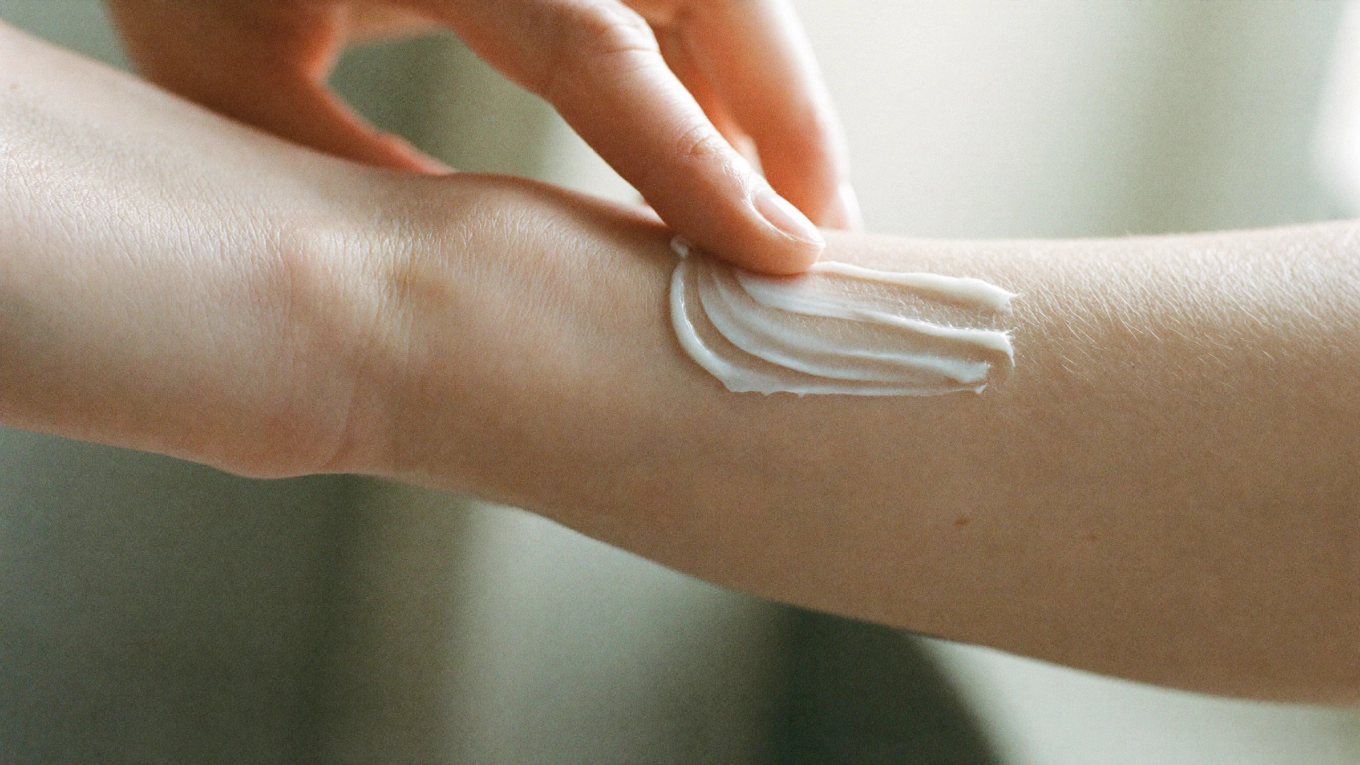
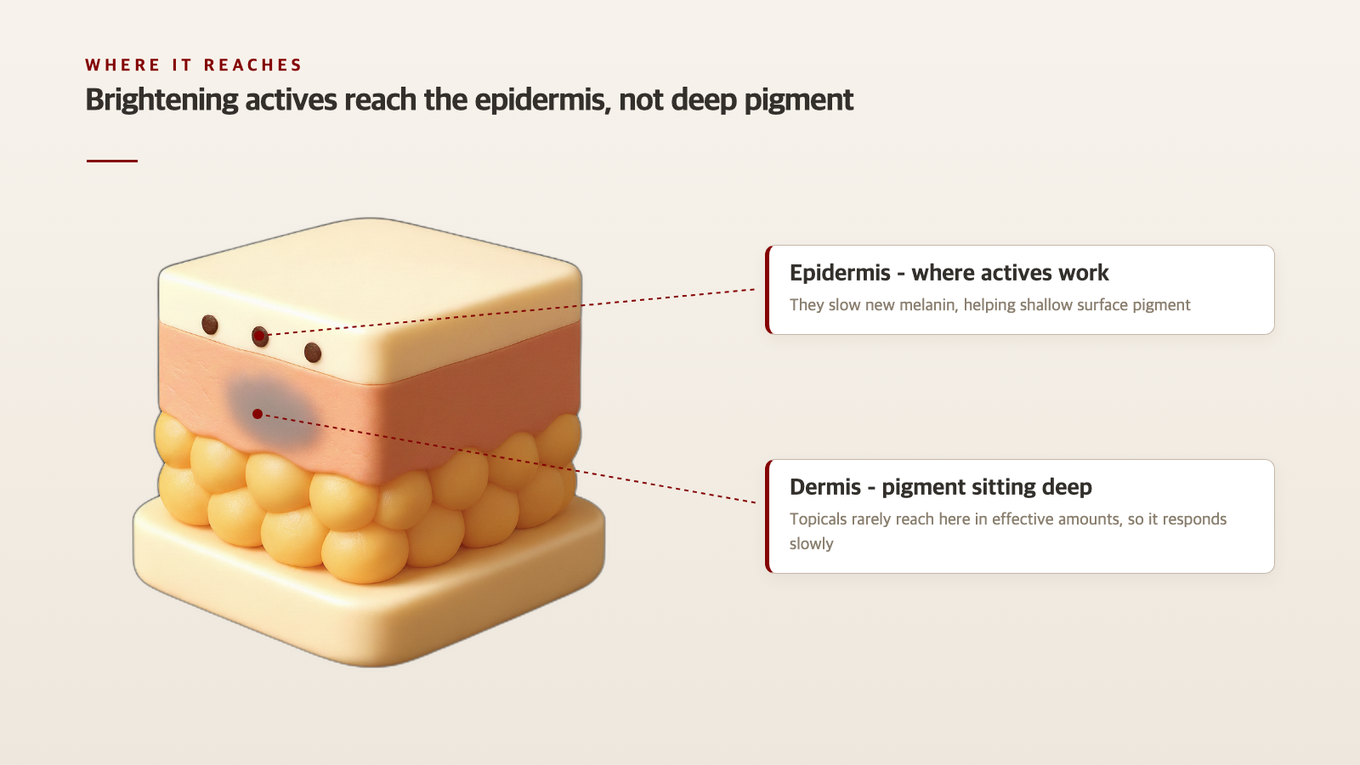
Most brightening ingredients act on the epidermis, at the stage where melanin is newly made. They can't physically lift pigment that has already settled deep in the dermis.
Let me unpack that a little. Different actives grab a different point in the process. Arbutin and vitamin C derivatives work by inhibiting tyrosinase, the enzyme that makes melanin, while niacinamide slows the transfer of finished melanin into the surface skin cells. The routes differ, but they all do their work along the path where pigment is formed and rises in the epidermis. So shallow pigment has room to fade with steady care.
The dermis is the problem. It sits below the epidermis, and topical ingredients struggle to reach that depth in an effective amount. That is why old, blurred, spread-out pigment and the pigment that shows through with a bluish cast respond so slowly no matter how faithfully you apply your creams. It isn't laziness. The layer your ingredients reach is simply a different one.
"So is my pigment in the epidermis, or in the dermis?"
Why that split (epidermal vs dermal) sets the pace of the response is something I covered in detail, from the pigment side, in Why Melasma Darkens After Summer. Today we build on that and look at what to do at home, and what to leave alone.
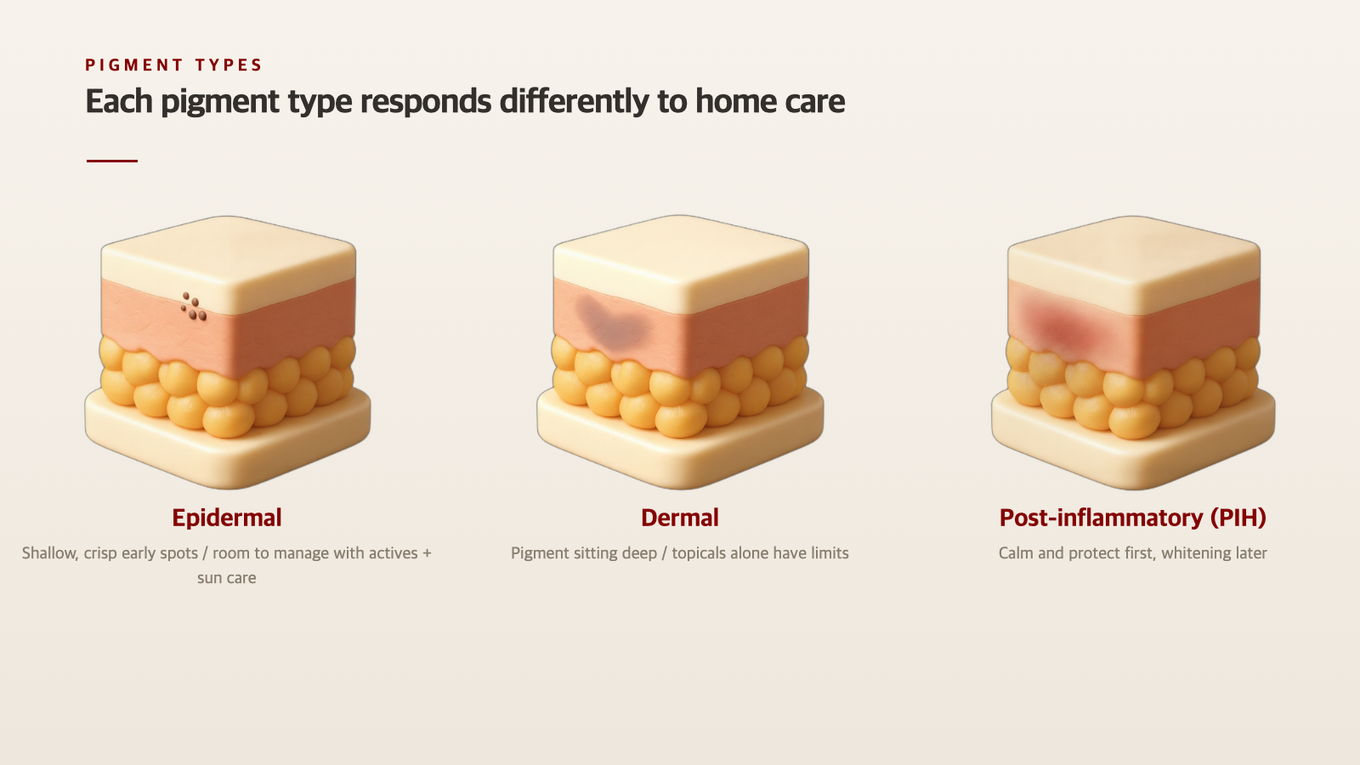
Once you know the mechanism, you have a way to judge. You can get a rough sense of whether your melasma or pigment is something you can work on at home, or whether it calls for a medical approach.
| Type of pigment | Closer to | What to expect from home brightening |
|---|---|---|
| Shallow early spots with crisp edges | Epidermis | Room to manage with actives + sun protection |
| Blurred, bluish, spread-out pigment | Dermis | Creams alone have limits |
| Pigment that surfaced after irritation (PIH) | Post-inflammatory, varied depth | Calm and protect first, brightening later |
| Wide, deep, mixed pigment | Epidermis + dermis | Home care is a support; needs a layer-by-layer approach |
⚠️ Please note - Don't use this table to self-diagnose. Dermal pigment and leftover PIH in particular are hard to tell apart by eye, and mistaking either one for the epidermal type and pushing hard is the fastest way to make things worse. Read the table only as a way to understand why the response speed differs.
Trying to fade pigment and darkening it instead really does happen. It usually starts with one of these four.
Exfoliating too often - A scrub or home peel makes skin look smooth for a moment. But repeat it often and the skin barrier thins, and a thinned barrier is more vulnerable to UV and irritation. That irritation piles up, and the pigment surfaces instead.
Layering high-strength brightening ampoules - Stack several "must-have" ampoules or push high-dose vitamin C and acids every day, and irritation builds up faster than any active benefit. When irritant contact dermatitis passes and leaves pigment behind, that is post-inflammatory hyperpigmentation (PIH), the pigment that comes back up after irritation.
DIY peels like a lemon pack - Putting acids or fruit acids on your face at home is risky because you can't control the concentration or the timing. Lemon and other photosensitizing ingredients in particular can meet sunlight and drive pigment up instead of down.
Brightening hard, sun protection loosely - This is the most common one. However much you fade, UV keeps making new melanin and you end up back where you started. Fading and blocking are one set; miss the blocking and the rest of the effort is canceled out.
💡 To sum up - For skin that is already sensitized, like right after a holiday, taking irritation away one piece at a time also lowers the odds of pigment coming back. Calming and barrier repair are the groundwork for tackling pigment in earnest.
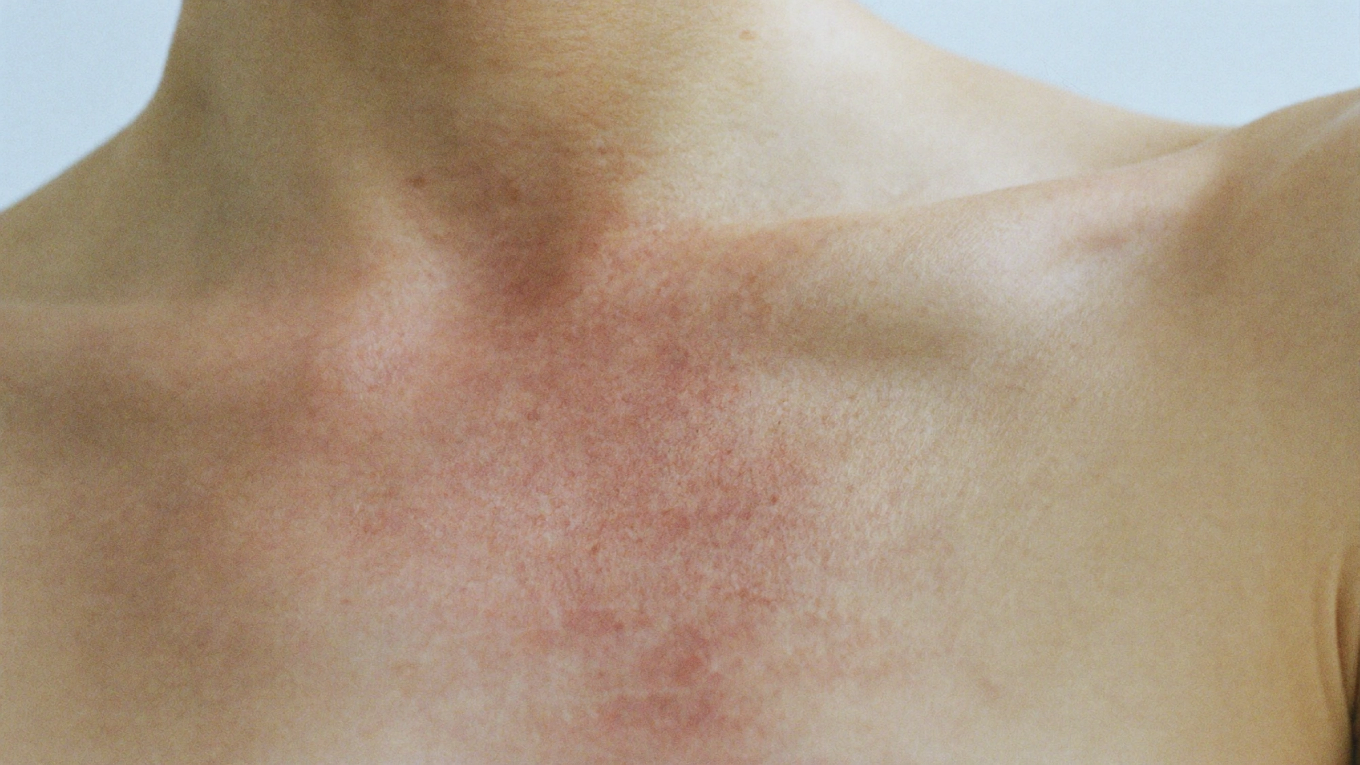
You don't need to start anything grand. Taking away what you have been doing comes first.
Even so, blurred spread-out pigment, old melasma, and PIH that surfaced after irritation often respond slowly to home care alone. That is when you start to consider a medical approach that works on pigment directly, and laser toning like Pico Toning (Pico K), which selectively shatters only melanin into fine particles, is one such method (the mechanism is covered in detail in the pigment article linked above). A laser isn't a cure-all, though. For dermal-type pigment or PIH, going too hard can bring the pigment right back, so checking the type first and starting at a low intensity is the premise.
What matters is the order. Get a rough read on which side your pigment is closer to, and if the skin is sensitized, lead with calming. Hold to just that, and you avoid most of those "I tried to fade it and darkened it" situations.
Melasma involves several tangled factors like UV and hormones, so it is hard to say creams alone will clear it completely. Brightening actives work on the stage where new pigment is made in the epidermis, so shallow pigment can respond to care, while pigment settled deep in the dermis is slower. The result and the pace depend on the type and depth of pigment and on individual differences.
Done often, it tends to do the opposite. Frequent exfoliation thins the skin barrier, and when irritation builds up in that state, pigment can come back as a defense response. Especially for skin that is sensitized right after a holiday, calming and moisture come before exfoliation.
More ingredients don't scale up the effect. Layering several high-strength products tends to accumulate irritation faster than active benefit, and pigment can be left behind where the irritation passed, as post-inflammatory hyperpigmentation (PIH). Using something steadily, within what your skin can tolerate, works better than piling on products.
Pigment with blurred, bluish, spread-out edges, or pigment that is old or surfaced after irritation, tends to respond slowly to home care alone. But dermal-type pigment and PIH look similar and are hard to tell apart by eye; in practice the type and condition need to be checked in a consultation to be accurate.
Autumn and winter, when UV eases off, are seen as relatively favorable, but more important than the season is calming sensitized skin first and protecting from UV consistently. Rather than starting strong care right after a holiday, it is safer to approach it once the skin has settled.
If your melasma looks darker after a holiday and you push brightening creams harder, you can end up drawing out the very pigment you meant to fade. Brightening actives work on the stage where pigment is made in the epidermis, so shallow pigment responds to care, but they don't reach pigment settled deep in the dermis very well.
That is why order matters. For sensitized skin, calm first; sun protection, every day; for shallow pigment, low-irritation brightening actives, steadily. For blurred old pigment and pigment that surfaced after irritation, it is better not to force it with home care alone and to look again at the approach.
Next time you pick up a brightening product, take a second to ask, "is this pigment closer to the epidermis, or the dermis?" That one distinction separates home care that spins its wheels from home care pointed the right way.
#PostVacationMelasma #DarkSpots #Hyperpigmentation #BrighteningCream #HomeCare #EpidermalPigment #DermalPigment #PIH #SeoulDermatology #ForeverClinic