

Blog
Expert tips for healthy skin
Expert tips for healthy skin
As summer ends, many of us notice new shadows on our skin or find existing melasma has become more pronounced.
Around this time, we often hear questions like, "Why does it get worse after summer?" The straightforward answer is: it's due to UV exposure continuously stimulating the melanin in your skin throughout the summer. How deeply this pigment settles affects how it can be lightened.
Today, we'll go over why pigmentation darkens and how laser toning can lighten it. Understanding the principles can help you determine which approach is best for your melasma.
Key Points at a Glance
- Melasma darkens after summer because UV rays stimulate melanin production.
- Pigmentation can be superficial (epidermal), deep (dermal), or mixed, affecting how quickly it responds to treatment.
- Laser toning targets melanin specifically, breaking it down finely with minimal heat spread.
- Treatments are spaced out to avoid cumulative irritation and prevent post-inflammatory hyperpigmentation (PIH).
- Post-treatment, UV protection is crucial to prevent recurrence of pigmentation.
- Results vary greatly depending on pigment depth/type.
Let's start with what melanin is. Melanin is a protective pigment that your skin produces to shield itself from UV rays.
When UV light hits the skin, melanocytes ramp up production, pushing the pigment upwards to form a natural sunblock. However, when UV exposure is intense and prolonged, like during summer, this protective response can lead to excessive melanin clustering in certain areas, which results in what we commonly see as melasma or dark spots.
"Why does it darken even with sunscreen?"
UV rays can penetrate through windows and reflect off surfaces, so complete protection is challenging. The cumulative exposure during summer becomes visible as pigmentation in autumn.
💡 Simplified - Melasma can be seen as a mark of your skin's diligent effort to block UV rays, not a sign of negligence. The approach should focus on lightening existing pigment and preventing new formation.
For more on how summer affects not just pigmentation but also collagen and skin barriers, see our Late Summer Reset Treatments. Today, we'll delve into pigmentation and how laser toning addresses it.

Melasma may look alike, but its characteristics vary depending on how deep the pigment sits. This depth affects how quickly it responds to treatment.
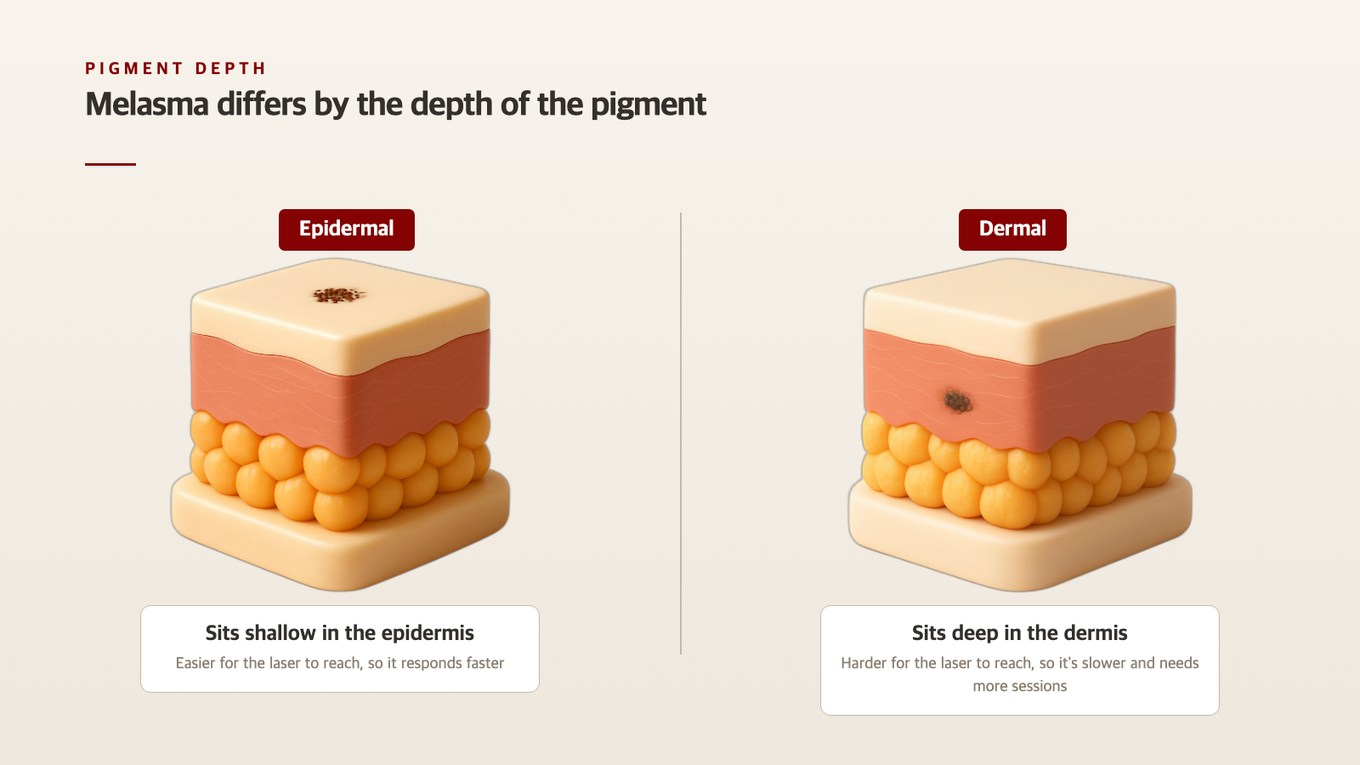
| Type | Pigment Depth | Appearance | Response Tendency |
|---|---|---|---|
| Epidermal | Shallow (epidermis) | Relatively sharp borders | Responds relatively quickly |
| Dermal | Deep (dermis) | Bluish/blurred | Slower response, requires more sessions |
| Mixed | Both shallow and deep | Dark and widespread | Requires layered approach |
⚠️ Note - The deeper the pigment, the harder it is for laser energy to reach it. Overly aggressive treatments can cause irritation and lead to rebound pigmentation. Identifying the type first is essential, but actual diagnosis and approach depend on individual skin condition.
The core principle is simple: Target melanin specifically, breaking it down finely while sparing surrounding tissue.
Lasers emit light at specific wavelengths that pass through clear tissue but are selectively absorbed by dark melanin. This absorption delivers a brief, intense shock to the melanin, breaking it into tiny fragments. These fragments are then gradually eliminated through the skin's metabolic processes.
Especially, pico-second lasers (one trillionth of a second) break down pigment before heat spreads to surrounding areas, minimizing thermal irritation. This approach is gentler on sensitive skin or melasma, and it underlies pigment-focused laser toning treatments such as Pico Toning (PicoK) and Lucas toning.
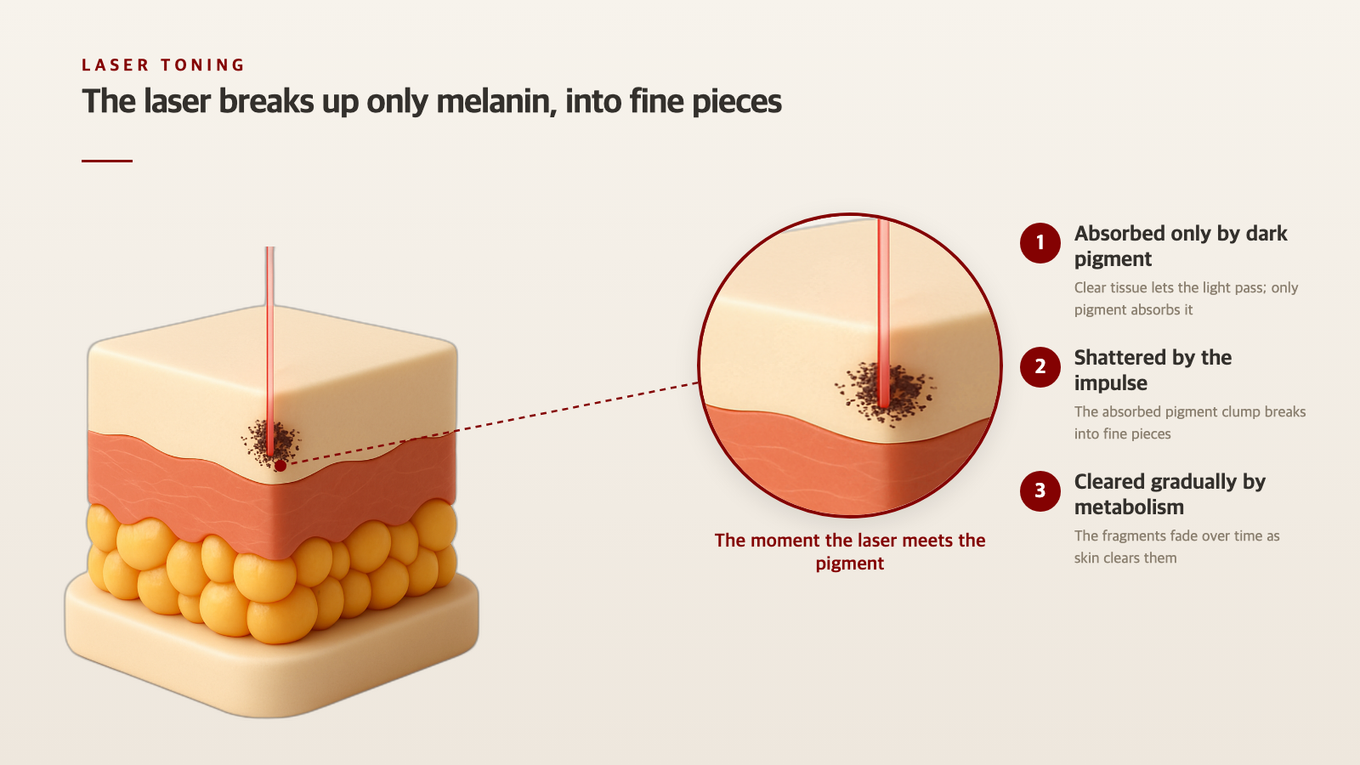
💡 Think of it like - targeting only the dark spots on a wall, breaking them into fine dust, which can then be gently cleaned away without scrubbing the wall hard.
A common misconception is that "stronger treatment means faster results." The reality is quite the opposite.
Applying high energy in one go can irritate not just the pigment but the surrounding skin as well. This can trigger a defense mechanism where the skin produces more melanin, leading to rebound pigmentation (PIH).
Therefore, treatments are designed to use low energy to break down pigment gradually, with intervals allowing the skin to recover. The exact number of sessions and intervals depend on the type of pigmentation and individual skin condition, with significant personal variation.
After toning, the skin is more sensitive to UV rays due to pigment treatment. If exposed to UV during this sensitive period, newly lightened areas can quickly repigment.
Remember the two-prong approach: lighten and prevent. While lasers handle the lightening, UV protection prevents new pigment formation. Neglecting either makes long-lasting results challenging. This is why the best time for pigmentation treatment is often considered to be fall and winter when UV exposure is lower.
Understanding the principles helps you make informed decisions. Here's a summary:
These are guidelines, and a professional evaluation is necessary for accurate diagnosis and treatment planning. Remember, understanding the principles helps you navigate treatment options, but it's not a self-diagnosis tool.
Melasma involves complex factors like UV exposure and hormones, so saying it's completely removable in one go is unrealistic. Laser toning aims to gradually break down existing melanin while UV protection prevents new pigment. Results and speed vary based on pigment type/depth and individual differences.
Aggressively targeting pigment with high energy can stimulate surrounding skin, triggering melanin production and resulting in rebound pigmentation (PIH). Using low energy to gradually break down pigment while allowing recovery is safer, which is why treatments are spaced out. The exact regimen varies per individual.
Epidermal pigment is easier for laser energy to reach, so it tends to respond quicker. Dermal pigment is deeper, requiring more sessions. Identifying the type guides the treatment approach.
Immediately after treatment, pigment may temporarily rise to the surface, appearing darker. Lack of UV protection can also lead to actual darkening due to PIH. The specific cause depends on skin condition and treatment history.
Fall and winter are ideal due to lower UV exposure, but consistent UV protection is crucial post-treatment as the skin becomes more sensitive to UV. Seasonal timing is discussed further in our Early Autumn Recovery Treatments.
Post-summer melasma darkening results from UV stimulating melanin. How it lightens depends on whether it's superficial or deep.
Laser toning breaks down melanin into fine particles over multiple sessions, with UV protection preventing new pigment. Lightening and prevention form the backbone of pigmentation management.
If you're bothered by melasma, understanding these principles can make future discussions on pigmentation less daunting.
#pigmentation #melasma #laser-toning #pico-toning #melanin #summer-melasma #Seoul-dermatology #Forever-Clinic