

Blog
Expert tips for healthy skin
Expert tips for healthy skin
As August gives way to September, you might feel your skin care routine isn't working as well as it did all summer. The air feels cooler, your cheeks are tighter, and post-treatment areas seem more sensitive.
It's quite common for people to notice these changes as summer transitions to early fall.
Skin that felt fine all summer can suddenly turn reactive once the weather cools.
If you've recently had a procedure or are planning one, it's time to reassess your routine. The transition from summer to early fall changes your skin's environment more than you'd expect. Yet many people carry their summer routine straight into fall, and that's where the trouble starts.
Our previous post on post-treatment aftercare covered the immediate days after a procedure. Today, we'll discuss the habits you might unconsciously maintain weeks after a treatment, especially as the seasons change.
Key Points at a Glance
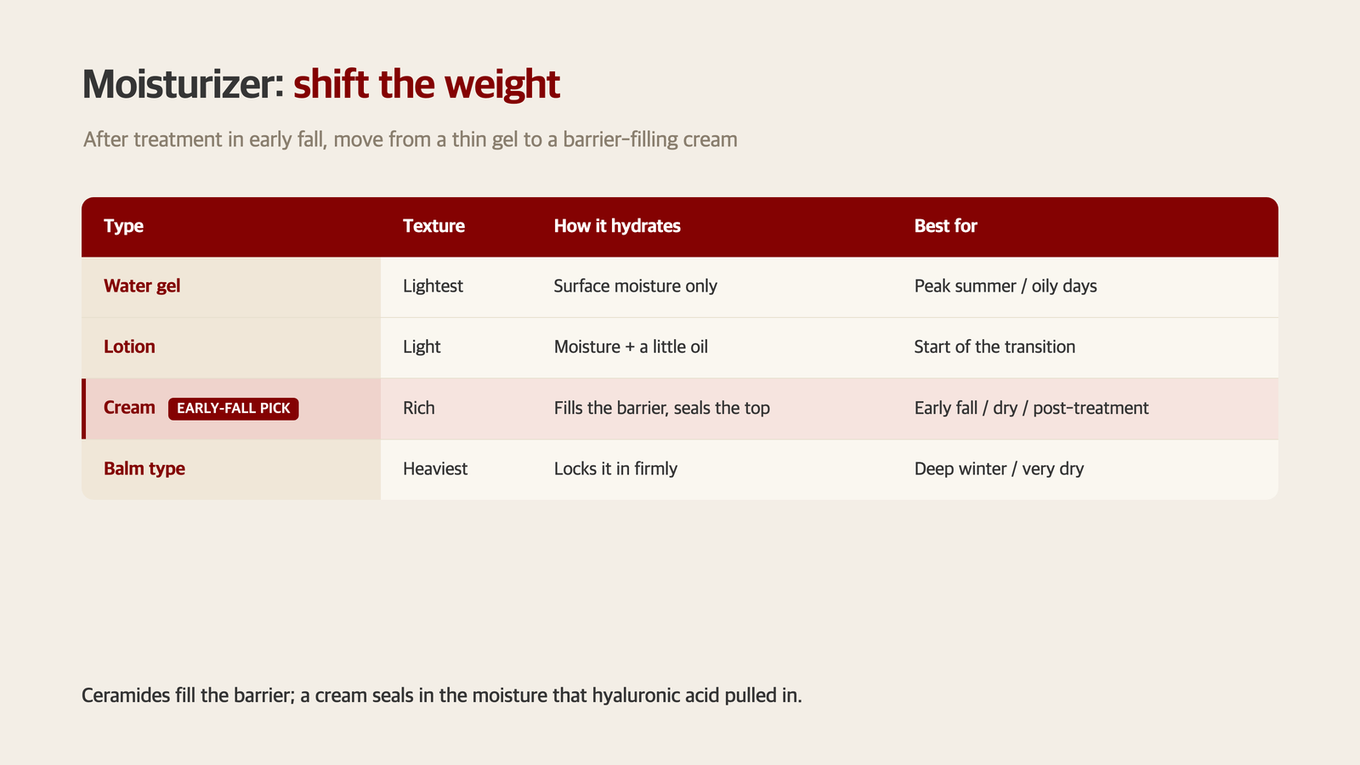
- Shift your moisturizer from a light gel toward a barrier-supporting cream.
- Ease off strong cleansers and frequent exfoliation, and switch to gentle, low-irritation care.
- Keep your daily sun protection unchanged, regardless of the season.
The biggest change is the humidity in the air. As humidity drops, your skin's ability to retain moisture shifts significantly.
In the height of summer, high humidity keeps the skin surface from drying out. But as we move into early fall, the air becomes drier, causing moisture from deeper skin layers to escape more quickly through the surface. This is known as Transepidermal Water Loss (TEWL). The lower the humidity, the greater the loss.
Adding to this, early fall is a time of fluctuating temperatures - warm days and cool mornings and evenings. This daily temperature variation can easily disrupt your skin's oil and moisture balance.
The key issue is that skin that's been treated has a temporarily weakened barrier.
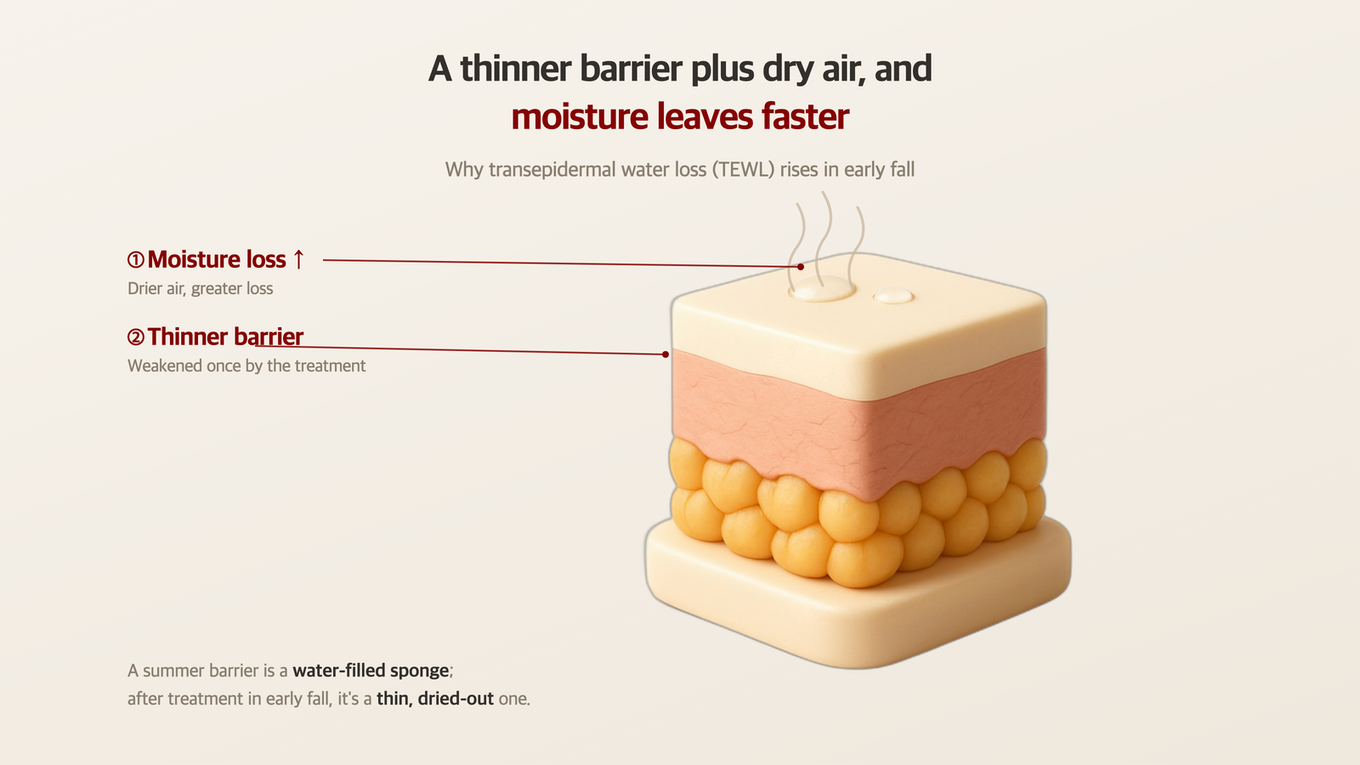
💡 Think of it this way - If a summer skin barrier is like a sponge saturated with water, a post-treatment barrier in early fall is a thinner sponge meeting dry air. Even under the same conditions, it's less able to hold onto moisture.
So during this time, you need to shift your care to suit your skin's current condition. Move from light gels to barrier-restoring creams. Your skin is already sensing the seasonal change.
Summer routines often focus on controlling oil and shine. In the drier early fall, these habits often need to head in the opposite direction. Let’s highlight five common adjustments.
1. Continuing with light gel/oil-free formulations
In summer, light moisture gels are comfortable. However, in the drier early fall, such gels may not effectively lock in moisture. Especially after treatments, it's better to shift toward formulations that enhance your skin's barrier.
2. Keeping up strong cleansing/pore care
Using refreshing cleansers and deep-cleansing all summer can strip away even the essential oils as oil production decreases in early fall. If your skin feels tight after washing, that's a sign.
3. Exfoliating to clear summer breakouts
We understand the urge to clear away summer skin issues. But over-exfoliating when your skin barrier is weakened and the air is dry can prolong sensitivity and redness. If your treatment was recent, it's best to pause.
4. Ignoring indoor humidity
In summer, indoor air can be dry due to air conditioning, but the high outdoor humidity makes us overlook this. Early fall dries out both indoor and outdoor air. Soon, heating will make indoor air even drier.
5. "Summer's over, so UV protection can slack off now"
This is the most common misconception. We’ll cover this separately.
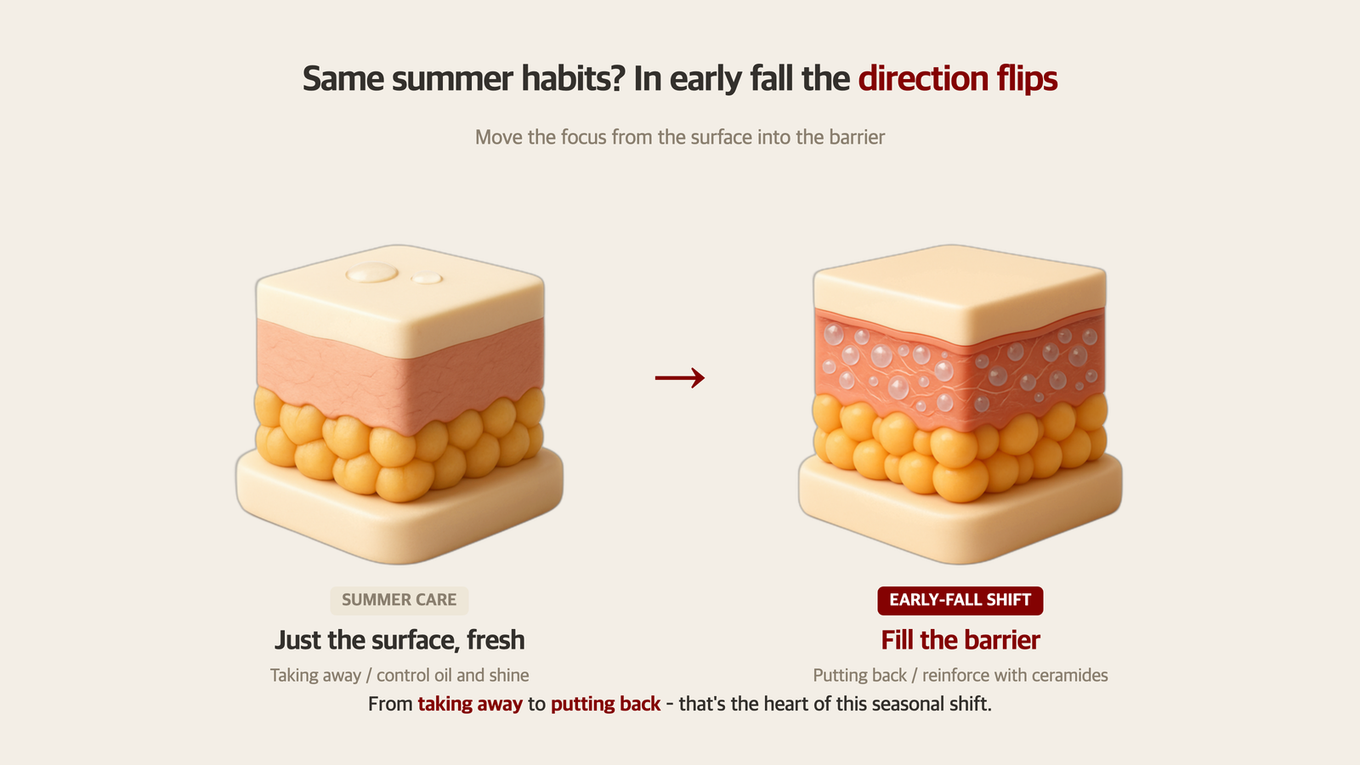
⚠️ Remember - This isn't about overturning all five habits suddenly. If you notice tightness after cleansing, makeup not sitting right, or unusually sensitive treated areas, that's when it's time to rethink your summer routine.
No, UV protection still matters in early fall. It's easy to get complacent since it's not as hot, but if your skin is recovering from treatment, you shouldn’t skip it.
There's a common misconception here. Post-summer, the overall UV exposure decreases slightly. However, the wavelengths (UVA) that penetrate deeply and affect pigmentation and aging don't fluctuate as much with the seasons. They remain nearly as strong. And as the weather cools, outdoor activities increase - outings, hikes, walks. With reduced heat, you might apply less sunscreen, effectively replacing decreased UV exposure with increased time outdoors.
Simply put, UV rays don’t disappear just because it’s cooler. They accumulate based on exposure time.
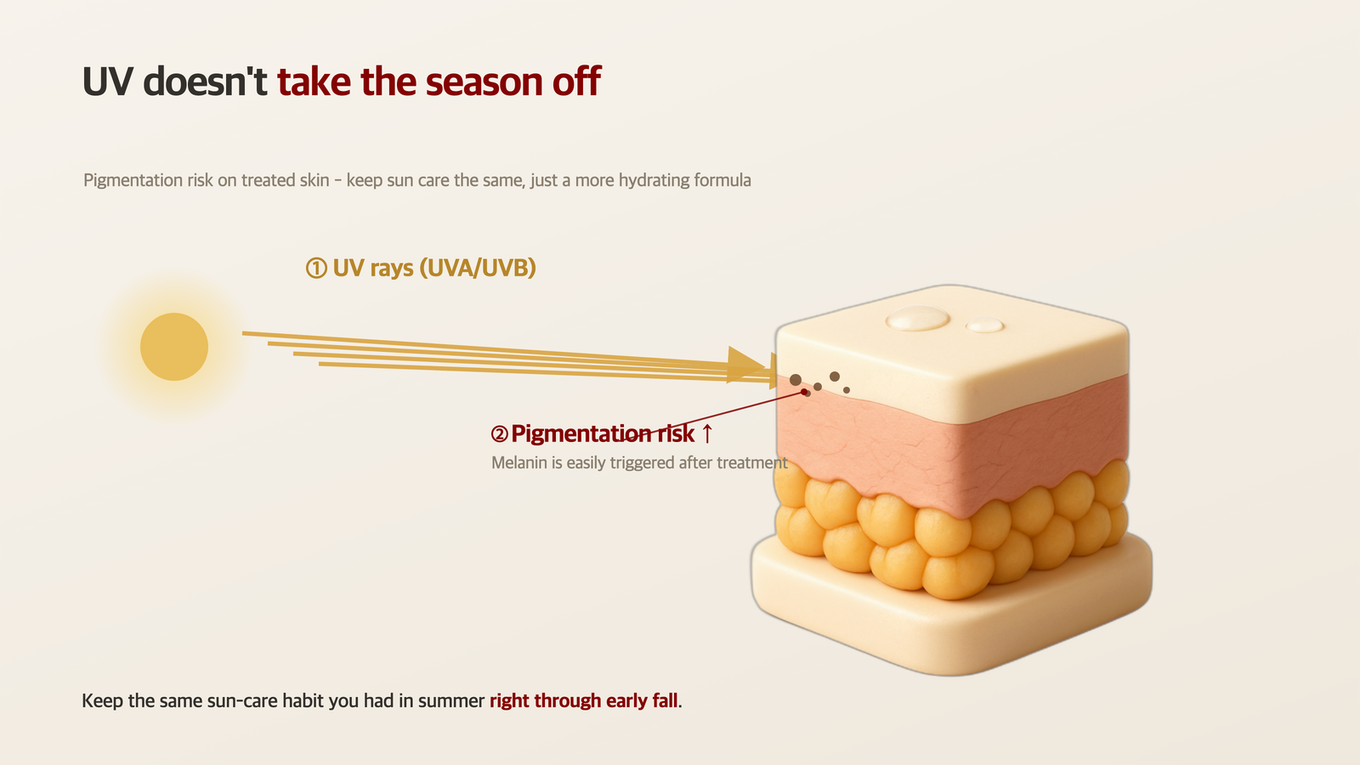
UV exposure adds to pigmentation risk on recovering skin, regardless of the season. The mechanism is explained in the linked summer aftercare post, so here we'll focus on one thing for early fall.
Keep your summer UV protection habits for early fall. Just switch to a slightly more hydrating formula to suit the drier skin. If you preferred lightweight options in summer, now opt for a moisturizing sunscreen to reduce tightness.
The key direction is simple: Shift your care to focus on replenishing and retaining moisture in early fall.
This adjustment is even more critical if your skin is recovering post-treatment. The table below is a starting point for the switch; adjust it to your skin's signals.
| Aspect | Summer Habit | Early Fall Adjustment |
|---|---|---|
| Moisturizer Type | Light moisture gel | Barrier-supporting cream |
| Cleansing | Refreshing cleanser | Gentle, mild cleanser |
| Exfoliation/Peeling | Regularly | Reduce frequency or pause |
| UV Protection | Daily, thoroughly | Maintain (switch to hydrating formula) |
| Ingredients | Oil control/pore care | Ceramides/Hyaluronic Acid focus |
If there's one thing to remember from the table, it's to shift the weight of your moisturizer - from light gels to barrier-supporting creams. Use ceramides to reinforce the barrier, and let hyaluronic acid draw in moisture that creams then seal in. In dry seasons, using moisture-drawing ingredients alone can backfire, so pairing them with a cream is the key part. At our clinic in Myeongdong, Seoul, we frequently advise this formulation adjustment for post-treatment early fall care.
For a clear step-by-step post-treatment home care routine, check out our post-procedure barrier recovery homecare guide. Revisiting it as the seasons change can be very helpful.
Yes, you can still undergo treatments. In fact, early fall can be advantageous for certain procedures, provided the aftercare aligns with the season.
Here's a key decision-making factor: whether your treatment is more 'UV-sensitive' or 'dryness-sensitive' will affect what you need to focus on.
For procedures like pigmentation reduction or toning, where UV exposure is a concern, early fall is welcomed. The peak summer UV burden is easing, making it easier to manage the risk of pigmentation reappearing. Conversely, treatments aimed at regeneration, like Rejuran or skin boosters, are more affected by dryness than UV. In such cases, simply adding an extra layer of moisture during recovery is sufficient.
If you postponed a treatment to get past summer, now is a good time to start. For more on which treatments suit this time, refer to our guide on choosing late summer reset treatments.
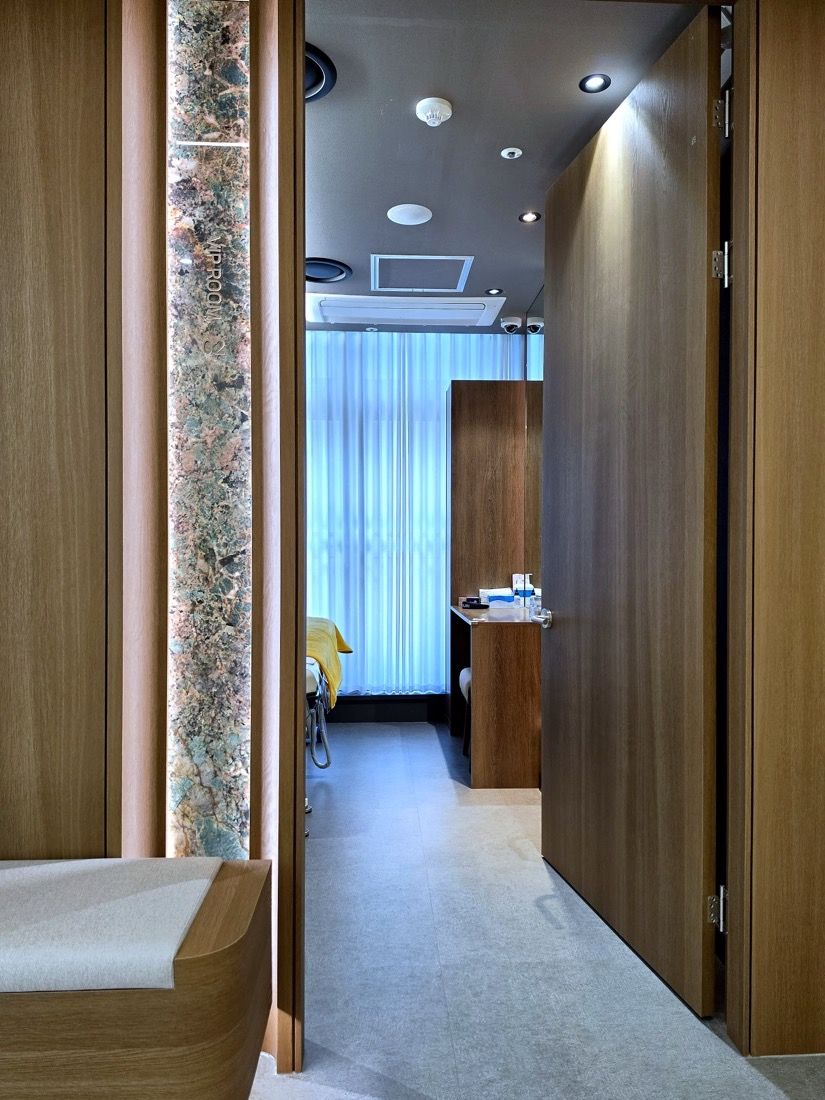
🩺 Doctor's Note - At Forever in Myeongdong, many patients return with sensitivity issues around this time of year. It's often due to aftercare not adapting to the seasonal change, rather than the treatment itself. I recommend considering the seasonal environment during the recovery phase, just as much as planning the treatment date.
Q. My skin is sensitive due to the seasonal change, should I postpone my planned treatment?
Not necessarily. If the sensitivity is due to dryness, you can stabilize the barrier with extra moisture before proceeding. However, if the sensitivity is severe, it's best to inform the treatment provider and adjust the timing according to your skin condition.
Q. Do I need to switch from my summer moisture gel immediately?
If there's no tightness, there's no rush to switch. If you notice tightness after cleansing, makeup not sitting well, or flakiness by the afternoon, that's when you should consider moving to a cream. Let your skin's signals guide you.
Q. Can I apply less sunscreen in fall compared to summer?
The frequency of application doesn't change much. Cooler weather doesn't eliminate exposure. Especially post-treatment, maintain summer standards and opt for a more hydrating formula if needed.
Q. Shouldn't I exfoliate if my skin is flaking?
In transitional seasons, flakiness often results from dryness, so focus on moisturizing first. If you've recently had a procedure, it's safer to pause physical exfoliation. If flaking persists, consult your treatment provider.
Q. Do I need to worry about dryness if I'm mostly indoors?
Indoor air can be drier, especially from early fall onwards when cooling gives way to heating, reducing indoor humidity. Even if you stay indoors, it's wise to keep up with moisturizing.
Just as important as the treatment itself, the weeks following need to align with the season for optimal results. This is especially true if those weeks span the transition from summer to fall.
In early fall, remember these three things: ① Shift to barrier-supporting moisturizing formulations ② Pause heavy cleansing/exfoliation habits ③ Maintain UV protection as you did in summer.
A routine that worked well in summer might now be too light for your skin. Your skin feels the seasonal shift first. Pay attention to tightness after washing, makeup that doesn't sit well, or unusually sensitive days - these signs need only a few days of extra attention to help your treatment settle in effectively.
#seasonalchanges #posttreatmentcare #fallskincare #skinbarrier #moisturizing #uvprotection #myeongdongdermatology #homecare