

Blog
Expert tips for healthy skin
Expert tips for healthy skin
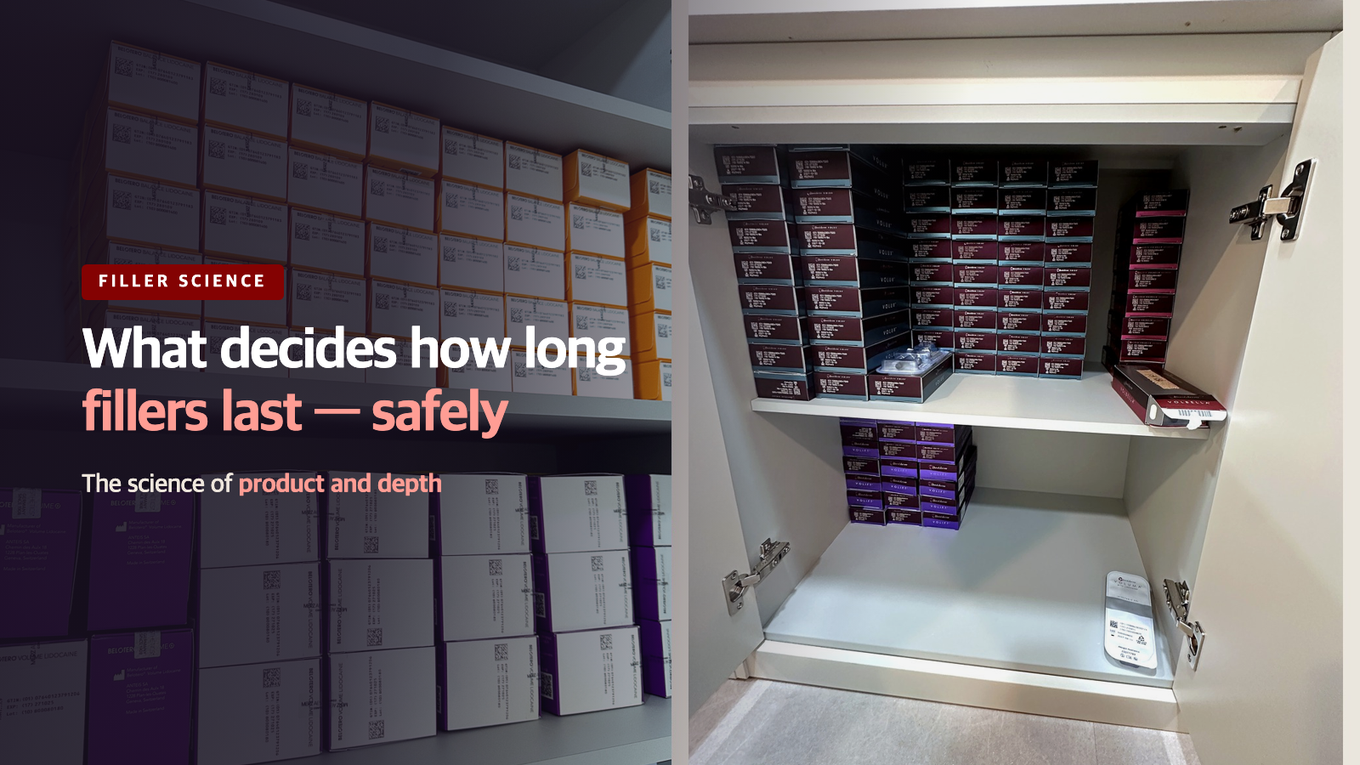
"After getting fillers, it seems like they disappeared after a few months. Is that normal?" "I’ve seen some scary filler side effects on the news. Are fillers safe?"
When dermal fillers come up at our clinic in Myeongdong, Seoul, these two questions usually come up together - one about longevity, the other about safety. They feel like separate worries, but they're closely linked by the same two factors: the properties of the product and the depth it's placed at.
Today, let's break down why these two factors are key to both longevity and safety. This isn't about recommending specific products. Understanding these principles can shift your thinking from "All fillers are the same" to "Which type suits my area best?"
Key Takeaways
- How long a filler lasts comes down more to its rheology (firmness/cohesivity/cross-linking) and injection depth than to the brand.
- Firmer fillers last longer when injected deeply, while softer fillers offer a natural look but absorb faster when placed more superficially.
- A "long-lasting filler" is really a matter of matching the right properties and depth to the right area.
- Safety hinges on anatomical knowledge, careful technique, and genuine products.
- A safety advantage of hyaluronic acid (HA) fillers is that they can be dissolved if needed.
Let’s clear up a common misconception first. Many people assume that "if it faded fast, it must have been a cheap or low-quality filler," but that's not always the case.
Even with the same filler in the same person, how long it lasts can vary a lot depending on where and how deeply it's injected. Areas like around the mouth, which move constantly, exert more force on fillers, causing them to disperse and break down faster. In contrast, fillers in less mobile, deeper areas like the jawline or cheekbones tend to last longer.
So if a filler seems to disappear quickly, it isn't necessarily the product's fault. It's often a matter of the area's movement, the injection depth, and whether the filler’s properties suited the area.

Areas like around the mouth, which move constantly, exert more force on fillers, causing them to disperse faster.
This is the heart of it. How long a filler lasts is driven more by its rheology than by the brand name. It sounds technical, but it really comes down to three things:
You can tune these three separately, but in real products they usually move together. Volumizing fillers tend to be firm and cohesive, while ones meant for shallow work are softer and spread more easily.
Understanding why these properties relate to longevity requires knowing that fillers face two forces in the body: mechanical pressure from facial movements and enzymatic breakdown. The more firm (G'), cohesive, and cross-linked a filler is, the better it withstands these forces.
💡 In simple terms - Soft, loose gels are easily squashed and quickly dissolve, while firm, tightly-knit gels hold their shape and dissolve slowly. The difference in filler longevity boils down to these property differences.
The idea that a filler's rheology predicts how it behaves and where it fits clinically is supported by major reviews in the field. A review by Sundaram and Cassuto (Plastic and Reconstructive Surgery, 2013) suggests using rheological metrics (like elastic modulus) as a framework for determining how fillers integrate into tissues and which depths/areas they best suit. Higher firmness supports long-lasting volume in deeper layers, while softer, less cohesive gels integrate naturally into superficial layers.
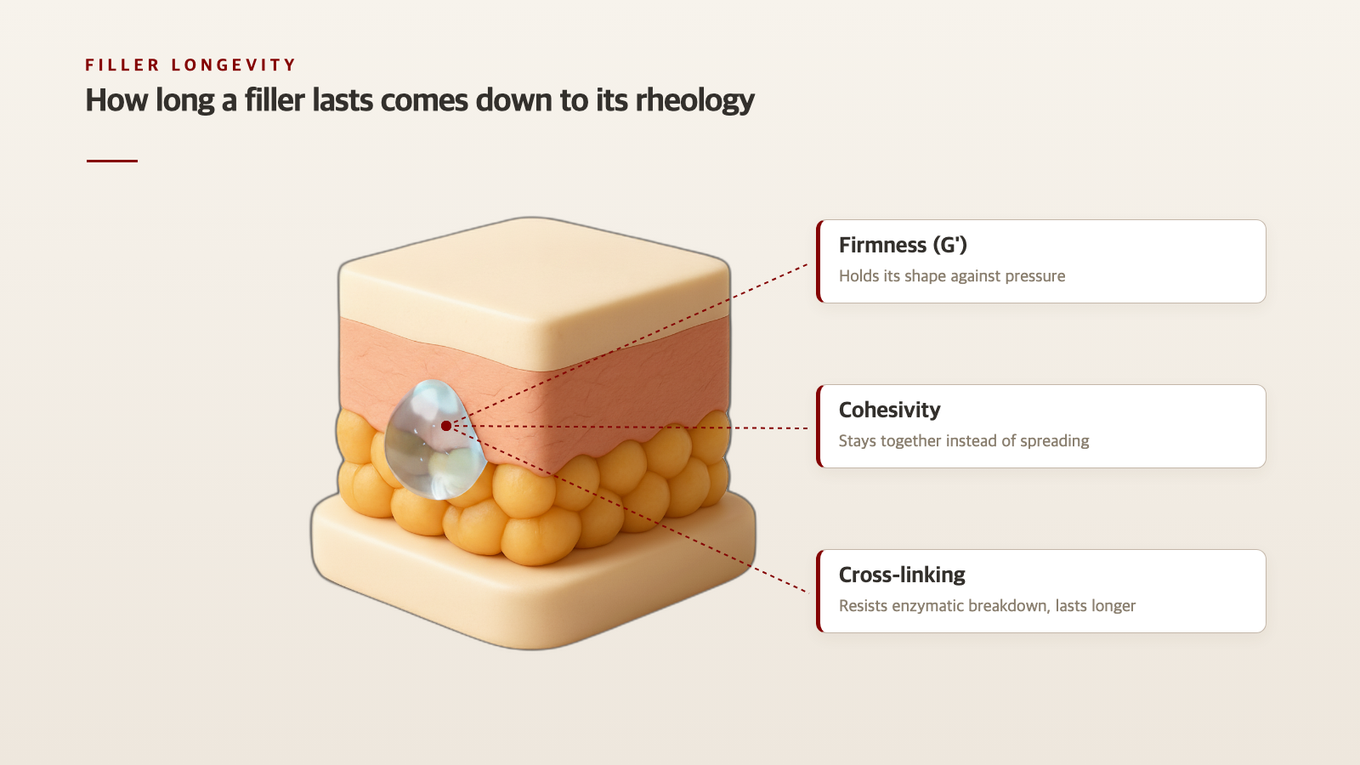
The firmer (G')/more cohesive/more cross-linked a filler, the better it withstands facial movement and enzymatic breakdown.
Once you understand filler properties, the next step is understanding depth. Even the same product can yield different results depending on the layer it’s injected into.
Here’s how it works: Firm, cohesive fillers (high G') are best for building and sustaining volume in deeper layers - atop bone or in deep fat layers. However, if placed too superficially, they might be visible or palpable. Conversely, softer, less cohesive fillers are great for subtle, thin layering in superficial areas like under-eye lines. They integrate naturally but absorb quicker.
This is why skilled practitioners consider not just "what filler" but also "which properties and at what depth" for each area. For deep volume, they opt for firm and deep; for fine lines, soft and superficial - mismatches can lead to unnatural results or faster absorption.
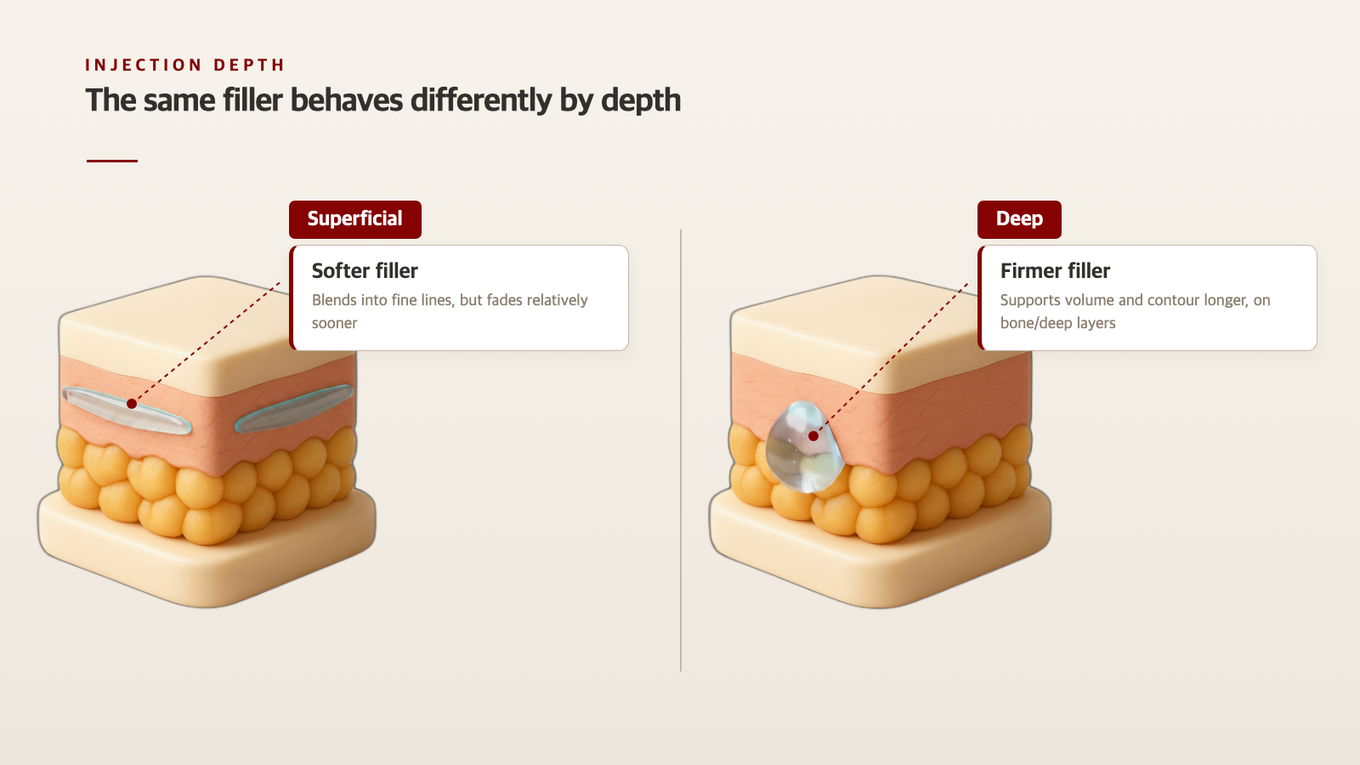
Soft fillers integrate naturally in superficial layers; firm fillers sustain volume in deeper layers. Properties and depth go hand in hand.
While longevity is important, safety should always come first with fillers. Let’s be candid. The most serious risk isn’t swelling or bruising - it’s a vascular complication, where filler ends up affecting a blood vessel. If filler accidentally enters a vessel or presses on one, blood flow to that area can be cut off and the tissue can be harmed. It’s rare, but it’s the complication we watch most closely.
So, how do we minimize this risk? By focusing on the fundamentals.
An additional safety advantage of HA fillers is being able to dissolve them with hyaluronidase if needed. Not all fillers can be reversed this way, which makes HA fillers a relatively reassuring choice for first-timers or anyone feeling nervous.

Genuine product is where filler safety starts - especially for something that stays in your body.
⚠️ Take Note - Minor swelling or bruising usually subsides within days. However, if the area becomes unusually pale or you get severe, lasting pain, tell us right away. Catching these signs early is part of staying safe. Reactions vary from person to person.
Once the principles click, you’ll naturally wonder, "So what about me?" This is the lens we use in the clinic to steer a decision. Treat it as a rough guide, not a fixed rule.
| Area/Goal | Suitable Properties | Injection Depth | Longevity |
|---|---|---|---|
| Deep volume (Chin/cheekbones/forehead) | Firmer, more cohesive | Bone or deep layers | Relatively long-lasting |
| Mid-volume (Nasolabial folds/hollow cheeks) | Medium properties | Deep dermis | Average |
| Fine lines (Under-eyes/lips) | Soft, well-spreading | Superficial dermis | Relatively short |

Different areas and goals call for different properties and depths. The right choice depends on the area.
In summary:
And remember, fillers aren’t always the answer. If sagging is your main concern, it’s better to consider lifting treatments rather than filling, and if texture or hydration is lacking, skin boosters might be more appropriate. Fillers are tools for 'filling and contouring' - keeping that in mind helps clarify direction. For insights into improving skin tone and hydration, you might also find the science of water glow skin boosters useful.
The more promising a treatment sounds, the more myths grow around it. Let’s honestly work through a few common ones.
"Do fillers last forever once injected?" - HA fillers naturally absorb into the body over time. This might seem like a downside, but it also means they can be reversed, enhancing safety. It allows for adjustments as trends or facial features change. Longevity varies greatly with properties, placement, and personal metabolism, so it’s hard to pinpoint an exact duration.
"Isn’t more filler always better?" - Not really. Over-filling can lead to an unnatural appearance. Each area needs different volumes, and natural looks come from 'the right amount in the right place'. Adjusting gradually rather than all at once often yields better results.
"Aren’t fillers and lifting the same thing?" - They target different concerns. Fillers add volume to hollow areas, while lifting raises sagging skin. If an area looks shadowed due to volume loss, fillers are suitable. For sagging, lifting is the better fit. Sometimes we combine both.

Even with the same filler, the call on properties, depth, and volume shifts with facial structure. Every plan starts from the area being treated.
🩺 Doctor’s Note - "Which filler lasts the longest?" is a question I hear often. But the answer isn’t about a specific product. Fillers last when the right properties meet the right depth for that area. And prioritizing safe application is always the first consideration.
If it feels like your filler disappeared quickly, it’s often not the product but a result of area movement/injection depth/properties matching. A firmer, cohesive, tightly cross-linked filler lasts longer when placed deeply, while a softer filler looks natural but absorbs more quickly when injected superficially.

Fillers are about filling and contouring, so the right amount in the right place looks natural.
So instead of asking "Which filler is the best?" ask "Which properties and depth suit my area?" And just as important as that call: safety rests on anatomical knowledge, genuine products, and HA’s reversibility.
Lastly, remember: Fillers are about filling and contouring, not about using more. Identify the hollow areas and what you want to contour first - that judgment comes before which filler to use.
It's hard to give a definitive answer like 'a few months'. Even with the same product, the area (more movement means faster absorption), injection depth, and individual metabolism create big differences. Generally, firm properties in deep layers last longer, while softer fillers in superficial layers have shorter durations. Accurate expectations should be set based on the area and condition.
The biggest difference is reversibility. Hyaluronic acid (HA) fillers can be dissolved with an enzyme called hyaluronidase. This means adjustments can be made if the results are unsatisfactory or there are issues, which is a significant safety advantage. At our Myeongdong clinic, we use HA-based Belotero/Juvederm.
The most serious concern is related to blood vessels. Rarely, but if a filler blocks or compresses a vessel, it can damage the tissue. That’s why it matters to know the anatomy and avoid risky areas, inject slowly at low pressure, and use genuine products. If you notice unusual pallor or severe pain after treatment, report it right away. Reactions and recovery vary from person to person, so it’s safest to check on any worrying sign, however small.
It depends on whether the concern is volume loss or sagging. If it’s about sunken areas casting shadows and aging your appearance, fillers for volume might be best. If it’s about sagging jawlines, lifting could be the answer. Often, both are combined, so first, identify whether your concern is 'volume loss' or 'sagging' to guide your decision.
#Fillers #HAFillers #FillerLongevity #FillerSafety #HyaluronicAcid #Rheology #InjectionDepth #Hyaluronidase #SeoulDermatology #ForeverClinic