
Blog
Expert tips for healthy skin
Expert tips for healthy skin
When you start researching lifting treatments, you eventually hit a fork in the road.
There's a lot of information out there about energy-based treatments like Ultherapy Prime and Thermage FLX. But 'thread lifting' keeps showing up right next to them, and while the name sounds familiar, what actually makes it different is hard to pin down.
This is a common sticking point for many patients during consultations.
"Doctor, how is thread lifting different from laser lifting?"
To put it simply: energy lifting uses heat to tighten the skin, whereas thread lifting involves physically lifting it with threads. The approaches are fundamentally different.
In an earlier post, I broke down how energy treatments split into ultrasound (HIFU) and radiofrequency (RF) here. Today I want to explain why thread lifting sits outside that group.
Here's the gist:
The biggest difference comes down to how each one moves the skin.
Energy lifting involves using ultrasound or radiofrequency to deliver heat into the skin. This heat causes collagen to contract, and over months, new collagen forms to enhance elasticity. It's a method where your skin generates the lifting force naturally.
Thread lifting, however, takes a different path. Dissolvable threads are inserted under the skin to physically lift sagging tissues right then and there. Where energy treatments wait for collagen to build, thread lifting hooks the tissue and raises it on the spot.
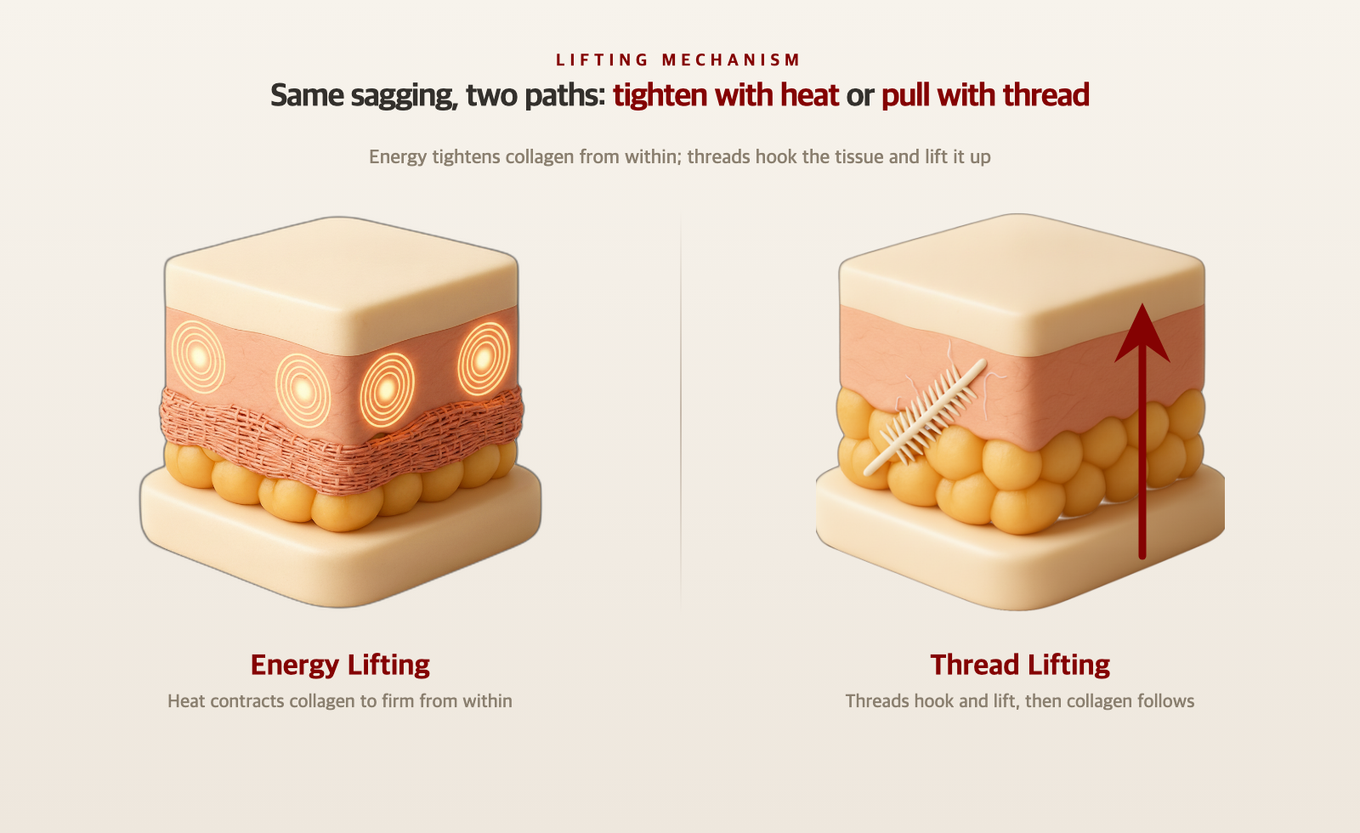
💡 In simple terms - Thread lifting is like hooking sagging curtains and pulling them up. It physically relocates the tissue.
When the sagging is already visible, heat alone often isn't enough - you need something that physically moves the tissue.
In many cases, yes - because the thread grips and pulls the tissue as it goes in, many people notice their contours looking somewhat tidier soon after (results vary by individual). The collagen that forms around the thread then takes over the support later on.
What makes thread lifting interesting is that it does two things at once.
First, it lifts the moment it goes in. Lifting threads have tiny barbs, or cogs, that grip the sagging tissue and carry it upward as the thread is drawn tight. So many people notice their contours looking somewhat tidier soon after the procedure - a clear contrast with energy lifting (results vary by individual).
Second, collagen settles in along the thread. It's understood that the body wraps around the inserted thread and lays down new collagen along its path. The thread itself dissolves over time, but the collagen it left behind stays and takes over the support.
If there's one thing I've learned doing these, it's this.
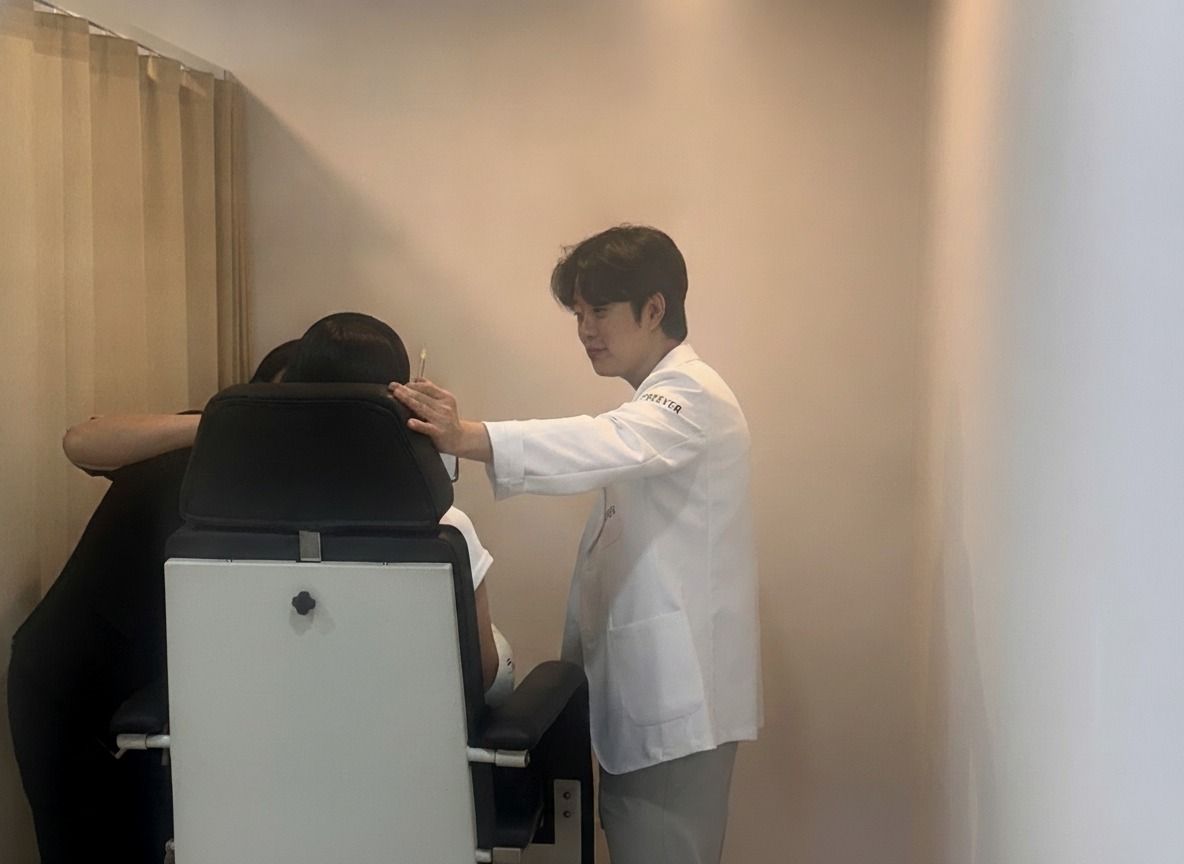
Unlike machine-based procedures, thread lifting requires manual design to determine the direction and amount of lift. Even with the same threads, the angle and vector you insert them at change the line. So in thread lifting, the design is what decides the result.
🩺 Doctor's Note - In my chair, I regularly see patients come back because their lines look off after too many threads went in. Nearly always, the pull went the wrong way for that part of the face - and every area pulls differently. That's why I settle the direction first, and count threads second.
This depends on 'what stage' your sagging is at.
There's a common misconception that thread lifting is superior to energy lifting.
Threads and energy have different ideal situations. Your starting point depends on your sagging stage.
If your skin isn't sagging significantly but you're concerned about overall elasticity/tightness, energy lifting can be less burdensome. However, if areas like the nasolabial folds or jawline are visibly sagging and need 'relocation,' thread lifting may be more suitable.
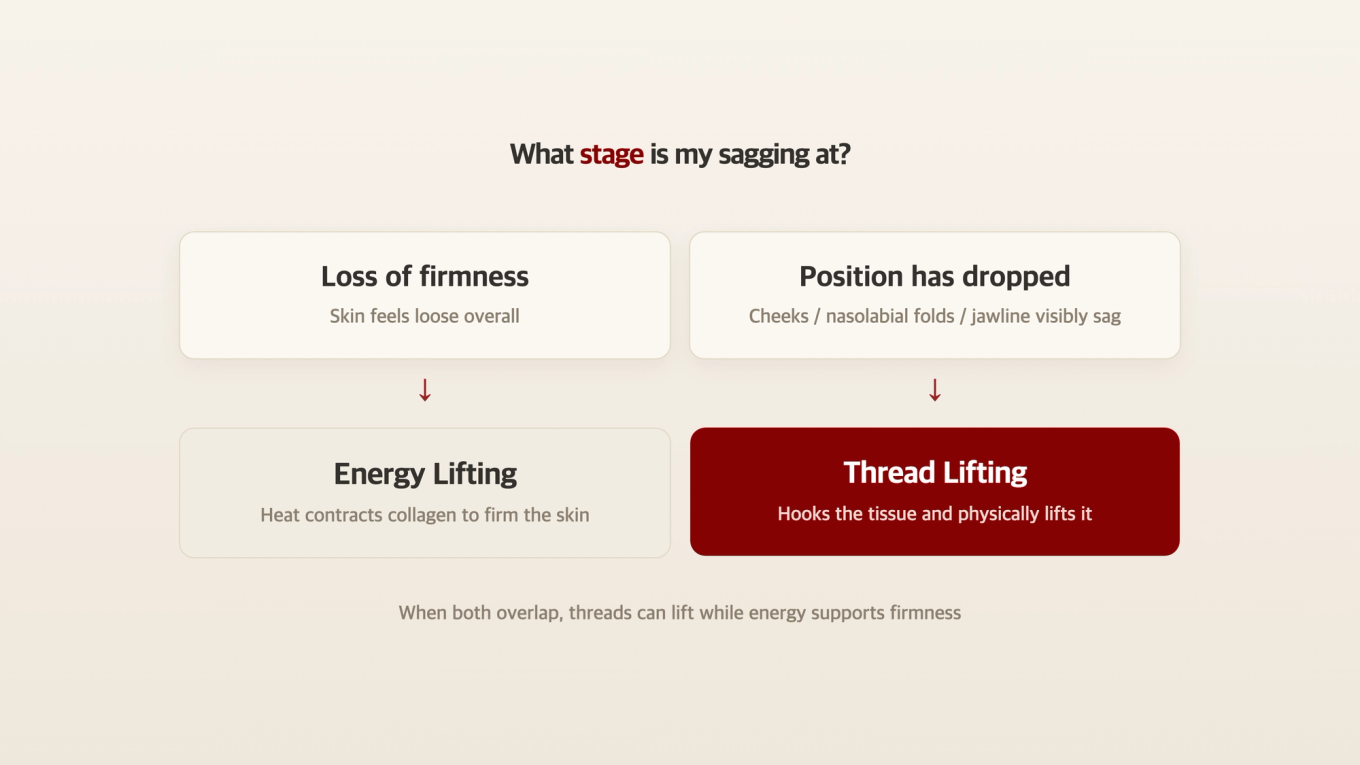
Here's a more detailed breakdown:
| If you have... | Best suited approach | Reason |
|---|---|---|
| Reduced elasticity/general tightening concern | Energy lifting | Heat tightens collagen and refines texture |
| Sagging in cheeks/nasolabial folds/jawline | Thread lifting | Physically relocates sagging tissue |
| Desire for immediate visible results | Thread lifting | Provides immediate lift (varies by individual) |
| Want to minimize downtime | Energy lifting | No insertion process, so less invasive |
| Concern for both sagging + elasticity | Combination of threads + energy | Threads lift, energy supports elasticity |
In practice, it's not always a clear-cut choice between the two. Often, threads are used to establish major lines, with energy treatments enhancing surrounding areas.
🩺 Doctor's Note - That said, I'm always upfront that thread lifting doesn't replace a surgical facelift. When sagging is severe or the skin has really loosened, a non-surgical approach runs into clear limits. Where it earns its place, in my experience, is that middle ground - surgery feels like too much, but you still want the line cleaned up.
Here's the short version: almost every worry comes down to two things - the design and individual variation. Get the direction right and the lift rarely shows, and the threads themselves are absorbed by the body over time.
When first exploring thread lifting, certain concerns often arise: will it look obvious, feel palpable, or pose risks? Let's address these common worries honestly.
"Will the lift look obvious?" - Overly aggressive or misaligned lifts can be noticeable. Therefore, setting a natural pulling direction at the design stage is what matters. When the direction is right, even several threads blend in without showing. A natural-looking result ultimately comes down to the vector.
"Will I feel the threads or have lumps?" - Initially, you might feel slight tension or tenderness, but it usually settles over time. However, individual experiences and recovery speeds vary greatly.
"Do threads stay in the body permanently?" - Lifting threads are generally dissolvable and absorbed by the body over time. Even after the threads dissolve, the collagen that formed around them continues to provide support.

⚠️ Note - Since this involves insertion, some swelling, bruising, or tension can occur for a few days post-treatment. Avoid opening your mouth wide or rubbing your face vigorously during this period. It's advisable to receive pre-treatment guidance on recovery and precautions.
How long the effects last depends on the type, amount, and direction of the threads, as well as individual skin condition/lifestyle. Rather than fixating on a specific duration, it's more accurate to think of the effect as easing off gradually over time.
Q. Can I resume daily activities right after thread lifting?
You may experience mild swelling or bruising at the insertion sites for a few days, but returning to daily life is often manageable. However, it varies based on the treatment scope and individual differences, and avoiding extreme facial expressions/massages in the initial days is advisable.
Q. Is it possible to combine thread lifting with energy lifting?
Yes, as they serve different purposes, they're sometimes combined. A common approach is using threads for major line lifting and energy treatments to enhance surrounding elasticity. Whether to do both at once or stagger them depends on your skin condition, so seek pre-treatment guidance.
Q. Does using more threads mean better results?
Not necessarily. Since different facial areas require different pulling directions, design often outweighs quantity in determining results. Excessive use can lead to unnatural outcomes.
Q. At what age is thread lifting recommended?
There's no fixed age. The key is whether your sagging is at a 'relocation' stage or still at an 'elasticity concern' stage, which matters more than age. Roughly, the point you start noticing sagging is about when it's worth weighing your options.
Q. How long do the effects of thread lifting last?
There's significant individual variation due to the type, amount/direction of threads, skin condition, and lifestyle. While threads give an immediate lift, the collagen formed around them takes over the support, so the effect eases off gradually over time.
Q. How is the cost of thread lifting determined?
It varies based on the type and number of threads, and the areas treated. It's not a one-size-fits-all treatment, so we first assess what design suits your sagging.
The difference between thread lifting and energy lifting boils down to one key question:
Is your sagging at an 'elasticity concern' stage or a 'relocation' stage?

If elasticity is the issue, energy lifting is the starting point. If the position has shifted, thread lifting is the way to go. In many cases, they complement rather than compete with each other.
Of course, the perceived effects and duration vary based on individual skin condition, sagging extent, and lifestyle. So rather than getting swayed by names or reviews, start by assessing what stage your sagging is at. From there, the choice becomes much simpler.
#ThreadLifting #LiftingPrinciples #Collagen #DissolvableThreads #EnergyLifting #Ultherapy #Thermage #SkinTightening #MyeongdongDermatology #JawlineLifting