

Blog
Informasi khusus untuk kesehatan kulit
Informasi khusus untuk kesehatan kulit
Search "Rejuran = regeneration shot" and you'll see it everywhere. But is there real evidence behind that word "regeneration," or is it just a nickname that stuck?
I get this question a lot at our Myeongdong clinic in Seoul. I'm not an author on any of the studies about this ingredient. Reading the evidence before I decide what to recommend is simply part of my job, so I've spent a fair amount of time with the research on polynucleotide (PN). Today I want to walk through what sits behind the word "regeneration" - how far the research has actually gone, and where it still can't tell us much.
One thing up front: in the collagen-booster and skin-booster market, the buzzwords tend to arrive before the evidence does. So whenever I hear "regeneration," I instinctively ask back - regeneration of what, measured in whom, under what conditions?
Quick Takeaways
- PN (polynucleotide) is a long-chain DNA fragment purified from fish DNA, usually salmon. Rejuran is a widely known PN injection.
- Several randomized controlled trials have reported improvements in elasticity, skin texture, and wrinkle depth - though most of these studies are small and short-term.
- The mechanism behind collagen production was mapped in detail in a 2025 study, through an immune-cell-to-fibroblast pathway. But that work is at the cell and animal stage.
- Review papers stay cautious: some studies showed clear improvement, others were limited or found no effect, and all point to the need for larger trials. None of it reads as a guarantee of regeneration.
On the current evidence, PN has been reported to improve skin elasticity, hydration, and texture in human trials, and to increase collagen production in cell and animal studies. What we still don't have is the large, long-term clinical data you'd need to promise "regeneration" outright.
Let me sort out the terms first. PN (polynucleotide) is a long-chain DNA fragment purified from fish like salmon, and Rejuran is the PN skin booster most people in Korea know by name - the one often called the "regeneration shot." A close relative, PDRN (polydeoxyribonucleotide), is a shorter fragment; same family, different product line. A 2024 review actually explains much of PN's action through PDRN's mechanisms: helping cells proliferate, stimulating new blood vessels, and calming inflammation.
When I decide whether to recommend Rejuran, I lean on two layers of evidence. One is the mechanism research that explains why it should work; the other is the clinical research that shows how it actually performed in people. Reading them separately keeps both the hype and the letdown in check. The more a treatment leans on evidence, the more honestly you have to talk about the conditions of that evidence.
Here's the mechanism I keep in mind when I weigh up Rejuran: PN changes the signaling between immune cells and fibroblasts in the skin, which in turn ramps up collagen synthesis. A 2025 study traced that pathway step by step, in both cells and animals.
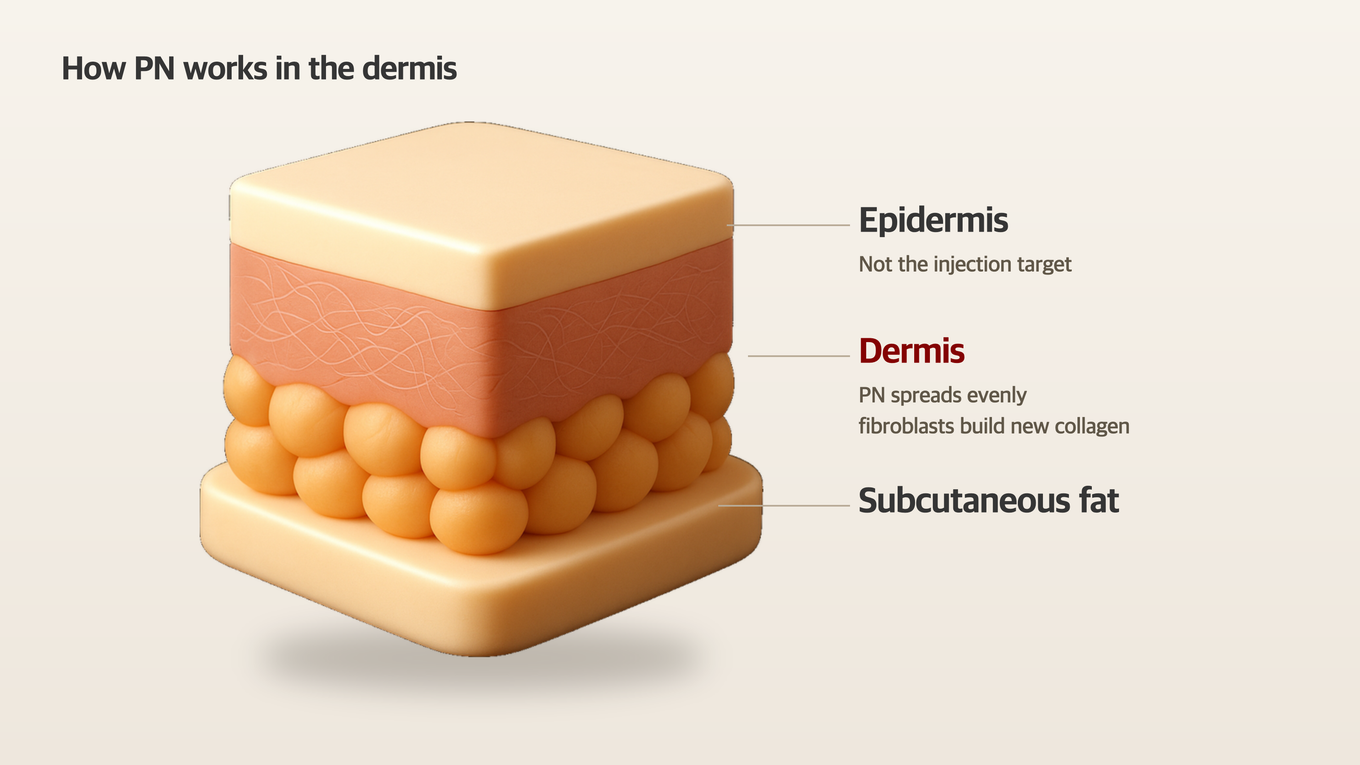
PN works in the dermis. Long-chain fragments purified from fish DNA spread through the layer and shift the signals between immune cells and fibroblasts, and new collagen builds up as a result.
Here's what the 2025 study in the International Journal of Molecular Sciences found. When PN was added to an aged-skin model, macrophages - a type of immune cell - switched on signals (cAMP/PKA/CREB) through their A2A receptors and raised levels of an enzyme called PCK1. Two things followed. Oxidative stress inside the cells dropped, and the macrophages shifted into a repair-friendly M2 state, releasing signals like IL-10 and TGF-β. Fibroblasts picking up those signals then made more type 1 and type 3 collagen. When the researchers blocked PCK1, the effect faded - which tells you that enzyme sits right at the crossroads of the pathway.
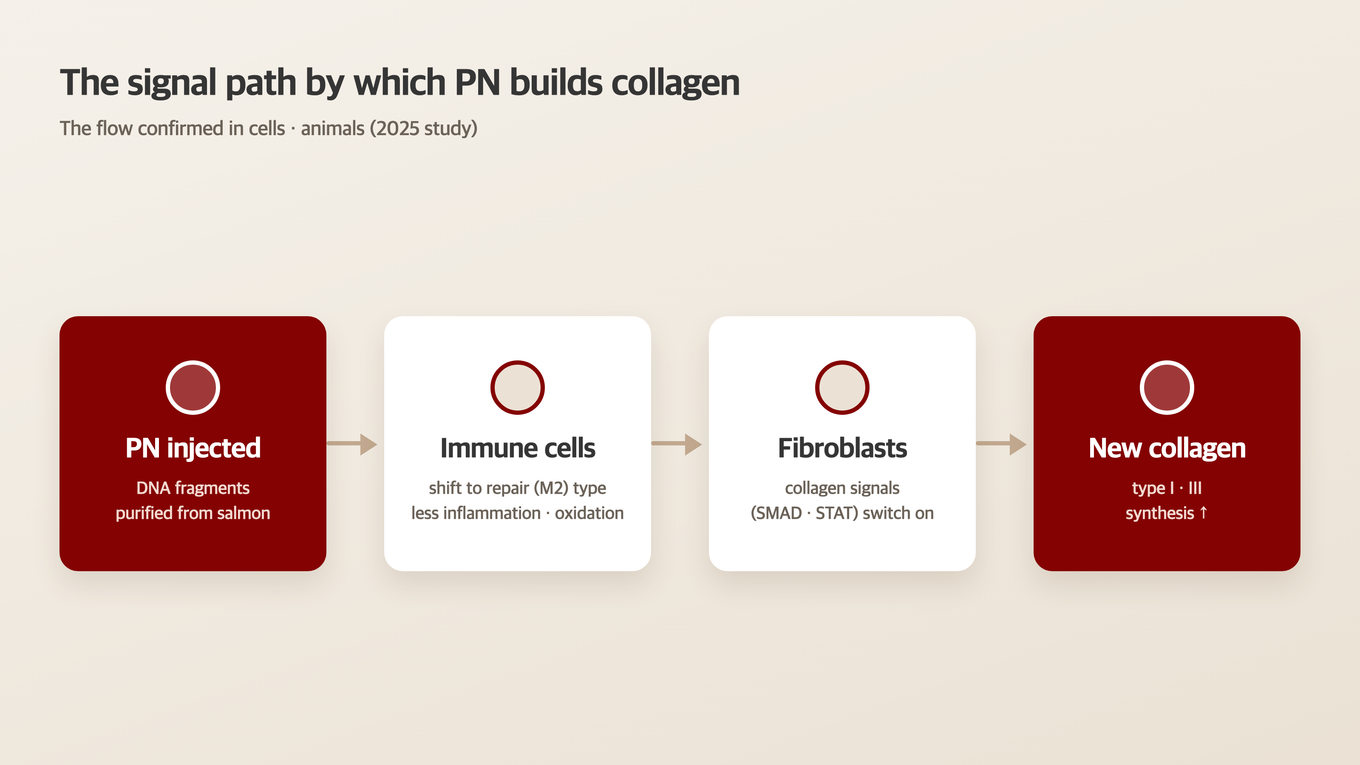
The signal flow behind PN-driven collagen. PN nudges immune cells into a repair state, and their signals flip the collagen switch in fibroblasts. This is the pathway the 2025 study confirmed in cells and animals.
The picture was the same in animal skin. Collagen density (measured by Masson's trichrome staining) climbed over time, and skin-elasticity readings rose alongside it. This is the point where the "collagen booster" label actually shows up in the data.

Mouse skin stained with Masson's trichrome after saline (far left) and PN at 3, 7, and 28 days. The blue-stained areas are collagen fibers in the dermis, and they grow denser as time passes after PN. Source: Byun et al. Int J Mol Sci 2025;26:8720, Figure 6 (CC BY 4.0). These are animal-stage results, so they don't translate directly to how much you'd see in human skin.
So PN runs on a different timeline than filler. Filler adds volume the moment it goes in; PN asks you to wait weeks to months while your body lays down new collagen. It's not a treatment you judge by the mirror the next morning.
Across small-to-mid-sized randomized controlled trials, PN has been reported to improve crow's-feet wrinkle depth and skin elasticity. Some results were mixed, so it's worth reading each study's size and duration together.
Here are a few of the better-designed studies from the 2024 review, which also graded the quality of the evidence.
| Study (Author) | Design / Size | Observed Direction |
|---|---|---|
| Yogya et al. | Randomized controlled, 120 participants (microneedling RF alone / RF+PN / no treatment) | Both treatment groups improved in wrinkle depth and elasticity at 6 months, with a bigger effect from adding PN |
| Kim et al. | 20 participants, 3D camera measurement, 1/3/6 months | Crow's-feet depth decreased and elasticity improved; generally well tolerated |
| Jeong et al. | Split-face, 20 participants (PCL vs PN filler) | Both groups improved in crow's feet at 12 weeks |
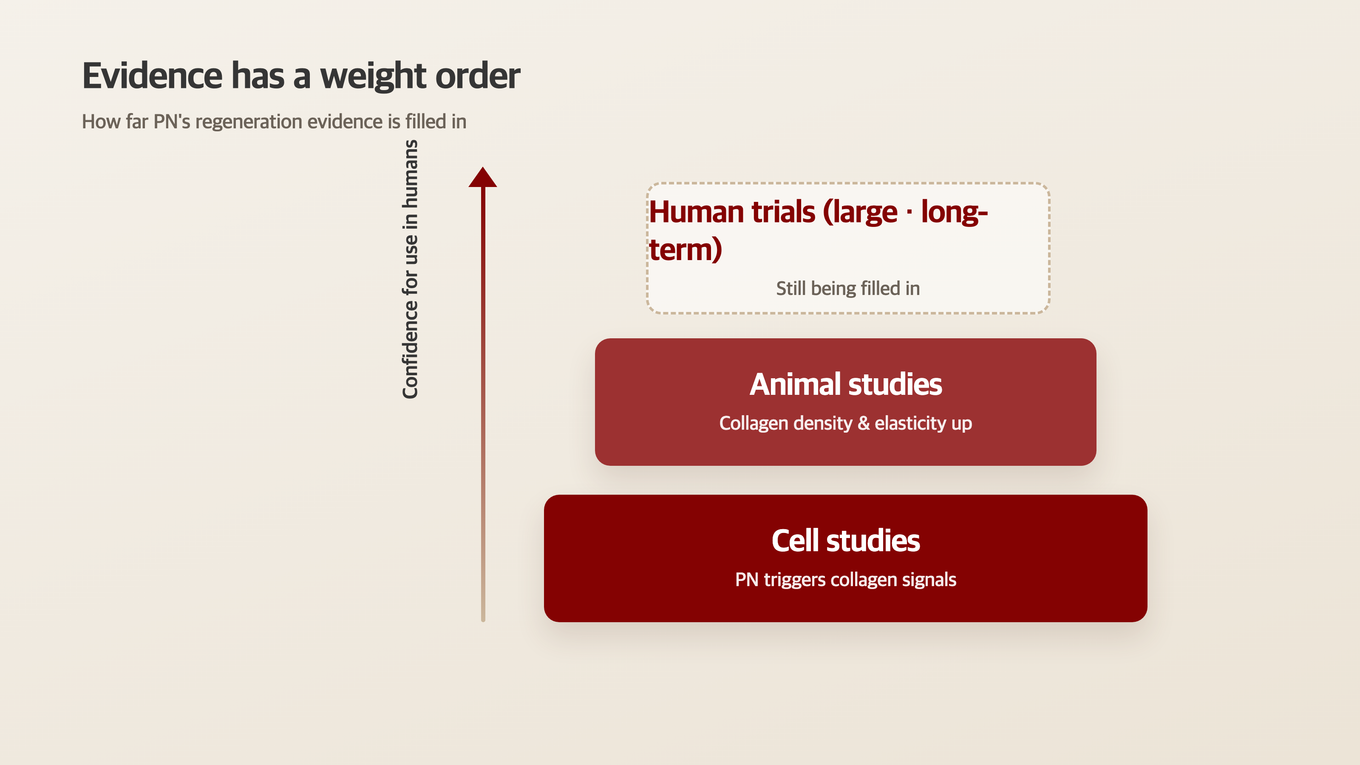
Evidence comes in tiers. PN's regeneration mechanism is confirmed in detail at the cell and animal stage, while human trials, mostly small and short-term, point in the direction of improvement. The large, long-term trials are the tier still waiting to be filled.
When I read this table, I start with size and duration. Even the largest study runs to about 120 people, with follow-up around six months. Many focus on one area, like the crow's feet, and large, long-term trials tracking full-face "regeneration" are still rare. So what this data shows is that PN works in the direction of improvement. It doesn't predict how much your own skin will change.
💡 In short - Mechanism studies answer why it works; clinical studies answer how it went in real people. For PN, the mechanistic side has firmed up recently, while the clinical side points toward improvement but still needs more scale and time.
Not as promises. Mechanism studies sit at the cell and animal stage, so they're evidence for the direction it works - not for how much your own skin will improve.
Scientific evidence carries different weight depending on where it comes from: cell experiments, then animal models, then human trials, with confidence rising as you move toward people. The 2024 review put it plainly - PN showed potential for improving skin elasticity, hydration, and texture, but efficacy and safety varied from study to study, and larger trials are needed to pin down the best dose, interval, and indications. The authors are firm that clinicians should hold both the current limits and the potential risks in mind.
| What the research has answered | What still needs confirming in people |
|---|---|
| The mechanism by which PN raises collagen synthesis is confirmed in cell and animal studies | How much improvement actually happens in human skin |
| Several trials report improvement in elasticity and wrinkles | How long the effect lasts |
| It's generally reported as well tolerated | Which skin types respond most |
⚠️ Worth knowing - PN is an injectable. Bruising, swelling, and redness can hang around for a few days, and if the depth or amount is off, nodules can form in rare cases. Most of this settles with time, but responses differ from person to person. And because it works by building new collagen, the change accumulates over weeks to months rather than showing up at once. Sharing your skin's condition and your medical history before treatment helps with both the result and your safety.
It fits people bothered by thinning skin, fine lines, loss of elasticity, and rough texture around the eyes - and it's the wrong tool if you want to fill lost volume right away.
Here's how I sort out the direction in a consultation.
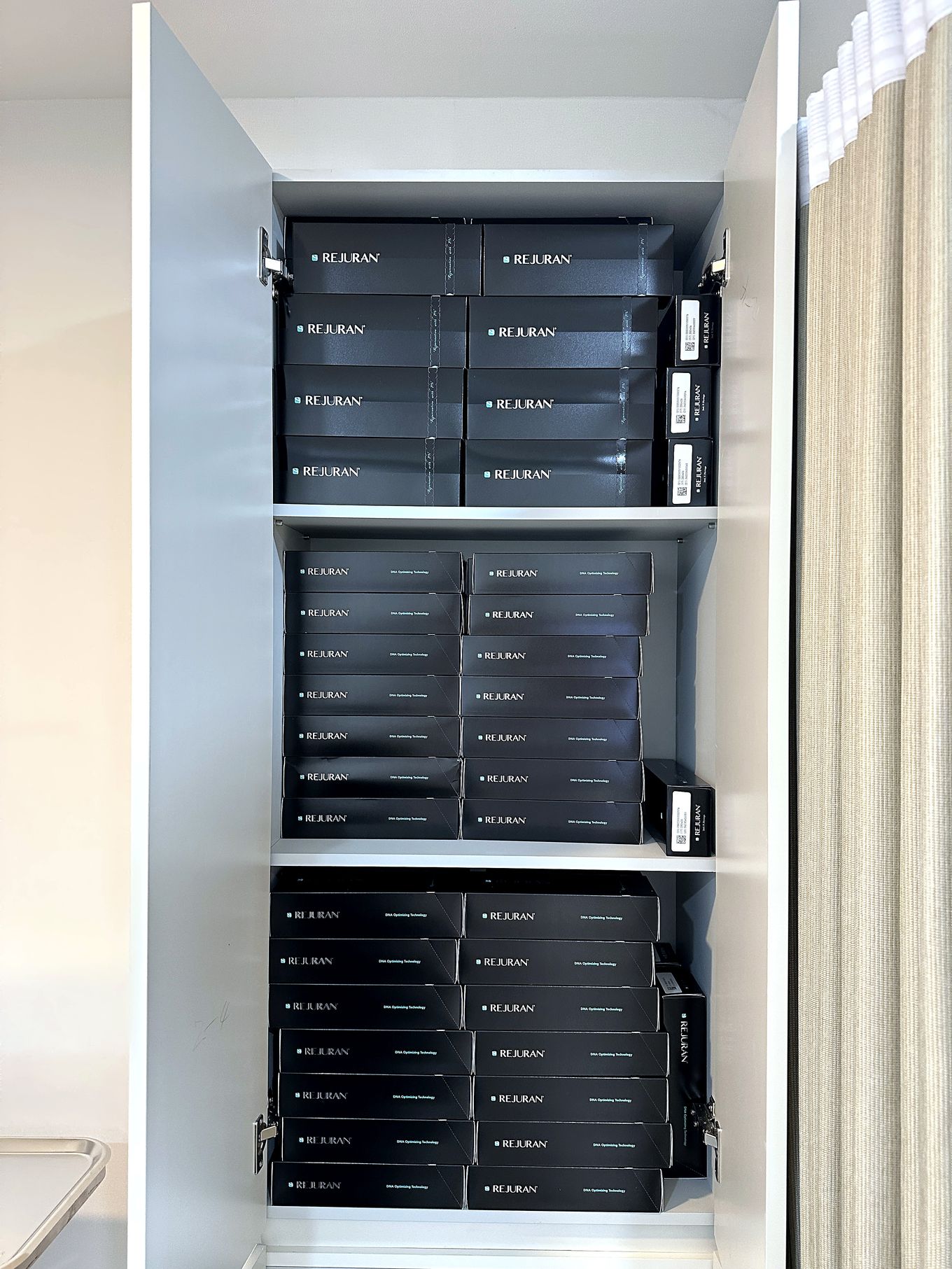
Genuine Rejuran stock in the storage cabinet at our Myeongdong clinic. Being able to show you exactly which product we use is what gives the evidence talk its weight.
One last thing: however good the papers are, a treatment comes down to the product and the hands doing it. Showing you genuine Rejuran at the clinic, and deciding injection depth, amount, and number of sessions from the mechanisms and limits I've read in these studies - both come from the same place. If you're going to talk about evidence, you first have to meet the conditions that evidence was built on.
Both are DNA fragments taken from fish, but they differ in length. PN (polynucleotide) is the longer chain; PDRN (polydeoxyribonucleotide) is shorter. Rejuran belongs to the PN family. The 2024 review explains much of PN's action through PDRN's mechanisms - cell proliferation, blood-vessel formation, and anti-inflammatory effects.
Right now there's no standard "X percent" figure for human skin. The mechanism for raising collagen synthesis is confirmed in cell and animal work, but the actual increase in people varies by study and by individual. If someone promises you an exact number, that's a reason to be more careful, not less.
This isn't an instant-volume treatment; the change builds over weeks to months as new collagen forms. How fast your body makes collagen depends on your age and skin condition, so when you feel the difference varies from person to person.
Because it's an injection, you can get bruising, swelling, and redness for a few days. Rarely, a nodule can form if the depth or amount isn't right. Trials generally report it as well tolerated, but responses differ, so it's worth sharing your skin condition and medical history before treatment.
For the mechanism research, search the journal details (International Journal of Molecular Sciences 2025, DOI 10.3390/ijms26178720); for the clinical summary, the same journal's 2024 review (DOI 10.3390/ijms25158224). Both are open access, so anyone can check the sources directly.
To "does Rejuran regenerate skin?", the most honest answer I can give right now is this: PN's mechanism for raising collagen is confirmed in cells and animals, and several human trials report improvement in elasticity and crow's feet. That's the part the evidence backs.
At the same time, the human trials are mostly small and short-term, and while some showed clear improvement, others were limited. There's no evidence yet that guarantees "regeneration." The change comes on slowly, over weeks to months, and how much you get differs from person to person. So if you're weighing up Rejuran, don't stop at "I heard it regenerates skin." Start by sorting out whether your concern is skin thickness and texture, or volume. Once that's clear, whether this treatment is the right direction for you gets a lot easier to see.
#Rejuran #Polynucleotide #PN #SkinBooster #CollagenBooster #SkinElasticity #SalmonDNA #SkinRejuvenation #MyeongdongSkinClinic #ForeverClinic