

Blog
Informasi khusus untuk kesehatan kulit
Informasi khusus untuk kesehatan kulit
Ever have those days when you feel well-rested but still get told you look tired? You glance in the mirror, and those hollowed eyes stare back. Search "under-eye hollows" and the screen fills with filler ads.
Let me give you the answer up front. Filler addresses just one cause of under-eye darkness: the shadow cast by a hollow, like the tear trough. If pigmentation, visible blood vessels, or protruding fat are the culprits, filler has almost nothing to work with.
So let's start by sorting the types. Figure out which kind of under-eye you have, and we'll go over when filler fits and when a different approach makes more sense.
Quick Overview
- The main causes of dark under-eyes are pigment, vascular issues, or structural shadows. However, mixed causes are most common (78% in one clinical study).
- Fillers are a potential solution when shadows are primarily due to structural hollows like tear troughs.
- Pigmentation issues may benefit from laser toning, thin skin/vascular issues from regenerative treatments, and protruding fat might require surgical consultation.
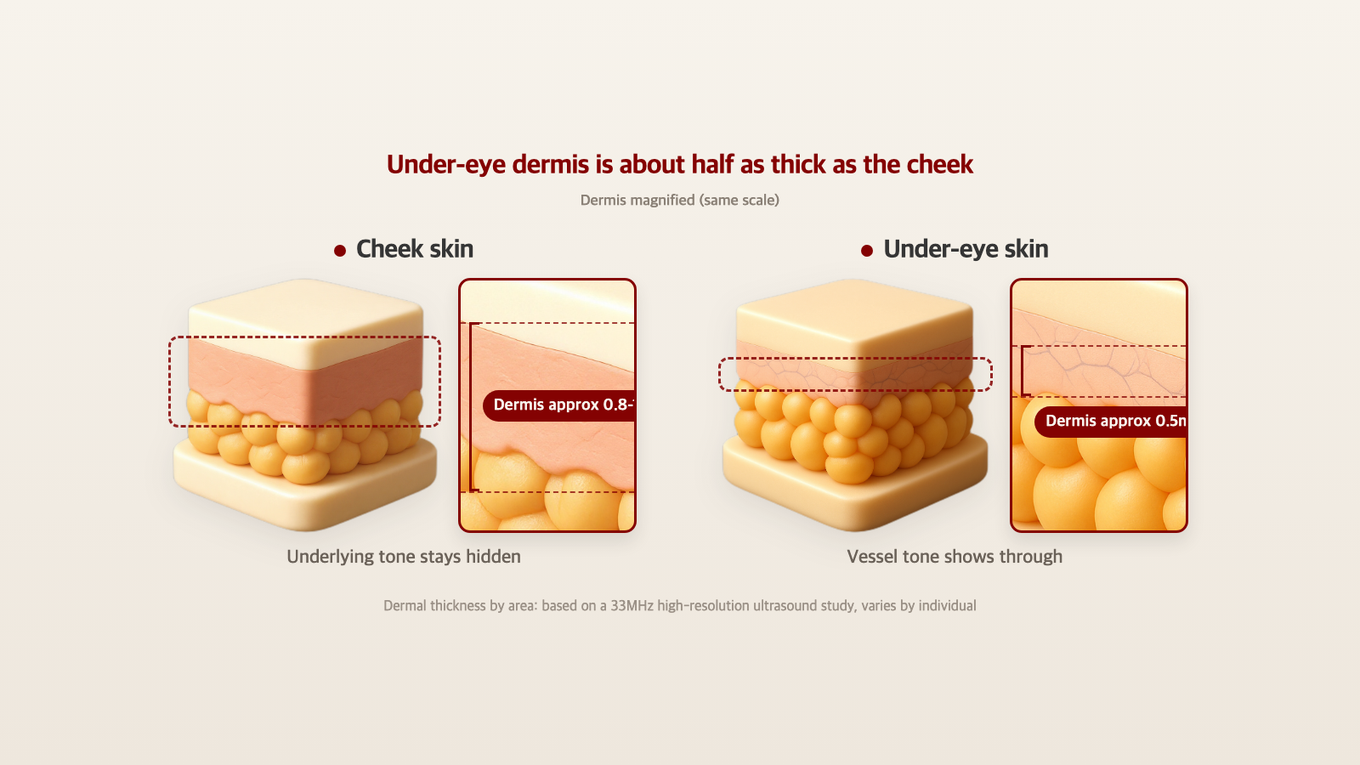
- The skin under the eyes is about 0.5mm thick, half that of the cheeks, so treatments here are approached more conservatively. Individual responses vary.
Dark circles typically fall into three categories: pigmentation, vascular, and structural shadows. Under-eye hollows belong to the structural category.
Academic literature also categorizes under-eye darkness into these types, plus mixed types. A clinical study using Wood's lamp and ultrasound found pure pigmentation in 5%, vascular in 14%, structural in 3%, and 78% had a mix of two or more types. This aligns with what we see in practice - it's more common to have a combination of shadows and pigmentation than just one issue.
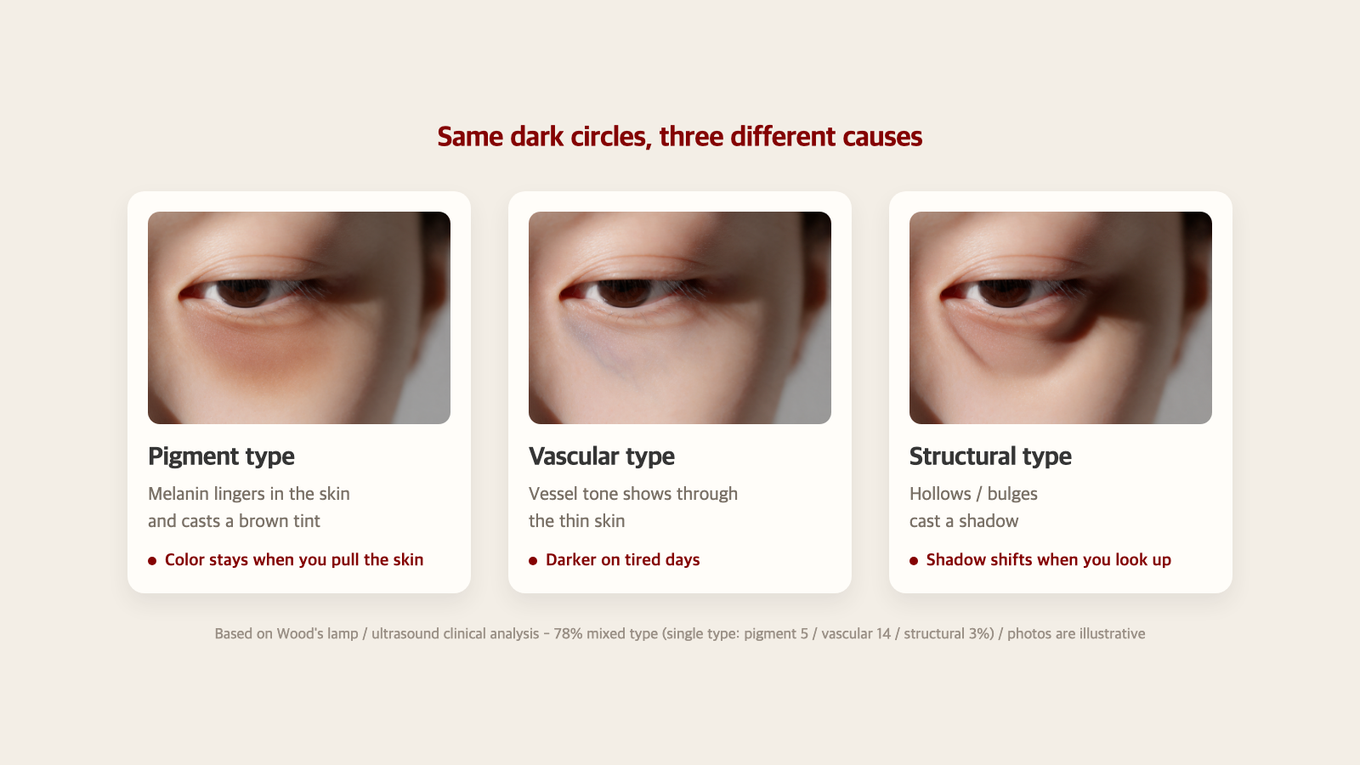
These distinctions matter because the treatment target shifts with each type. Pigment needs to be broken down, visible vessels need a thicker layer to cover them, and shadows need the hollow filled. Filler works on the third one: shadows.
You can get a preliminary idea at home in just a minute.
⚠️ Note - These methods are just for guidance. With 78% being mixed types, there's a good chance multiple issues overlap. Final assessment should be done by examining the skin directly.
Fillers are considered when the tear trough (a diagonal hollow under the eye towards the nose) creates shadows. The treatment aims to smooth out the surface by filling the hollow.
The shadows in the tear trough are a result of lighting. Most lights come from above, so when there's a hollow, less light reaches inside, creating a dark band. This is why makeup often fails to conceal it - the darkness comes from contours, not color, so changing angles brings it back.
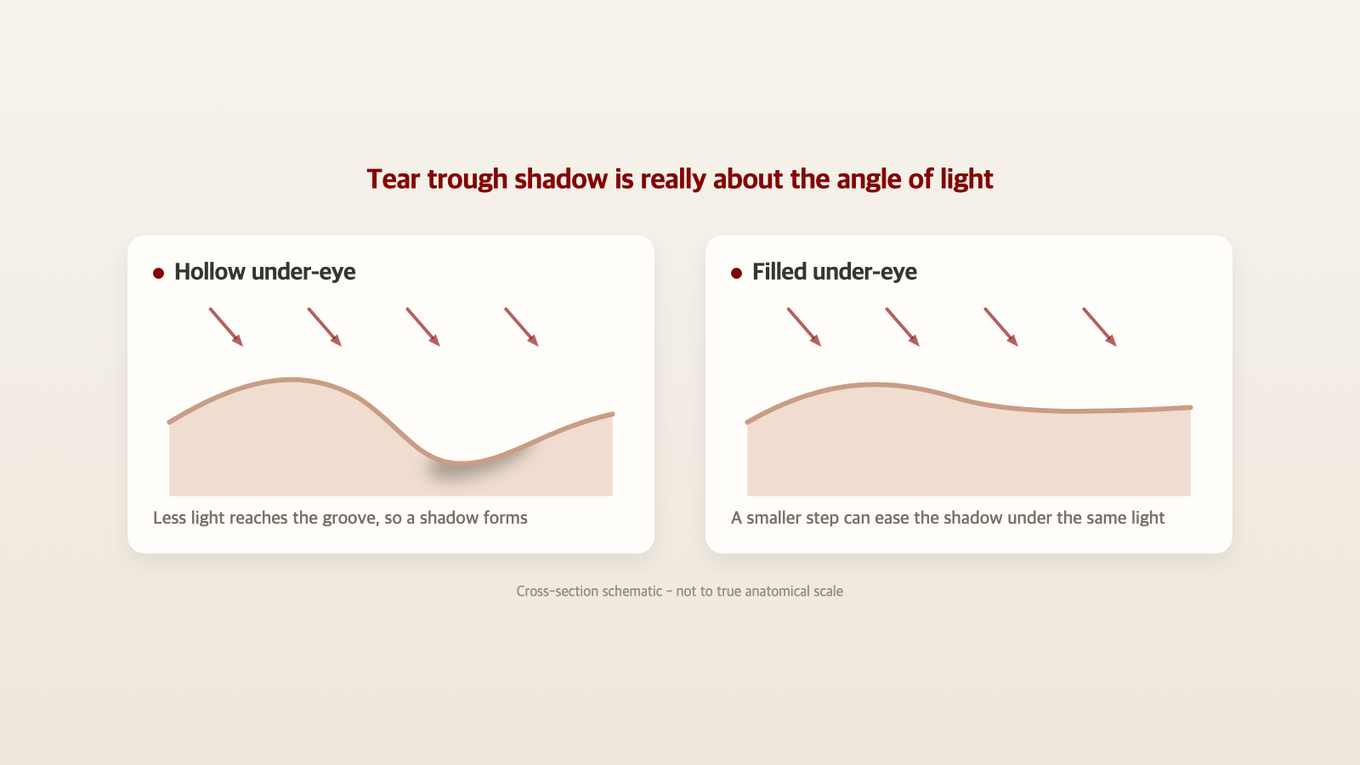
Therefore, fillers can reduce the depth of the hollow, potentially lightening the shadow. Note that tear trough hollows often develop with age as under-eye fat and bone support diminish. Details on volume loss in the face by layer can be found in this article.
A point on why hyaluronic acid (HA) fillers are commonly used under the eyes: they can be reversed with hyaluronidase if any issues arise or if you're unhappy with the outcome. This reversibility acts as a safety net for such a visible area.
At this stage, it's tempting to jump to the conclusion that fillers will solve all under-eye hollows. But in practice, we pause because not all hollows are due to true volume loss. This is the most critical part.
Yes. Under-eye issues caused by visible blood vessels, pigmentation, and protruding fat fall outside the scope of what fillers can address, and fillers might even worsen the appearance.
One at a time.
Visible vessels under thin skin. A study using 33MHz high-resolution ultrasound measured under-eye dermis at an average of 0.53mm, compared to about 0.8-1.2mm in the cheeks. This thin layer allows muscle and vessel tones to show through. Fillers won't cover this tone, and placing HA too shallow can cause the Tyndall effect, where the filler itself casts a bluish hue under the skin. It's like adding a different kind of darkness to an area you're trying to lighten.
Pigmentation issues. If the brown tint is due to melanin, contour-altering treatments won't erase it. This requires laser treatments like Pico Toning that break down pigmentation. The principles of laser toning for pigmentation and melasma are detailed here.
Protruding under-eye fat (under-eye bags). When the fat around the eye pushes forward, the groove below the bulge looks even deeper by contrast. Fill only that groove and the bulge and the groove puff up together, so the whole under-eye can look swollen. A review on under-eye correction notes that prominent under-eye bags are better addressed with surgical approaches like lower blepharoplasty or fat repositioning. I'll be honest: once it's a surgical case, this is past what a dermatology procedure can do, and I don't recommend filler.
💡 In short - Fillers work on "hollows." For visibility, pigmentation, or protrusions, different tools are needed.
Based on the cause: pigmentation issues respond to laser toning, thin skin/vascular visibility to regenerative treatments, and prominent fat protrusions to surgical consultation.
| Under-eye Issue | Main Problem | Treatment Approach |
|---|---|---|
| Tear trough hollows | Shadows from contour | Fillers (HA) to smooth out the surface |
| Thin skin/vascular visibility | Thin dermis shows underlying tones | Regenerative treatments for skin thickness/texture |
| Pigmentation | Brown tint from melanin | Laser toning like Pico Toning or Lucas Toning |
| Fat protrusion | Bulge and relative hollow | Surgical consultation (beyond non-surgical scope) |
Let's expand on regenerative treatments. For vascular issues or thin skin, the aim is to "thicken and strengthen the curtain," using regenerative treatments like Rejuran Eye (PN) or collagen stimulators. Liquid collagen boosters like GOURI are discussed here, emphasizing their even distribution without clumping in thin areas. However, unlike fillers, these treatments take multiple sessions and change gradually, with individual variability in results.
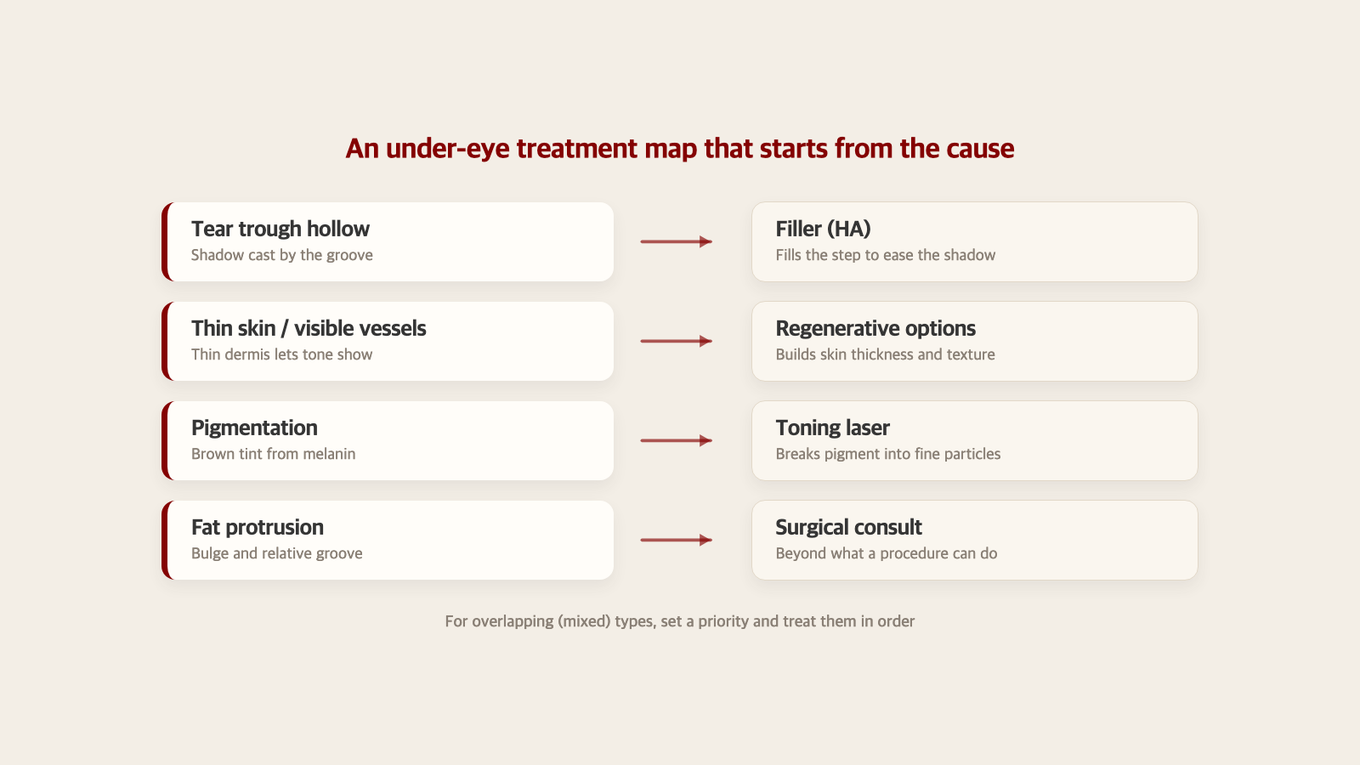
For mixed types, prioritize. If both pigmentation and hollowing are present, start with the predominant issue. Address one, observe changes, then decide on the next step. This cautious approach is best for the delicate under-eye area.
During the initial consultation, see if they explain "what type your under-eye issue is" before moving to treatment options. When treatment comes after the type is clarified, it's easier to weigh the reasoning and decide together.
At our clinic in Myeongdong, Seoul, we start by identifying the cause. As mentioned, there are types where fillers are suitable and types where they're not, and some issues, like prominent fat protrusion, are surgical cases. I believe that advising against fillers when they're not appropriate is also a valuable consultation outcome. Finding the approach that fits the cause first is, in my view, what leads to satisfaction and trust in the result.

If you choose to proceed with treatment, check two things: what materials are used and are they genuine (is the HA filler reversible), and is the practitioner experienced with the vascular layout around the eyes? The under-eye area is delicate and close to blood vessels, so placement and quantity can significantly impact both results and safety.
Common side effects include bruising and swelling for a few days, and if placed too shallowly, the filler might cause the Tyndall effect, appearing bluish. HA fillers can be dissolved with hyaluronidase if needed. It's a delicate area where vascular complications, though rare, are possible, so it matters that the injector knows the vessel layout around the eyes. Recovery varies from person to person.
Start by identifying the cause of your under-eye issue. Check if the darkness changes when you pull the skin, look up, or if it varies with your condition to get a sense of whether it's pigmentation, structural, or vascular. With 78% being mixed types, precise assessment and prioritization in consultations ensure safety.
Given the small, conservative amounts used under the eyes, it's hard to provide a blanket duration. HA is a material that gradually breaks down in the body, and the rate varies based on the product and individual metabolism. It's more practical to assess and top up as needed.
Under-eye darkness results from a mix of pigmentation, vascular, and structural (shadows) issues, with fillers addressing only the tear trough hollow. Observing skin movement, lighting changes, and condition-based variance can guide your approach.
Before searching for "best under-eye filler clinics," determine if fillers target your specific issue. This one step can save you from mismatched treatments and awkward results.
#UnderEyeHollows #UnderEyeFiller #DarkCircles #DarkCirclesTreatment #TearTrough #TyndallEffect #UnderEyeFat #RejuranEye #PicoToning #SeoulDermatology #ForeverClinic