

Blog
Expert tips for healthy skin
Expert tips for healthy skin
"When they said it was a regeneration treatment, I thought they’d be adding some beneficial ingredients. So why are they drawing my blood?"
This question often pops up when MetaCell is mentioned at our clinic in Myeongdong, Seoul. Most people envision regeneration treatments as adding beneficial substances externally, much like fillers. So, starting with a blood draw seems counterintuitive.
MetaCell works the other way around. Instead of introducing new substances from outside, it uses the recovery signals already present in your blood. It’s like borrowing the signals your body naturally uses for wound healing and redirecting them for skin care.
Today, rather than trying to sell you on a procedure, I want to walk through why this "reverse order" actually makes sense. By understanding what is extracted from your blood and how it works on your skin, you can better manage your expectations of what MetaCell can and cannot achieve.
Key Points First
- MetaCell isn't about introducing new substances; it's an autologous approach using recovery signals from your blood.
- The process involves drawing blood, centrifuging it to separate platelet-rich plasma (PRP), and using the growth factors and signaling molecules it contains on the skin.
- Growth factors (such as PDGF/TGF-β/VEGF/EGF) are signals your body uses for wound healing. Exosomes are tiny vesicles (about 30-150nm) that facilitate intercellular communication.
- Because the materials come from your body, there’s a lower risk of immune rejection or foreign body reactions. However, like any procedure, there are precautions and individual differences.
- This approach is different from external collagen boosters (such as Gouri/liquid PCL) and can be seen as complementary.
- Clinical evidence for this type of treatment is still accumulating. It's more accurate to see it as aiming to help, with results that vary from person to person, rather than expecting immediate or guaranteed results.
No. It works by delivering recovery signals from your blood so your skin responds on its own. This approach is fundamentally different from those that involve filling with external substances.
That distinction is really the whole thing. Procedures like fillers or volumizing treatments add volume externally. You see the effect the moment they go in. MetaCell, however, doesn’t add substances directly. Instead, it delivers signaling molecules that your body naturally uses for tissue repair to trigger the skin's inherent recovery processes. So instead of an immediate result, the skin responds gradually over time.
Our skin naturally heals itself when injured, following a predetermined signaling pathway. Most of the materials used in MetaCell are derived from this pathway, essentially gathering and reactivating signals that were already within you.
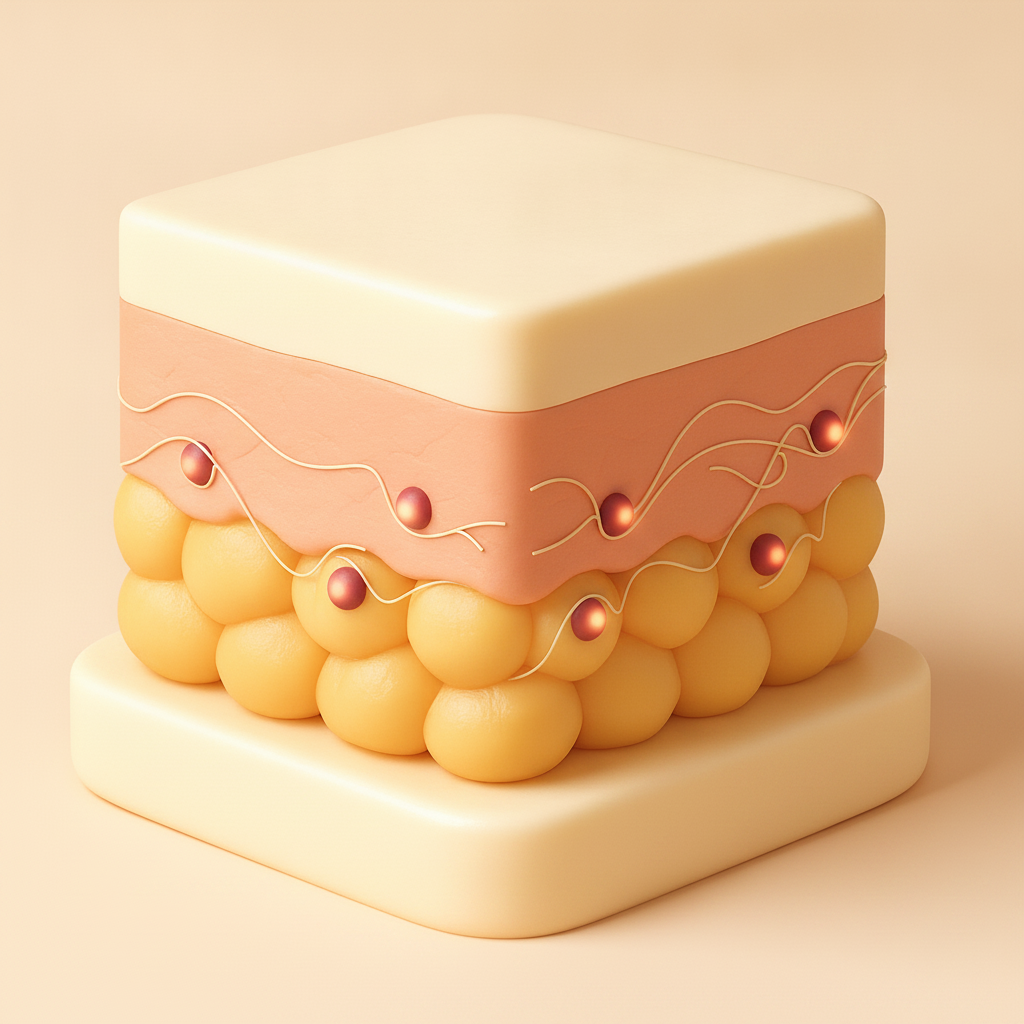
The approach of reactivating recovery signals that cells naturally use within the dermis. Unlike methods that add volume, results follow gradually after the procedure.
One thing to clarify: "helping the skin respond naturally" is more of a direction than a guarantee. The degree of response varies with age, skin condition, and lifestyle. I’ll revisit this point later.
When blood is centrifuged, it separates into layers, allowing us to isolate the platelet-rich plasma (PRP) layer. The growth factors and signaling molecules contained within are used for regeneration.
The process itself is straightforward. Blood is drawn and spun in a centrifuge, causing the heavier red and white blood cells to settle at the bottom, with plasma floating on top. A layer rich in platelets forms in between, known as platelet-rich plasma (PRP). The spin itself is over quickly.
Platelets are specifically used because they rush to a wound first, help seal it, and send out signals like "repair here." These signals are the growth factors, stored in tiny granules (alpha granules) within the platelets, which are released upon activation.
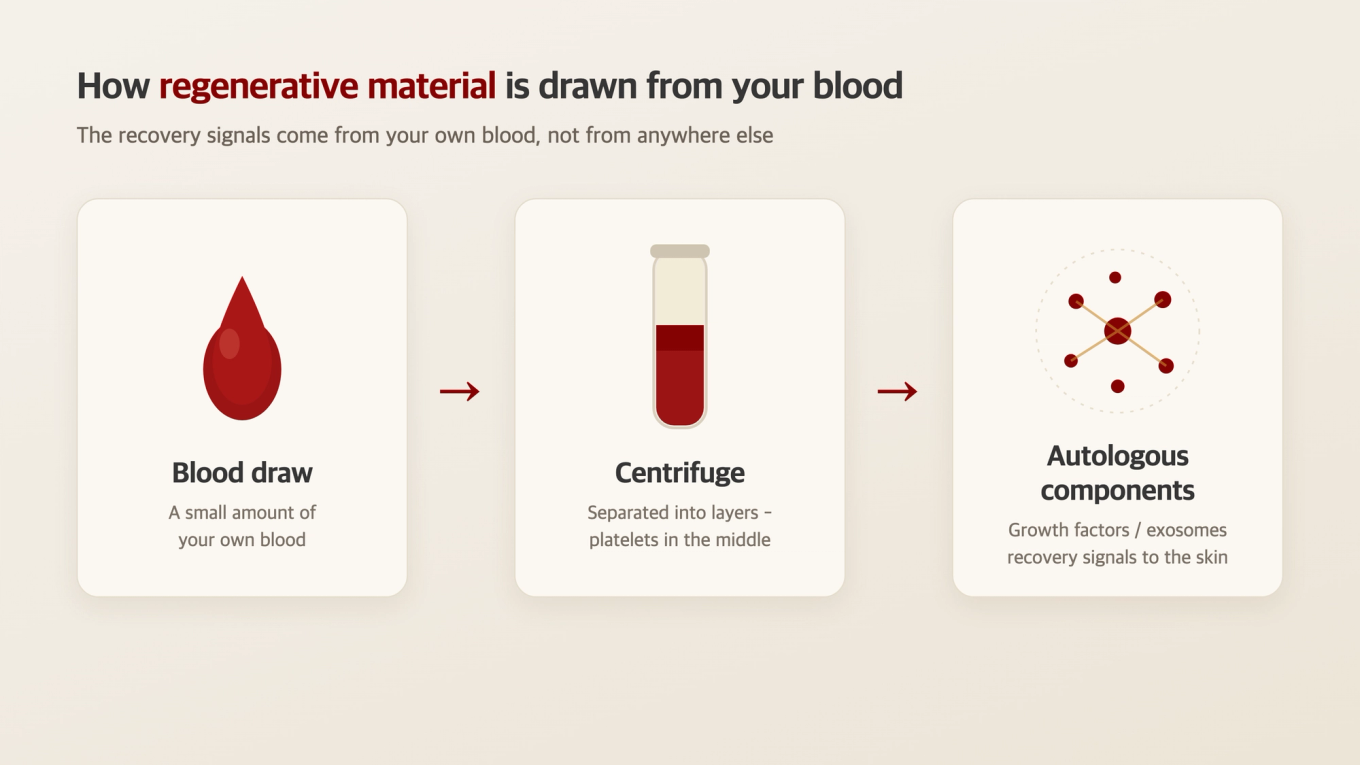
Blood draw → centrifuge to separate layers → platelet-rich plasma (PRP) → delivering the growth factors/signaling molecules to the skin. The key is that these materials come from your body.
MetaCell takes it a step further. The concept is to "awaken" these autologous components with light and heat stimuli before use, which I'll explain in more detail later. For now, remember this: everything used comes from your blood.
Each growth factor has its own job: signaling new blood vessels to form, helping remodel the dermis, and prompting cells to grow. These are the same signals your body uses during wound healing.
Here's a breakdown of the roles of different growth factors:
| Signaling Molecule | Role in the Skin |
|---|---|
| PDGF | Signals to recruit and proliferate necessary cells for recovery |
| TGF-β | Involved in dermal remodeling, collagen organization, and scar maturation |
| VEGF | Promotes the formation of new microvasculature to supply oxygen/nutrients to tissues |
| EGF | Aids in the growth of epidermal cells and the healing of the skin barrier |
These signals function in sequence rather than isolation. It’s like borrowing the body's program for healing wounds, using the signals without the wounds themselves.
Exosomes are also mentioned here. They are tiny vesicles released by cells, about 30-150nm in size, carrying proteins or RNA as signaling molecules to facilitate intercellular communication. Think of them as letters exchanged between cells. The idea is that these signals from autologous blood convey messages to skin cells, directing them to "move towards recovery."
I want to be straight with you here. While it's well-established biologically that growth factors and exosomes are involved in regenerative signaling, the specific effects of autologous components processed by MetaCell on the skin have not yet been widely verified through large-scale studies. Therefore, I describe it as a "designed operating principle" rather than promising specific improvements.
Instead of using the autologous components directly, they are stimulated with light and mild heat to activate them before use. This approach is known as photobiomodulation (PBM).
PBM involves stimulating cells with specific wavelengths of light. It’s explained as increasing activity by affecting the mitochondria, the cell’s energy factory. MetaCell explains that it uses a combination of light and mild heat (photothermal stimulation) to prepare the autologous components. The idea is to awaken the growth factors and signaling molecules into a more active state.

The concept of stimulating autologous components with light and mild heat to prepare them in an active state. It's about making existing signals more alert.
Let me cut through the hype. You might see claims in ads or device introductions about "ATP increased by so many times," "growth factors increased by so many times," but these numbers are often provided by manufacturers and have not been independently verified. Therefore, I do not use such multipliers as evidence in this article. The concept that PBM is "designed to activate autologous components" is where we can honestly draw the line right now.
The approach is different. Autologous regeneration awakens your recovery signals so your skin can react naturally, while collagen boosters add substances externally to create an environment where collagen can grow.
Viewing them as competitors can cause confusion. The goal is the same: to rebuild your collagen, but the starting points differ.
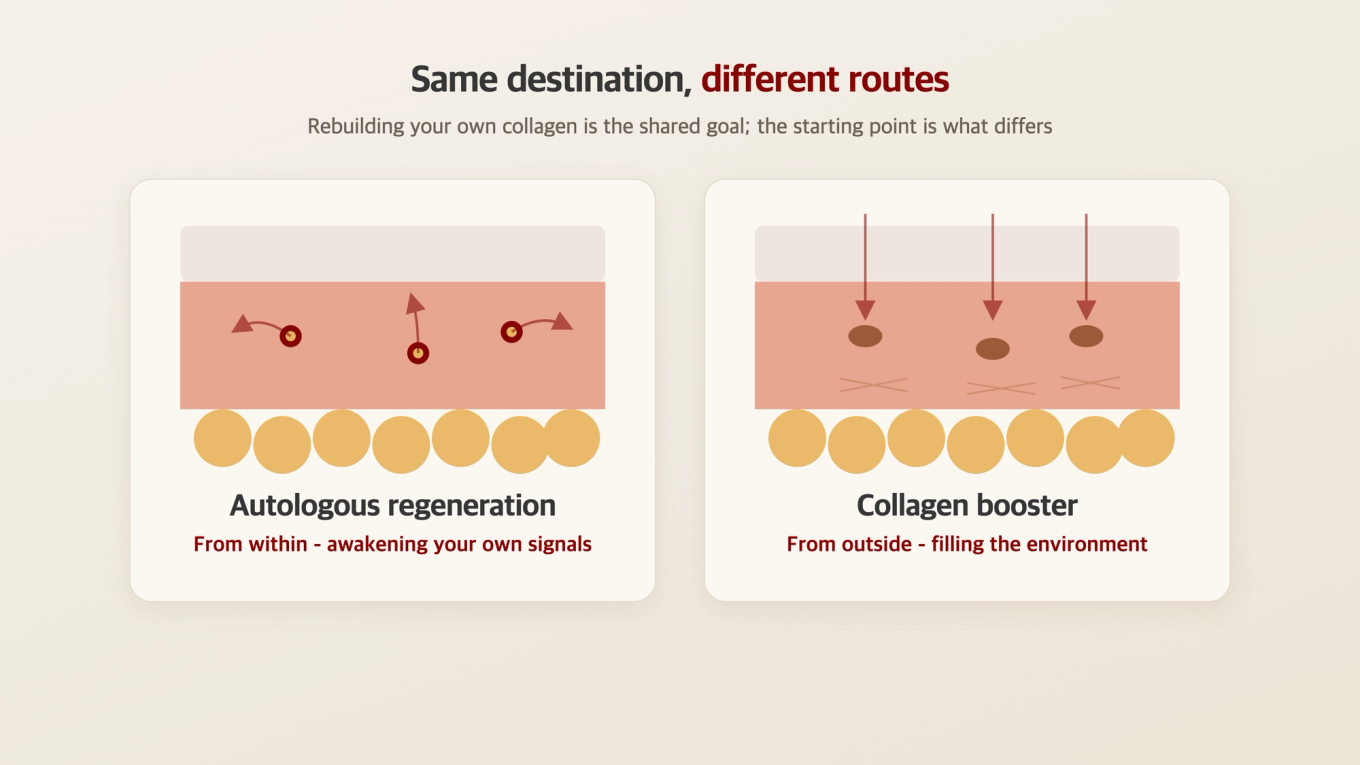
Autologous regeneration awakens your signals to induce a response, while collagen boosters add substances to reinforce the environment where collagen grows. Different routes to the same destination.
| Type | Autologous Regeneration (MetaCell) | Collagen Booster (Gouri/liquid PCL) |
|---|---|---|
| Materials Used | Growth factors/signaling molecules from your blood | Biocompatible substances introduced externally |
| Mechanism | Awakens your recovery signals to induce a response | Reinforces the environment where collagen grows |
| Speed of Results | Gradual, with significant individual variation | Gradual, progressive |
| Immune Response | Low due to autologous origin | Depends on the biocompatibility of the substance itself |
Dr. Lee at our Myeongdong clinic has worked with collagen boosters for years from this same regenerative standpoint. The path of awakening signals with autologous blood and the path of creating the environment with substances don’t contradict each other. Depending on the skin condition, one might be prioritized, or both might be considered over time. So rather than asking "which is better," it’s more about "which should come first for my skin right now."
MetaCell suits people who want to support skin regeneration with less burden, using materials from their own body. It's not suited for those who expect immediate, dramatic results.
In clinical settings, these are the guidelines used for determining direction. Consider them as a framework rather than definitive answers.
A word on the risks and misconceptions. The claim that "there are no side effects because it's autologous" is inaccurate. While it’s true that the immune burden is lower, as the procedure involves blood draws and injections, reactions like redness, swelling, or bruising can occur, and hygiene and aftercare matter. It’s not "automatically safe because it’s my blood," but rather "an approach with lower immune burden."
And as previously mentioned, clinical evidence for this type of procedure is still developing. Therefore, I don’t promise that MetaCell will "transform you in one go." It’s an approach where autologous components send signals for your skin to react, and that reaction varies individually - this is precisely what can be accurately stated. For guidelines on how to critically assess regenerative procedure advertisements, you might find self-verification criteria useful.

The direction aimed for by awakening your recovery signals. A gradual, healthy improvement in texture over time.
Because it uses recovery signals (growth factors/signaling molecules) present in your blood as regenerative materials. Instead of introducing new substances externally, it’s an autologous approach using what is derived from your body, making blood draw the first step. A small amount of blood is centrifuged to separate the platelet-rich plasma (PRP), and the components within are used.
Not necessarily. While the immune burden is typically lower because the materials come from your body, the procedure involves blood draws and injections, so reactions such as redness or swelling may occur. Every medical procedure involves individual differences and precautions, so "automatically safe because it's my blood" is not accurate; it's more about "an approach with lower immune burden."
Growth factors are signaling proteins that direct cells to "grow, repair," while exosomes are tiny vesicles that carry such signaling molecules between cells, roughly 30-150nm in size. If growth factors are the letter content, exosomes are like the envelope delivering it. Both are involved in the regenerative signaling obtained from autologous blood.
Since it’s an approach that sends signals for the skin to respond naturally rather than filling volume externally, changes come gradually over time rather than immediately. The degree and speed of response vary greatly with age and skin condition. It’s more realistic to view it as a treatment that shows effects over time rather than expecting results "in a few days."
They aren’t competitors, but rather different paths. MetaCell awakens your recovery signals to induce a response, while collagen boosters like Gouri provide substances to reinforce the collagen-growing environment. The destination is the same: rebuilding your collagen, so depending on your skin condition, one can be prioritized, or both can be considered over time. The right question is "what should come first for my skin right now" rather than "which is better."
The reason MetaCell starts with a blood draw is simple. It’s not about introducing new substances externally but rather using the recovery signals already present in your blood. By extracting growth factors and signaling molecules from the platelet-rich plasma and awakening them with light and heat before applying them to the skin, it encourages natural responses.
The principle also clearly defines its limitations. Responses develop gradually and vary individually, and the notion that "there are no side effects because it's autologous" is not entirely accurate. Clinical evidence for this type of treatment is still accumulating, so understanding it as "aiming to help, with results that vary from person to person" is more accurate than expecting immediate or guaranteed results.
Therefore, viewing MetaCell as "an approach to gradually manage by awakening your body's signals" rather than "a one-time filling treatment" is more precise. It has a different path from external collagen boosters but shares the same goal. Understanding the principle makes it much easier to assess if this approach suits you. That assessment comes first, and the treatment follows.
#MetaCell #PRPTreatment #PRP #SkinRegeneration #GrowthFactors #Exosomes #CollagenBooster #RegenerativeTreatment #Gouri #MyeongdongDermatology #ForeverClinic