

Blog
Expert tips for healthy skin
Expert tips for healthy skin
"Is it true that ultrasound lifting rebuilds collagen? Or is it just a brief, temporary effect?"
At our clinic in Myeongdong, Seoul, whenever a consultation turns to Ultherapy Prime or Shrink Universe, nine times out of ten this is the question that follows. "Collagen regeneration" is such a common line in ads that the marketing skips over what actually happens inside the skin and jumps straight to the promise. A little skepticism is only fair.
The thing is, histology has already answered a good part of this question. There are studies that removed human skin, stained the collagen and elastin directly, and measured them, backed by a growing body of animal and cell work. But the evidence doesn't all carry the same weight. Mix what was confirmed in humans with what was seen in animals or cells, and the story starts to inflate. So today I'll separate it out by grade of evidence and answer, one by one, the questions that actually come up in consultations, using what the research shows.
This isn't a pitch for any device. Once you know where the phrase "heat makes your collagen build back" comes from, it gets much easier to sort out what you can reasonably expect from ultrasound lifting and what you shouldn't.
The short version
- Ultrasound lifting (HIFU) passes through the epidermis and leaves tiny thermal coagulation points only at set depths in the dermis and fascia.
- When that heat denatures old collagen, the repair response draws in fibroblasts that build new collagen and elastin.
- In human skin histology, new collagen appeared in the mid and deep reticular dermis and new elastin in the deep dermis two months after treatment (most pronounced in the deep dermis).
- But it takes time. In animal models, mature collagen and new elastin were clearer at 90 days than at 14 days.
- And it isn't for everyone. The right direction depends on how much sagging there is and on your skin's condition.
Yes. In studies that stained human skin directly, new collagen was observed in the mid and deep dermis and new elastin in the deep dermis two months after treatment.
A Korean study compared collagen (Masson's trichrome stain) and elastin (Victoria blue stain) in human skin before and two months after the procedure (Suh et al., J Cosmet Laser Ther 2015). Dividing the dermis into papillary, upper, mid, and deep reticular layers, it found that HIFU produced new collagen in the mid and deep reticular dermis and new elastin in the deep reticular dermis, with the new growth most pronounced in that deep dermis. Because this was confirmed visually through cell staining, it carries a different weight than an ad line.
One question tends to come up here: if the surface is untouched, why does the reaction start deep inside? The structure makes it click. Ultrasound lifting concentrates ultrasound energy at a single point at a set depth, creating a very small thermal coagulation point. It's like focusing sunlight through a magnifying glass, where only that one spot burns. The epidermis is passed over, and the heat stays only in the targeted dermis and fascia.
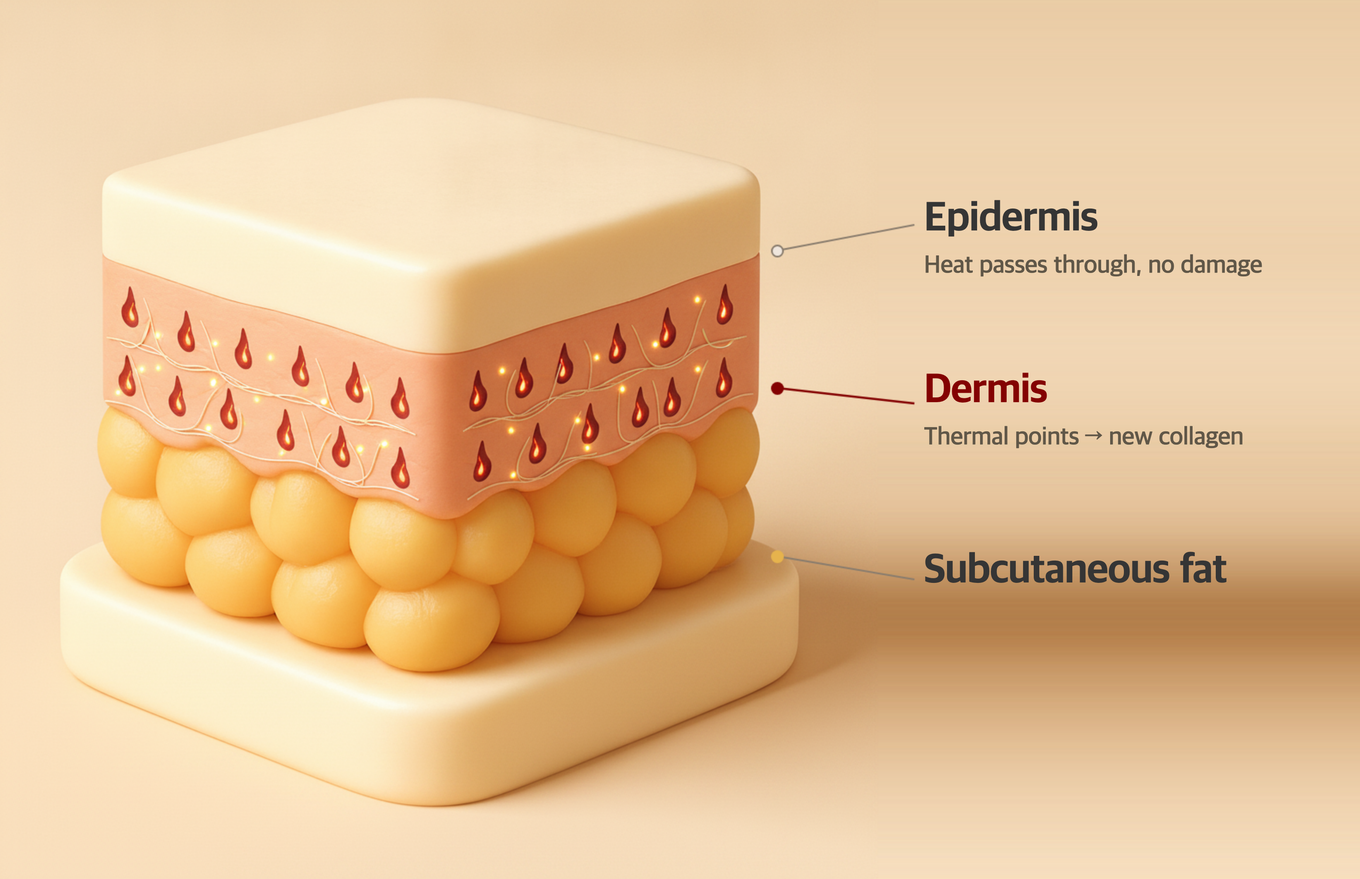
The epidermis is left alone while thermal coagulation points form at set depths in the dermis. New collagen starts forming around those points.
Because when a thermal point denatures old collagen, the body reads that spot as "something to repair," calls in fibroblasts, and builds new collagen and elastin.
Step by step, it goes like this:
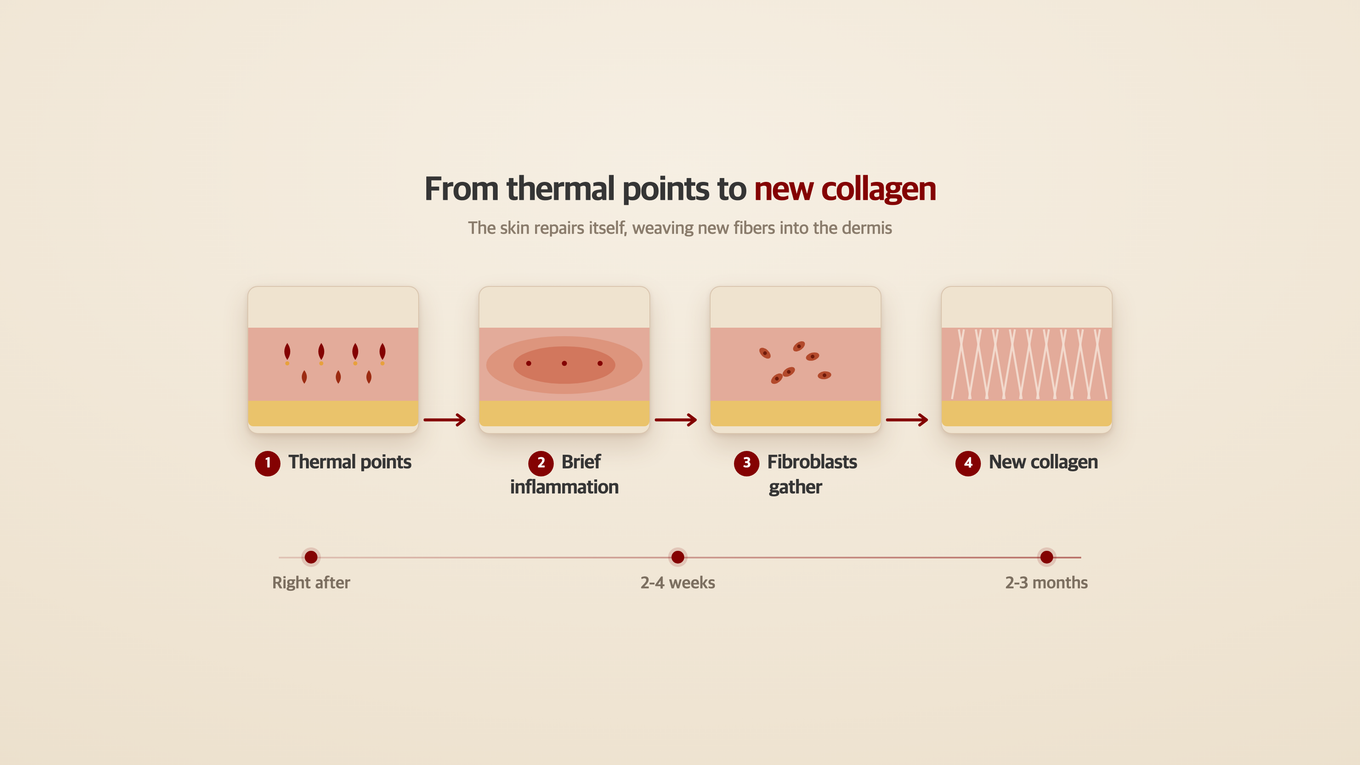
Thermal point → brief inflammation → fibroblasts gather → new collagen. The change you can see on the surface follows this process weeks to months later.
This sequence has been observed step by step in a detailed animal model. In a standard treatment, coagulation points formed in flame-like shapes at three depths in the skin, 1.5mm, 3.0mm, and 4.5mm, and around them gathered fibroblasts carrying HSP47, a marker that switches on when new collagen is being built (Marquardt et al., J Cosmet Dermatol 2025). Since this was seen in animal-model skin rather than human, it's best read as mechanistic evidence for the order in which the change unfolds.
One study went further, down to the cell-signaling level. In aged human fibroblasts and 12-month-old mouse skin, ultrasound stimulation lowered an aging-related signaling protein (Caveolin-1) and increased collagen and elastin synthesis (Oh et al., Cells 2023). In other words, heat works as a "rebuild" signal to the cells. I'll be clear that this too is evidence from aged cells and mice, not a human clinical trial.
Put simply, it's close to weaving fresh threads back into a loosened net. So the real result comes not from the moment of treatment but from the collagen your body builds over the following weeks to months. The focused ultrasound that showed new collagen in both human and animal models works the same way as the MFU-V class devices, like Ultherapy Prime, that we use at our Myeongdong clinic (the cell and mouse signaling studies back that mechanism at a lower level of evidence). This is the kind of histological evidence I use to judge how a treatment actually works.
The change comes on gradually, over weeks to about three months. So judging by what you see in the mirror on the day of treatment is too early.
The animal model above, where 90 days showed clearer mature collagen and new elastin than 14 days, points to that same timeline. Roughly, it flows like this:
Here's where one misunderstanding splits off. The tight feeling right after treatment is usually a temporary effect of tissue contracting under the heat. The real collagen remodeling comes afterward, on a different clock. Expect the two to be the same thing, and you'll feel let down when "it all loosened up in a few days." So there's no reason to lose heart looking in the mirror the day after. At that point your body is still busy building new collagen.
Since these weeks to months are what shape the result, care that keeps the skin comfortable in the meantime lays the groundwork. It doesn't have to be elaborate; the point is to hold to the basics.
How long the skin needs to settle varies with intensity, area, and skin condition, so watching your own skin's response and adjusting is the practical way to go.
Remodeling runs over the months after treatment. Basic moisture and sun protection through that window support the result.
Both use heat to prompt collagen remodeling, but ultrasound delivers it focused to a set depth, while radiofrequency spreads it through a broader volume.
The human histology study above shows this difference well. HIFU acts focally on deep tissue, so the collagen in the mid and deep reticular dermis and the elastin in the deep dermis stood out, whereas monopolar radiofrequency (RF) works on the same deep tissue but in a more diffuse way, with collagen seen across several layers from the papillary to the deep dermis (Suh et al., J Cosmet Laser Ther 2015). It's hard to call one flatly better than the other. They aim at different things.
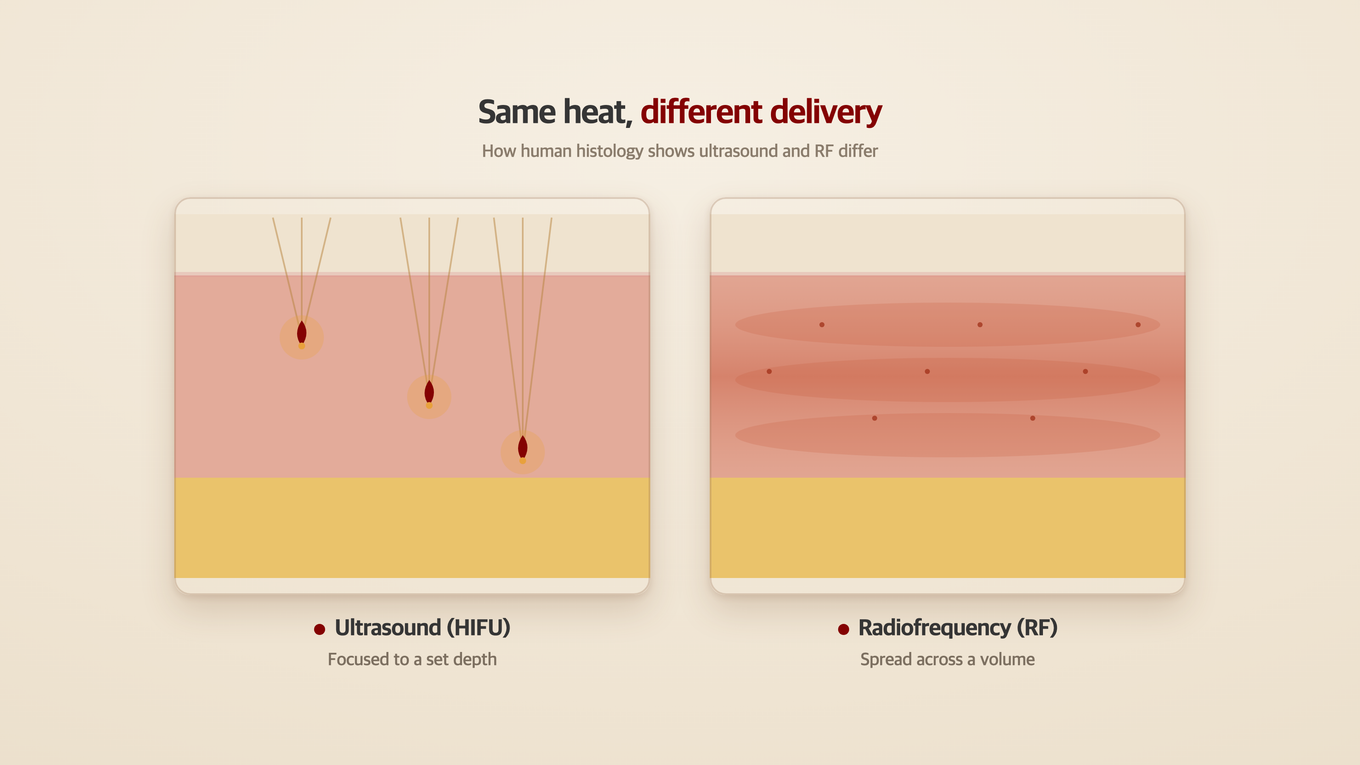
Same heat, different delivery. Ultrasound is focused to a set depth; radiofrequency acts across several layers of the dermis.
| Aspect | Ultrasound lifting (HIFU) | Radiofrequency lifting (RF) |
|---|---|---|
| How heat is delivered | Focused to a set depth | Spread through a volume |
| Layer most prominent in histology | Mid and deep reticular dermis | Papillary through deep dermis |
| How it feels | Deep-layer lifting and firmness | Overall thickness and tightening |
| Devices at our Myeongdong clinic | Ultherapy Prime / Shrink Universe / Titanium | Thermage FLX |
Our Myeongdong clinic has both the ultrasound family (Ultherapy Prime, Shrink Universe, Titanium) and the radiofrequency family (Thermage FLX). So rather than fixing on a device first, we set the direction by the layer we're aiming at and the state of the skin.
It fits early- to mid-stage loss of firmness and blurring contours, the kind of early laxity people often weigh a non-surgical lifting option for, while significant sagging or lost volume may call for other approaches alongside it.
Here are the axes I lean on when setting direction in the clinic. Take them as ways to think it through rather than as fixed answers.
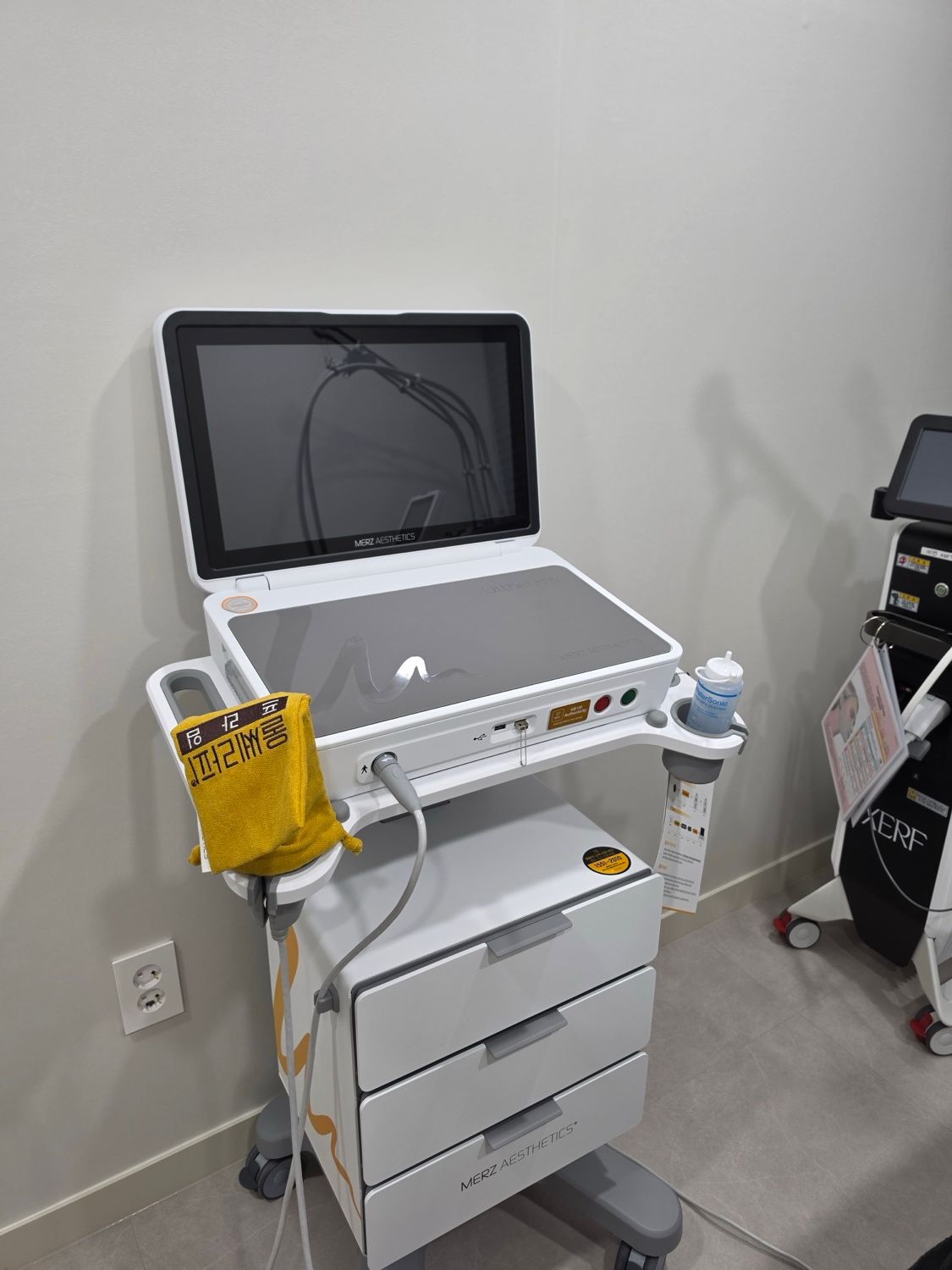
The actual focused-ultrasound (MFU-V) class device that histology studies looked at. Installed and kept in maintained condition at the Myeongdong clinic.
The collagen remodeling behind ultrasound lifting really sits inside a bigger picture of regeneration. Waking fibroblasts with heat, and filling in the environment where collagen can form with ingredients, the way collagen boosters work, are different routes to the same destination: rebuilding your own collagen. The fact that Dr. Chanjong Lee has worked with collagen boosters like Gouri and liquid PCL for years at our Myeongdong clinic reflects this same view of regeneration. So rather than pitting lifting against boosters, it's better to approach it by what your skin needs first, right now.
The newly built collagen settles in and tends to hold for a while, but the exact length varies a lot from person to person. Aging keeps going after treatment, so it isn't permanent. Rather than a "guaranteed few months," it's more realistic to set a maintenance cycle that matches how fast your own skin ages.
The human studies showed results by layer rather than as a single "increased by X percent." Two months after treatment, new collagen in the mid and deep reticular dermis and new elastin in the deep dermis rose significantly. In the animal model, mature collagen and new elastin were significantly greater at 90 days than at 14 days. How much it increases varies widely with age and skin condition.
Collagen remodeling does start from a single session. But how many sessions and at what interval depends on the degree of sagging and your skin's condition. Since even one session's result unfolds over months, it's usual to set the next direction after seeing that change.
There can be a sensation in the moment the thermal points form, felt differently depending on intensity and area. Faint redness or swelling after treatment usually settles within a few days, though this varies. During recovery, keep up basic moisture and sun protection, and avoid adding heat to the treated area for about two weeks.
No, that's not how to read them. Histology studies show the mechanism and the trend, that this treatment works in the direction of increasing collagen and elastin. On top of that, human studies and animal or cell studies sit at different grades, so you can't carry the animal model's 90-day figures straight over to a human result. How much you actually respond varies widely with age, skin condition, and lifestyle.
They take different routes. Ultrasound lifting uses heat to wake fibroblasts and prompt collagen to rebuild, while a collagen booster adds ingredients to fill in the environment where collagen can form. The destination is the same for both, rebuilding your own collagen, but the layer they target and the method differ, so depending on your skin they're chosen on their own or considered together.
"Ultrasound lifting rebuilds collagen" isn't only an ad line. Histology that looked at human skin confirmed new collagen and elastin in the dermis two months after treatment, with that response most pronounced in the deep dermis. Animal and cell studies back that direction with a mechanism and a timeline.
At the same time, the evidence spells out the limits just as clearly. The change comes on slowly over weeks to months, how much it increases differs from person to person, and aging continues, so it isn't permanent. Human studies and animal or cell studies also sit at different grades. So ultrasound lifting is more accurately understood as "a treatment you manage while waiting for your collagen to fill back in" than as "a treatment that pulls you tight in one go."
Above all, it isn't for everyone. It fits early- to mid-stage loss of firmness, but significant sagging or lost volume may need a different approach. Once you know the evidence, it gets far easier to gauge for yourself whether this treatment points in the right direction for you. That judgment comes first; the device comes after.
Once you see that the evidence behind ultrasound lifting is, in the end, a story of regeneration, of "rebuilding collagen," it helps to look alongside it at how stem cells and collagen boosters work together, and the picture of firmness and regeneration comes into sharper focus. If you want deeper evidence, you can also check the actual histology paper (Suh et al., 2015).
#UltrasoundLifting #HIFU #CollagenRemodeling #Ultherapy #ShrinkUniverse #Titanium #SkinTightening #Histology #NonSurgicalFacelift #MyeongdongDermatology #ForeverClinic