

Blog
Expert tips for healthy skin
Expert tips for healthy skin
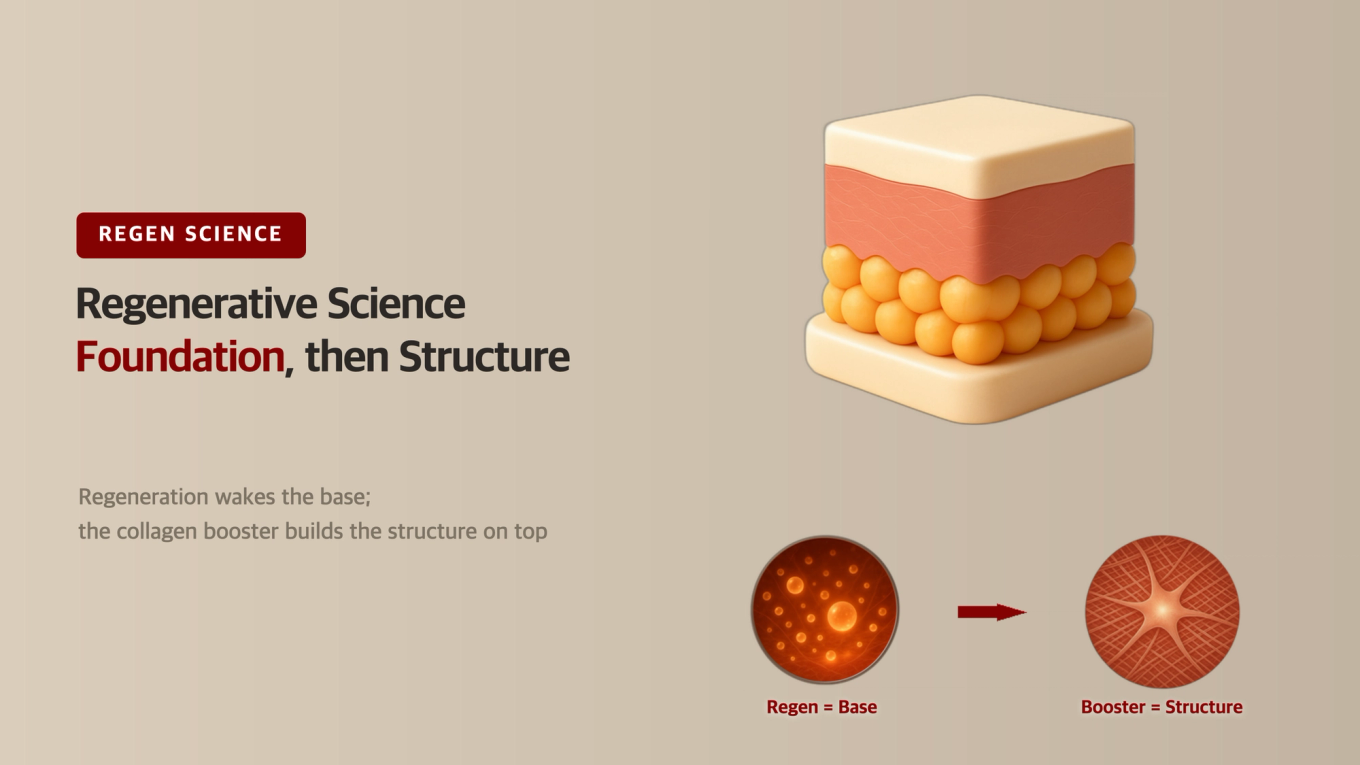
"Doctor, should I go for stem cell therapy or a collagen booster? They both claim to be regenerative, so what's the difference?"
This comes up almost every time the subject of regenerative treatments does at our clinic in Myeongdong, Seoul. These days 'stem cells,' 'exosomes,' and 'collagen boosters' all get grouped under the same word - regeneration - so it's easy to read them as rival treatments, as if picking one means you can skip the rest.
But once you look at how they actually work, they aren't at odds at all. They do different jobs. Regenerative treatments lay the groundwork so the skin can rejuvenate; collagen boosters build the structure on top of that. Today I'll walk through how the two split the work, and why recent dermatology research points to using them in a set order rather than as separate, either-or choices.
This isn't about recommending any specific product. Understanding that 'regeneration' covers two distinct roles can clarify what your skin truly needs.
Key Takeaways
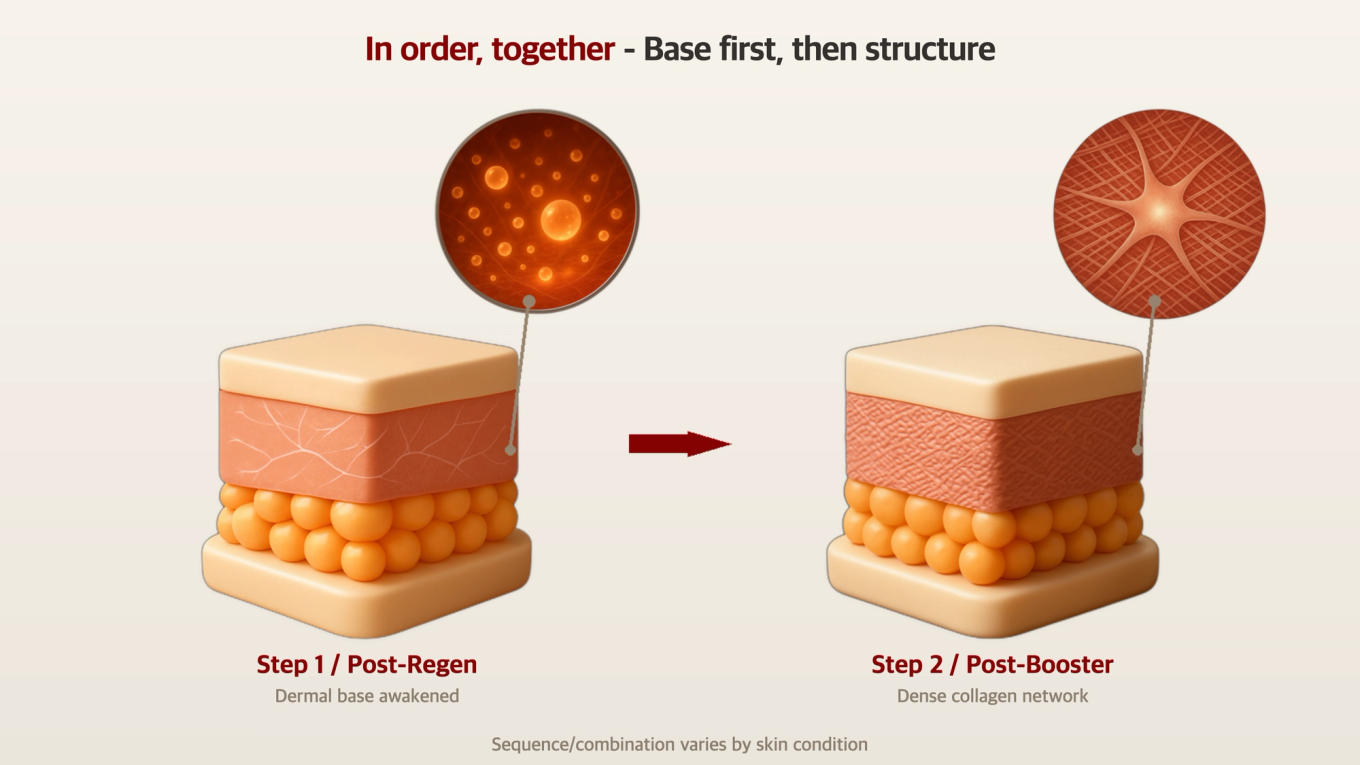
- Stem cell/exosome-based regenerative treatments wake up the skin's foundation (its soil) by delivering repair signals.
- Collagen boosters (like liquid PCL such as Gouri) build collagen structures on that foundation.
- So, the relationship is not competition but foundation → reinforcement.
- Recent reviews suggest that preparing the skin environment with regenerative treatments can enhance the subsequent collagen induction response.
- However, not everyone needs both. Depending on skin condition, one might suffice.
Let's clear up a common misconception first. Choosing between stem cell regenerative treatments and collagen boosters is not a matter of picking one over the other.
Many people think "aren't all regenerative treatments the same?" but what they do within the dermis is quite distinct. One revives the microenvironment for cellular activity, while the other stimulates fibroblasts to build collagen structures on that environment.
"So what do they each specifically do?"
Here's a brief breakdown:
💡 To put it simply - if regenerative treatments are like preparing the soil for seeds to take root, collagen boosters are like erecting pillars to build a house on that soil. Different roles and sequences mean there's no competition.
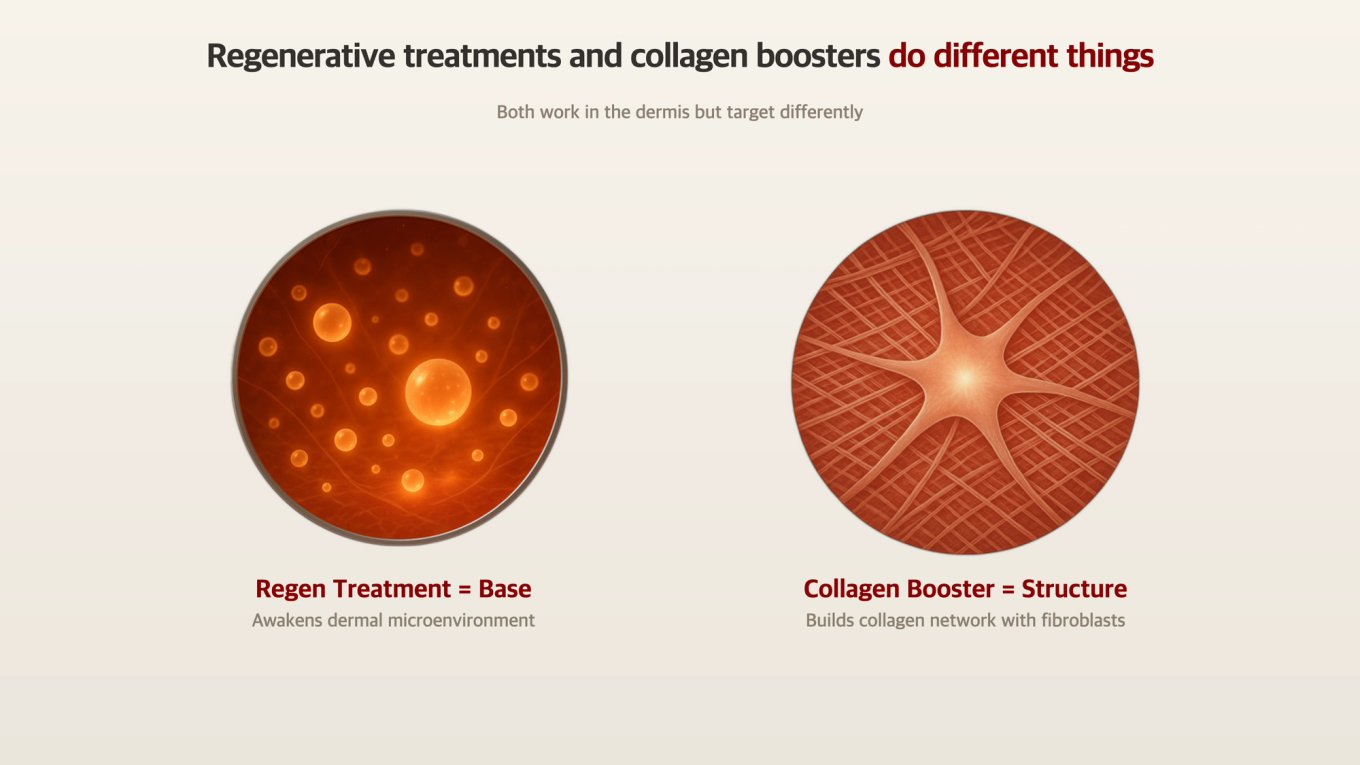
Let's go a step deeper into what regenerative treatments actually do. Stem cell or exosome therapies don't build collagen themselves - they revive the environment the collagen-making cells work in.
In our skin, the collagen factory is the fibroblast deep in the dermis. As we age and UV damage adds up, these cells slow down, and the microenvironment around them (growth factors, signaling molecules) dries out. Think of soil that has gone hard and lost its nutrients.
Regenerative treatments introduce regenerative signals here.
One thing worth flagging: these signals prepare the foundation (the soil). They don't put up a solid collagen frame on their own. So it's more accurate to see a regenerative treatment as getting the skin ready to respond again than to expect a dramatic volume change from it alone.
Once the foundation is ready, it's time to build the structure - and that's the job of collagen boosters. Among the various skin boosters out there, these are the ones grouped as collagen-stimulating injectables.
Collagen boosters place a biocompatible material like liquid PCL (such as Gouri) into the dermis to stimulate fibroblasts to make new collagen directly. As the material triggers a controlled tissue response, fibroblasts switch on, and new collagen forms and slowly organizes into a denser network over time.
This mechanism is supported by actual research. In a study co-authored by Dr. Chanjong Lee from our clinic in Myeongdong, using liquid PCL (Gouri) resulted in increased dermal thickness and type 1 collagen production ("Liquid-Form Polycaprolactone Injection Enhances Dermal Thickness and Collagen Production in UVB-Induced Photoaging Skin", Journal of Cosmetic Dermatology, 2026). This aligns with the goal of collagen boosters to stimulate 'new collagen production.'
💡 Think of it this way - if regenerative treatments "wake the workers up," collagen boosters "hand them the bricks to build the wall." That's why the filled-in, firmer changes tend to show up at this stage.
For detailed insight into how collagen boosters remodel the dermis, check out How Collagen Boosters Create Collagen Structures.
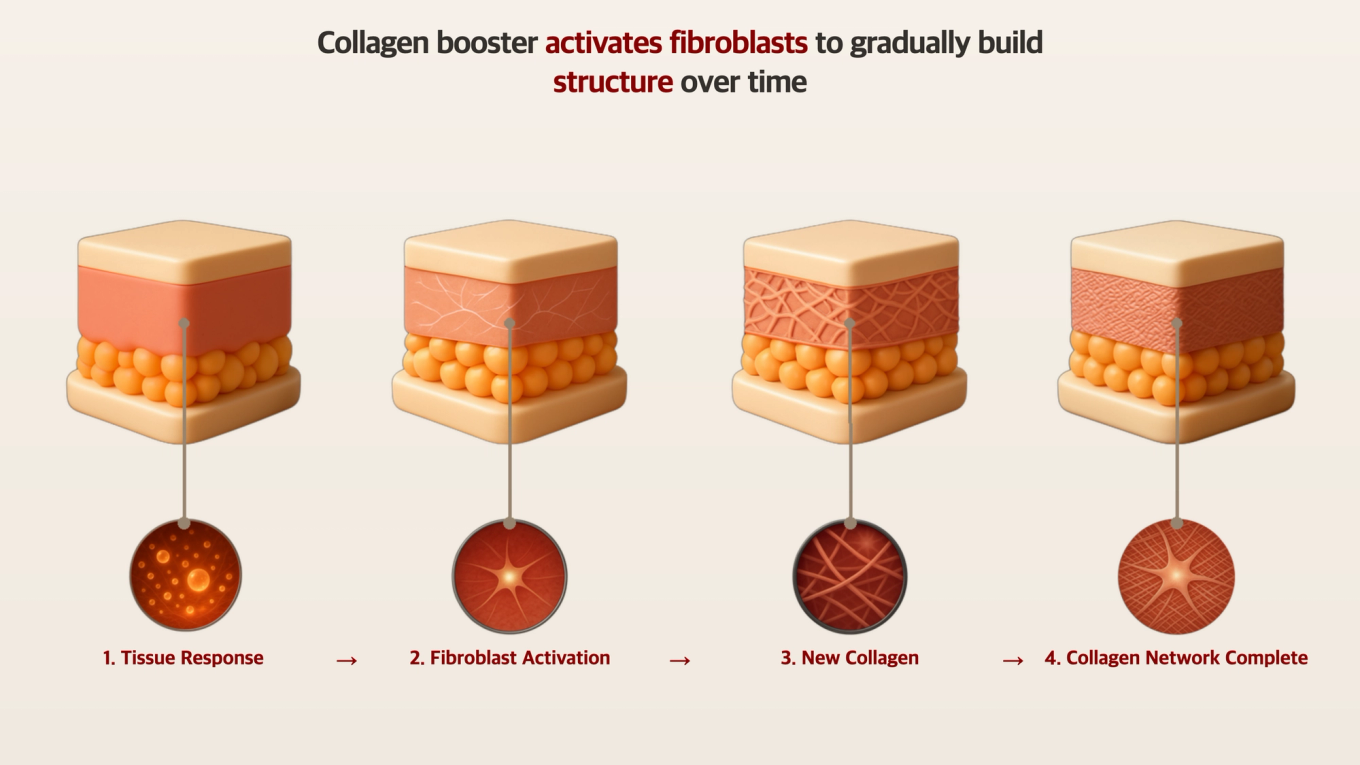
Now, the key point: why do recent studies suggest there's a sequence to these treatments? The flow of preparing the foundation first, then building the structure.
A 2026 review in an international journal (Dal Col et al., International Journal of Molecular Sciences) highlights the concept of 'skin bed preparation.' It suggests that optimizing the skin microenvironment with regenerative biomolecules first results in a more responsive environment for subsequent collagen-inducing treatments. This shifts the skin from a 'breaking state' to a 'building state' by reducing oxidative stress and chronic inflammation.
To rephrase:
⚠️ Take note - 'Together' doesn't mean 'simultaneously, unconditionally.' The nature and timing of the two treatments depend on the skin's condition. Some might only need foundation preparation, while others require structural reinforcement first. The sequence and combination are determined by individual skin needs, not a one-size-fits-all formula.
This is where our combined approach at our clinic in Myeongdong comes in. We treat the regenerative side (Metacell) as the foundation, then add a collagen booster like Gouri as the reinforcement - a step-by-step sequence that lets each treatment do the part it's actually good at.
Knowing the principles can help clarify "What should I do?" Here's a guide to the thought process we consider in clinical settings. These aren't definitive answers but guidelines for consideration.
⚠️ Honestly speaking - Not everyone needs both treatments. We don't recommend the "do everything because it's trendy" approach. Instead, assessing the skin's condition and planning only what's necessary is the right approach.

Given the high expectations surrounding regenerative treatments, let's address some common misunderstandings honestly.
Effects are gradual, with significant individual variation. Whether it's regeneration or collagen boosters, it takes time for your cells to react and build collagen. The transformation is more about gradual refinement than immediate dramatic changes. The extent and timing of changes depend heavily on age and skin condition, making it hard to generalize.
The word 'stem cell' gets used loosely. A stem cell 'therapeutic' (an approved drug), a stem cell 'procedure' (a licensed medical technology), and a culture-media 'cosmetic' are three different categories. Ads tend to blur them all into one 'stem cell,' so it's worth checking exactly what you're getting.
Regulation and safety for exosome and culture-media treatments are still being worked out. Since purification method and purity have a lot to do with both results and safety, Korea's drug safety authorities are still refining the standards. That's why we care more about being transparent about which material we use and how we handle it than about flashy claims.
🩺 Note from the Doctor - In consultations, I often hear the expectation "Will regeneration drastically improve my skin after one session?" I then share the diagram we've discussed today. Knowing that regeneration wakes the foundation and collagen boosters build the structure helps explain why 'in one go' isn't as accurate as 'sequentially, tailored to your skin.' At Myeongdong Forever Clinic, we guide patients to see regenerative treatments as 'foundation-laying steps' rather than a 'cure-all.'
They do different jobs. Regenerative treatments wake up the foundation (the soil) of your skin, while collagen boosters build the collagen structure on top. So they aren't competitors - it's a foundation-and-reinforcement relationship. That said, not everyone needs both; depending on your skin, one can be enough.
Recent review studies suggest that preparing the skin microenvironment with regenerative biomolecules first leads to a more responsive environment for subsequent collagen-inducing treatments. It follows a sequence of preparing the foundation with regeneration and then building the structure with boosters. However, the sequence and timing are determined case-by-case based on skin condition, not necessarily done all at once.
At our Myeongdong clinic, our regenerative treatment is Metacell. It uses autologous exosomes/growth factors derived from your blood, designed to minimize external material burden. We also consider liquid PCL-based collagen boosters like Gouri.
Both regeneration and collagen boosters require time for your cells to respond and build collagen. The changes are gradual and become noticeable over time rather than immediately after treatment. The extent and timing vary greatly depending on age and skin condition, making it hard to predict precisely.
Not exactly. Stem cells are the actual cells, while exosomes are tiny vesicles (small pouches) that cells secrete as signaling substances. In regenerative treatments, the focus is often on using signaling substances (growth factors/exosomes, etc.) exchanged between cells. Since the term 'stem cell' is used broadly, it's important to verify what you're actually receiving.
Choosing between regenerative treatments and collagen boosters is not about selecting one over the other. Regenerative treatments awaken the foundation of your skin, while collagen boosters build the structure on top.
Recent research highlights the concept of 'preparing the skin bed,' indicating that laying the foundation first enhances the response to subsequent collagen induction. Thus, the natural sequence is foundation → reinforcement.
Remember, though, not everyone needs both. The first step is determining whether your skin needs foundation preparation or structure building. The sequence is then tailored accordingly. Just remembering the phrase 'regeneration for the foundation, boosters for the structure' is enough.
#StemCell #CollagenBooster #RegenerativeTreatment #Metacell #Gouri #SkinRegeneration #Exosome #SkinBooster #MyeongdongDermatology #ForeverClinic