

Blog
Informasi khusus untuk kesehatan kulit
Informasi khusus untuk kesehatan kulit
Exosome skin boosters, stem cell skincare ampoules. Nearly every ad for them leans on the word "regeneration." Open a paper that actually tested exosomes on human faces, though, and the numbers are a lot more cautious than the ads.
"Do exosomes actually regenerate skin, or is that just marketing?"
Here's the straight answer. There is a randomized trial done on human faces, and it did show signs of improvement. But the evidence hasn't built up far enough to say exosomes "regenerate" skin. So let's walk through the paper itself: what was measured, and what's still missing.
The short version
- Exosomes are signaling vesicles, roughly 30-150nm across, released by cells. They contain no cells. They carry the signaling molecules a cell sends out.
- In a 12-week randomized split-face study of 28 people (J Cosmet Dermatol 2023), the exosome side improved significantly more than the control side on wrinkle roughness, elasticity, hydration and pigmentation.
- Both sides also had microneedling, so the control side improved too. What you can credit to the exosomes is the gap between the two sides, and the authors themselves listed the small sample, single ethnicity and short follow-up as limitations.
- An April 2026 systematic review found long-term safety evidence lacking. In a 2019 notice, the US FDA said there were no FDA-approved exosome products at the time and warned of serious adverse events linked to unapproved products.
- Our clinic in Myeongdong, Seoul doesn't offer a standalone exosome treatment. For improving dermal condition we use Metacell, which is based on your own blood. It is a different material from the one in the study, so these numbers should not be read as Metacell results.
Having read this paper closely as a doctor at Forever Clinic in Myeongdong, Seoul, I'd put the evidence for exosomes improving skin at the level of one randomized split-face study: 28 people compared over 12 weeks (J Cosmet Dermatol 2023). Wrinkle, elasticity, hydration and pigmentation measures improved more than the control in that study, but large, long-term evidence is still thin.
Let me sort out the terms first. I divide stem cell-related treatments into three types, based on what actually goes into the skin.
Definition - Exosomes are membrane vesicles about 30-150nm in diameter that cells release. They carry signaling molecules such as proteins and RNA and deliver them to other cells.
So the claim that "exosomes put stem cells into your skin" is simply wrong. What goes in is a signal. The idea behind this whole category is that fibroblasts in the dermis pick up that signal and are prompted to make more collagen. I break down the three types in more detail in What exactly is a stem cell treatment?
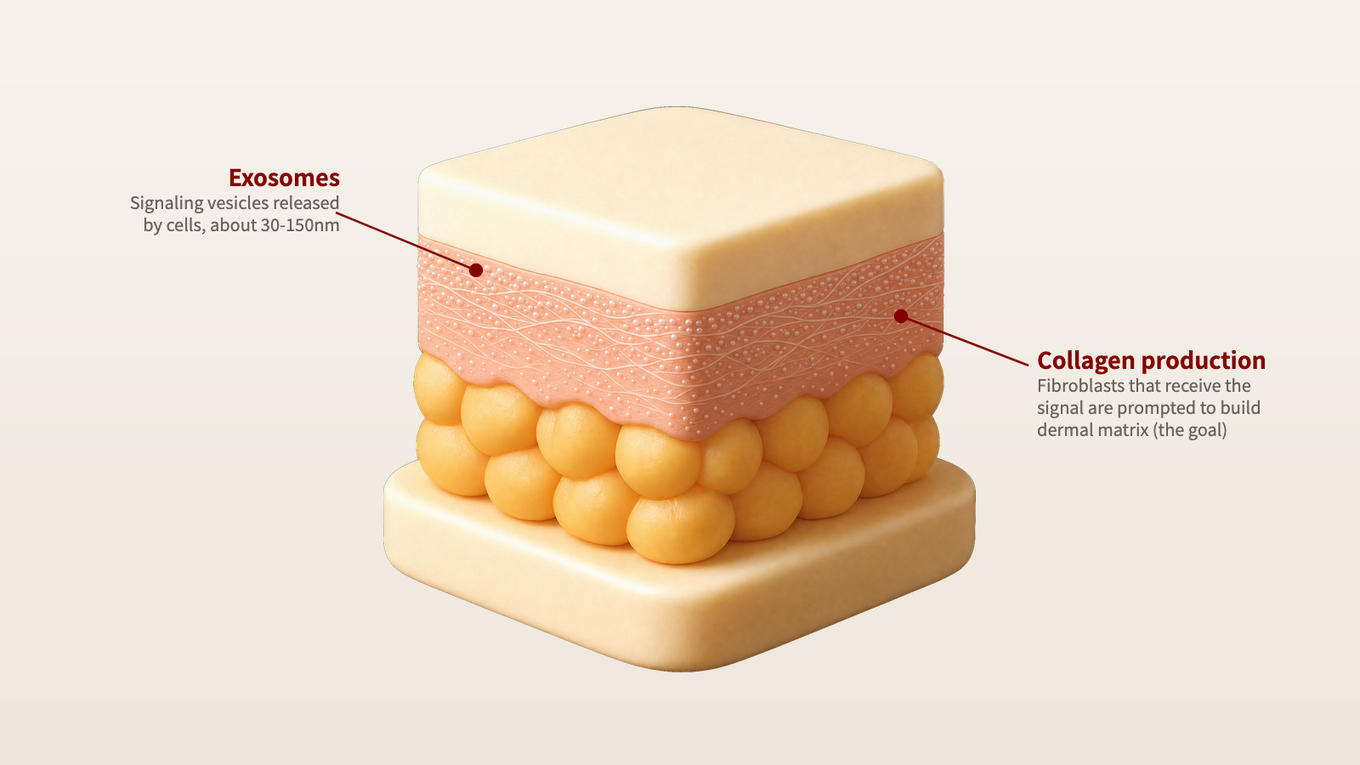
Exosomes target the dermis. This concept model shows the idea that signaling vesicles reach fibroblasts and prompt them to produce dermal matrix such as collagen. Sizes are not to scale.
The researchers took 28 people aged 43-66 (average age 54) and split each face in half. One side got an exosome-containing solution, the other got saline, and both sides were treated with 1mm microneedling. The study was published in the Journal of Cosmetic Dermatology in 2023 by a Korean dermatology team (Park GH et al.).
Here's how it ran.
I picked this paper because of its design. Comparing the left and right sides of the same person cancels out most of the noise from age, skin type and lifestyle. That sets it apart from ad material along the lines of "I tried it and my skin got better."
The downside: because needles were involved, both sides had temporary redness, swelling and pinpoint bleeding during and after treatment. These were reported as mild and cleared up on their own within a week. The study was funded by a government grant (National Research Foundation of Korea), and the authors declared no conflicts of interest. The material was a commercial freeze-dried exosome product dissolved into solution. You can read the original on PubMed.
At 12 weeks, mean wrinkle roughness on the exosome side was down 12.4%, about 6 percentage points more than the control side (6.6%). Only the exosome side gained elasticity (+11.3%); the control side actually fell 3.3%. Overall improvement judged from photos (GAIS) was also significantly higher on the exosome side (p=0.005).
| Measure (12 weeks vs baseline) | Exosomes + microneedling | Saline + microneedling | p-value |
|---|---|---|---|
| Mean wrinkle roughness (Ra) | 12.4% decrease | 6.6% decrease | 0.031 |
| Maximum wrinkle depth (Rt) | 14.4% decrease | 6.8% decrease | 0.008 |
| Elasticity | 11.3% increase | 3.3% decrease | 0.002 |
| Hydration | 6.5% increase | 4.5% increase | 0.037 |
| Melanin index | 9.9% decrease | 1.0% decrease | 0.044 |
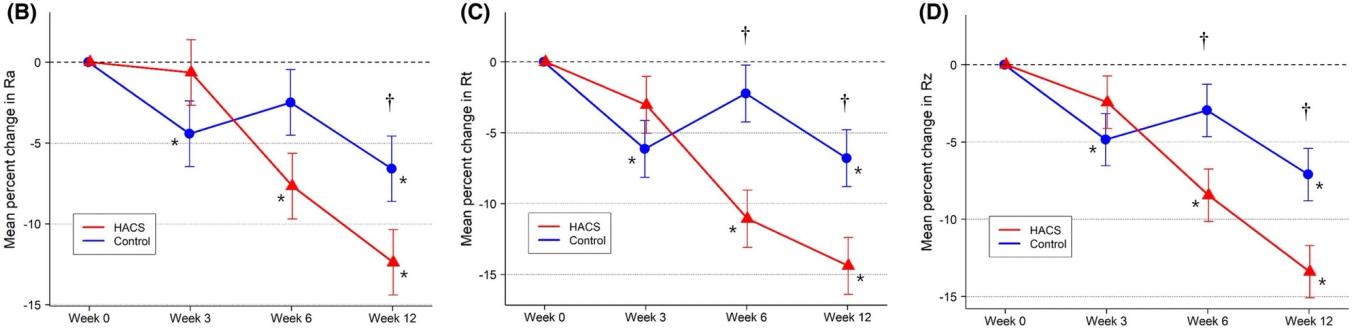
The red line is the exosome side, the blue line the control (saline) side. At week 3 the control side had actually dropped more; from week 6 the exosome side pulls ahead. The third graph (Rz) shows a 13.4% vs 7.1% decrease at 12 weeks (p=0.007). Source: Park GH et al. J Cosmet Dermatol 2023;22(12):3418-3426, Figure 4 B-D (CC BY 4.0). This is a small 28-person study, and results vary from person to person.
One thing you have to keep in mind when reading these numbers: the control side got better too. Microneedling on its own makes tiny wounds in the skin that trigger a healing response. So what you can credit to the exosomes in this table is the difference between the two sides. For mean wrinkle roughness, that's about 6 percentage points.
Is that a big difference? The devices clearly picked it up, and the dermatologists' photo ratings showed a difference as well. But that margin came from three sessions over 12 weeks.
The part I found interesting was elasticity. On the control side it ended up lower at 12 weeks than at the start (-3.3%), while the exosome side had already gone up by week 3. It peaked at week 6, then eased a little to +11.3% at week 12. Hydration rose on both sides, and the 2-percentage-point difference at 12 weeks was significant.
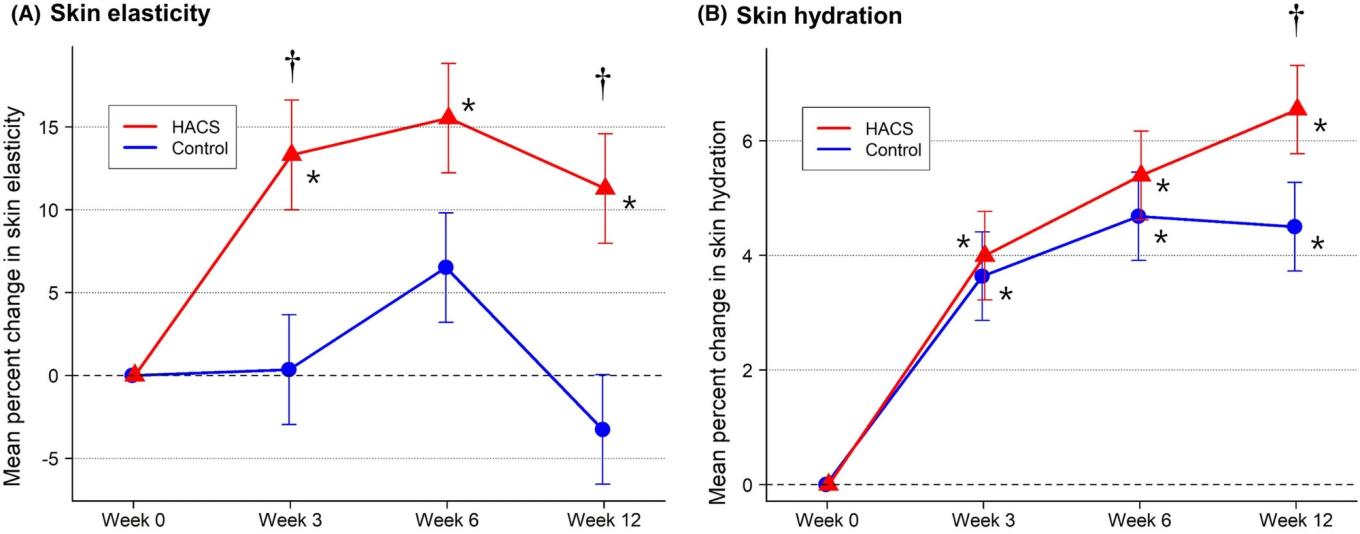
Elasticity is on the left and hydration on the right; the red line (HACS) is the exosome side. How much your own skin changes depends on its condition. Source: Park GH et al. J Cosmet Dermatol 2023, Figure 5 (CC BY 4.0).
In the 4 people who had biopsies, the paper reported that collagen density, elastic fibers and newly formed collagen in the dermis on the exosome side had increased from baseline. The control side showed similar changes, but less clearly. That points the same way as the device measurements.
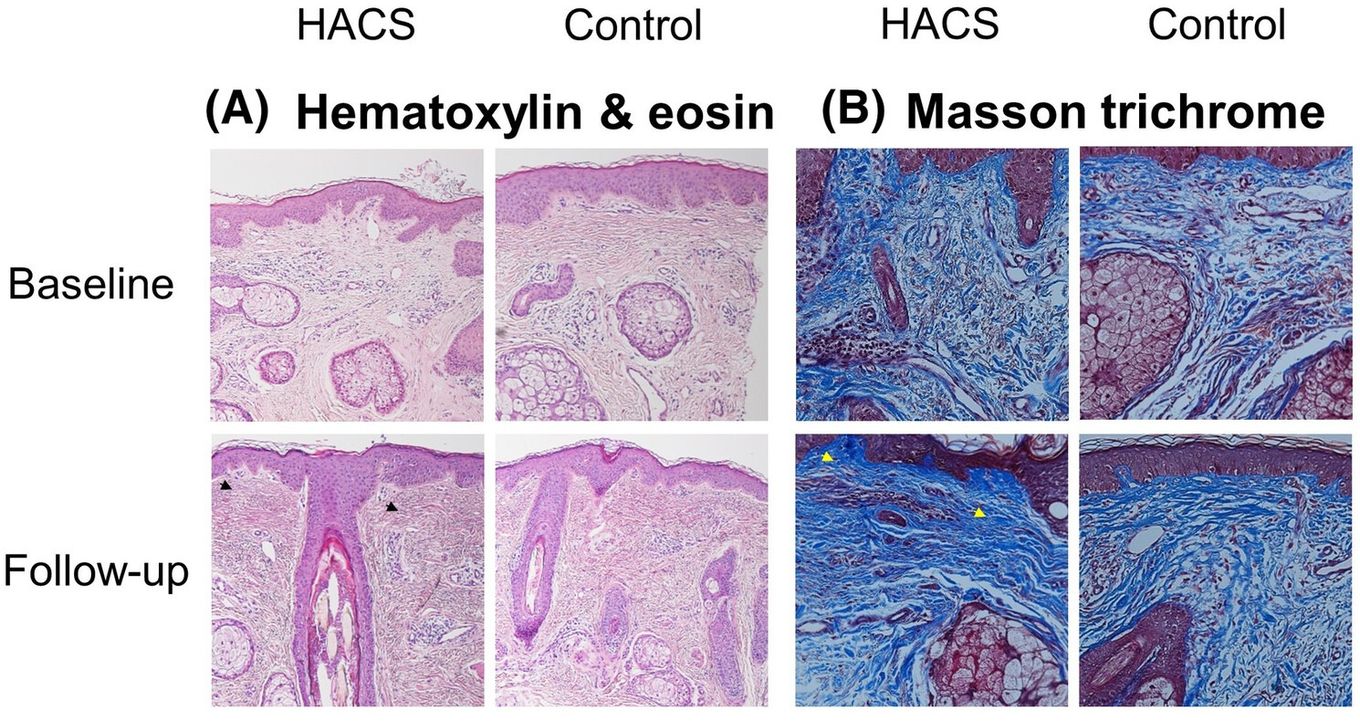
Top row is baseline, bottom row is follow-up; within each stain, the left is the exosome (HACS) side and the right is the control side. In the Masson's trichrome stain on the right, the blue areas are collagen, and the arrows mark changes the authors pointed out. These are representative images the authors chose from the 4 biopsied participants. Source: Park GH et al. J Cosmet Dermatol 2023, Figure 7 A-B (CC BY 4.0).
Honestly, this was the part I found most convincing. Surface measurements can be thrown off by how your skin is doing that day or by the lighting, while tissue images show the inside of the dermis directly. Still, it's 4 people out of 28. That's unavoidable when the test means cutting out a small piece of facial skin, and it's why I'd read this as data that confirms the direction, nothing more.
On the current evidence, it's hard to say "regenerate" with any certainty. The authors themselves listed the limits: every participant was of the same ethnicity, the sample was small and the follow-up was short. An April 2026 systematic review reached a similar conclusion: short-term results look promising, but long-term safety and efficacy need more evidence.
These are the weak spots that review (Dhaliwal NK et al., J Cosmet Dermatol 2026) pointed out.
⚠️ Good to know - The same review noted reports of complications such as delayed granulomas, hyperpigmentation and anaphylaxis when exosomes were injected. That's a different route from the topical-plus-microneedling method used in this study, and the review added that the complications may have come from the exosome preparations themselves. In a December 2019 public safety notification, the US FDA said there were no FDA-approved exosome products at the time and warned of serious adverse events reported with unapproved products.
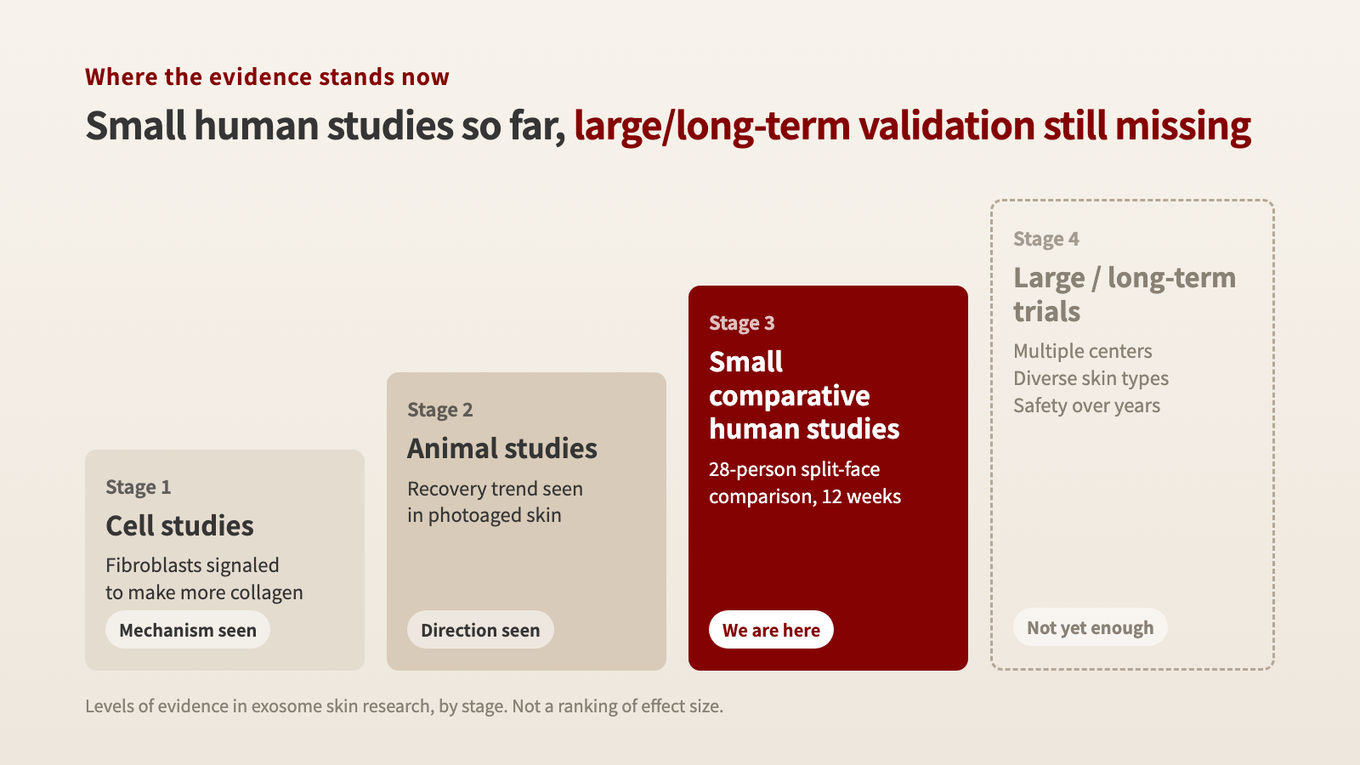
Looking at how evidence builds up, we're currently at the "small comparative human studies" stage. The steps show how far validation has gone, not how large the effect is. The cell and animal stages follow the summary in a review paper (Bai G et al., Skin Health Dis 2024).
That's why I don't use the phrase "regenerates your skin." What I can say is this: "It's a signaling approach aimed at improving the dermis, and a small human study picked up signs of improvement." The current evidence takes me that far and no further.
Our Myeongdong clinic doesn't offer a standalone exosome treatment; for improving dermal condition we use Metacell. Metacell is an autologous approach: growth factors and signaling molecules taken from your own blood are activated with light and heat (photobiomodulation, or PBM) and then used. The study applied an exosome product made from a donor's adipose-derived stem cells, so the two differ right from the starting material.
| Comparison | Exosomes in the study (Park 2023) | Metacell (Forever Clinic Myeongdong) |
|---|---|---|
| Source of material | Donor adipose-derived stem cells (commercial product) | Your own blood (autologous) |
| What's used | Exosome-containing solution | Growth factors/signaling molecules from your blood |
| Processing | Freeze-dried product dissolved before use | Activated with light and heat (PBM) |
| Level of evidence | One randomized study, 28 people | No independent study of this size yet |
So why spend this long on an exosome paper? Because Metacell rests on a related idea: using signaling molecules from outside the cell to trigger a response in the dermis. But "related" is only a hypothesis. This paper confirmed results for that particular exosome solution. It did not confirm anything about Metacell.
That's why on this blog I explain how Metacell works in detail, but describe its results only as "aimed at improvement, with individual variation." Why it uses your own blood, and how the autologous approach works, is covered in its own piece: Why does Metacell draw your blood?
Was the research done in humans? Is there a control group? What was measured? How long was the follow-up? Is the material in the study the same as the treatment you'd be getting? Where do the numbers come from? Run through these six and most overstated evidence falls away.
For screening the ad copy itself, I've written a separate checklist: Stem cell treatment ads: how much should you believe? That piece looks at the language of the ad. The six points here are for the research the ad cites.
They suit people who want to work on dermal condition, like texture, fine lines and elasticity, over a few months. If you want lost volume back right away, or sagging contours lifted in one go, they're the wrong tool.
Here's how to tell whether your skin is a match for this kind of treatment.
Also, go in knowing that Metacell doesn't yet have evidence on the scale of the study above. Expect change to be gradual, with a lot of individual variation. Even in the exosome study, the changes were measured over three sessions and 12 weeks.
No. Stem cells are living cells, and exosomes are the signaling vesicles, about 30-150nm in size, that those cells release. Treatments that use exosomes contain no cells, only the signaling molecules.
It's too early to call them proven. One randomized comparative study in 28 people found that wrinkle, elasticity, hydration and pigmentation measures improved more than the control, but the sample was small and follow-up lasted 12 weeks, so long-term effects and safety still need confirming. Results vary from person to person.
Not directly. The study used an exosome product made from a donor's adipose-derived stem cells, while Metacell is an autologous method that activates signaling molecules from your own blood. Metacell has to be judged on its own evidence.
Don't assume they have none. In this study, temporary redness, swelling and pinpoint bleeding settled within a week. The 2026 systematic review noted reports of complications such as granulomas when exosomes were injected. It's worth checking which product is used and how it's delivered.
Right now the exosome evidence sits at "28 people, 12 weeks, one randomized split-face study." Within that, wrinkle, elasticity, hydration and pigmentation measures improved more than the control, and the biopsies (4 people) pointed the same way. Long-term effects and safety are still open questions.
Next time an ad promises "regeneration," take a second to check what study is behind it, how many people it followed and for how long. That one check filters out a lot.
#Exosomes #StemCellExosomes #ExosomeResearch #ExosomeSkinBooster #StemCellSkincare #SkinBooster #Metacell #SkinResearch #ForeverClinicMyeongdong