

Blog
Informasi khusus untuk kesehatan kulit
Informasi khusus untuk kesehatan kulit
"The treatment itself went fine. It's what I'm supposed to do at home afterward that throws me."
It's something we often hear at our clinic in Myeongdong, Seoul, right as you're getting up after a treatment. While you're on the table, we handle everything. The moment you walk out the door, it's on you. And this is where a lot of people quietly assume, "I had the treatment, so I'm set. The rest will sort itself out."
But in the clinic you see it play out differently. Two people get the same treatment, and for one the result holds for months while the other is disappointed within weeks. More often than you'd think, that gap comes down to how they spent the first few days afterward as much as the skill of the treatment itself. So today I want to walk through why "aftercare" has caught on the way it has, and how the treatment and what you do at home actually connect into one continuous thing. Think of it as me explaining it to you across the desk.
This isn't a pitch for any particular product. Once you see aftercare as the last step of the treatment - as protecting the few days when dermal recovery is settling into a result - it gets much clearer what you actually need to do at home right now.
Key takeaways
- A treatment leaves your skin with a deliberate stimulus, so the days right after are the recovery window that shapes your result.
- During this window the skin barrier is briefly weaker, which makes it more sensitive to irritation and UV than usual.
- So home care really comes down to three things - protecting the barrier, soothing, and blocking UV - kept as gentle as possible.
- Each treatment has its own recovery point (laser, injections, lifting), so what you watch for shifts a little too.
- This is a stage where doing less beats an expensive product, and if something seems off, a check with your clinic comes before self-diagnosis.
Let me start with the trend itself. A few years ago, finding "a clinic that does the treatment well" was pretty much the whole search. These days, noticeably more people ask "what do I need to do afterward?" first.
There's a reason. Most of the treatments people go for now work by nudging the skin to repair itself. Skinboosters, collagen boosters, lifting - they all do this. More and more of them give the skin time to respond, with the result building gradually over several days. So how you spend those recovery days naturally started to matter.
💡 In plain terms - if a treatment is like handing your skin an assignment, aftercare is setting up the conditions so it can actually do that assignment well. Hand over the assignment, stay out of the way, and you're already halfway there.
One more piece. As more people started getting treatments on a regular cycle, aftercare turned into a routine that comes back around each time. When you go in regularly, getting through each recovery well is what gives the next treatment a better starting point.

Recovery matters as much as the treatment. We treat the treatment and the aftercare as one continuous flow.
So let's get into what's actually going on inside your skin right after a treatment. Once you know this, why those few days matter makes sense on its own.
However different they look, treatments share one thing: they give the skin a deliberate stimulus. Laser does it with heat, injections with tiny needle punctures, lifting with heat deeper in the skin. Different methods, same signal - "hey skin, fix this bit." The fibroblasts in the dermis pick up that signal, wake up, and start building collagen, and that's what turns into the result we're after.
But while that repair is getting underway, the barrier at the very surface is briefly weaker than usual. It has just taken a hit, so it holds onto moisture less well, and there's a stretch where it's more sensitive to outside irritation and to UV.
So aftercare has exactly one goal: don't get in the way of the repair inside, and protect the weakened barrier outside. Get through these days well and the dermal recovery carries all the way into the result. Overdo it now and swelling or irritation can drag on, and the result suffers with it.
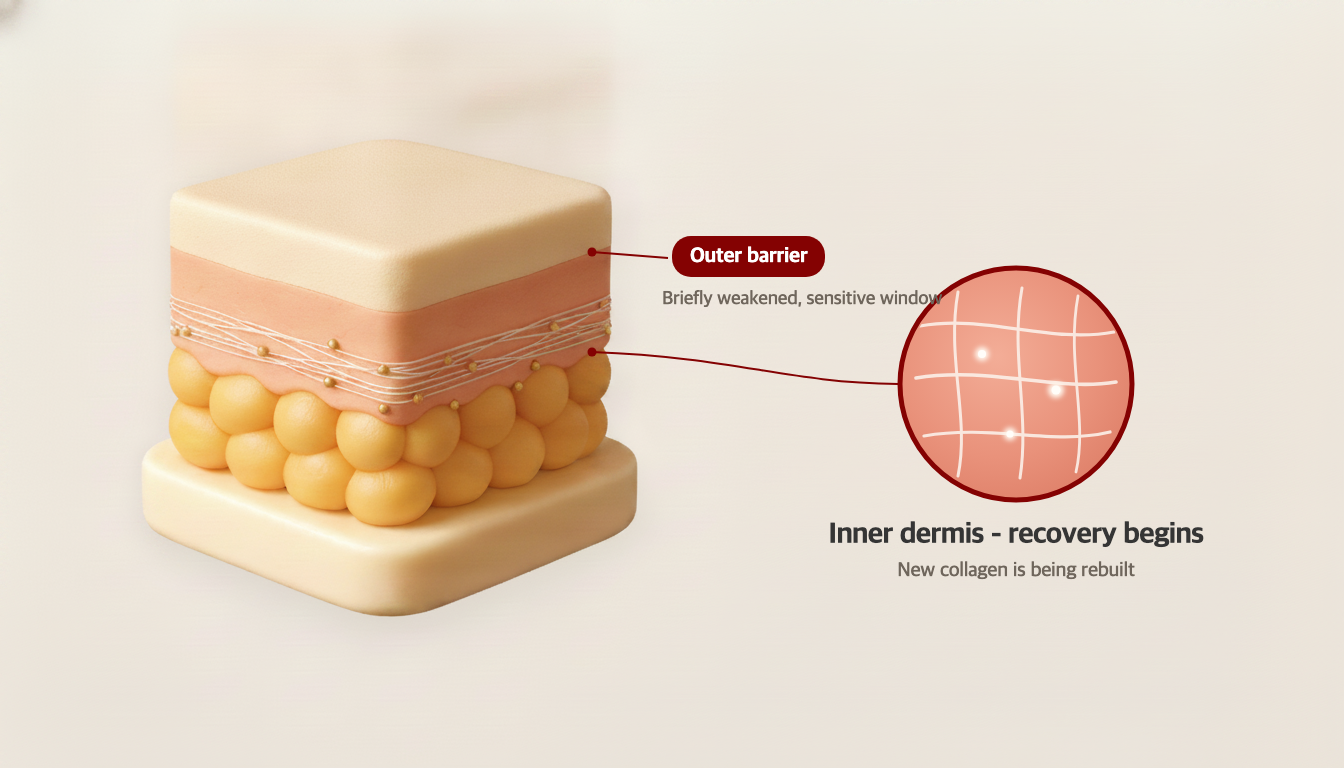
Right after a treatment, repair starts in the dermis while the outer barrier is briefly weaker. Guarding that recovery window is what aftercare is.
Once you know the principle, the order falls into place. Aftercare isn't doing anything at any time - what you focus on shifts a little with each stage of recovery. Here's the broad arc.
The exact timing varies a lot with the treatment and your own skin, so read the timeline below as "roughly this order," not a fixed schedule.
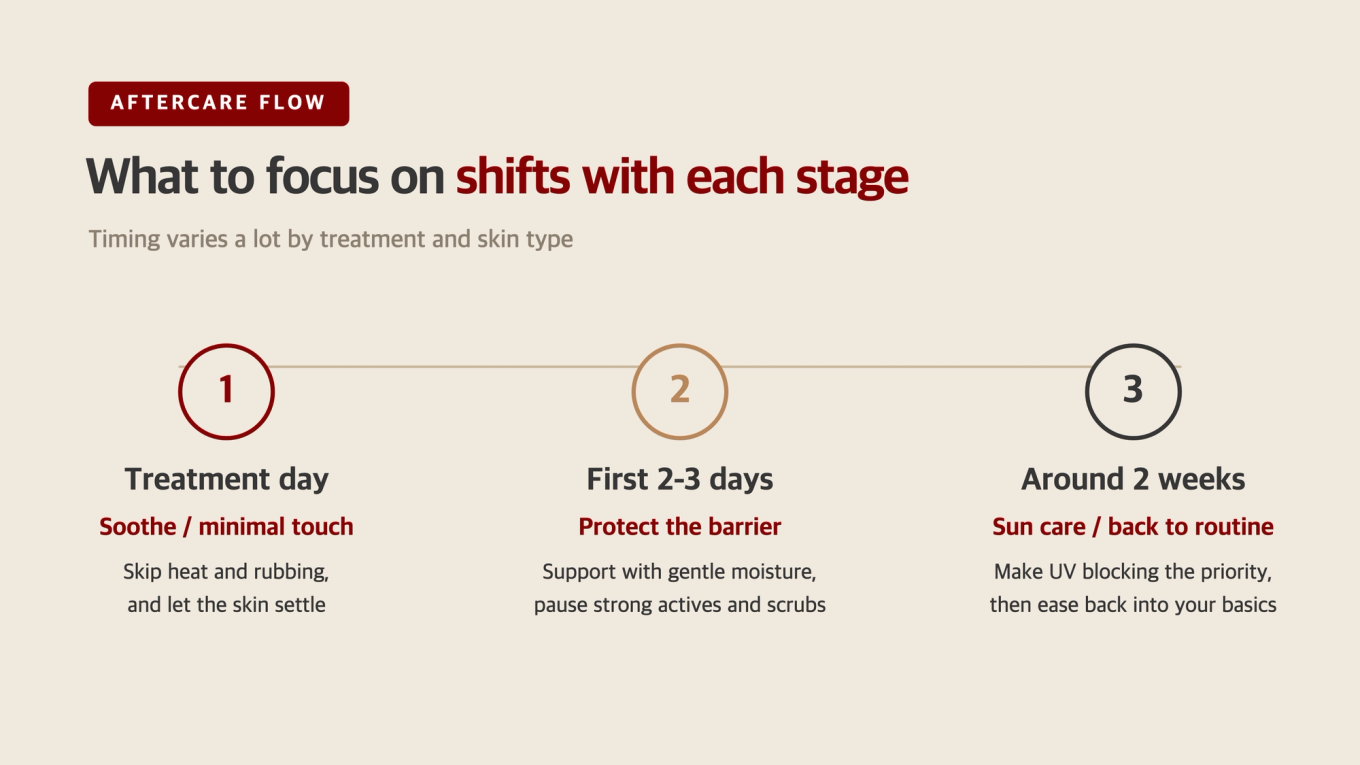
What to focus on changes with the recovery stage - soothing on the day, the barrier early on, then sun protection and your basic routine.
⚠️ Good to know - this order is a rough sketch. Treatments that scab, like laser, run longer and call for more caution, while something like a skinbooster, where the marks fade fast, is shorter. So it's more useful in practice to remember the order of the stages than a specific number of days.
If home care is starting to feel complicated, here's the reassuring part: what you actually need to do at home sorts into three things. Know just these three and most post-treatment care is covered.
First, protect the barrier. You're propping up the weakened barrier with gentle moisture. If "gentle" feels vague, picture a basic moisturizer without fragrance, alcohol, or high-strength acids. While you're recovering, it's safer to stick with something familiar that has always suited your skin than to trial a new functional product.
Second, soothe. This is calming the heat and the fine swelling that come right after. Cool it down, but go easy - pressing ice straight on the skin or rubbing too hard can become irritation itself.
Third, block UV. Recovering skin holds onto pigment easily, so UV protection during this stretch decides how the result finishes. Keep it up even indoors, even on overcast days. If I had to keep only one of the three, this is the one I'd pick. That's how directly UV during recovery lands on your treatment result.
The core of post-treatment home care is protecting the barrier, soothing, and blocking UV. During recovery, less is what lasts.
"So does the care differ for every treatment?" is the natural next question. It does. The big principle stays the same, but which layer of skin a treatment touched, and how, changes the recovery point. Broadly, it splits three ways.
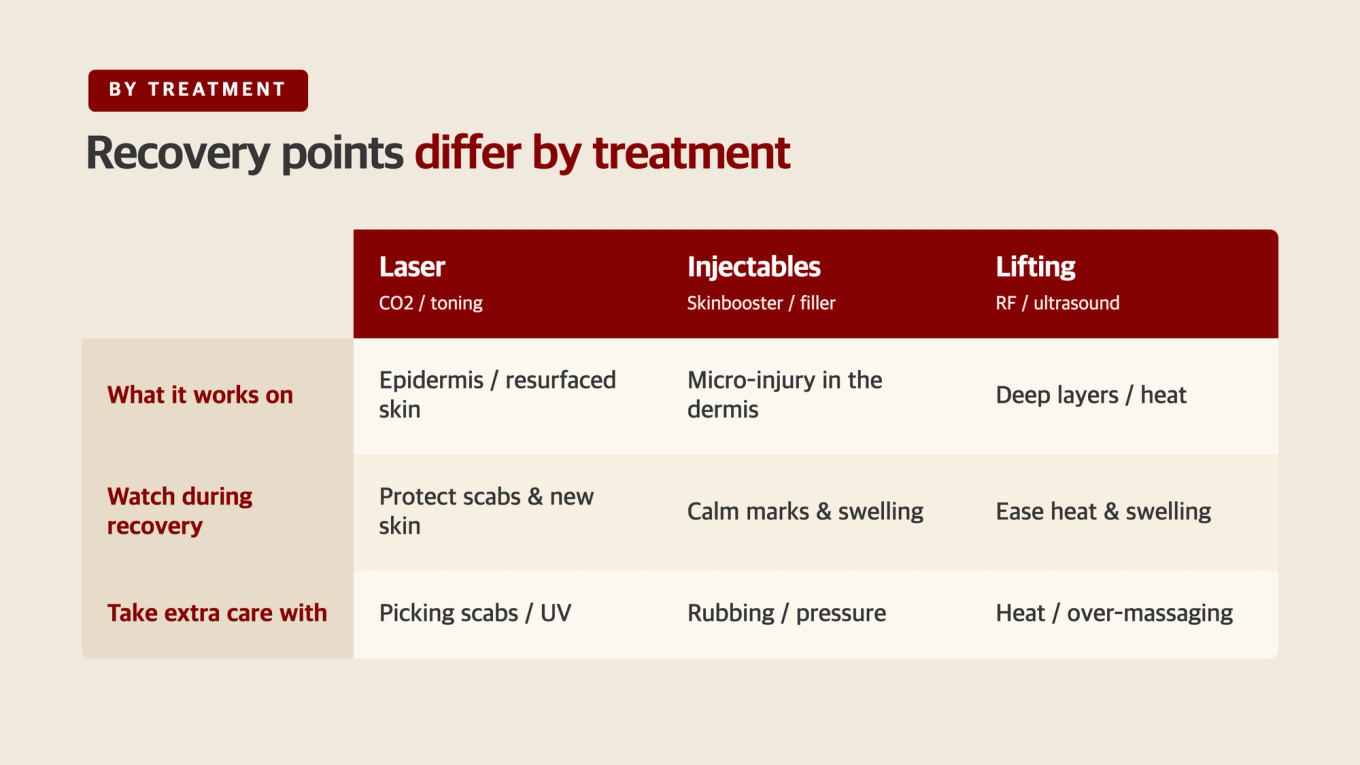
Laser, injections, and lifting reach different layers in different ways, so what you watch for in recovery differs too.
🩺 Doctor's note - when I plan a treatment, I map out "if you have this done, here's how the next few days at home should go" as part of it. In the clinic, now and then someone comes back irritated because they piled on extra products trying to boost the result. The treatment and the aftercare are one set. So for someone who can't easily clear out a stretch of recovery time, I'll sometimes suggest an injection-type treatment, where marks settle relatively fast, before a scab-forming laser one. Along with which treatment is right, it's worth looking at whether your schedule can carry that treatment's recovery.
Big expectations bring their share of misconceptions. Let me be straight about where aftercare tends to go wrong.
More expensive product, layered on thick, must be better? It's usually the opposite. Recovering skin is sensitive, and stacking several unfamiliar ingredients on it can turn into irritation. This is a stage to pare back rather than add. Gentle moisture and sun protection - during recovery, those two are enough.
Don't scrub or irritate the skin to heal faster. The urge to peel off a scab or slough away flaking, because it's bugging you, makes sense. But touching a regenerating surface can leave pigment or a mark, so at this stage holding back is part of the care.
Not every bit of swelling or marking is normal. The fine swelling or marks in the days after a treatment usually settle on their own, but there's individual variation. If pain gets worse, if redness or warmth won't settle after several days, or if you notice a reaction unlike your usual, check with the clinic that treated you rather than toughing it out on your own judgment. This isn't meant to alarm you - it's because catching it early usually means it passes simply.
During recovery, paring products back beats piling them on. If something seems off, a clinic check comes first.
It depends on the treatment. With something like a skinbooster, where marks fade fast, you can usually go back to normal from the next day, just being careful not to rub the treated area hard on day one. With a laser treatment that leaves a regenerating surface, the point where you can wash and wear makeup again comes later and needs more care. So for "when," following the guidance from the clinic that treated you is the most accurate.
It's best to avoid activities that raise heat a lot on treatment day and for a few days after. Saunas, jjimjilbangs, hot baths, and intense exercise all push up blood flow and heat, which can make swelling or irritation worse. In the clinic, now and then someone hits the jjimjilbang the day after a treatment and comes back with swelling. Until your recovery has steadied, it's safer to hold off.
Yes, especially during recovery. The UV that provokes pigment (UVA) passes through window glass and pours down even on cloudy days. So the days you waved off with "I'm indoors today, it'll be fine" add up, and can leave pigment marks on the very result you worked to get. For the two weeks or so of recovery, it's safer to keep it up even indoors.
Not necessarily. The key is less "where you bought it" and more whether it's a gentle product suited to recovery. That said, on the sensitive skin right after a treatment it's safer to go with a familiar, low-irritation product than to trial something new, and the surest way to know which ingredients to avoid is to get guidance from the clinic that treated you.
The difference between someone whose result holds and someone who's disappointed within weeks comes down, more than you'd expect, to the days after the treatment. The treatment has given your skin a signal to repair, so all aftercare really is is not getting in the way of that repair and protecting the weakened barrier.
Gentle care at home, built up over days, carries your treatment result further.
In the end it's three things - protecting the barrier, soothing, and blocking UV, matched to the stage of recovery, and checking with the clinic if something seems off. As a rough feel by treatment: injection-type care usually has you back to normal in a few days; laser calls for a bit more care while the regenerating surface heals; and with lifting, the swelling settles and the line comes together over time. That's the real substance behind the buzzword "aftercare."
Just don't forget this. Good aftercare is subtracting more than adding. For recovering skin, a few quiet days are the biggest care of all. When you're choosing which treatment to have, look at whether you can carry that treatment's recovery too - and you'll hold onto the result longer.
If you're curious about the principle of how a treatment itself repairs the skin, Why Rejuran is called a "regeneration injection" makes it clearer how treatment and recovery connect.
#Aftercare #PostTreatmentCare #HomeCare #SkinBarrier #SunProtection #SkinRecovery #SkincareRoutine #MyeongdongDermatology #ForeverClinic