

Blog
Informasi khusus untuk kesehatan kulit
Informasi khusus untuk kesehatan kulit

"Why does my face still look odd despite getting fillers, and that sunken look hasn't gone away?"
This is a common question at our clinic in Myeongdong, Seoul, especially when discussing areas like the cheeks or the front cheekbones. You might notice shadows inside your cheeks in the mirror, your nasolabial folds deepen when you smile, or your face looks narrower and more tired compared to old photos. The first thought usually is, "Maybe I just need some filler here."
However, in practice, even with the same filler, some people fill in naturally while others just look overdone, with the real problem left untouched. The reason? Facial volume loss isn't just a skin issue; it's a result of simultaneous reduction in fat, bone, and skin layers. Ignoring which layer is most affected and just filling the surface often leads to disappointing results.
Today, let's break down why facial volume diminishes by examining these three layers, much like explaining it in the consultation room. This isn't about recommending specific treatments but understanding which layer is causing your concern, so you know where to focus.
Key Points at a Glance
- Facial volume loss involves three layers: fat, bone, and skin (dermis), not just the skin.
- Fat decreases and sags downward - filling the sunken areas (using HA fillers) is suitable here.
- Bone absorption leads to a loss of structural support - this is the most overlooked layer, needing deep structural reinforcement.
- Skin (dermis) becomes thinner and weaker due to collagen loss - the approach is to stimulate collagen production rather than filling.
- That's why "just one filler for all" isn't effective; first, identify which layer is lacking for a natural result. (There's significant individual variation.)
Let's start with the conclusion. The face looking sunken isn't just because the skin thins; it's due to the simultaneous reduction of three layers beneath the surface.
Our facial structure consists of the skin (epidermis and dermis) on top, followed by fat, and then bone. In youth, these layers are plump and support each other, giving a smooth contour. But with age, all three tend to shrink - usually at the same time, each in its own way. Fat shrinks and slides down, bone loss occurs from the inside, and the dermis thins as collagen breaks down.
So, facial sinking is akin to support diminishing across multiple layers at once. Understanding this helps explain why just filling the surface often doesn't fix the entire picture.
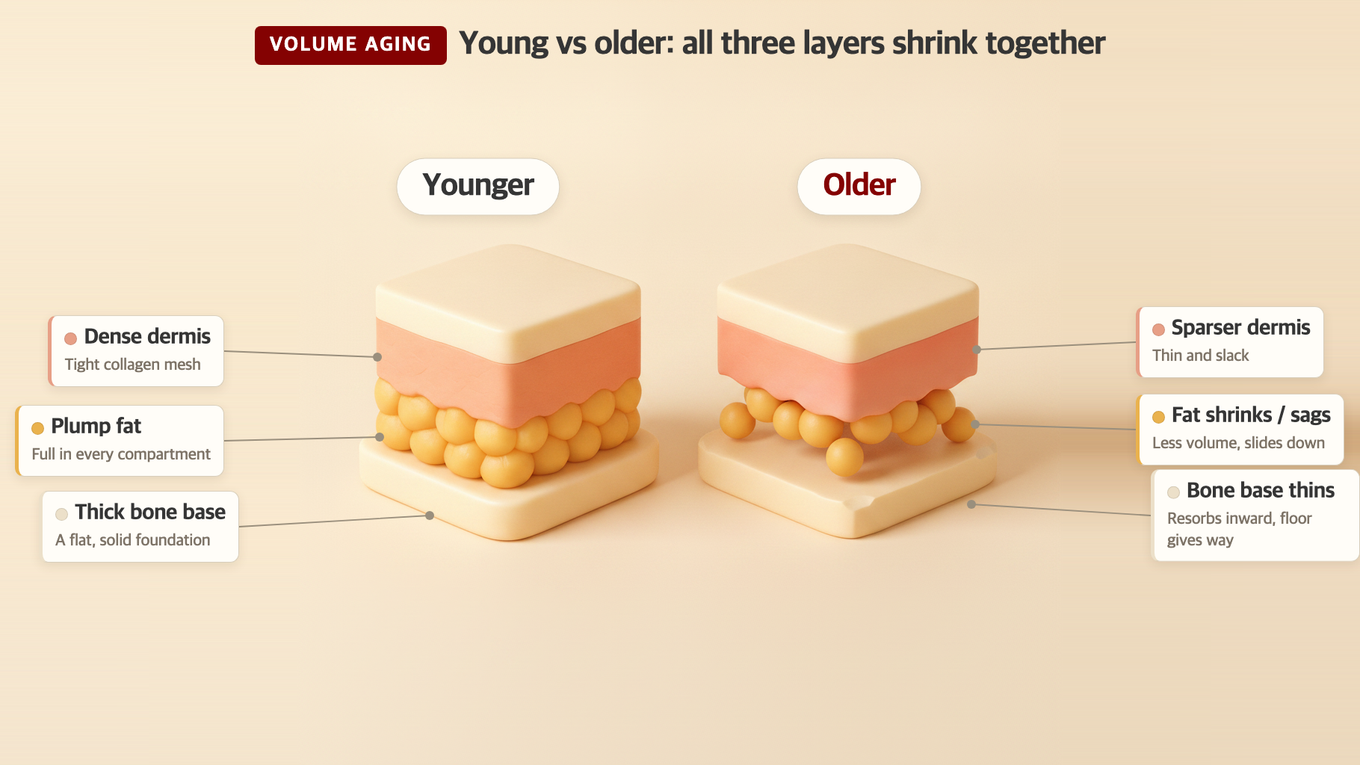
Even the same face loses volume across all three layers. Fat depletes/sags, bone support shrinks, and the dermis becomes sparse.
The most noticeable layer is the fat. When people say "my face looks gaunt from weight loss," they're referring to this layer.
Facial fat isn't a single mass but is partitioned into several compartments like the deep inner cheek, temples, and under-eye areas. With age, these compartments shrink at varying rates. As the support for the upper compartments weakens, gravity causes the fat to sag downward. This leaves you hollow up top and heavy down below - a common pattern where the cheeks look sunken while the area around the smile lines bulges.
Thus, when the fat layer is primarily affected, filling the sunken compartments is the right approach. Hyaluronic acid (HA) fillers, which immediately fill the space, are a typical choice. However, the key here is knowing "which compartments need filling." Adding volume to areas where fat has already sagged can make the face look heavy, while the sunken upper compartments remain unaddressed. This is why the positioning of fillers determines the outcome.

For a depleted fat layer, filling is the right approach. However, where and how much to fill depends on which compartments are sunken.
💡 Simply Put - Think of the fat layer as a cushion. If the stuffing is gone and shifted to one side, you need to refill precisely where it's needed to make it even. Filling indiscriminately can lead to a lumpy look.
This is often the most surprising revelation in consultations. "Bones shrink?" Yes, as we age, facial bones resorb inward and gradually diminish.
Notably, the bones around the eyes, the cheekbones, upper jaw, and jawbone are affected. As these bones recede and shrink, the fat and skin above them lose their foundation. This can make under-eye areas appear deeper, the front cheekbones flatter, and the jawline sag, making the entire face appear sunken. When the surface still looks fine but shadows fall easily, that's often a sign the foundation underneath has given way.
The problem is that this layer is the least noticeable. So if the foundation is gone and only the surface fat is filled again and again, you get an odd look - like inflating a balloon that has no solid base underneath.
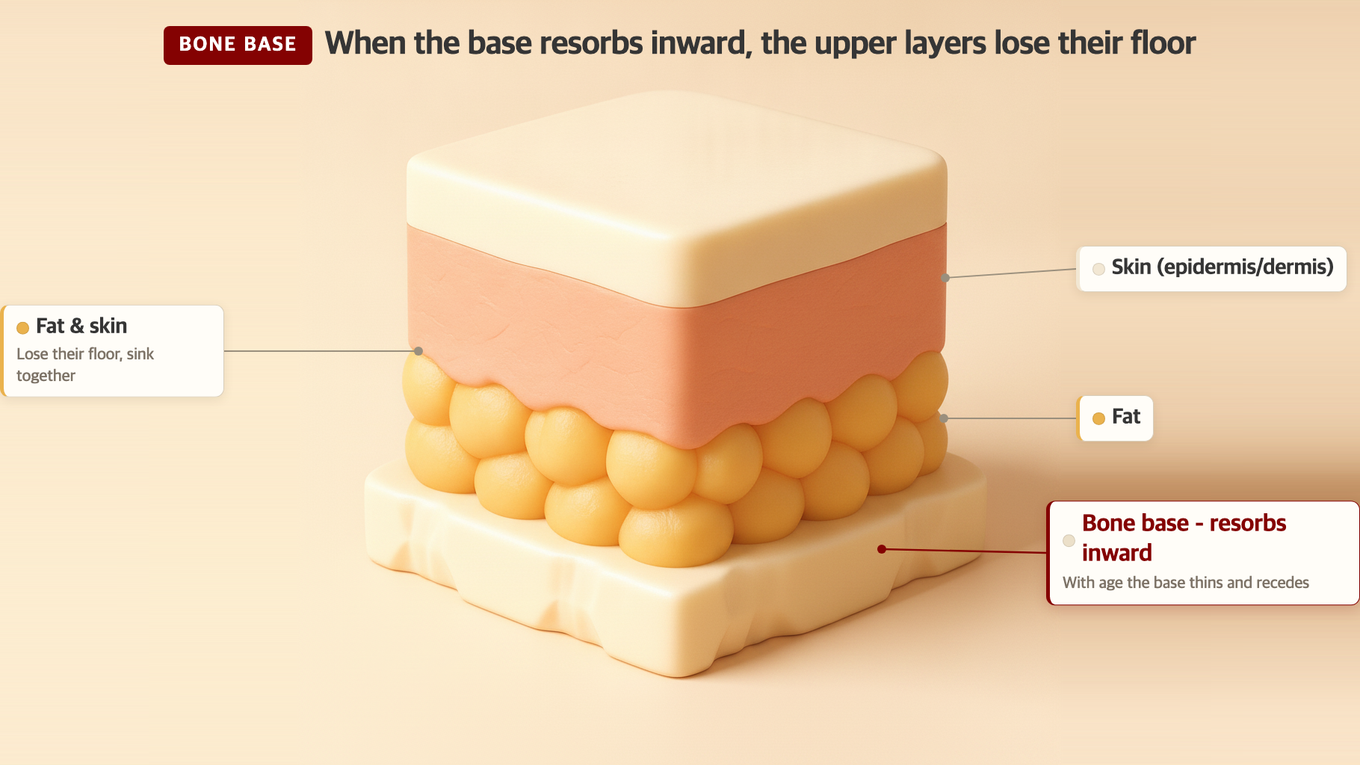
When bone support is absorbed inward, the fat and skin above lose their foundation, making the face look sunken.
When primarily the bone layer is affected, the approach is to reconstruct from deep within. This involves creating firm support close to the bone or using collagen-inducing materials like CaHA (e.g., Radiesse) that also provide structural support. Unlike surface plumping, this addresses the loss of foundational support.
The third layer is the skin, specifically the dermis. The dermis is a mesh of collagen and elastin, providing support and elasticity.
With age and UV exposure, this collagen mesh becomes sparse, and the cells (fibroblasts) that produce collagen weaken. This leads to a thinner, less resilient dermis. A thinning dermis casts more shadows under the same lighting, makes fine lines around the eyes and mouth more prominent, and gives the skin a saggy appearance. Even if the fat and bone remain the same, a thin dermis can make the face look tired.
This layer behaves differently from the other two. While fat is about filling and bone about supporting, the dermis requires stimulation to regenerate. Therefore, the approach is to stimulate collagen production.
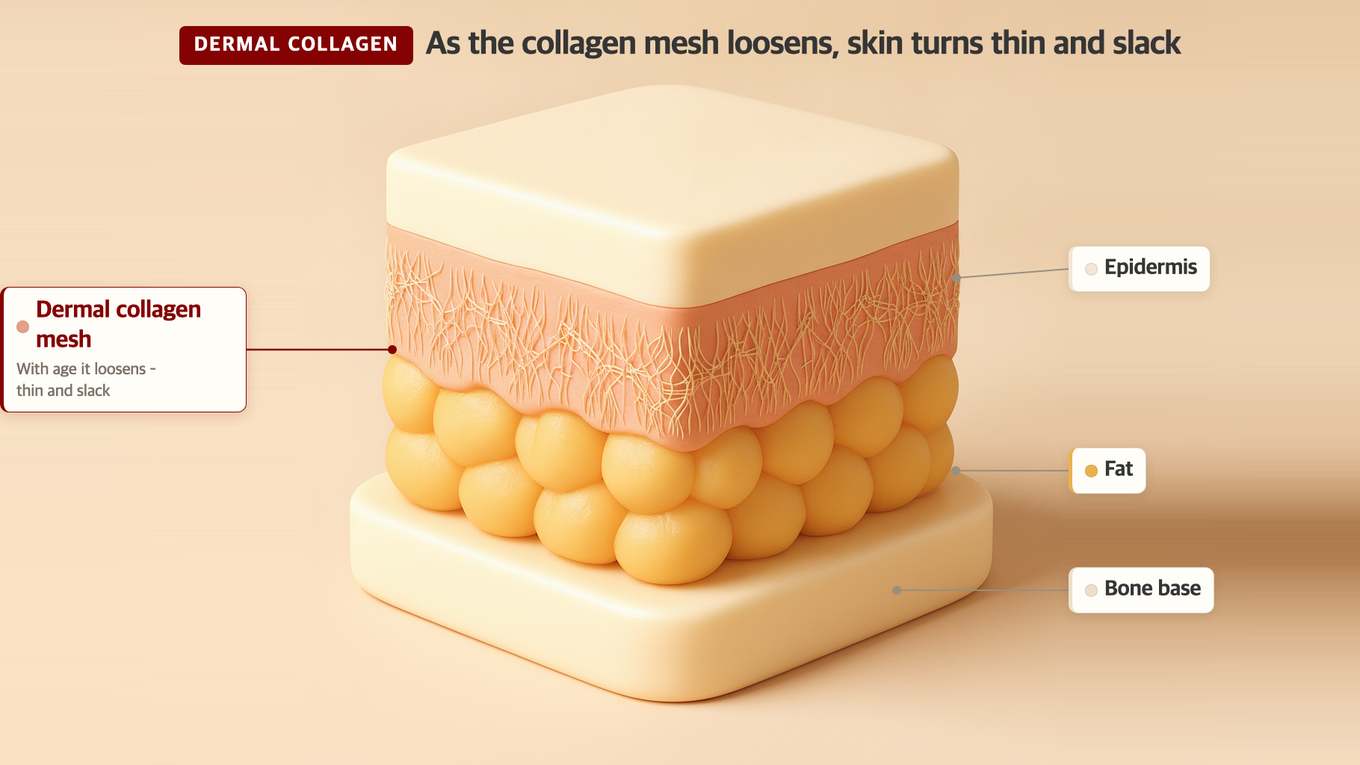
When the collagen mesh in the dermis becomes sparse, the skin becomes thin and weak, making the face look tired even if fat/bone remain.
Collagen-inducing substances vary. There are PLLA types (e.g., Sculptra), PDLLA types (e.g., Juvelook), and liquid PCL types (e.g., GOURI). The commonality is they don't fill immediately but instead encourage your collagen to rebuild over time. Thus, results appear gradually over weeks to months, with speed varying based on age and skin condition.
By breaking down the layers, you can see why a single approach isn't effective. Each layer loses volume differently, requiring a different method to address it.
Using only collagen stimulation for someone with fat loss may leave the face feeling underfilled, while only using fillers on someone with a thin dermis won't improve skin firmness. If structural support is lost, merely plumping the surface can lead to an unnatural look. It's not about "what's best overall," but "which layer is most deficient for me."
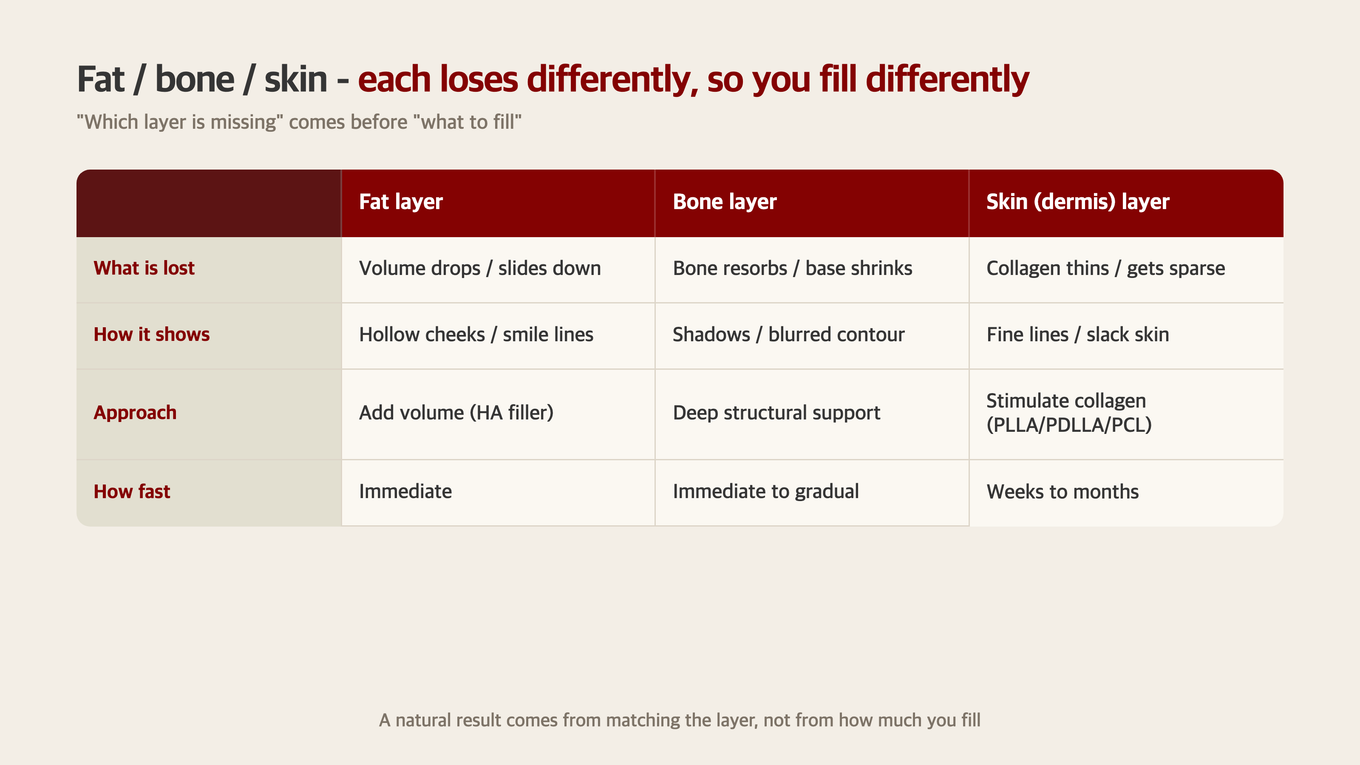
Fat, bone, and skin differ in what they lose and how they should be addressed. Hence, the approach depends on which layer is deficient.
Now that you understand the principles, you're likely wondering, "So, what about me?" Here are some guidelines from clinical experience to consider as a starting point for thought, not a definitive answer.
Most often, it's not just one layer that's affected but a mix of several layers. Therefore, in practice, it's common to consider combinations like "some fat + some dermis."
⚠️ Important Note - In volume treatments, the most common regret isn't 'not enough' but 'too much.' If only the surface is filled repeatedly without addressing depleted layers, the face can become overly full and heavy. Natural results come not from how much you fill but by filling the right layer. Also, ensure the substances used are officially distributed genuine products, and inquire about potential reactions like swelling or bruising post-treatment, as individual responses can vary.

Smooth continuity comes from filling the right layers. What makes it look natural is placement, not how much you add.
They target different layers and work differently. Fillers (HA type) immediately fill sunken areas, suitable for filling depleted fat compartments. Collagen stimulators (PLLA/PDLLA/PCL types) don't fill but encourage your collagen to regenerate, focusing on thinning dermis. The effect onset also varies: fillers are immediate, while stimulators develop gradually over weeks to months. It's not about which is better but where the deficiency lies.
They can't restore bone itself. However, treatments exist to create support in deeper layers to compensate for the foundational loss caused by bone absorption. This can involve placing firm volume close to the bone or using collagen-inducing materials that also provide structure. Remember, this differs from surface plumping.
Sagging and volume loss are different issues. Lifting involves pulling up lax tissues, suitable for sagging but doesn't refill volume loss. If volume loss is the main issue, lifting alone may be insufficient, and filling deficient layers may also be necessary. Conversely, if sagging is the main concern, focus more on lifting than volume.
Not necessarily. Individuals vary in how much each layer is affected, and often the most deficient layer is addressed first. Even with multiple affected layers, it's more common to prioritize and address them sequentially rather than all at once. It's not about "doing it all" but "where to start for my face."
If your face looks sunken, the issue usually isn't just the skin but a combination of three layers beneath. Fat reduces and sags, bone resorbs inward, and the dermis thins due to collagen loss. Each layer loses differently and requires a different approach.

When fat, bone, and skin support each other in their correct places, the face flows smoothly from one area to the next.
Thus, volume treatments are more about matching the method to the layer than about how much is filled. Some layers need filling, others need support, and some require collagen stimulation.
However, remember, not everyone needs all three layers addressed. Some may only find fat lacking, others only the dermis. First, determine which layer is deficient in your face, then decide on the treatment. Remembering that "facial sinking comes from three layers" is enough.
If you want to understand more about how collagen gets rebuilt, How Collagen Boosters Remodel the Dermis makes the skin-layer part of this story much clearer.
#FacialVolume #SunkenFace #Fillers #CollagenStimulation #Sculptra #Radiesse #VolumeAging #FacialFat #SeoulDermatology #ForeverClinic