

Blog
Informasi khusus untuk kesehatan kulit
Informasi khusus untuk kesehatan kulit
There's something I've been hearing a lot in my office lately - that people aren't looking for a drastic change, they just want to look a little better.
A few years back, people would typically start by pointing out exactly which part to change and by how much. But recently, more and more people begin their consultations by simply wanting to look better. At first, I thought it was just a matter of taste, but with so many people expressing similar desires, it's clear this is becoming a trend.
This emerging trend is being called 'slow-aging'. While anti-aging focused on 'erasing age', slow-aging is about 'aging well, at a slower pace'. The goal itself has shifted.
I won't be recommending specific procedures here. Instead, I'll explore "why people today prefer to 'look better' rather than 'look different'". Understanding this shift can help you make decisions based on your own standards, rather than simply following trends.
Quick Overview
- The aim of beauty treatments is shifting from 'erasing age (anti-aging)' to 'aging well (slow-aging)'.
- Evaluation criteria have changed too - from 'noticeable changes' to 'looking refreshed and healthy'.
- Hence, there's a preference for approaches that are 'subtle, natural, and long-lasting' rather than 'drastic all at once'.
- However, 'slow-aging' is also a buzzword that gets attached to all sorts of things. Look beyond the word and see what's being done and the rationale behind it.
- Your decision should be based on your 'personal goals' not just what's trending.
In a nutshell, the goal has changed from 'erasing age' to 'aging well'.
The concept of traditional anti-aging was clear-cut. Eliminate wrinkles, lift sagging skin, fill in hollows. It was about erasing signs of aging to revert to a younger appearance. The more noticeable the result, the better it was perceived.
However, what people want now is quite different. They want their face to look healthy and relaxed for their age. If you're in your 40s, you want to look like you're in your 40s - just not tired and sagging. Think of it as slowing down the aging process of your current face, rather than rewinding it to a younger version. This is what the industry refers to as slow-aging.
This isn't a figment of my imagination. Beauty trend reports in Korea also forecast similar changes for 2026, noting a shift away from merely aiming to look younger. Instead, there's a growing acceptance of aging as a natural process, with more focus on maintaining the skin's inherent health and texture. These reports might vary, so take them as indicators that the trend is leaning in this direction. In my practice, this isn't just a conversation for those in their 40s or 50s. Plenty of people in their 20s and 30s are interested in preventive care, choosing to manage their skin little by little before significant damage occurs.
💡 In simple terms - The old goal was 'turning back the clock', while today's goal is 'making the clock tick slower'. It's about maintaining your current state healthily for longer, not rewinding it.
These two perspectives have fundamentally different end goals. Therefore, the suitable procedures and criteria for satisfaction also differ. Let's break it down in a table.
| The Anti-Aging View | The Slow-Aging View |
|---|---|
| Erase signs of aging | Keep your skin's current condition healthy |
| Noticeable changes at once | Subtle, long-lasting changes |
| Evaluated by 'looking different' | Evaluated by 'looking good' |
| Special event focus | Consistent care routine |
Let's clear up a misconception: Slow-aging doesn't mean 'doing nothing and aging gracefully'. It's quite the opposite. It's about intervening consistently before the skin deteriorates, to maintain your current condition for a longer time.
Understanding why this makes sense for your skin requires a brief look beneath the surface.
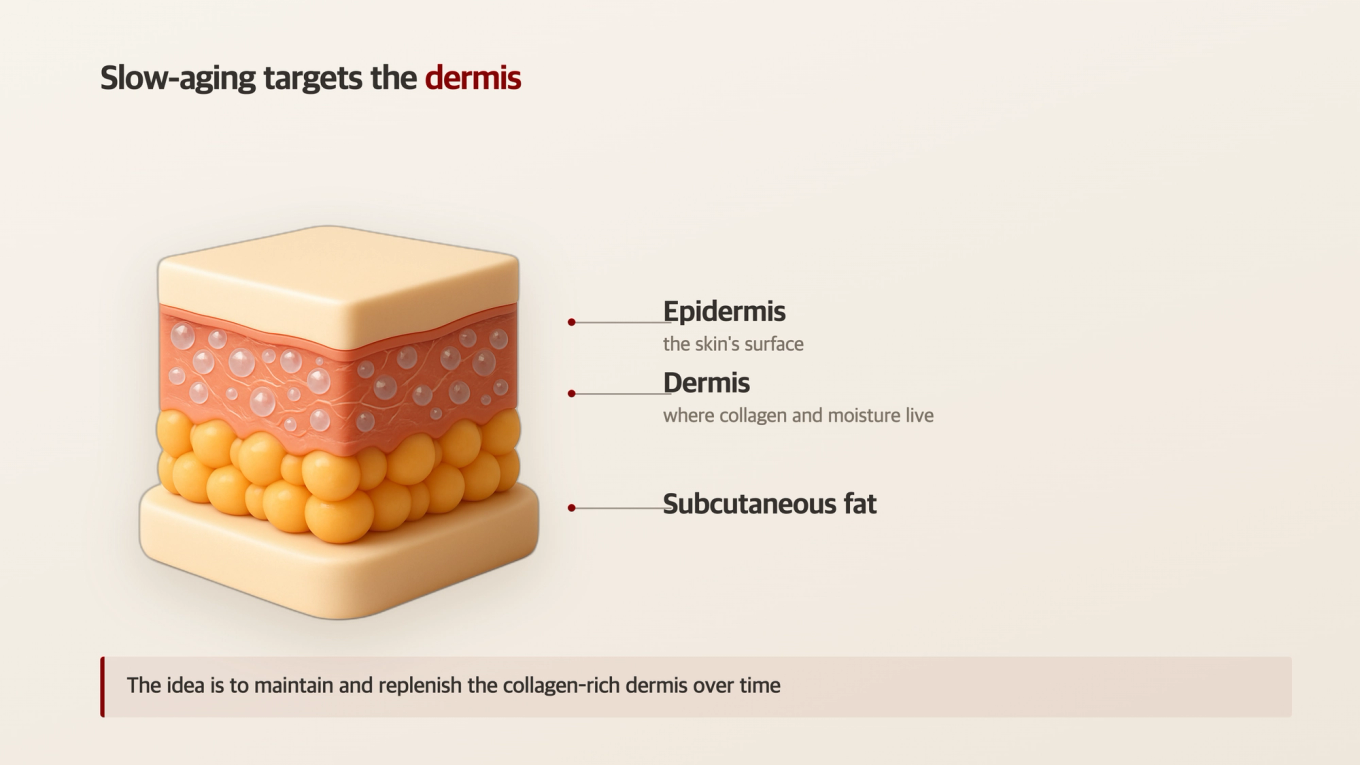
Collagen, which determines skin's elasticity and texture, is mostly found in the dermis layer. It's below the epidermis, a bit deeper. But this collagen doesn't just appear or disappear overnight. After a stimulus, it takes several weeks to months for new collagen to stabilize and improve the texture. It's a tissue that builds up and diminishes slowly over time.
Therefore, maintaining good skin was always naturally 'slow'. Resetting the surface doesn't suddenly fill the dermis with collagen. The 'less, more often, longer' approach isn't a fad; it reflects how collagen actually forms.
This 'less, longer' approach is reflected in treatment plans, focusing more on regeneration and maintenance rather than aggressive tightening. The direction of treatment categories is discussed in detail in this article on why regenerative aesthetics are gaining popularity. This piece focuses on why people’s goals have shifted, so if you're curious about treatment categories, check out that article.
After reading this far, slow-aging might seem like the perfect solution. But it's more about your goals than what's good or bad. Slow-aging aligns well with some people but not with others. Let's see which group you might fit into.
👍 This suits you if:
👎 If your goal is:
⚠️ Keep in mind - 'Slow-aging is trendy' shouldn't be your decision criterion. If your goal is noticeable change and you only focus on regenerative methods because it's trendy, you might end up feeling like 'I've had something done, but I can't really tell the difference'. Trends indicate 'what people are currently desiring', but your assessment should always be based on your skin's condition and your goals.
Let's have a candid conversation. The more appealing a term, the quicker marketing seizes it. 'Slow-aging' is appearing more in advertisements, but sometimes the term and the substance don't align. Here are three scenarios to watch out for with the 'slow-aging' label.

Proposals promising 'natural' results but suggesting drastic changes - If the pitch is slow-aging but the plan is aggressive lifting and filling, the term and approach don't match. Focus on 'what's being done and to what extent' rather than the slogan.
Claims of 'one treatment for complete slow-aging' - Slow-aging is a perspective, not a treatment name. Various methods align with this view, so "this one treatment completes slow-aging" is misleading. Instead, step back and assess such claims critically.
Age-fear marketing urging 'do it now before it's too late' - Slow-aging is about relaxed, preemptive care. Yet, some sell it with urgency, which contradicts the essence of slow-aging. For official product or procedure standards, check with authorities like the Ministry of Food and Drug Safety.
The more appealing the term, the more you should verify what it truly represents.
Slow-aging is more than just a buzzword; it's a significant shift in beauty goals. The focus is moving from 'erasing age' to 'aging well', from 'looking different' to 'looking good'. Thus, approaches that are 'subtle, natural, and long-lasting' are naturally gaining preference.
However, just because a trend is appealing doesn't mean every 'slow-aging' label is trustworthy. Instead of being swept up by the term, first verify "what is being done, on what principle, and with what evidence". Knowing the trend doesn't mean you have to follow it blindly.
🩺 Doctor's Note - In my office, the way people express their desires has changed. It used to be about bringing in photos of celebrities and asking to look like them. Now, more people simply say they want their skin to look healthy and relaxed. I welcome this shift. A person's face naturally carries the years they've lived, and that can actually look more natural and relaxed. Aiming for drastic changes is an endless pursuit, but finding the point where 'my condition looks good' is a point of personal satisfaction.
The end goals are different. Anti-aging aims to 'erase signs of aging and revert', while slow-aging seeks to 'maintain current age healthily for a longer time'. Accordingly, the treatments and satisfaction criteria ('looking different' vs. 'looking good') differ. It's not just a change in terminology; it's a change in direction.
There's no single 'slow-aging treatment'. Slow-aging is a perspective, not a treatment name. Methods that gradually enhance skin texture/tone/elasticity align well with this perspective, but what suits you depends on your skin condition and goals. Be wary of claims like "this one treatment completes slow-aging".
Not at all. Strong treatments aren't worse; they target different goals. If your aim is to change structure clearly, like lifting sagging contours or filling hollow cheeks, then lifting or volume treatments are suitable. The slow-aging perspective is more about maintaining the skin's condition over time, so they're complementary rather than competing.
There's no one-size-fits-all answer, but if you see slow-aging as 'maintaining the current state longer' rather than 'reversing damage', then early preventive care aligns with this trend. But even then, evaluate your skin's condition first. If there's nothing urgent, there's no need to rush.
It's not about being 'weaker'; it's about 'different directions'. If you gauge results by drastic changes, gradual improvements might seem weaker. However, changes like skin texture/tone/elasticity naturally accumulate over time with a 'less, longer' approach. Effects vary by method and individual response, so view it as "expecting improvement in this direction, but individual results may vary".
#SlowAging #AntiAging #NaturalResults #AntiAgingTrends #SkinQuality #AgingWell #MyeongdongDermatology #ForeverClinic