

Blog
Expert tips for healthy skin
Expert tips for healthy skin
"If I get one lifting treatment, it stays that way forever, right?"
This comes up a lot once a consultation starts at our clinic in Myeongdong, Seoul. It's a big decision to make, so of course you want it to last a long time. Ideally, indefinitely. But when that expectation goes unchecked, something goes wrong. A few months later the line settles a little, and the first thought is "did it fail?"
That worry usually has nothing to do with a bad treatment. More often it comes from picturing lifting as a job that's finished in one go. Lifting doesn't work that way. So today I'll walk through why lifting results fade a bit over time, how long they actually hold, and how to plan retreatment - the same way I'd explain it across the desk in the clinic.
This isn't a pitch for any particular device. Trade the idea of "one time, forever" for a realistic picture built on duration and retreatment cycles, and starting lifting comes with less disappointment and a much clearer plan.
Key Takeaways
- Lifting doesn't "implant" collagen. It stimulates your own fibroblasts to build collagen again.
- That's why the result shows up gradually over 2-3 months, not the moment you get up from the bed.
- Here's the catch: that collagen also fades over time with aging and UV. Permanent results aren't possible by design.
- Duration usually lands somewhere around six months to a year, though it varies a lot by device, area, and skin.
- So lifting works best planned as a treatment you manage on a cycle, not a one-and-done.
Let me start with the biggest sticking point. A lot of people picture lifting as "one treatment and it just stays."
That's fair. The name itself is "lifting" - it means pulling upward - and ads lean into the dramatic impression. But that "lift" isn't a wall of bricks laid and fixed in place. It's closer to setting up the conditions for your skin to recover its own firmness. And what your skin builds on its own, it can also lose on its own with time.
Let me split two pictures here.
Feeling the line settle a little a few months later is usually not a failed treatment. Collagen naturally declines over time, and reading that natural dip as "the effect is gone" is where the mismatch comes from.
A defined line is the payoff of skin rebuilding collagen gradually over several months.
So let's get into what lifting actually does underneath. To understand duration properly, this part comes first.
Ultrasound lifting like Ultherapy Prime and Shurink Universe (HIFU), and radiofrequency (RF) lifting like Thermage FLX, deliver heat energy precisely to a specific depth under the skin and create tiny points of stimulation. Your body reads that stimulation as a "repair this" signal, and the fibroblasts in your dermis wake up and start building collagen again. So lifting doesn't add collagen from the outside - it triggers your own cells to make it.
That's why the effect follows an order and a timeline.
💡 The simple version - Lifting isn't sticking artificial flowers in a garden. It's watering dry ground and waking the seeds. That's why nothing changes overnight - it grows over months. And what grows will wither in time if you don't tend it. That's exactly why lifting has a timeline and a duration.
This is also where you see why "permanent" is hard by design. Even when a treatment triggers new collagen, the clock of aging doesn't stop. Collagen keeps draining as you get older, and UV speeds that up every single day. So what the treatment topped up drains again over time, and retreatment is what fills that gap back in.
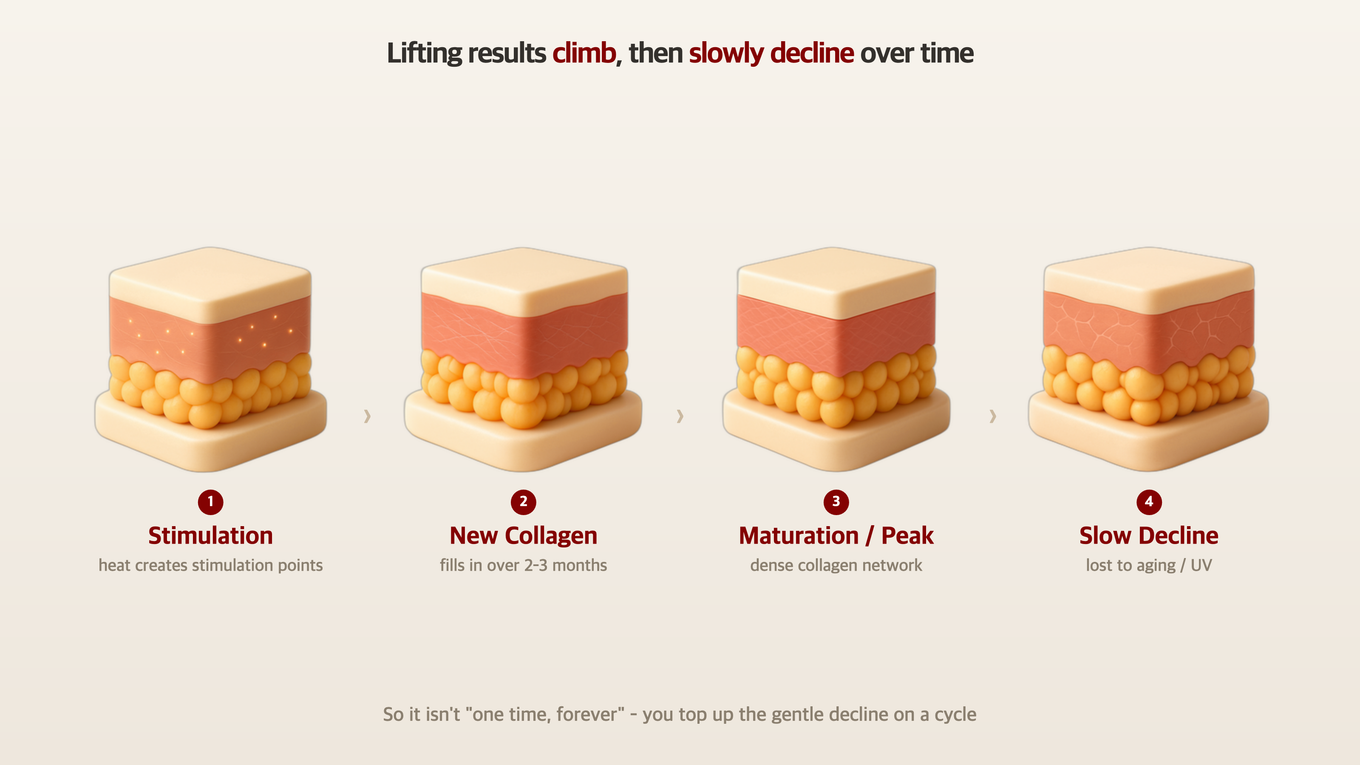
Lifting results climb through stimulation, regeneration, and maturation, then slowly decline with aging. That's why a cycle matters.
Once you get the mechanism, this is the thing everyone wants to know: "OK, so how many months, how many years?"
Honestly, nailing it down to "exactly this many years" wouldn't be straight with you. Duration swings widely with the device, the area, the energy used, and above all your age and skin. There is a rough range, though. Ultrasound and RF lifting are often treated as around a six-month to one-year management cycle.
Let me also head off a misread of the word "lasts." The effect doesn't fall off a cliff one day. After it peaks, collagen tapers very slowly, and somewhere along that gentle slope you start feeling "it's about time to do this again."
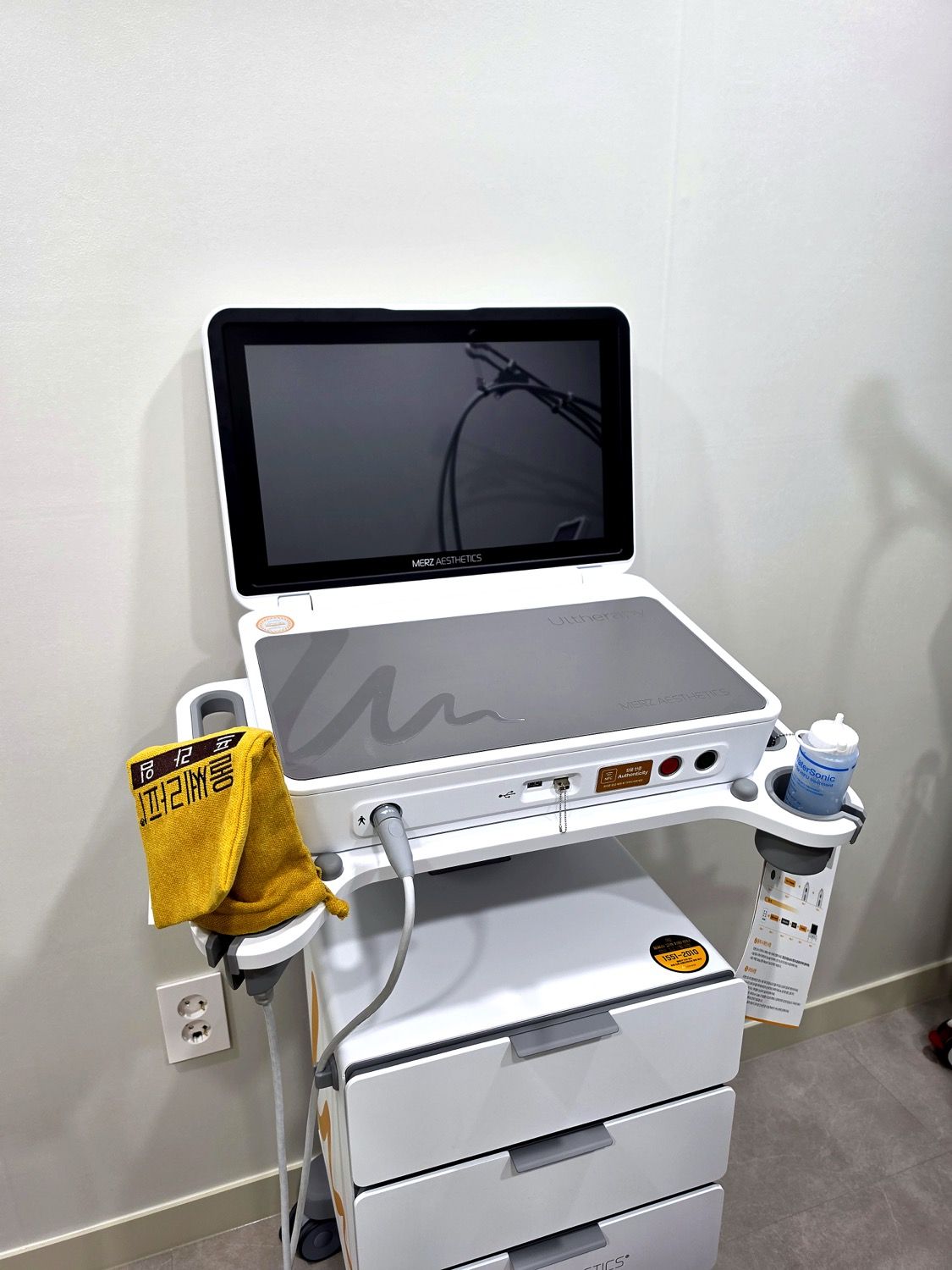
Lifting starts with "which depth do you put the energy into, and how precisely." The device and settings are where duration begins.
Here are a few reasons the same treatment can last differently.
If the effect is finite, the next question follows on its own: "So when do I do it again?"
The point is not "rebuild from scratch after the line has fully collapsed," but topping up along the gentle downward slope before it drops. Stimulate again around the time collagen peaks and starts easing off, and you don't have to start from the bottom every time. So retreatment is usually set around the time the duration is winding down. For ultrasound or RF, that's commonly somewhere between six months and a year, adjusted by how things look.
Let me clear up one more worry. "There's a retreatment cycle" can land as "so I'm paying forever," which feels heavy. But flip the view: lifting is often steadier - in stimulation and in result - when you top up the gentle decline on a cycle than when you cram one big job in at once. "Just right, on a cycle" tends to lead to a more natural line than "all at once, hard."
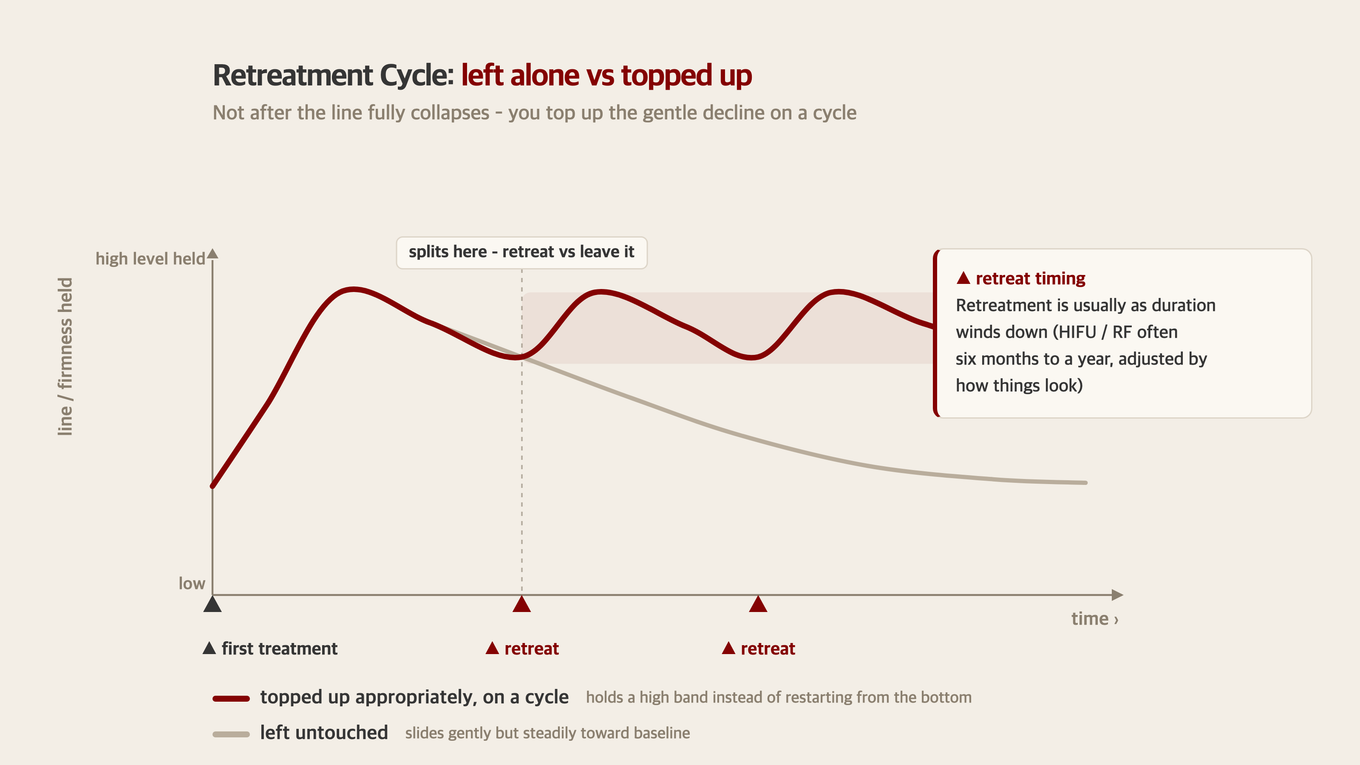
Both paths are identical up to the peak after the first treatment. They split as the duration winds down - left alone, it slides gently but steadily toward baseline; topped up in time as the decline begins, it holds a high band instead of restarting from the bottom.
So rather than fixing the retreatment cycle at "definitely every X months," it's more accurate to watch how your line and firmness shift over time and set the next point from there. Picture it as "a treatment I manage" from your very first session, and retreatment starts to look like part of the plan rather than a sign of failure.
You're probably wondering, "So what cycle should I be on?" Here's the grain we use to point a direction in the clinic. Take these as guiding principles, not fixed answers.
Lifting leans more toward managing the line on a cycle than finishing in one shot. So it sits a little apart from the goal of "one dramatic change that just holds." Knowing that going in narrows the gap between expectation and result.
The higher the expectation, the more misreadings tag along. Let me name a few honestly.
"Go hard once and it lasts"? - Not necessarily. Pushing the energy up doesn't scale the collagen response up with it, and if the stimulation is too much, recovery and discomfort can grow instead. Duration hinges more on which layer you hit, precisely and appropriately than on raw intensity.
"No need to do anything until the next retreatment"? - Not so. Holding onto the collagen the treatment built means daily care has to come along with it. Sun protection especially is the most basic way to slow collagen loss, and skipping it shortens the very duration you worked for.
"No visible result in a few days means it failed"? - As I said, lifting fills collagen in over 2-3 months. The tightness right after is temporary contraction; the real change shows up with time. So calling it a failure because "I don't see it right away" is early. That said, reactions like swelling or marks after treatment usually settle within a few days, but they vary from person to person and can rarely show up differently. If anything lingers or feels off, don't tough it out - get it checked in person, and telling us your medical history and skin type beforehand keeps things safe.
Holding onto the collagen lifting built means daily care like sun protection has to come with it. Duration grows with care.
🩺 Doctor's Note - In the clinic I often meet the disappointment of "I already did it, why again?" When I do, we look at the collagen curve I laid out today together. Once you see that lifting isn't a wall raised in one go but a treatment that wakes and lifts your own collagen and reinforces it once it fades, it clicks why "on a cycle, matched to your skin" is more accurate than "one time, forever."
"I'm curious about lifting, but I also want water glow or a booster, and the maintenance side confuses me" - I hear that a lot too. All three involve collagen, but they aim at different layers and hold in different ways. Let me split the axes and compare.
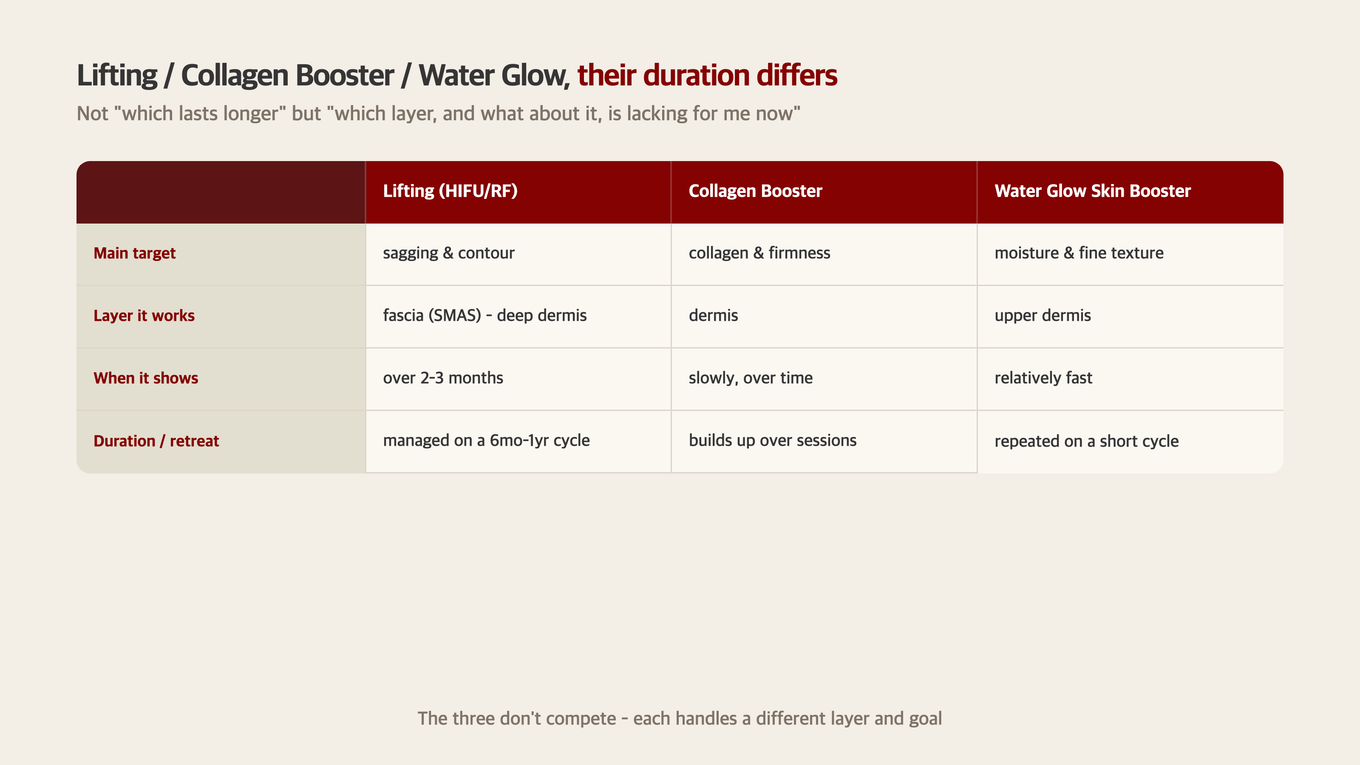
The three work on different layers and hold in different ways, so the right pick is whatever your skin is short on right now.
To put the axes in a line:
⚠️ Good to know - The three aren't competing; each handles a different layer and goal. So the question isn't "which lasts longer" but "which layer, and what about it, is lacking for me right now." For more on how water glow fills the dermis with moisture, see Water Glow Skin Boosters Change the Dermis, Not Just the Surface.
Permanent duration is hard by design. Lifting stimulates your fibroblasts to build collagen again, but even that collagen fades over time with aging and UV. Think of it as slowing the pace of collagen loss and refilling what's dropped, rather than stopping aging itself. So "manage it on a cycle" is a more realistic picture than "one time, forever."
It swings widely with the device, area, energy used, and your age and skin, so pinning it to "this many years" is tough. Ultrasound and RF lifting are often treated as around a six-month to one-year management cycle, but that's a range, not a fixed figure. People with good sun protection and strong collagen production can hold it longer; the reverse can run shorter.
Reinforcing as collagen peaks and starts easing off is usually more natural than waiting for the line to fully collapse. That point commonly lands around when the duration is winding down. But since the rate of decline differs from person to person, it's better to watch how firmness shifts after treatment and set the next point from there than to fix "definitely every X months."
Not necessarily. Pushing the energy up doesn't scale the collagen response with it, and too much stimulation can add recovery burden or discomfort. Duration hinges more on hitting the right layer precisely and appropriately than on intensity. So "just right, on a cycle" is often steadier than "all at once, hard."
If you feel the line settle a little a few months after lifting, it's usually not because the treatment failed. It's because "one time, forever" was riding on it. Lifting wakes and lifts your own collagen, and even that collagen thins with time against aging.

A defined line isn't fixed in one go - it carries on when you hold your collagen on a cycle.
So what lifting is going for isn't "one finished result," but holding the line on a cycle. Duration is commonly referenced as around six months to a year, but that's not a fixed figure - it shifts with age and care from person to person. Retreatment is set as the point where you fill that gentle decline in ahead of time.
One thing not to forget: not everyone needs to rush into lifting right now. If your firmness is still fine, basic care and sun protection come first; if sagging has started, a management plan comes first. Just holding onto the one line - "lifting isn't once, it's a cycle" - is enough to manage it over the long run without the letdown.
If you want more on how the dermis rebuilds collagen, How Collagen Boosters Build Collagen rounds out the picture of firmness and duration.
#Lifting #LiftingDuration #RetreatmentCycle #Ultherapy #Thermage #Shurink #HIFU #SkinTightening #SeoulDermatology #ForeverClinic