

Blog
Expert tips for healthy skin
Expert tips for healthy skin

Right after a Sculptra session, the area looks pretty full in the mirror. A few days later it seems to be back where it started, and it's easy to feel it has already worn off. That's a normal course. What filled the area that day was the water used to dissolve the powder plus swelling from the injections. The work Sculptra is actually there to do happens over the following months.
Sculptra's active ingredient, PLLA (poly-L-lactic acid), is a collagen stimulator made of microparticles that the body breaks down very slowly. Immune cells and fibroblasts gather around these particles, and your own collagen builds up in that spot. In a biopsy study of 14 healthy adults, type I collagen rose by a statistically significant amount at 3 and 6 months (Goldberg et al., Dermatol Surg 2013).
The evidence comes in layers. Human clinical trials, human biopsies, human tissue observation and animal studies each tell you something different, so in this post I'll go through them one layer at a time.
Key Takeaways
- The volume you see on treatment day is water and injection swelling. The US FDA label says this swelling goes down within hours to days and the original contour shows again.
- Collagen forms around the particles. In human tissue containing PLLA, macrophages, fibroblasts and type III collagen were found next to the particles, and type I collagen outside the capsule surrounding them (Stein et al., J Dermatol Sci 2015).
- In human skin, collagen was measured at 3 and 6 months. Type I collagen rose significantly at both time points, and inflammation stayed at about pre-treatment levels (Goldberg 2013).
- The FDA approval trial was done on smile lines (nasolabial folds). In some of the 116 patients, improvement lasted up to 25 months after the last treatment, and results depended on how deep the lines were to begin with.
- The downside is lumps that can show up late. In the approval trial, nodules or papules appeared in 17.2% of patients, and nodules showed up on average about 209 days after the first treatment (FDA label).
The volume right after treatment comes from the water used to dissolve the PLLA powder and from swelling caused by the injections themselves, so it's normal for it to go down within hours to days. The US FDA label tells doctors to let patients know this ahead of time.
Sculptra comes as a powder in a vial. Before treatment, sterile water (5 mL per the FDA label) is added to dissolve it, and that water goes into the deep dermis along with the particles. That's why, by the end of the session, the hollow areas look completely filled.
Bottom line: you can't judge the result in the mirror that day. The label also warns to correct only part of the area in the first session and not to overfill, and says to wait at least 3 weeks before deciding whether more correction is needed, because hollow areas tend to improve gradually over several weeks.

Sculptra's timeline, with the source behind each step. Spacing is not to scale.
⚠️ Good to know - There's always a stretch when the swelling has gone and it looks like you're back where you started. That's the first box on the timeline. It's better not to book another session based on how things look at that point.
At our clinic in Myeongdong, Seoul, this is how I think about the way Sculptra works: macrophages and fibroblasts gather around the PLLA microparticles and wrap around them, and your own collagen builds up in that spot. Meanwhile, the particles break down very slowly.
Review papers describe this as a "subclinical inflammatory response," mild enough that nothing shows on the surface. The body recognizes the particles as foreign and surrounds them, and that response becomes the signal to make collagen. Over time, the PLLA breaks down, the inflammatory response settles and collagen increases (Vleggaar et al., J Drugs Dermatol 2014).

The particles break down very slowly, and the collagen that builds up around them supports the area. Layer thickness and particle size are not to scale.
One study actually looked at this arrangement in human tissue. In 2015, Stein's team examined human tissue containing PLLA with immunofluorescence staining, and here's how things were laid out.
Across the tissue there were also signs of myofibroblasts and new blood vessels, and gene expression of type I and type III collagen and of TGF-β1 (a signaling molecule that tells fibroblasts to make collagen) was significantly higher. The authors suggested that the volume from PLLA filler most likely comes from this capsule and the collagen around it. That said, the abstract doesn't say how many tissue samples there were or how they were obtained.
What I found interesting in this study was how slowly the particles break down. PLLA particles placed under the skin were still found in the tissue 28 months later, much slower than previously thought. Particles that last a long time mean the response can keep going for a long time. They also mean that if they clump in one spot, you might be able to feel them for just as long. I'll come back to this when we get to the downsides.
Yes. In a study where 14 healthy adults were injected with PLLA and biopsied at 3, 6 and 12 months, type I collagen rose significantly at 3 and 6 months (Goldberg et al., Dermatol Surg 2013).
With this study, I start with the limitations the authors pointed out themselves.

Goldberg 2013 study design and results by time point. The size of the increases isn't given in the abstract, so it isn't shown here.
For real-world treatment results, the evidence is the FDA approval trial. In the trial, 116 people treated with Sculptra for smile lines were compared with 117 people who received a comparison treatment, and at 13 months their wrinkle scores had improved more. In an extension study that followed 106 patients for longer (95 completed), some patients' improvement lasted up to 25 months after their last treatment. The label also notes that improvement depended on how severe the lines were before treatment, and that results beyond 25 months weren't studied in the trial (FDA label).
It did in an animal study. In aged mice whose skin was sampled at 14 months old, collagen fibers and newly made collagen, both lower than in young mice, went back up 28 days after PLLA was injected (Oh et al., Cells 2023). But the PLLA in this study was synthesized by the research team, so it isn't the same as the Sculptra product.
The study also traced the pathway. PLLA increased IL-4 and IL-13 release by macrophages, shifting them toward a repair-oriented type (M2), which then switched on TGF-β signaling in fibroblasts. What stood out more to me was that the enzymes that cut collagen (MMP2, MMP3) went down. These enzymes were elevated in the aged mouse skin, and they dropped after PLLA was injected.
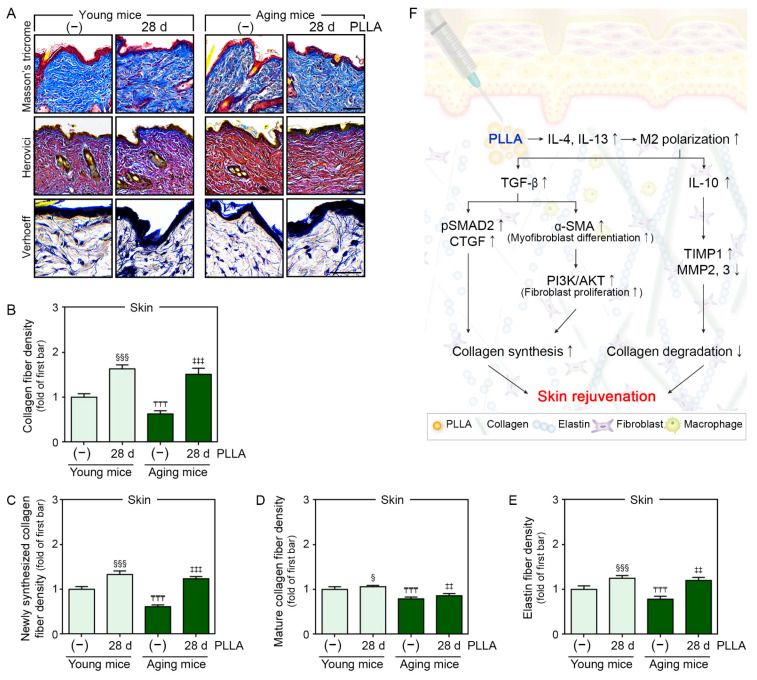
Figure 6 from the paper. Young (13 weeks) and aged (14 months) mouse skin injected with saline or PLLA (synthesized by the research team, not the Sculptra product). (A) From top: collagen fiber staining (Masson), staining that tells new collagen from mature collagen (Herovici), elastic fiber staining (Verhoeff). (B-E) Density of collagen fibers, new collagen, mature collagen and elastic fibers. (F) Study summary. Source: Oh S, et al. Cells 2023;12(9):1320, DOI 10.3390/cells12091320 (CC BY 4.0)
So I read this study only as mechanistic evidence that older tissue still has a pathway that can respond to PLLA. Mouse skin is much thinner than human skin, there were 3 mice per group, and the observation period was 28 days. Part of the pathway was seen in cultured cell experiments. It's not a reason to expect the same size of change in people. I've covered how fibroblasts slow down with age in The cells that keep skin firm age too.
There are several layers of evidence, from human biopsies to the 2009 US approval trial. But the studies differ in participants, body area and what they measured, so they can't be boiled down to one number.
I sort the evidence by "who was measured, and for what." Even among PLLA studies, measuring collagen directly in human skin, scoring wrinkles, and tracing signaling pathways in mouse skin each tell you something different.
| Study | Participants | What it showed | Limitations |
|---|---|---|---|
| FDA approval trial (approved 2009) | 116 people with smile lines, 106 in extension | Improvement at 13 months, up to 25 months in some patients | Smile lines only, varied with line severity |
| Goldberg 2013 | Biopsies from 14 healthy adults | Type I collagen up significantly at 3 and 6 months | Small study, 12 months inconclusive |
| Stein 2015 | Human tissue containing PLLA | Cells around the particles, where type I and III collagen sit | Sample size and sourcing not stated in abstract |
| Oh 2023 | Aged mouse skin | More collagen fibers after 28 days, signaling pathway | Animal study, not the Sculptra product |

Each layer of evidence answers a different question. None of them guarantees an individual result.
There's a gap, too. As far as I've checked, I couldn't find any study comparing Sculptra head to head with other collagen boosters such as GOURI under the same conditions. I've laid out how the two differ in ingredients and treatment approach in GOURI vs Sculptra, but there's no evidence yet to say which one makes more collagen.
It suits people who want to support lost volume over several months and can come in for multiple sessions. If you need results right away or the schedule doesn't work for you, another option is a better fit.
I roughly split injectable boosters into two groups by how deep they go. Rejuran and Juvelook work on the texture of the dermis, while Sculptra supports volume from a deeper layer. The FDA label also specifies injection into the deep dermis. But since the approval trial was done on smile lines, areas like the temples or under the cheekbones have no approval-trial evidence behind them, and that's where I rely on my own treatment criteria. The FDA label also states that safety and effectiveness outside smile lines have not been evaluated.

The side of the cheek below the cheekbone. Sculptra is placed in a deep layer under the skin (depth per the FDA label). This area was not part of the approval trial.
The main downside is lumps, often called Sculptra nodules. In the FDA approval trial, nodules or papules occurred in 17.2% of the Sculptra group (20 of 116) and 12.8% of the control group. Nodules appeared late, on average about 209 days after the first treatment (median 160 days), and lasted about 180 days on average. In post-marketing reports, nodules and granulomas were the most common serious adverse events, and in rare cases they needed treatment such as steroid injections or removal.
The label warns that injecting too shallow or overfilling can make these reactions more likely. It also recommends massaging the area 5 times a day, 5 minutes each time, for 5 days after treatment. That's why I don't compromise on depth or on the amount in the first session. Injection-site reactions such as swelling, bruising, pain and redness are fairly common, and I've laid out what's within the normal range in Swelling, bruising and bumps after booster injections.

Genuine Sculptra in the storage cabinet at our clinic in Myeongdong, Seoul. The FDA trial figures in this post refer to this product under its US approved name (SCULPTRA Aesthetic).
It looks fuller on the day, but that's water and injection swelling, which goes down within hours to days. The FDA label says to wait at least 3 weeks before deciding on more correction, and collagen changes are best judged over months.
In the smile-line approval trial, some patients' improvement lasted up to 25 months after the last treatment. Results depended on how severe the lines were before treatment, and results beyond 25 months weren't studied in the trial. How long it lasts varies from person to person, depending on the area and the condition of your skin.
PLLA breaks down over time, but slowly. In a human tissue study, particles placed under the skin were still found 28 months later (Stein 2015). That's why getting the depth and amount right matters.
The FDA label recommends massaging the treated area 5 times a day, 5 minutes each time, for 5 days after treatment. The goal is to help the product settle evenly and reduce lumps. How firmly and how exactly to massage is best explained for the specific area you had treated.
Sculptra builds collagen through the body's response of wrapping around PLLA particles. Type III and type I collagen build up around them, and in human skin, increases in type I collagen were measured at 3 and 6 months.
Wait at least 3 weeks before deciding on extra sessions, and judge collagen results over months. Start by asking whether you can space out sessions and wait, whether your concern is hollowing (if it's sagging, lifting comes first), and whether you're comfortable with the chance of late lumps. That should give you a good sense of whether this treatment fits you.
#Sculptra #PLLA #PolyLacticAcid #SculptraResearch #CollagenStimulator #CollagenBooster #CollagenProduction #VolumeLoss #SkinClinicSeoul #ForeverClinicMyeongdong


