

Blog
Expert tips for healthy skin
Expert tips for healthy skin
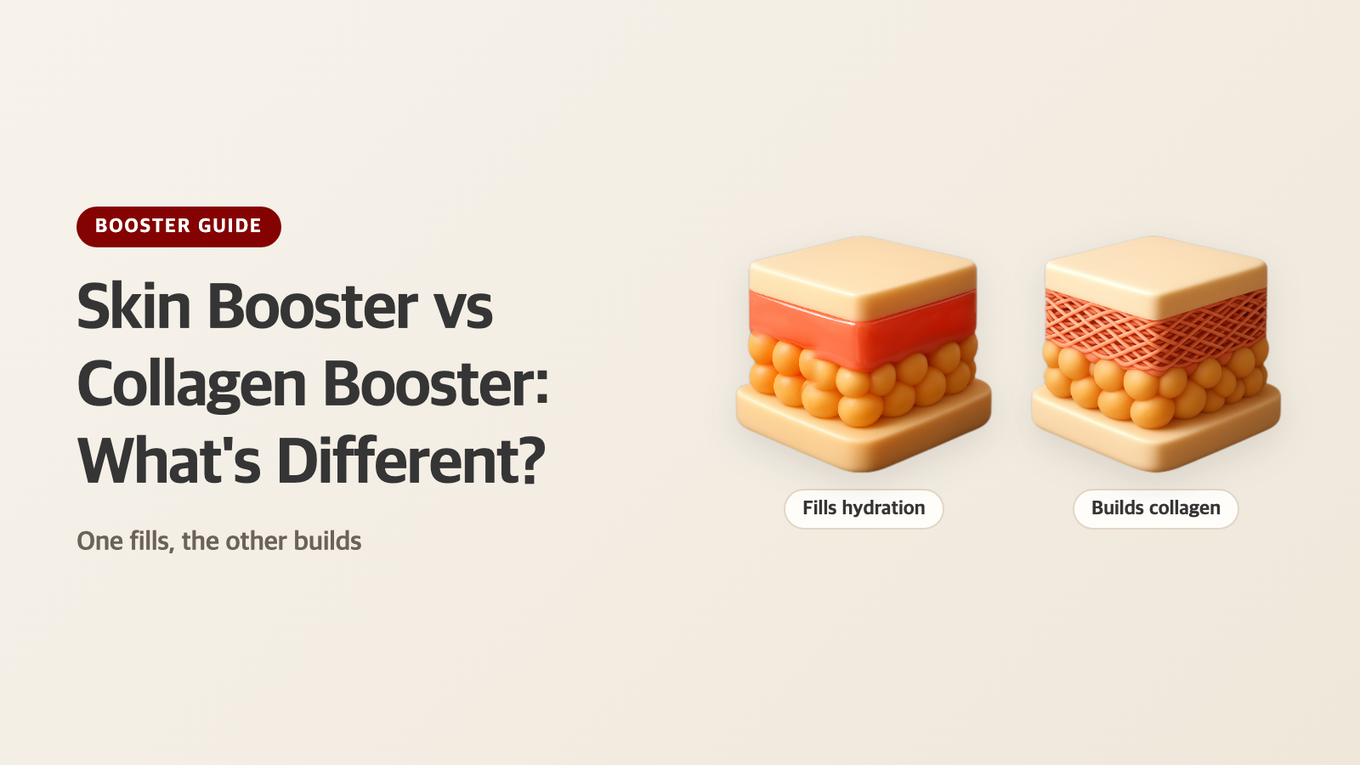
Start researching skin treatments in Korea and everything seems to be a booster. The water-glow injection (the HA hydration shot Korean clinics are known for) is a booster. Rejuran is a booster. GOURI is a booster. The names sound so alike that they look like one family of treatments.
'Booster' is a loose umbrella word for injecting something into the skin to improve its overall condition, and two different categories hide underneath it. Skin boosters fill the dermis directly with hydration and nutrients. Collagen boosters stimulate your body to make new collagen. What goes in is different, the goal is different, and even the timeline for results is different.
Choose a treatment without this distinction and you end up with disappointments like "I got the water-glow injection, but my skin is no firmer than before." The treatment did what it was designed to do. Its target was simply somewhere else. Today I'll split these two categories for you the same way I explain them to patients at our clinic in Myeongdong, Seoul.
Key Takeaways
- A skin booster places ingredients like hyaluronic acid (HA) or polynucleotides (PN) directly into the dermis to work on hydration, texture, and repair. The injected ingredients do the work themselves.
- A collagen booster uses biodegradable polymers such as PLLA, PDLLA, or liquid PCL to stimulate fibroblasts, so your own body builds new collagen.
- That's why the timelines split: filling shows relatively early, building takes weeks to months.
- Products that seem to sit on the border, like Rejuran, Juvelook, and GOURI, cause most of the confusion. I place each one below.
- Response and duration vary a great deal between individuals.
A skin booster fills the dermis directly with hydrating and nourishing ingredients, aiming at texture and moisture. A collagen booster (the category US dermatology usually calls a biostimulator) uses biodegradable polymers to stimulate collagen production, aiming at skin thickness and elasticity. The substance injected, the purpose, and when you feel the change are all different.
If I'm allowed one analogy: a skin booster stocks the warehouse with supplies, and a collagen booster places an order for construction. Stock the shelves and the benefit starts as soon as the goods are in, but once supplies run low you restock. Order construction and you wait for completion, but what stands at the end is a structure your own body built.
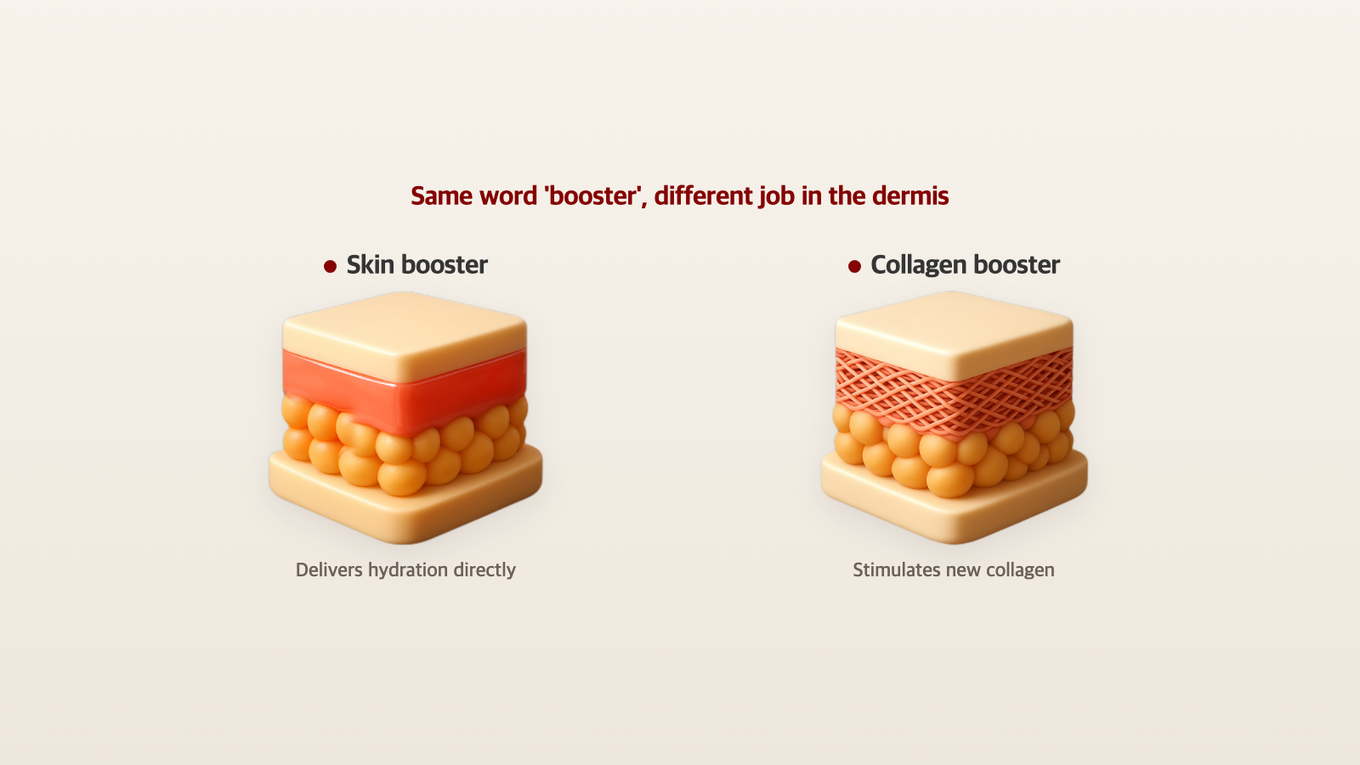
Here are the two categories, side by side.
| Skin booster | Collagen booster | |
|---|---|---|
| Typical ingredients | Hyaluronic acid (HA), polynucleotides (PN) | PLLA, PDLLA, liquid PCL |
| Job in the dermis | Supplies hydration/nutrients directly, supports a repair-friendly environment | Stimulates fibroblasts - new collagen synthesis |
| Concerns it targets | Dry, dull skin, rough texture, tight feeling, sensitized skin | Thinning skin, loss of elasticity, fine lines |
| When you feel it | Relatively early (individual variation) | Liquid PCL: first changes reported as early as 2-4 weeks (varies by report); PLLA: most active over 3-6 months (per the literature; individual variation) |
| Familiar examples | HA water-glow injections (a market umbrella term), Rejuran | Sculptra, Juvelook, GOURI |
⚠️ Worth knowing - this table gives you the broad skeleton, nothing more. Some products, like Juvelook, carry both traits, and what the same product can realistically offer shifts with your skin's condition. I'll sort the borderline cases separately below.
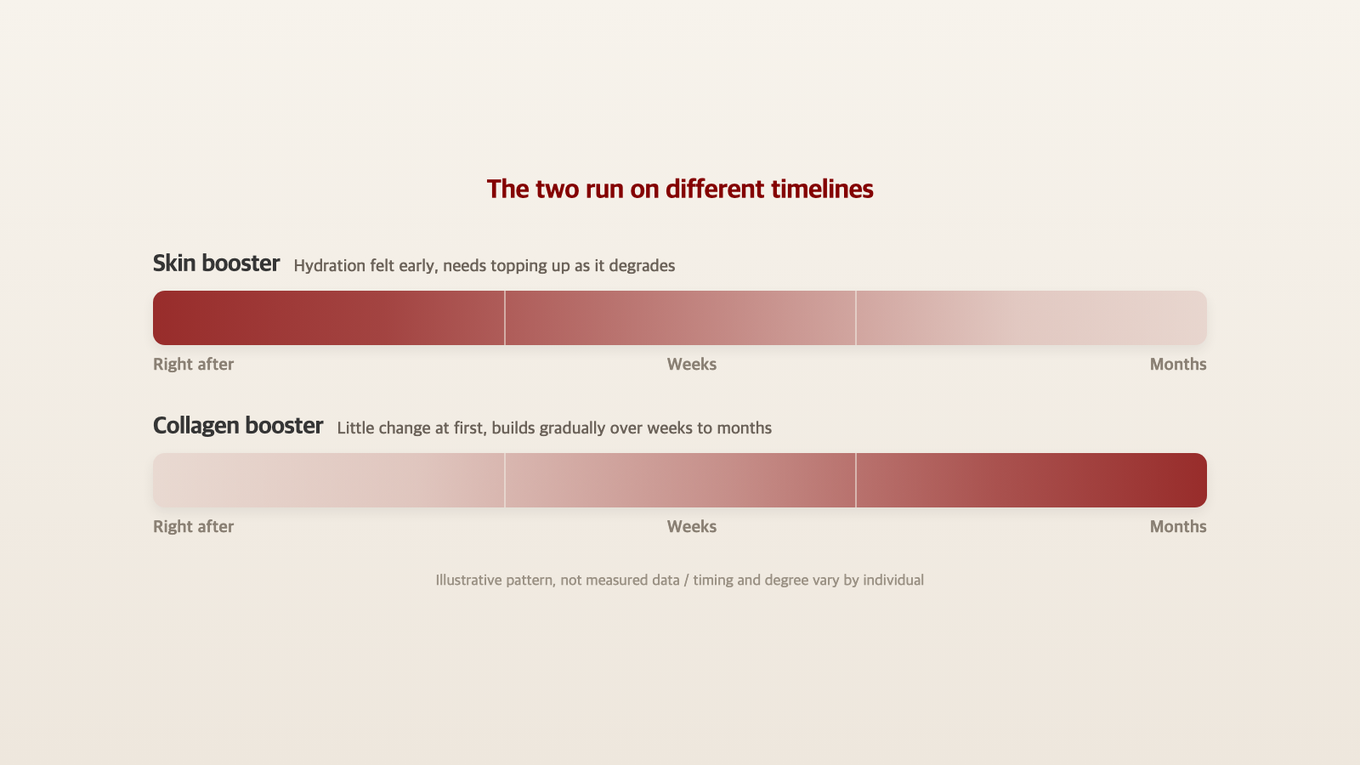
A skin booster is felt relatively early because the injected ingredients themselves do the work in the dermis. A collagen booster needs the biological time your body takes to synthesize collagen, so it builds gradually over weeks to months.
Hyaluronic acid is a hydrophilic molecule that binds water strongly. From the moment it enters the dermis, it starts holding on to the moisture around it. That's why the HA family, commonly lumped together as 'water-glow injections', tends to change hydration and texture early, and why it needs topping up as the ingredient gradually breaks down. I covered why this direct-supply approach plays out in the dermis in how water-glow skin boosters actually work.
A collagen booster runs in a different order. The injected polymer's job is to act as a signal that wakes fibroblasts in the dermis. The stimulated cells need time to build new collagen: some reports describe liquid PCL's first changes as early as 2-4 weeks, though the timing varies between reports, and the PLLA family ramps up production over 3-6 months (with individual variation). The polymer itself biodegrades gradually in the meantime.
I've seen this mechanism in research I took part in as a co-author. In a study published in the Journal of Cosmetic Dermatology in 2026, injecting liquid PCL into a skin model with induced photoaging significantly increased dermal thickness and collagen density at 6 weeks (p<0.001, a UVB preclinical model). Since it's a preclinical animal result, it doesn't promise a specific degree of improvement in people. Read it as evidence for the mechanism: this category works by getting the body to build.
One thing worth flagging. If what you want is to restore lost volume right now, neither category is the answer. Immediate volume is filler territory; boosters work on the skin itself, the foundation underneath. So you track a booster's progress over weeks, not in the mirror the next morning.
Rejuran leans to the skin-booster side with its focus on repair and texture recovery, GOURI and Sculptra are collagen boosters, and Juvelook is a hybrid: PDLLA to stimulate collagen, with hyaluronic acid alongside.
Let me start with why the confusion exists: the market sells all of these under the one big label 'skin booster'. We've done it ourselves - in our comparison of Rejuran, Juvelook, and GOURI we grouped the three as skin boosters for convenience. Naming conventions are what they are. When you're choosing, though, sorting by how they work is the accurate way.
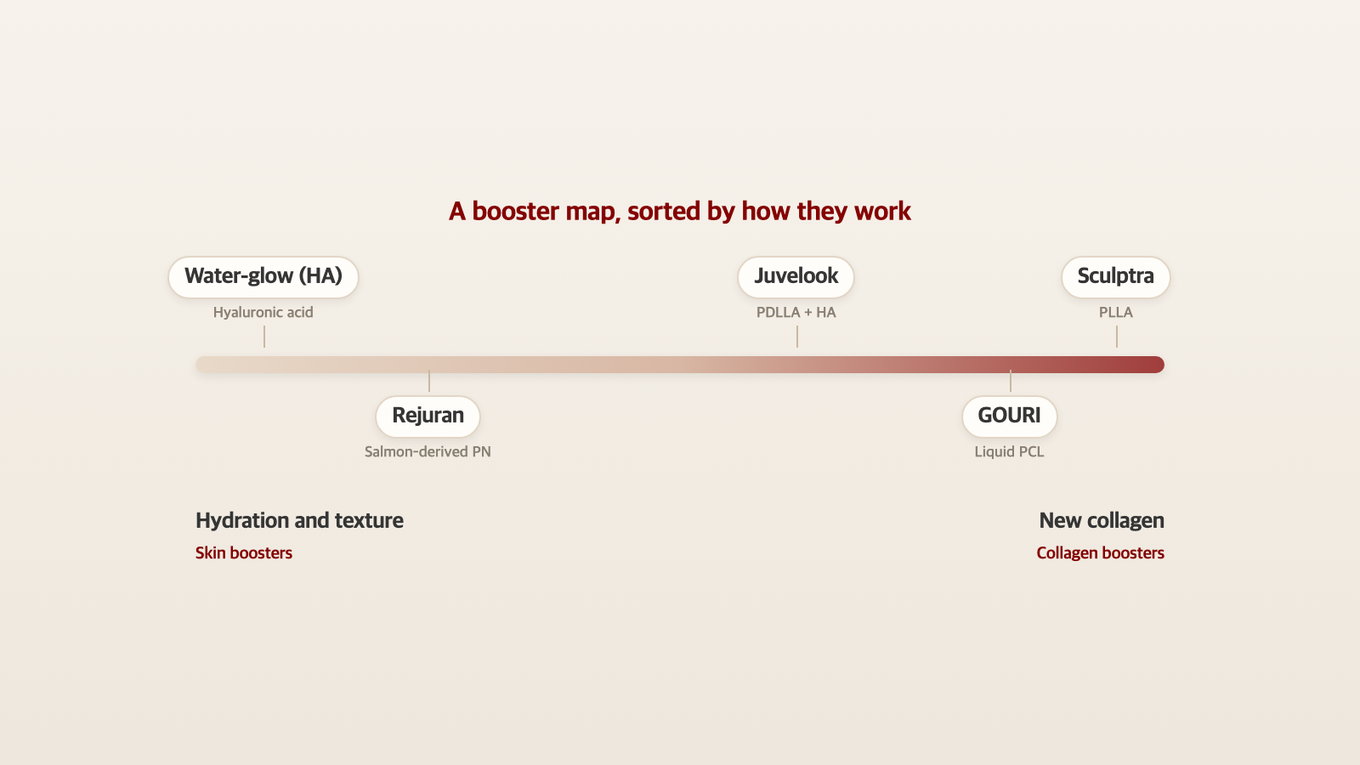
Three borderline products, placed:
"So which is better, the water-glow injection or GOURI?"
I hear this question often, and the question itself lines up two different categories in a single race. If hydration and texture are your concern, the water-glow side works on its target; if thinning skin and elasticity are your concern, GOURI works on its own target. Which one is 'better' is decided by your concern, and by nothing else.
If your concern is dryness, rough texture, or hydration, start with skin boosters. If your skin feels thinner and less elastic, start with collagen boosters.
A bit more concretely:
There are also cases where a collagen booster is a poor fit. If you want a dramatic change in one session, or your schedule can't accommodate months of waiting, this category's timeline itself becomes a source of stress. And both categories are injection treatments, so bruising and swelling can last a few days; with the collagen-stimulating family, small nodules can form in rare cases when injection depth or amount is off. This is where the injector's judgment shapes the outcome. I've covered how sessions are spaced in a separate post on collagen-booster session counts.
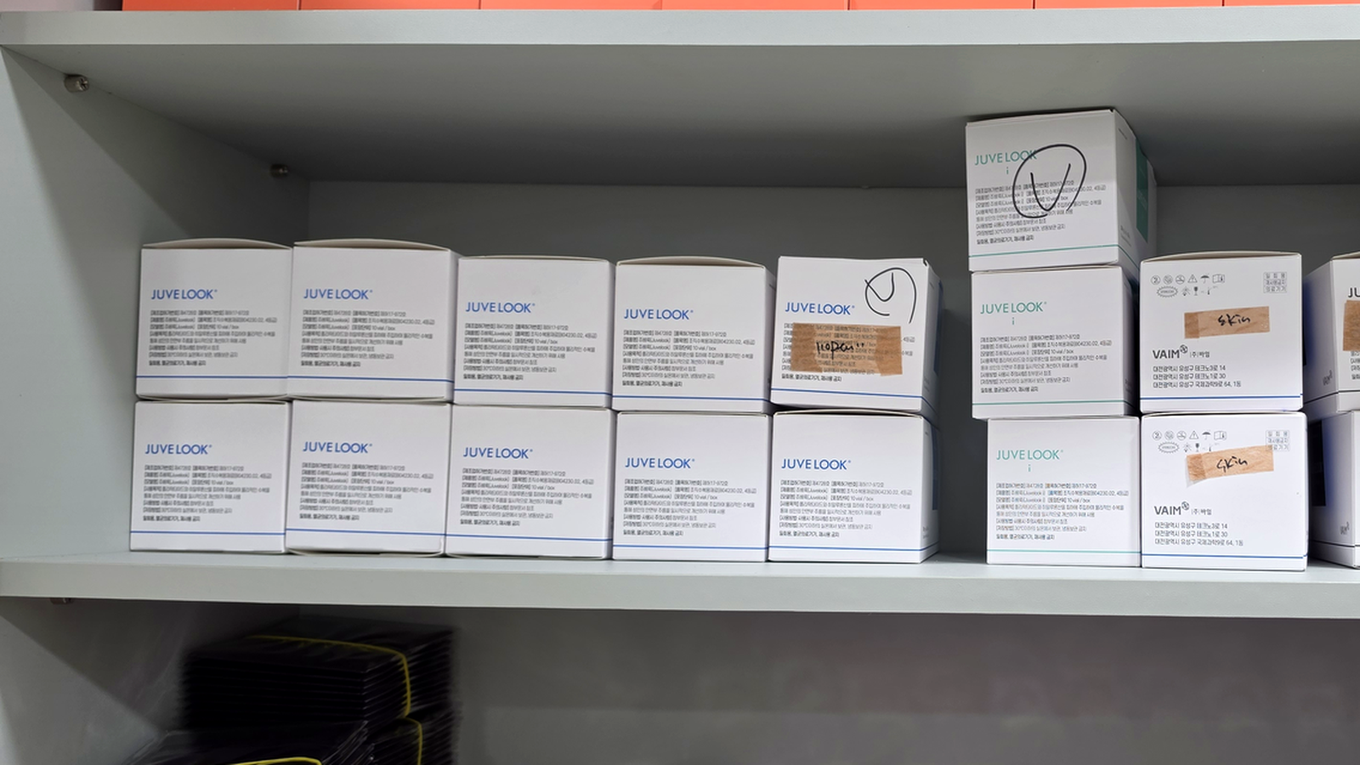
That's why the first question in my consultation room is where on that spectrum your concern sits. Rejuran, Juvelook, GOURI, and Sculptra are, at bottom, different product families used for different purposes. Once the category is settled, product choice is the next problem, and keeping that order saves both wasted money and disappointment.
'Water-glow injection' is less a product name than a market umbrella term for HA skin boosters that place hyaluronic acid directly in the dermis. GOURI is a collagen booster that stimulates collagen production with liquid PCL. Different substance, different purpose, and a different timeline: the HA family shows up relatively early as hydration, while GOURI's first changes are described as early as 2-4 weeks in some reports (timing varies by report), with elasticity building gradually (individual variation).
They're categories with different purposes, so when needed, they're sometimes combined, with sessions split up and spaced apart. But stacking several treatments into one visit doesn't scale the effect proportionally, and sequencing them with sensible intervals, based on your skin's condition, tends to be safer. Which combination fits is best settled after your skin has been assessed.
Your body needs time to make new collagen, so change accumulates gradually. The timing of liquid PCL's first changes varies between reports (some describe changes as early as 2-4 weeks), Juvelook (PDLLA) has a study observing improvement through 24 weeks (6 months), and PLLA (Sculptra) has a systematic review reporting improvement continuing for up to about 2 years (25 months). Seeing little change right after treatment is the normal course for this category, and the pace and degree vary widely with age and skin condition.
Both are injection treatments, so bruising, swelling, and redness for a few days are common to both. With the collagen-stimulating family, small nodules can occasionally be felt when injection depth or amount is off, which is why the injector's command of anatomy matters. Most settle with time, but there's individual variation, so share your skin condition and medical history fully before treatment.
'Booster' is one word covering two different things: skin boosters that fill the dermis with ingredients directly, and collagen boosters that get your body making new collagen. They split on what goes in, which concern they aim at, and when the effect arrives.
So before you search treatment names, put your own concern into one line. Is it "dry and rough-textured", or "thinner and less elastic"? Once that line exists, questions like "water glow or GOURI?" mostly answer themselves. The category sets the direction. The product comes after.
#SkinBooster #CollagenBooster #SkinBoosterVsCollagenBooster #Biostimulator #CollagenStimulator #GOURI #Rejuran #Juvelook #SkinRejuvenation #MyeongdongDermatology #ForeverClinic