

Blog
Informasi khusus untuk kesehatan kulit
Informasi khusus untuk kesehatan kulit

If you're planning your skin around the holidays and the New Year, the basic order is to put the regenerative treatments that build results slowly first, and keep the two weeks right before your events clear.
From late October to late January is a little over three months. In my view, that's enough time to see one multi-session booster through to the end. Get the order backwards, though, and swelling and bruising land in the same week as your holiday parties, and by January it's hard to tell what actually made the difference.
Key Takeaways
- Regenerative treatments run on a long clock. Studies measured new collagen 2 months after treatment (ultrasound lifting, Suh 2015) and at 3 and 6 months (PLLA, the ingredient in Sculptra, Goldberg 2013). That's why they go at the front of the plan.
- Sculptra needs at least 3 weeks between sessions. Per the FDA label it's usually 3 sessions (up to 4), and other boosters have their own interval guidance by product.
- Two weeks clear of new injectables before an event is the minimum buffer. In the Sculptra FDA trial diaries, 76.1% of symptoms resolved within 14 days; the rest were still there at the 14-day mark.
- Judge the result in the new year. In the same trial (sessions 4 weeks apart), more participants said they were at least slightly improved at 3 months than at 1 month. These are Sculptra trial results, not a prediction for other treatments or for any individual.
- Starting in the new year isn't too late. But that pushes the collagen-building months into spring and early summer, when UV climbs again (in Seoul, erythemal UV peaks in June and bottoms out in December, per the Korea Meteorological Administration).
When I put together a plan that runs from the holidays into the new year at our clinic in Myeongdong, Seoul, my yardstick is how long each treatment takes to build its result. The slow treatments go first. Quicker treatments go later.
A regenerative treatment roadmap works backward from how long each treatment takes to build its result, so the slowest ones get scheduled first. I sort treatments into three clocks.
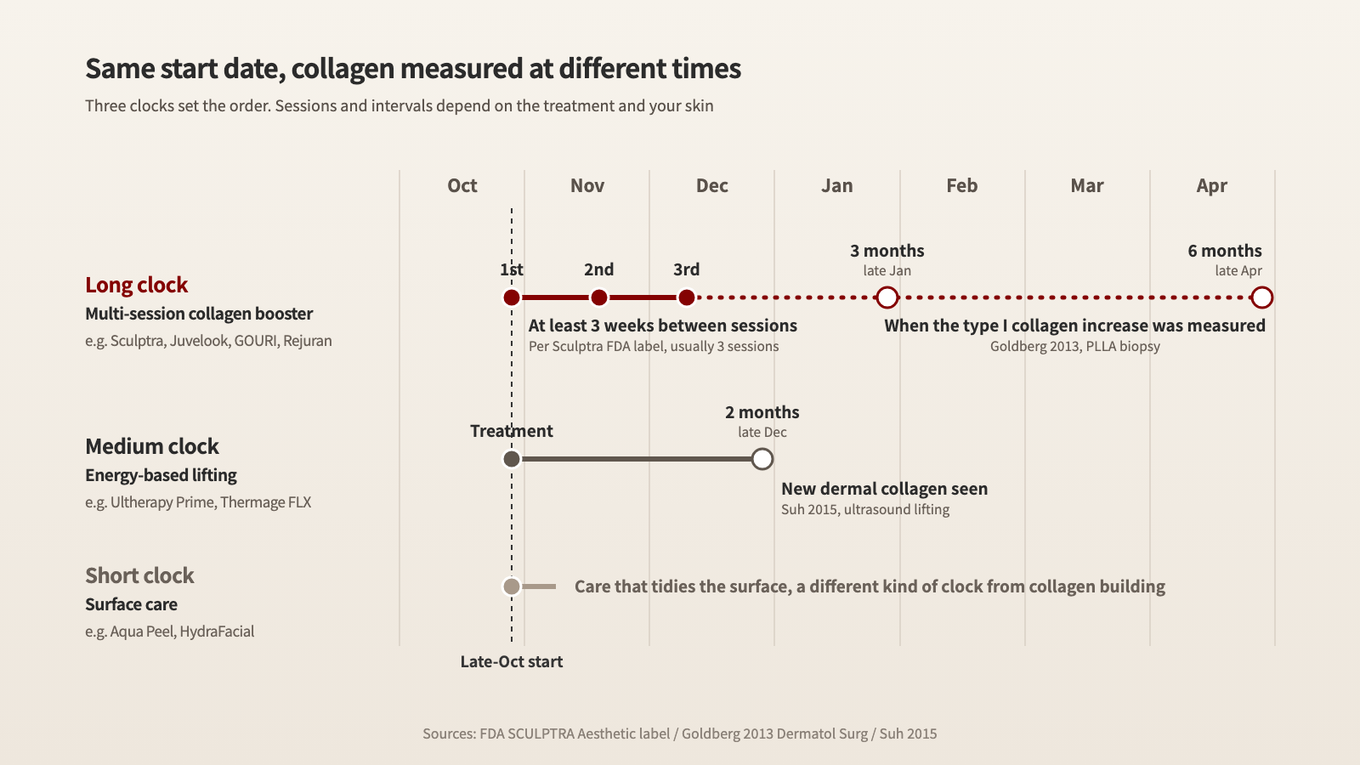
Even with the same late-October start, the point at which studies measured collagen differs by treatment. This example shows only the minimum interval between sessions, so if your event is after mid-December, the 3rd session moves to after it.
That settles the order. A multi-session booster has to start now if you want something to look at in the new year, while surface care has no reason to be rushed.
Because after an injectable treatment, swelling and bruising can take close to two weeks to settle. Honestly, bruising is the weak spot of this plan. In the Sculptra FDA trial, 93.5% of participants recorded tenderness and bruising, and 87.1% recorded swelling, in their 4-week post-treatment diaries.
Going back over the Sculptra label, I found the recovery ranges spelled out in some detail.
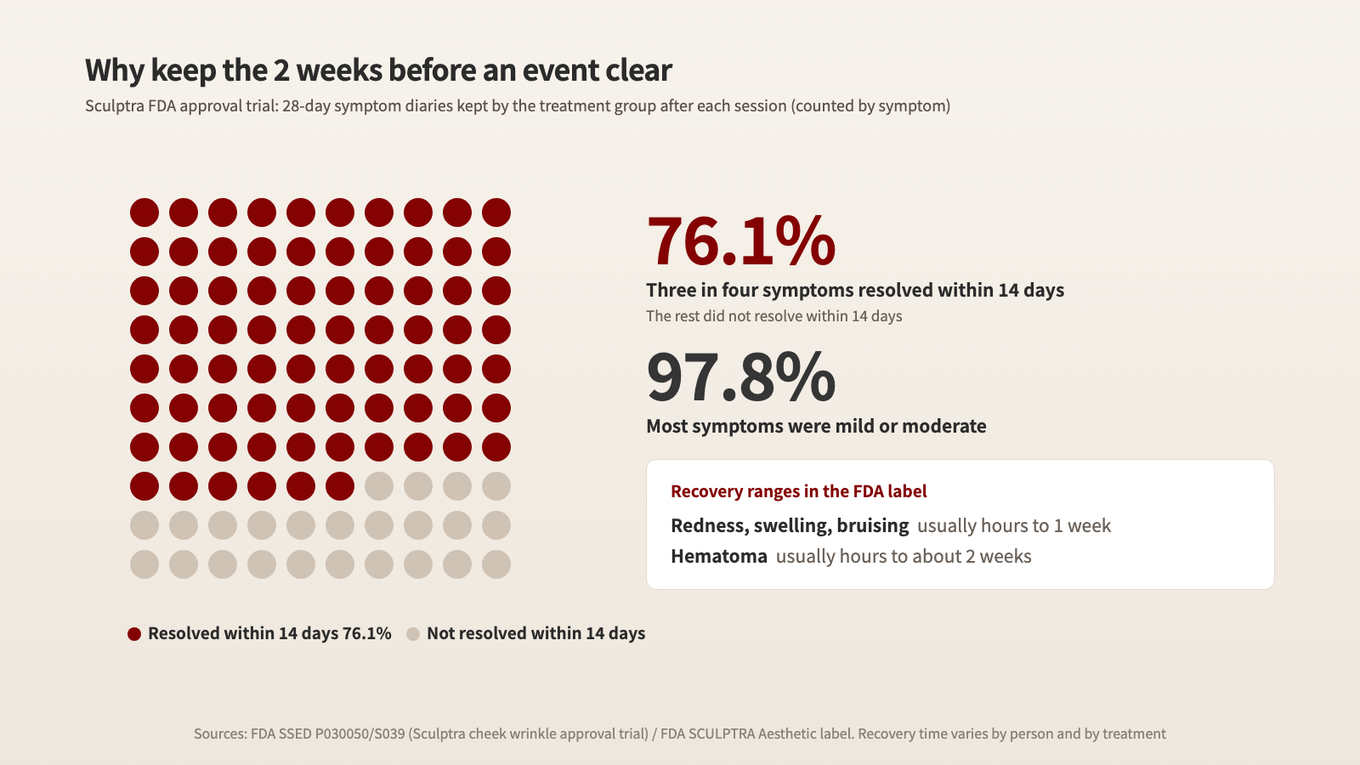
Symptom-level tally from the Sculptra FDA approval trial (treatment group, a 28-day diary after each session). Recovery time varies by person and by treatment.
So three out of four symptoms settled within two weeks, and the rest went past two weeks. Even with a two-week buffer, some of that can remain, and with only one week the margin gets tighter.
These numbers are from the Sculptra trial. Rejuran, Juvelook, GOURI and energy-based lifting each have their own side effects and recovery patterns, so check each treatment separately (FDA Sculptra label). I covered the problems with getting several treatments on the same day in Can You Get All Your Fall Treatments at Once?.
Split late October through the new year into five stages: check, start, continue, keep clear, and assess. The dates shift earlier or later depending on your event dates and sessions.
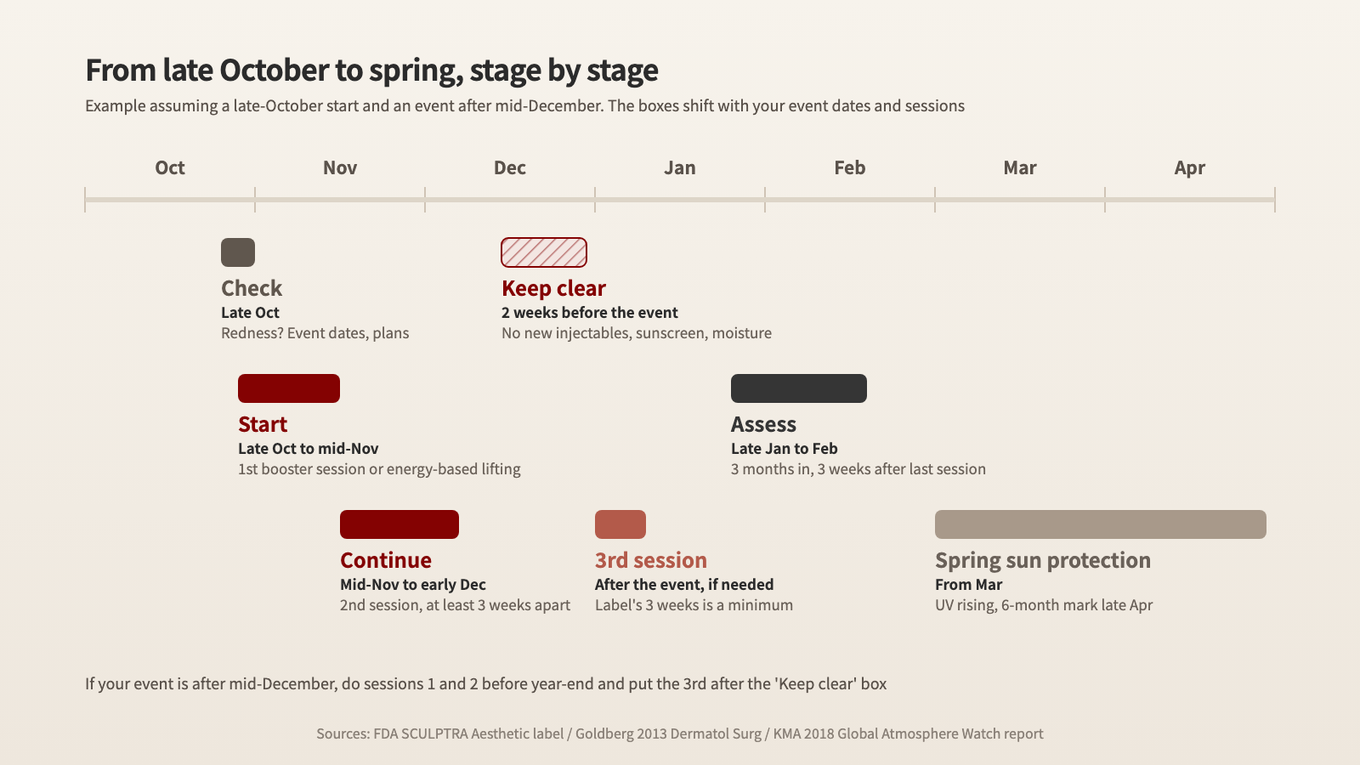
An example assuming a late-October start and an event after mid-December. Actual sessions and intervals depend on the treatment and your skin.
The numbers explain why I don't judge by how the first month feels. In the Sculptra FDA trial, with sessions 4 weeks apart, more participants said they were at least slightly improved at 3 months than at 1 month. These are Sculptra trial results, not a prediction for other treatments or for any individual.
No. If anything, you worry less about recovery clashing with holiday events. But a January start pushes the 3 to 6 months when collagen was measured into April through July, right when UV gets stronger again.
In a Korea Meteorological Administration report, Seoul's monthly average erythemal UV (UV weighted by how much it reddens skin) was highest in June at 2.68 kJ/m² and lowest in December at 0.45 kJ/m². The principle that UV cuts collagen synthesis and speeds up its breakdown is covered in Why Autumn and Winter Are Said to Be Best for Collagen Treatments.
| Start | Holiday events and recovery | When collagen builds | When to assess |
|---|---|---|---|
| Late October | No overlap if the 3rd session goes after the event | Nov to Apr, starting in low-UV months | Late Jan to Feb |
| January | No overlap | Apr to Jul, as UV rises | April onward |
| All at once in December | Recovery easily lands in party week | Dec to Jun | Hard to tell what worked |

The jawline and the area under the cheek in winter sun. Your face gets sun no matter the season.
A January start clearly suits some people. If your calendar is packed through the holidays and you can't free up a two-week gap, or your skin is sensitive right now and needs calming first, it's easier on your schedule to stick to sun protection and moisturizing through the holidays and start a multi-session booster in January.
It depends on which layer your concern sits in. The layer has to match for months of waiting to mean anything.
I sort concerns by layer into three broad groups.
If your concerns fall into two or more groups, I recommend picking just one for this season and holding the other until after the new year check. That way you see one result cleanly before deciding on the next.
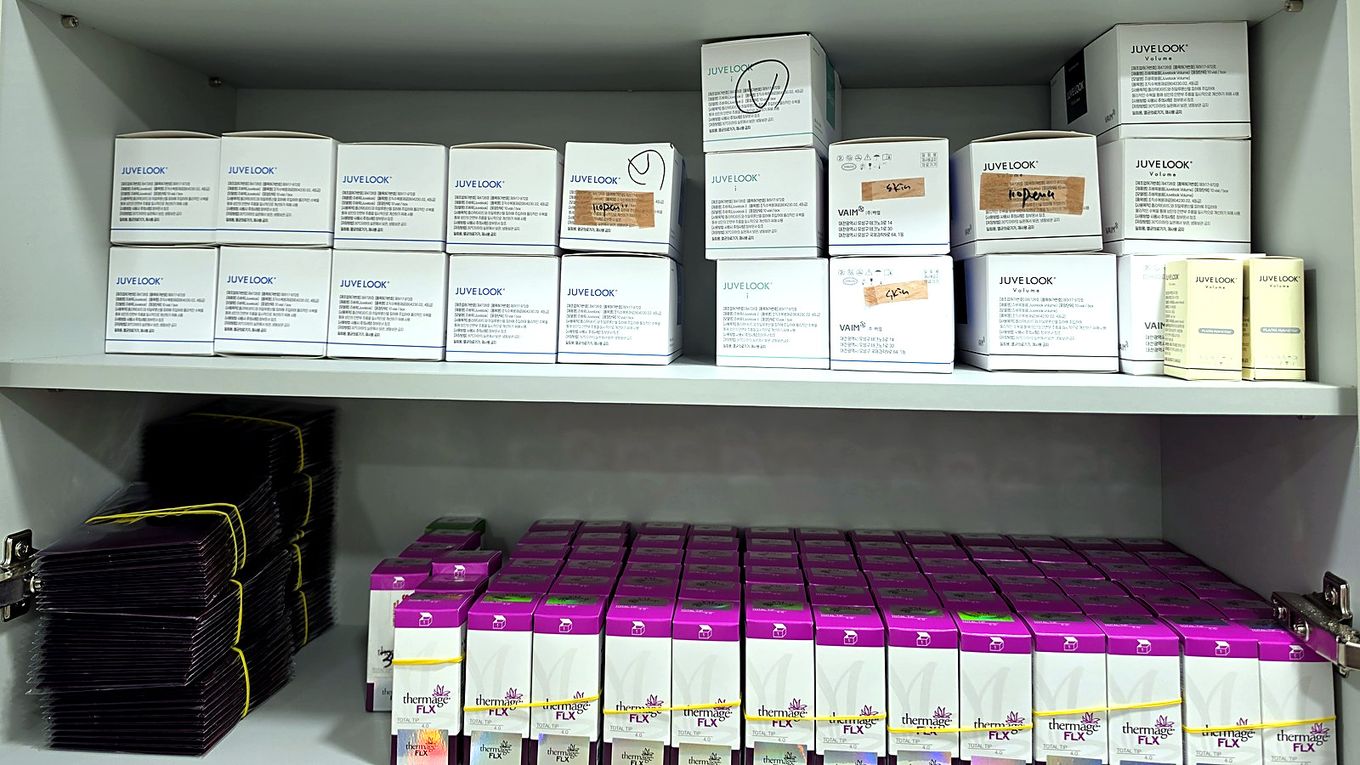
Genuine Juvelook boxes and Thermage FLX tips in the storage cabinet at our clinic in Myeongdong, Seoul.
Here's who this season's roadmap fits, and who should rework it.
You can, but the timing is tight. By the Sculptra label, a hematoma can last up to about 2 weeks, and in the FDA trial, close to a quarter of symptoms didn't resolve within 14 days. Mention your event date up front and confirm the start timing before treatment. If how you look on the day matters, starting after the event puts less strain on your schedule.
Yes. Just don't do them on the same day; space them out, and pick one of the two as this season's main treatment first, so the new year assessment stays clean. Order and spacing depend on your skin and the combination of treatments.
Compare photos side by side taken in the same lighting, at the same angle and with the same expression as before you started. With a late-October start, the 3-month mark is late January, and the 6-month mark, when the PLLA study measured collagen, is late April. If you had Sculptra, check for late-onset lumps at this point too.
A skin plan that bridges the holidays and the new year comes down to this order: put the slow regenerative treatments first, keep the two weeks before your events clear, and hold the assessment until late January or later.
You only need to decide three things now. When your events are, which layer your concern sits in, and which one thing you'll do first this season. Once those are settled, the rest of the calendar falls into place.
#YearEndSkincare #NewYearSkinPlan #CollagenTreatmentRoadmap #CollagenBooster #RegenerativeTreatments #TreatmentOrder #Sculptra #EnergyBasedLifting #SkinClinicSeoul #ForeverClinicMyeongdong


