

Blog
Expert tips for healthy skin
Expert tips for healthy skin

If a booster fully dissolves within a few months, do the results disappear with it? It's one of the questions people get stuck on most when they're looking into collagen boosters.
A collagen booster (often called a biostimulator) is a treatment that places a biodegradable material in the dermis, the deeper layer of the skin. The tissue reacts to that material, and the reaction prompts fibroblasts (the cells that make collagen) to produce new collagen. That's why I look at two timelines separately: how long the injected material stays, and how long the collagen made in the meantime stays.
Key takeaways
- The product does break down. According to the manufacturer's leaflet, GOURI (liquid PCL) is absorbed and cleared over about 12 weeks. Sculptra (PLLA) is slowly split by water into lactic acid and finally metabolized into carbon dioxide and water, and there is a report of particles still being found in human tissue 28 months later.
- The new collagen is your own tissue. Skin collagen as a whole turns over so slowly that its half-life is estimated at about 15 years (Verzijl 2000, an estimate).
- No study has measured this directly yet. I haven't found any published study that directly measured how much new collagen remains in human skin after the product has been fully absorbed.
- It isn't permanent either. One measurement found that adult skin collagen declines by about 1% a year (Shuster 1975), and the new collagen sits in that same skin.
I don't think the results switch off the moment a collagen booster is absorbed. At our Myeongdong clinic, I explain it in two parts: the injected material is what triggers the tissue response, and the collagen produced by that response is what builds up in your own dermis.
When a biodegradable collagen booster (GOURI, Sculptra, Juvelook) is placed in the dermis, the body recognizes the material and a tissue response begins. That response stimulates fibroblasts to make new type I and type III collagen. Meanwhile, the material gradually breaks down and leaves the body. A review paper on PLLA describes the same pattern: over time the PLLA degrades, the inflammatory response settles, and collagen increases (Vleggaar 2014).
Put in order, there are three stages.
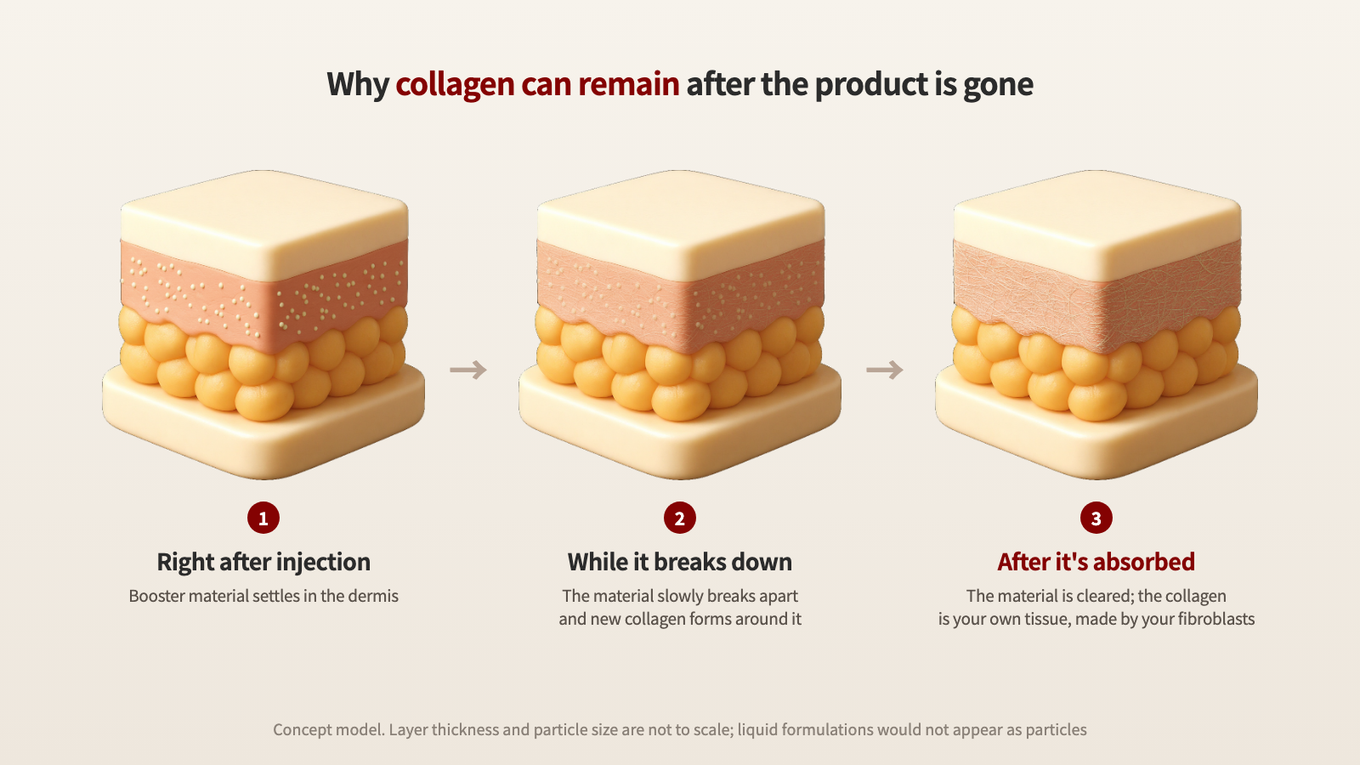
This is a concept model. Layer thickness and particle size are not to scale, and a liquid formulation like GOURI wouldn't appear as particles.
When the fullness from treatment day goes down within a few days, some people worry it's already been absorbed. Sculptra's FDA label notes that water-related swelling right after treatment can look like a full correction and then subside within hours to days. With other boosters, too, the early swelling often goes down first, so it's hard to judge absorption from changes at that point.
Biodegradable collagen boosters break down mainly through hydrolysis (water molecules cutting the polymer chains). The chains split into small fragments, which are then metabolized and cleared. How long the material stays varies widely by ingredient and formulation, so I look at the evidence for each product separately.
| Product (ingredient) | How long the product stays, and the evidence | When new collagen was confirmed |
|---|---|---|
| GOURI (liquid PCL) | Absorbed and cleared over about 12 weeks (manufacturer's user leaflet, in humans) | Increased dermal thickness and collagen density 6 weeks after injection (photoaged mouse model, J Cosmet Dermatol 2026) |
| Sculptra (PLLA) | Particles recovered from tissue 28 months after subcutaneous injection (Stein 2015, human tissue) | Significant increase in type I collagen on biopsies at 3 and 6 months (Goldberg 2013, 14 patients) |
| Juvelook (PDLLA) | I couldn't find a published study measuring its breakdown time in human skin | I also couldn't find a published study timing collagen in human skin, so none is listed here |
Looking at the GOURI row, the absorption period stated by the manufacturer is about 12 weeks. In a mouse study I co-authored, differences in dermal thickness and collagen density were already measured 6 weeks after injection. Because the species differ, the two numbers can't be compared directly. What this study tells us is only that collagen changes were measured in mice at 6 weeks. It's an animal model, so the degree of change in people varies from person to person. I've written up the study design and figures separately in GOURI (liquid PCL): does it really build collagen?
Sculptra is the opposite case: the material stays for quite a long time. A German research team analyzed human tissue and reported that PLLA particles break down much more slowly than previously thought, and were still recovered 28 months after subcutaneous injection (Stein 2015). In the same study, type III collagen had built up right next to the particles and type I collagen outside the capsule surrounding them. So with Sculptra, before you even ask what happens "after the material is gone," you're looking at a case where the material and the collagen sit side by side for a long time.
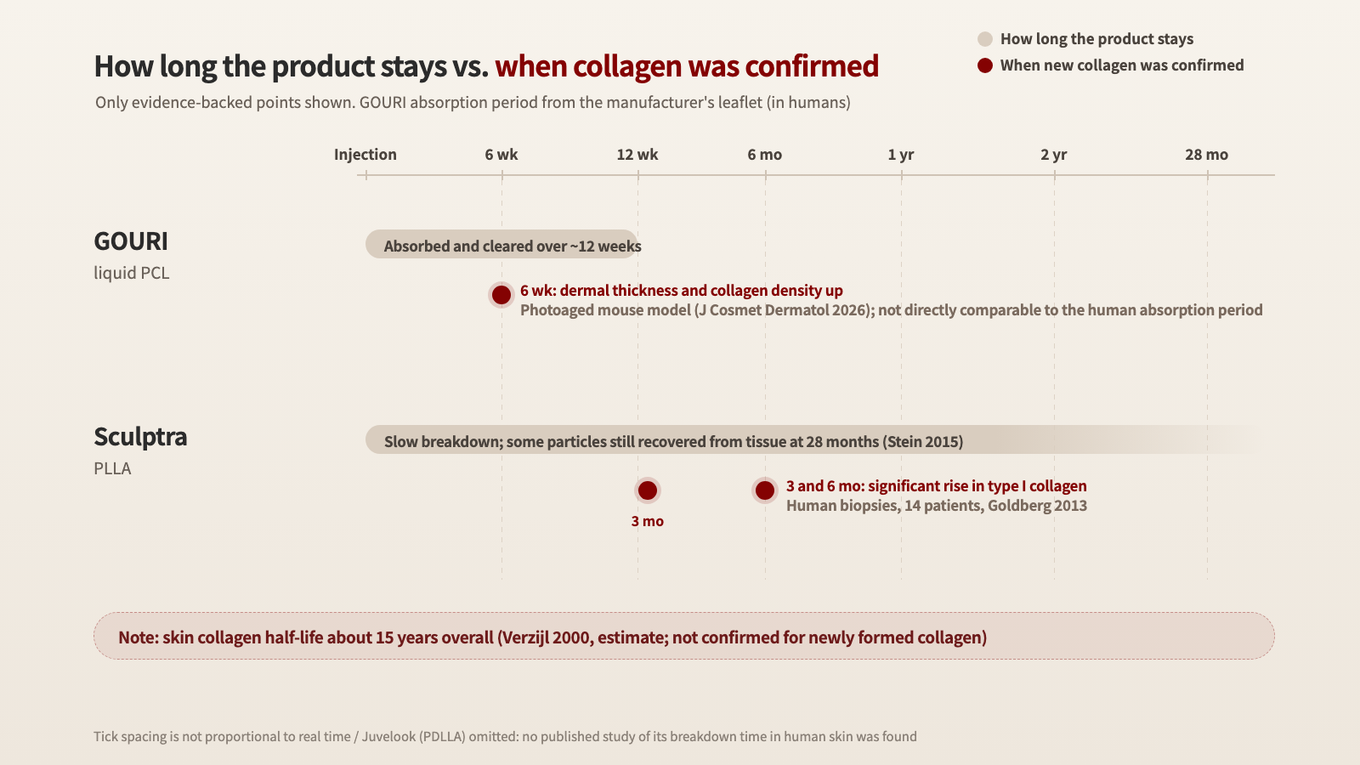
How long each product stays and when collagen was confirmed, side by side. GOURI's 6 weeks comes from a mouse model, so it can't be compared directly with the 12-week figure in humans, and the tick spacing isn't proportional to real time.
Because the collagen made in the meantime is protein your own fibroblasts produced, and skin collagen naturally changes very slowly. That said, it hasn't been separately confirmed whether that same pace applies to collagen newly made after a treatment.
There's one number that shows how slowly skin collagen turns over. A Dutch research team measured an age-related change in the form of aspartic acid that accumulates in collagen, and estimated the half-life of skin collagen as a whole at about 15 years (Verzijl 2000). For cartilage collagen it was 117 years. It's a calculated estimate, not a direct measurement, and it's an average that includes collagen that has been there for a long time.
💡 How I separate the two - How long the product stays depends on the product (about 12 weeks for GOURI; for Sculptra, some is still found after 28 months). How long the collagen stays depends on your own skin. So I don't guess how long results will last from "short absorption time" alone.
That doesn't mean the remaining collagen stays as it is, either. Dermal collagen is constantly being broken down by UV exposure and aging, and rebuilt, and a classic measurement found that adult skin collagen declines by about 1% a year (Shuster 1975, forearm skin). Why fibroblasts slow down with age is covered in The cells that keep skin firm age too.

This is a concept chart. The axes have no values, and it isn't a graph of real measurements or anyone's individual progress. How much improvement you see varies from person to person, and there may be none.
There's no evidence that a material lasting longer means bigger or longer-lasting results. A material that stays longer does keep stimulating for longer, but it also means the body has that much longer to react to it.
Let me start with the downside. In the pivotal trial described on Sculptra's FDA label, nodules or papules were reported in 17.2% of the Sculptra group (20 of 116) and 12.8% of the control group (15 of 117). The nodules appeared late, on average around 209 days after the first treatment. In other words, because the material stays a long time, reactions can also show up months later. I've written about this in more detail in How Sculptra (PLLA) Builds Collagen.
For GOURI, the manufacturer's leaflet lists bruising, redness, swelling, injection-site pain, and itching as common reactions, and rash, skin discoloration, hardening, and small lumps or nodules as possible reactions. Rarely, there are reactions such as inflammation or infection that need treatment. With any booster, rare but serious adverse events are possible, so go over the warnings on the product label and discuss them in your consultation before treatment. The frequency categories in the GOURI leaflet are expected frequencies based on clinical experience, so they can't be compared directly with the Sculptra rates, which were measured against a control group in a pivotal trial.
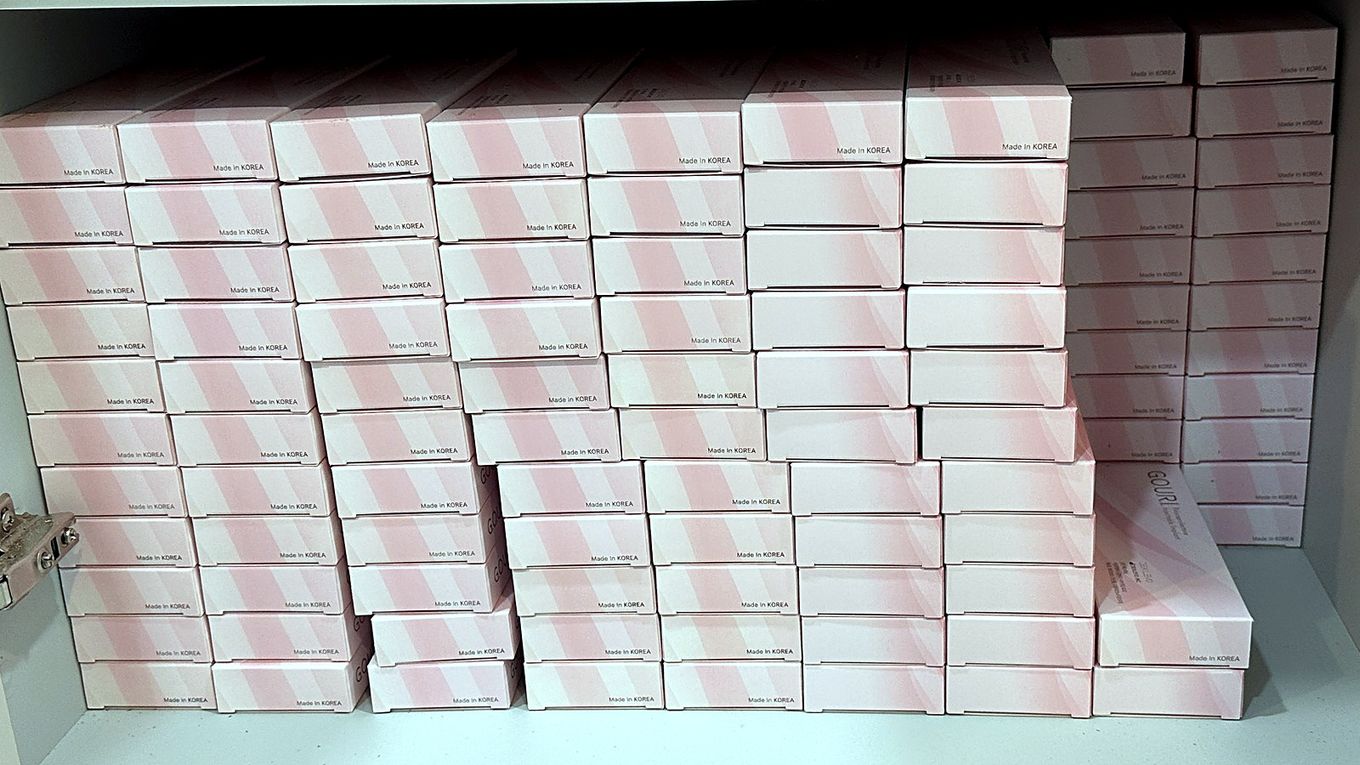
Genuine GOURI boxes in the storage cabinet at our Myeongdong clinic. Absorption time differs by product, so knowing what you received is the starting point for reading your progress.
So when choosing a product, I look at these three things before "how long does it stay?"
Because your skin keeps aging, even with that remaining collagen in place. I think the right way to time the next session is not by the product's absorption period but by whether photos taken under the same conditions show the change fading.
Here's a common mix-up. Since GOURI is absorbed in about 12 weeks, people assume they need it every 12 weeks to keep the results. But the absorption period is a number about the product, and the timing of the next session is decided by how the collagen is doing, so there's no reason the two should match. For Sculptra, too, the FDA label reports that in its approval trial some patients saw improvement continue up to 25 months after their last treatment. That's a partial result from Sculptra's approval trial, so it doesn't guarantee any individual result, and it isn't a fixed duration for everyone.
How fast new collagen builds up and declines differs from person to person, so the timing of your next session is based on how your own skin is doing.
How long the remaining collagen stays noticeable varies with factors like age, sun exposure, and smoking. That's why it's more accurate to decide on the next session after finishing the planned sessions and comparing photos taken a few months apart under the same lighting and angle.
No. Biodegradable collagen boosters break down in the body and are absorbed and cleared. GOURI (liquid PCL) takes about 12 weeks according to the manufacturer's leaflet, while Sculptra (PLLA) breaks down slowly, and there's a report of particles still being found in human tissue after 28 months.
I don't think the results end at the moment of absorption, because what they rest on is your own collagen, made by fibroblasts in the meantime. That said, no published study has yet directly measured how much collagen remains in human skin after the product is fully absorbed, and since aging continues, how long you notice it varies a lot between people.
There's no evidence for judging how long results last from absorption time alone. Absorption time is how long the product stays, while results depend on how well the collagen made in the meantime holds up, so the two need to be looked at separately. I also haven't found a human study comparing how long results last between products with different absorption times.
It's hard to judge absorption from changes at that point. Sculptra's FDA label also notes that water-related swelling right after treatment subsides within hours to days, and with other boosters the early swelling often goes down first as well. New collagen forms over weeks to months, so look at photos taken under the same conditions a few months later.
A collagen booster uses a material your body breaks down to get your own collagen made. That's why "it's been absorbed" and "the results are over" need to be looked at separately. That said, there's still no direct evidence on how much remains after absorption, and it varies from person to person.
Rather than how long a product stays, base your decision on the layer where your concern is, your session plan, and how things look in photos taken under the same conditions a few months later.
#CollagenBooster #BiodegradableBooster #CollagenBoosterLongevity #HowLongDoCollagenBoostersLast #GOURI #LiquidPCL #Sculptra #PLLA #CollagenRegeneration #ForeverClinicMyeongdong


