

Blog
Expert tips for healthy skin
Expert tips for healthy skin
Regenerative treatments show results late, and the response varies from person to person, so the first month is a hard time to judge whether one is working. Honestly, even when one suits you, the waiting is the hardest part.
Regenerative (collagen-stimulating) treatments, including injectable biostimulators, prompt fibroblasts in the dermis to make new collagen. Collagen boosters (GOURI, Sculptra, Juvelook, Rejuran) and energy-based lifting both belong here. How much new collagen builds up, though, differs between people. That holds even in controlled trials run for regulatory approval.
Key Takeaways
- Even in clinical trials, "improved" didn't reach 100%. In the Sculptra trial in the FDA approval documents, blinded evaluators rated 71.6% of treated participants as improved in cheek wrinkles at 12 months (26.1% in the untreated control group).
- The first month is only partway through the plan. In the same trial, 57.4% of participants rated both sides of their face as at least slightly improved at 1 month, and as monthly sessions added up, that reached 88.9% at 3 months.
- How change is assessed shifts the verdict. In a radiofrequency lifting study, blinded photo scoring rated 83.2% of treated areas as improved, while treating physicians who didn't refer to the before photos rated only 28.9% as improved (both counted by treated area).
- What works against collagen differs by person. In smokers' skin, synthesis rates of type I and type III collagen were 18% and 22% lower than in non-smokers.
No. The same treatment gets different responses in different people. At our clinic in Myeongdong, Seoul, the first fact I keep in mind when I look at regenerative treatment results is that even in a controlled FDA approval trial, the "improved" rating wasn't 100%.
| Method | Study | What was measured, and when | Rated "improved" |
|---|---|---|---|
| Collagen booster (PLLA, Sculptra) | FDA approval trial 2023, 97 treated, avg. 3.6 sessions | 12 months, blinded evaluator, at least 1-grade wrinkle improvement on both cheeks | 71.6% (untreated control 26.1%) |
| Focused ultrasound lifting (research device) | Alam 2010, 35 people, 1 session, no control group | 90 days, 3 blinded physicians, brow lift | 86% (30 people), avg. 1.7 mm |
| Radiofrequency lifting (early Thermage device) | Fitzpatrick 2003, 86 people, 1 session, no control group | 6 months, blinded photo assessment, at least 1-point wrinkle improvement | 83.2% (by treated area around the eyes) |
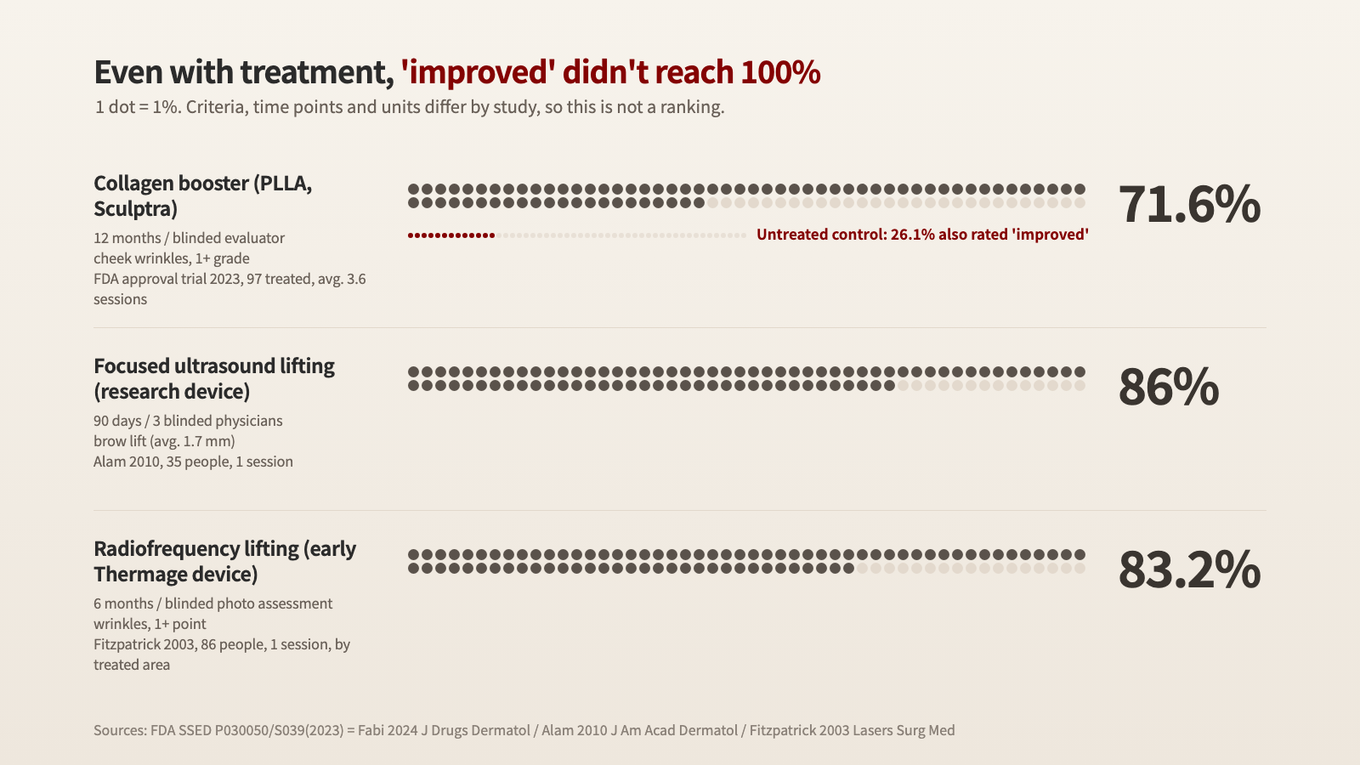
Each dot is 1%. The studies use different criteria, time points and units (people vs. areas), so they can't be ranked against each other.
Facts first: in the Sculptra trial, about seven in ten were rated improved and close to three in ten weren't. There's no reason to hide that.
The size of the change matters too. The average brow lift in the ultrasound lifting study was 1.7 mm. Measure it with a ruler and it's a clear change. In the mirror, it's small enough to miss at first.
The part of this data I kept coming back to, though, was the control group. Even among people who received nothing, 26.1% were rated "improved." The study didn't identify a cause. My reading is that natural ups and downs in skin condition, or variation between assessments, can produce a number like this on their own. I made the same point in GOURI (liquid PCL): does it really build collagen?: even a treatment with research behind it leaves room for individual variation.
With regenerative treatments given as a series, 1 month in is still mid-treatment. So at that point, the change people notice themselves starts out lower than what the medical team sees.
The Sculptra FDA trial was designed with up to 4 sessions spaced a month apart. What I found interesting is that the treated person and the treating physician were asked the same question separately: "Is there any improvement at all?"
| Time point | Self-assessment | Treating physician |
|---|---|---|
| 1 month | 57.4% | 68.1% |
| 2 months | 79.3% | 89.7% |
| 3 months | 88.9% | 96.3% |
| 12 months | 92.0% | 94.3% |
Both ratings rise as sessions add up. They just start from different places. At 1 month, physicians saw change in close to seven in ten, while patients saw it in just over half. New collagen from PLLA was confirmed on biopsy at 3 and 6 months (Goldberg 2013), so judging Sculptra results by how the first month feels seems too early to me.
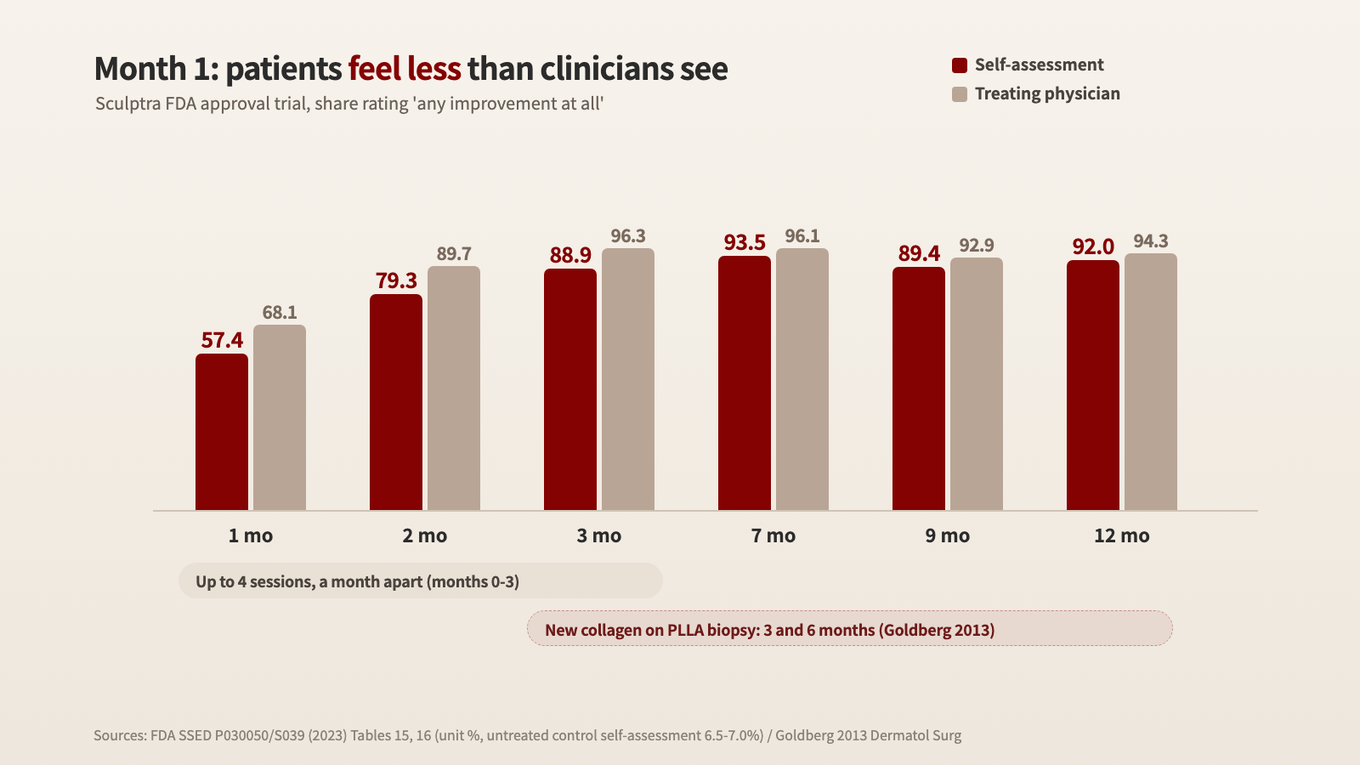
Self-assessment and treating-physician assessment from the FDA approval documents. Months 0 to 3 were the period when up to 4 sessions were given a month apart.
Looking plump right after treatment and then deflating within days feeds the same misunderstanding. With an injectable like Sculptra, which is mixed with water, much of the volume right after treatment is swelling and the injected water. I've walked through this in How Sculptra (PLLA) Builds Collagen.
⚠️ Good to know - It's only fair to cover the downsides too. In the same FDA trial, in diaries kept for 4 weeks after treatment, 93.5% recorded tenderness, 93.5% recorded bruising and 87.1% recorded swelling. 97.8% of symptoms were mild or moderate, and 76.1% resolved within 14 days. In the label's post-marketing reports, serious adverse events were rare, but the most commonly reported serious ones include nodules and granulomas, and the same list also includes visual disturbance symptoms, infection or abscess, paresthesia and facial nerve paralysis, and ischemia or necrosis. Nodules mostly appeared months after injection. Some went away on their own or after steroid injections into the nodule, while others lasted up to 2 years or had to be surgically removed. In the ultrasound lifting study, temporary, mild redness and swelling were common. In the radiofrequency study (early device), redness and swelling were uncommon, but second-degree burns occurred with 21 of 5,858 radiofrequency pulses (0.36%), and 3 of 86 people still had small scars at 6 months. For the other treatments named here, such as Rejuran, Juvelook, GOURI and Radiesse, side effects and limits differ by treatment, so check them at your consultation.
More accurate than memory, but photos aren't a perfect yardstick either. Two sets of data show that the way change is assessed can shift the verdict.
Even the treating physicians, looking without earlier photos, rated only about three in ten treated areas as improved. So if you look in the mirror every day and can't tell, that's not strange at all. That's why I treat photos taken under the same lighting and from the same angle as a better yardstick than memory, but I don't draw conclusions from them alone.
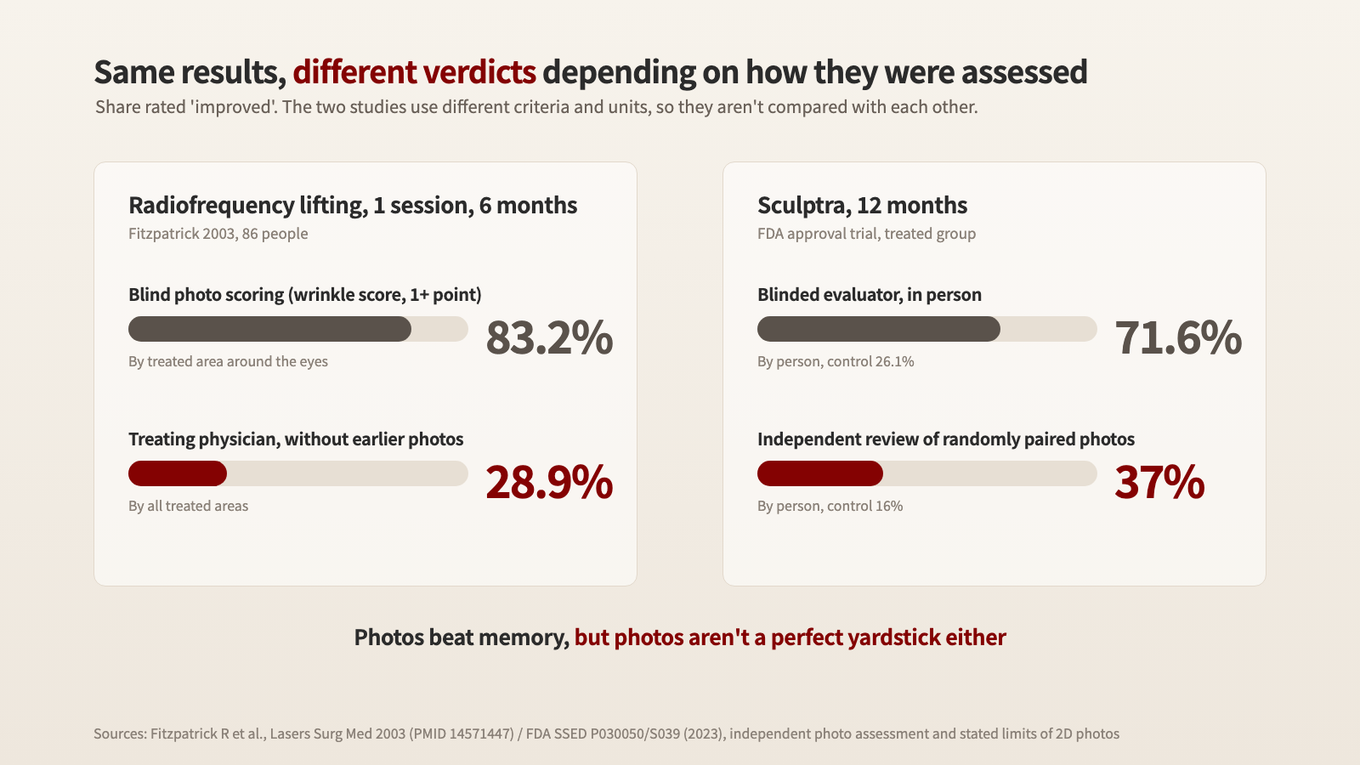
Sources: Fitzpatrick 2003 (83.2% counted by eye-area treatment sites, 28.9% by all treated areas), FDA SSED P030050/S039 (counted by person).
At our clinic in Myeongdong, I look at a regenerative treatment's result as the difference between the collagen synthesis the treatment adds and what your skin loses day to day. Even with an identical treatment, that second part differs from person to person.
One caveat: the factors below weren't measured as treatment responses. They're factors shown to lower everyday collagen synthesis or skin recovery. The only one directly linked to treatment response is age (an FDA subgroup analysis).
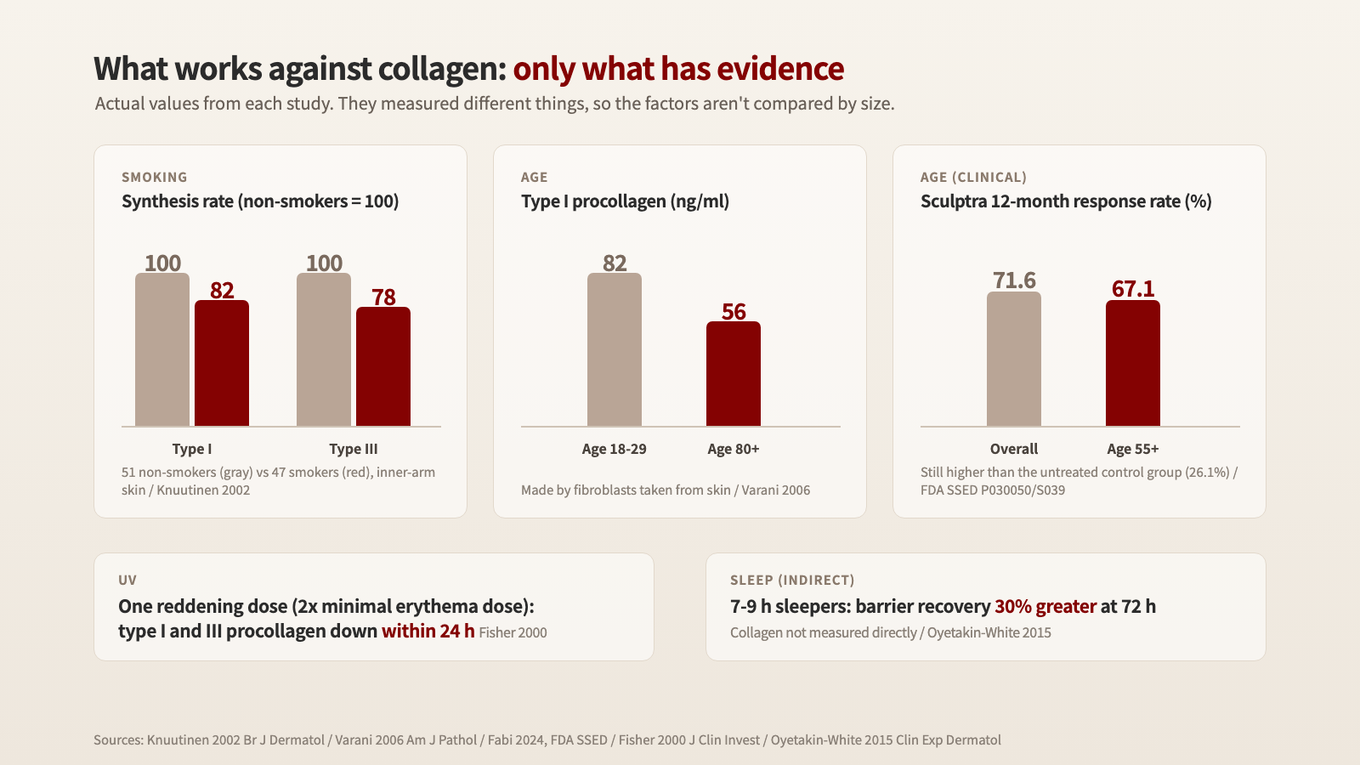
Each study's actual values, shown as bars. They measured different things, so the factors can't be compared by size.
Before writing a regenerative treatment off as a failure, check five things first: timing, your point of comparison, the target layer, what's working against collagen, and the treatment record. I rule them out one by one.
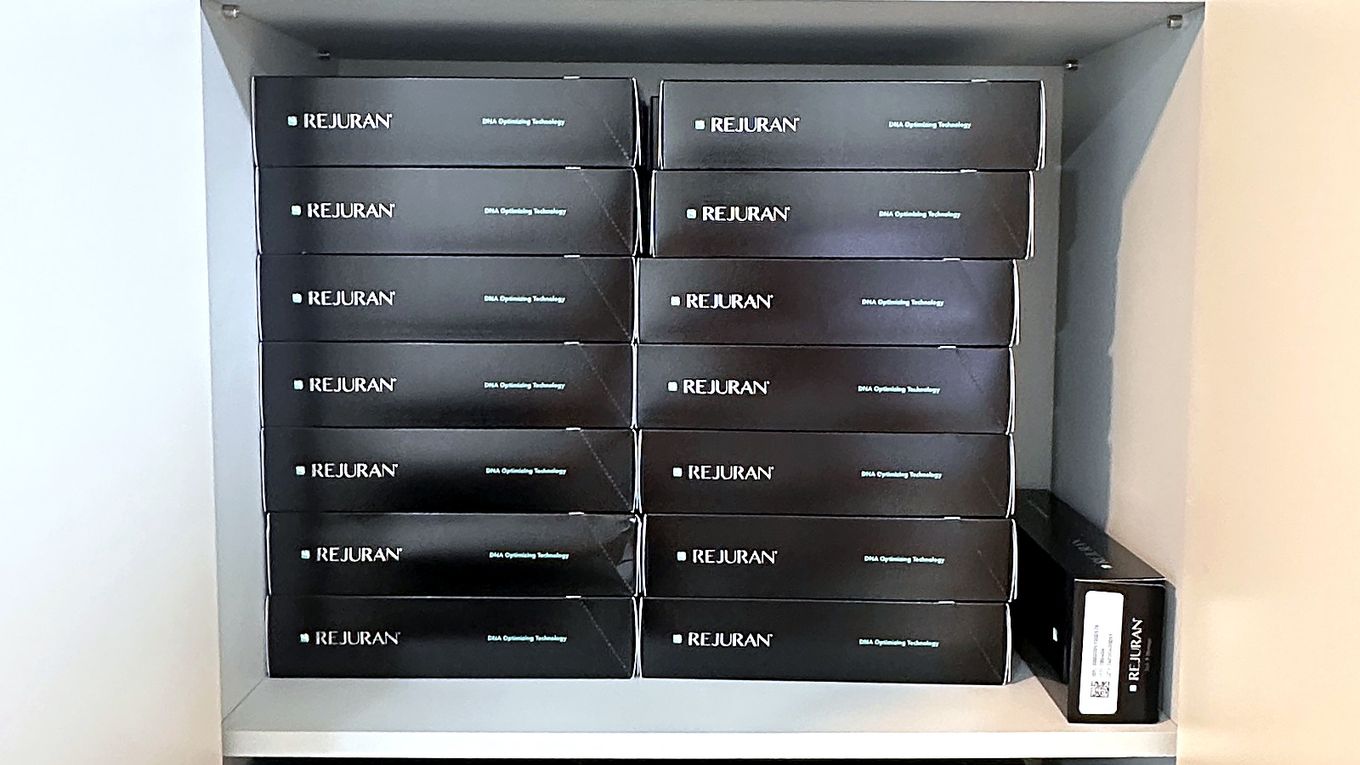
Genuine Rejuran boxes in the storage cabinet at our clinic in Myeongdong.
Not necessarily. When the response is weaker, I think it's better to sort the cause into one of four cases before repeating the same treatment harder or more often. The right next step depends on the cause.
Timing matters for judging, too. It's hard to judge partway through because the sessions aren't finished yet, and the new collagen they prompt hasn't fully shown up in the result. So my yardstick is what photos taken under the same conditions show a few months after the planned sessions are complete. If there's still no difference after waiting that long, that's the time to redesign.
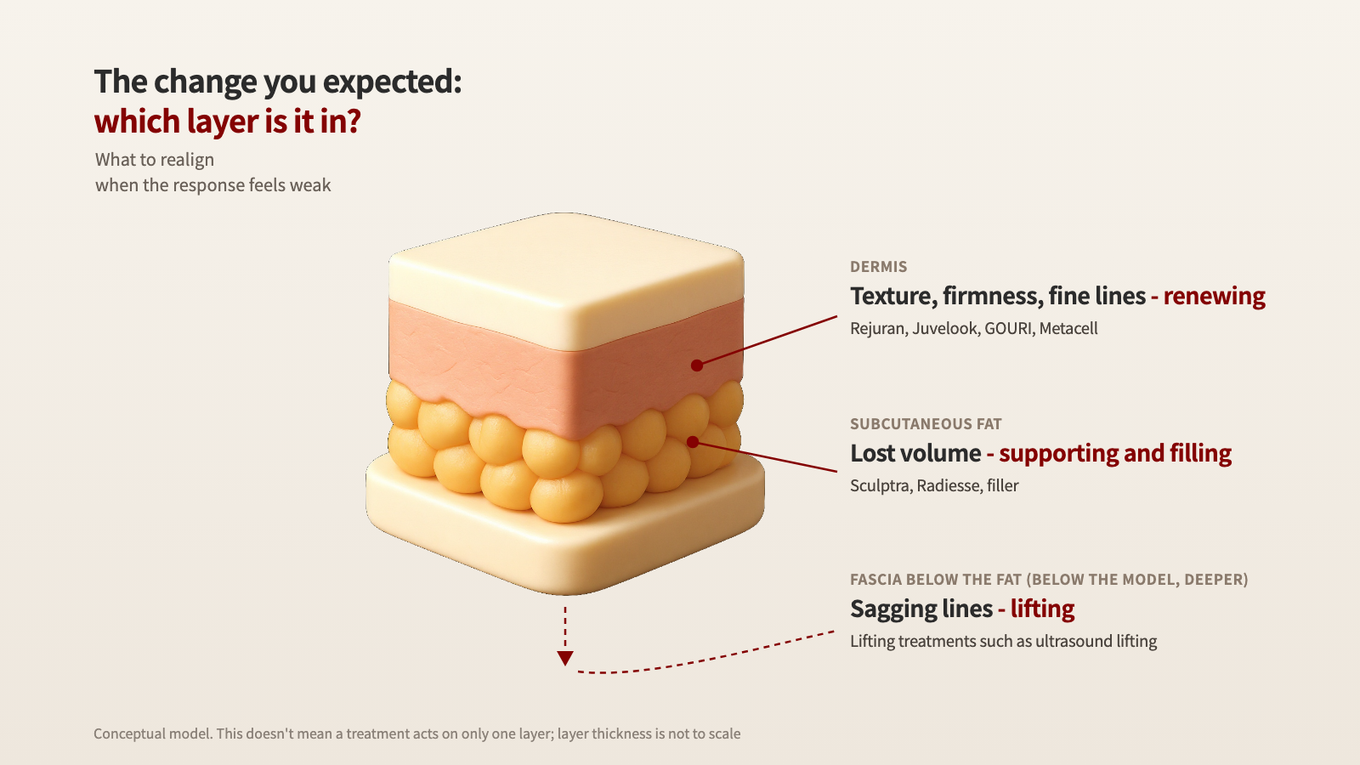
A model of what each layer is mainly targeted for. It doesn't mean one treatment acts on only one layer.
Here's who regenerative treatments tend to suit, and who is more likely to be disappointed.
If it's only been a few weeks, it's too early to tell. In the Sculptra trial, 57.4% rated both sides of their face as at least slightly improved at 1 month, and 88.9% at 3 months as sessions added up. Keep tracking with photos taken under the same conditions until a few months out, when new collagen has been confirmed in studies.
In the Sculptra trial, the share who rated both sides of their face as at least slightly improved was 57.4% at 1 month and 88.9% at 3 months. Much of the volume right after treatment is swelling and goes down within days. Depending on the study, new collagen was confirmed in tissue at 2 months (ultrasound lifting) or at 3 and 6 months (PLLA).
Age is a factor, but only one of several. Smoking and UV also work against collagen synthesis, and even people 55 and older had a higher response rate than the untreated control group. I don't draw a conclusion from age alone.
It depends on the cause. If it's still early, waiting comes first. If your concern and the layer the treatment targets don't match, the layer needs realigning. How to decide on the number of sessions is covered separately in How many collagen booster sessions do you need?
Regenerative treatments get different responses in different people, even with the same product and the same method. So rather than going by how the first month feels, I judge by photos taken under the same conditions a few months after the planned sessions are complete.
Before deciding "it didn't work," look at five things first: timing, your point of comparison, the target layer, what's working against collagen, and the treatment record.
#CollagenTreatments #RegenerativeTreatments #CollagenBooster #CollagenBoosterResults #IndividualResponse #TreatmentExpectations #Sculptra #CollagenSynthesis #SkinClinicSeoul #ForeverClinicMyeongdong


