

Blog
Informasi khusus untuk kesehatan kulit
Informasi khusus untuk kesehatan kulit
Autumn and winter are often called the best time for collagen treatments. Is that just because it's the slow season?
I get this question every autumn. Honestly, I think it's half right. The other half has evidence behind it, and that evidence is about the 2 to 6 months after treatment more than the treatment day itself.
Regenerative treatments stimulate the dermis to make new collagen. Collagen boosters and energy-based lifting both fall into this group, and the new collagen builds up gradually after treatment. How much builds up varies from person to person. UV does exactly the opposite during that same period. That's the reasoning behind spending this recovery window in the months when UV is at its weakest.
Key Takeaways
- UV hits collagen from both sides: less gets made, more gets broken down. A single UV exposure on human skin sharply reduced synthesis of type I and type III procollagen (collagen's precursor) within 24 hours (Fisher 2000). In another study, type I collagen breakdown was 58% higher in exposed skin (Fisher 1997).
- The sun's heat pushes the same way. In a Korean study, infrared light and heat from sunlight increased a collagen-degrading enzyme (MMP-1) (Cho 2008).
- New collagen is measured between 2 and 6 months. The time points checked in studies were 2 months after treatment (ultrasound lifting) and 3 and 6 months (PLLA).
- In Seoul, erythemal UV peaks in June and is lowest in December. The monthly average daily dose is 2.68 kJ/m² in June and 0.45 kJ/m² in December, a nearly sixfold difference (Korea Meteorological Administration).
- No study has directly shown that the season changes results. Exposure can climb again in winter too, at a ski resort or in a sauna, so sun protection matters in every season.
When I think about timing for regenerative treatments at our clinic in Myeongdong, Seoul, my starting point is this: UV increases the enzymes that cut dermal collagen and reduces new collagen synthesis. It pushes down on the very synthesis these treatments are trying to raise.
These results were measured directly in human skin. A University of Michigan team exposed volunteers' buttock skin to UV and then took tissue samples.
The authors summed it up this way: UV suppresses collagen synthesis and speeds up its breakdown at the same time. How much collagen you have comes down to the gap between what gets made and what gets broken down. So I think of the 2 to 6 months after a regenerative treatment as the period when newly made collagen has to hold its ground.
A liquid PCL study I co-authored starts from the same premise. We first exposed mouse skin to UVB for 4 weeks to create a thinner dermis with sparse collagen, then looked at whether collagen increased again from there (Seo et al., J Cosmet Dermatol 2026). That's why we used photoaged skin as the model. The details are in GOURI (liquid PCL): does it really build collagen?
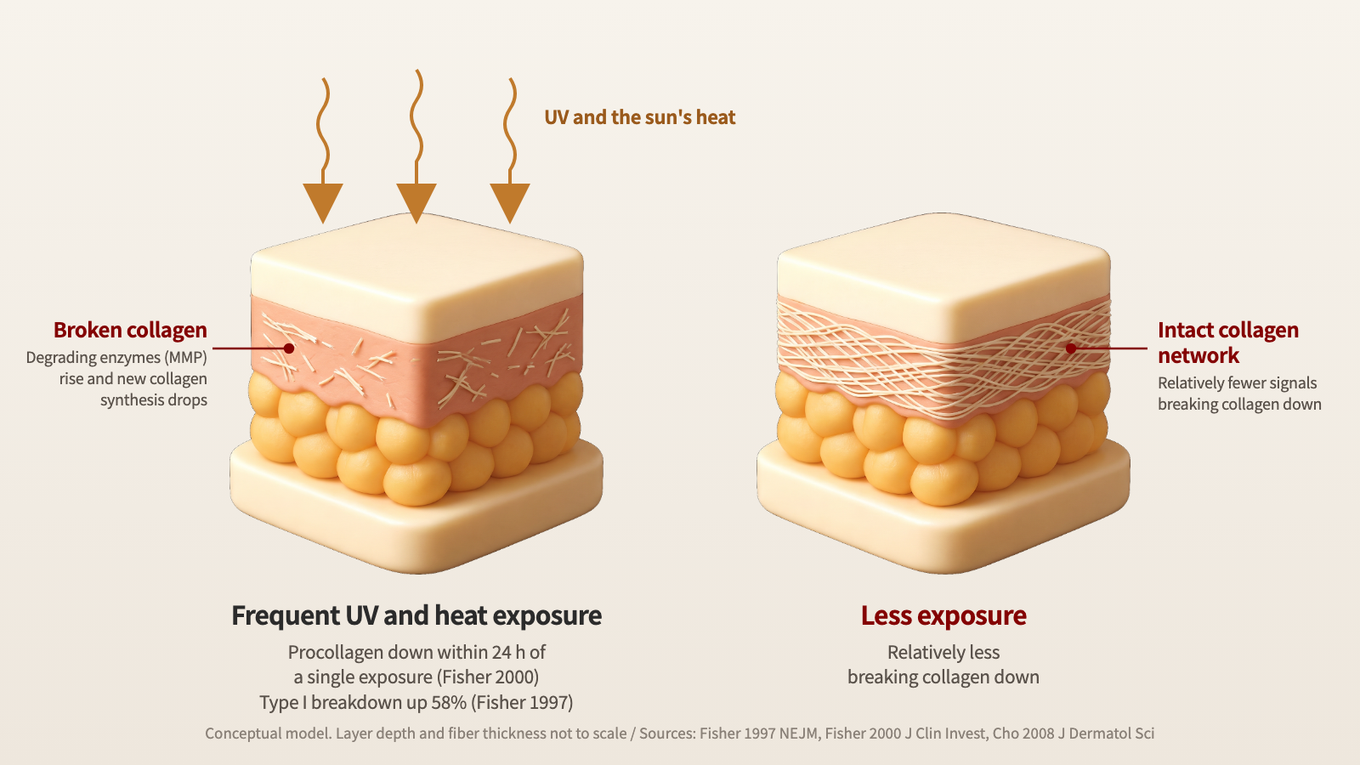
The same skin cross-section model, with only the dermis drawn differently. Fiber thickness and layer depth are not to scale.
It isn't only UV. A Seoul National University team exposed the skin of 16 healthy people to real sunlight and separated out the effects of UV, infrared plus visible light, and heat. Infrared and visible light increased collagen-degrading enzymes (MMP-1, MMP-9) and reduced type I procollagen, and the sun's heat also contributed to the rise in MMP-1 (Cho 2008, J Dermatol Sci). Under direct sunlight, skin temperature can climb close to 40°C (Cho 2009).
Ultherapy and Thermage use heat too. How is that different from the sun's heat?
They do. Ultrasound lifting like Ultherapy Prime delivers heat to small points at set depths, while radiofrequency like Thermage FLX warms a broader area of the dermis. The methods differ, but both deliver brief heat at a set depth and strength. Midsummer sun or frequent saunas heat the whole skin for longer, again and again. I've covered when it's OK to use a sauna after treatment in Alcohol, sauna and exercise after a skin booster.
As I see it, the 2 to 6 months after treatment matter more than the date itself, because that's the window where studies found new collagen. Depending on when you start, that window can run through high-UV months or low-UV months.
Here's when each study took its measurements:
So what does UV look like during that window? A Korea Meteorological Administration (KMA) global atmosphere watch report includes erythemal UV data (UV weighted by how strongly it reddens skin) measured in Seoul by Yonsei University from 2004 to 2018. When I looked it up, the monthly average daily dose was highest in June at 2.68 kJ/m² and lowest in December at 0.45 kJ/m². That's close to a sixfold gap. The year's peak UV index mostly came in July and August (KMA 2018 Global Atmosphere Watch Report).
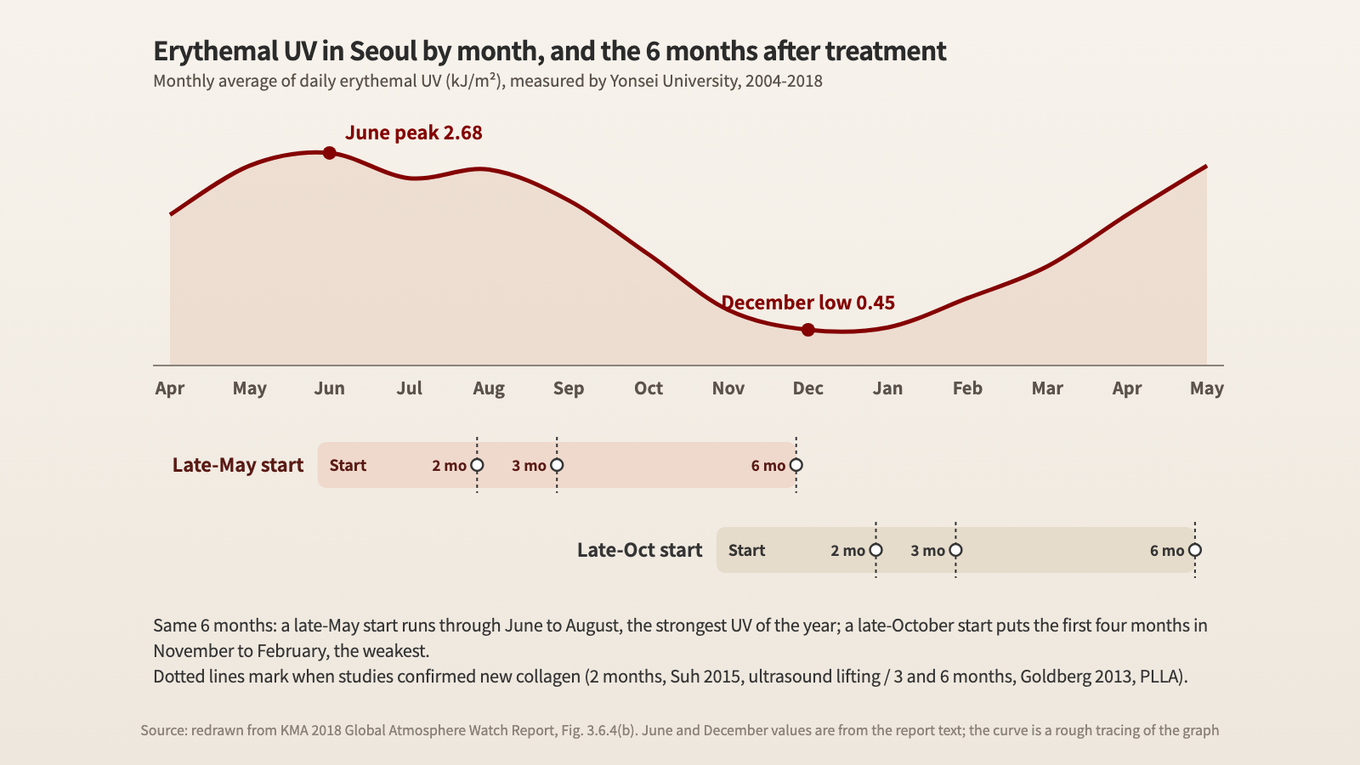
The curve is a rough redrawing of the KMA report graph; the numbers are values from the report text.
If you start in late October, the first four months overlap with November to February. By month 6, in April, UV has climbed back to roughly September levels. So I split the seasonal argument in two. What has evidence: UV is weak during the early months when collagen is building. What doesn't: the claim that "it works better if you do it in autumn." As far as I've been able to check, no clinical study has compared that directly.
There is one relevant paper from pigment laser treatment. A study of 516 people treated with laser for solar lentigines (brown spots caused by sun exposure) at five Korean tertiary hospitals found that post-treatment hyperpigmentation was more closely linked to skin factors, like reddish spots and uneven pigmentation across the face, than to the season of treatment (Kang 2017). It isn't a collagen study, but it leans toward the view that season alone doesn't decide the outcome.
No. UV is still there in winter, and it climbs again on snow and at altitude. You only get the seasonal benefit when your exposure actually drops.
The same KMA report shows total UV, which includes part of UVA, at 0.90 MJ/m² in June and 0.27 MJ/m² in December, about a 3.3-fold difference. That's a smaller drop than the nearly sixfold fall in erythemal UV. Add the World Health Organization (WHO) figures and the picture looks like this:
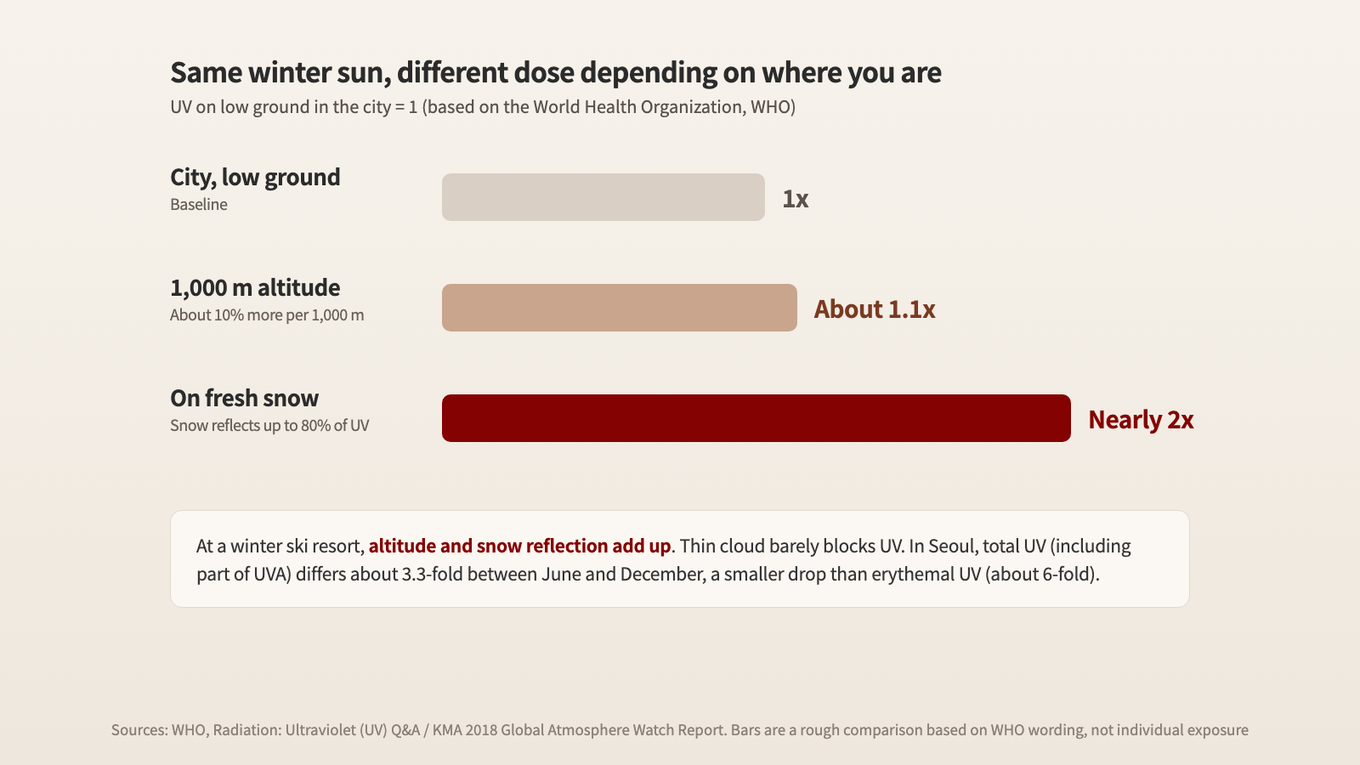
A rough comparison based on WHO wording, not the actual dose any one person receives.
Winter brings one more variable. Dry air and indoor heating leave more people with a sensitive skin barrier. I've laid out how to decide in that situation in Sensitive skin in autumn: should you get a treatment now or wait?
Count backward from your target date. If you're aiming for year-end gatherings, even a late-October start is on the tight side. For treatments done over several sessions, it's more realistic to think of year-end as "still in progress," with the collagen assessment coming in the new year.
One caveat up front: collagen treatments aren't something anyone can promise to finish by a set date. What you can sketch is a rough sequence, based on the time points used in studies and the approved labeling.
| Treatment type | Course | When change was seen | If you start in late October |
|---|---|---|---|
| Energy-based lifting (e.g. ultrasound lifting) | Follow-up after treatment | New collagen at 2 months (Suh 2015) | About 2 months by year-end |
| Collagen booster in sessions (e.g. Sculptra) | Usually 3 sessions, at least 3 weeks apart (FDA label) | Human biopsies at 3 and 6 months (Goldberg 2013) | 3rd session in early December, assessment in the new year |
| Both | Time for early swelling and bruising to settle | Varies by treatment and person | Avoid treatment right before an event |
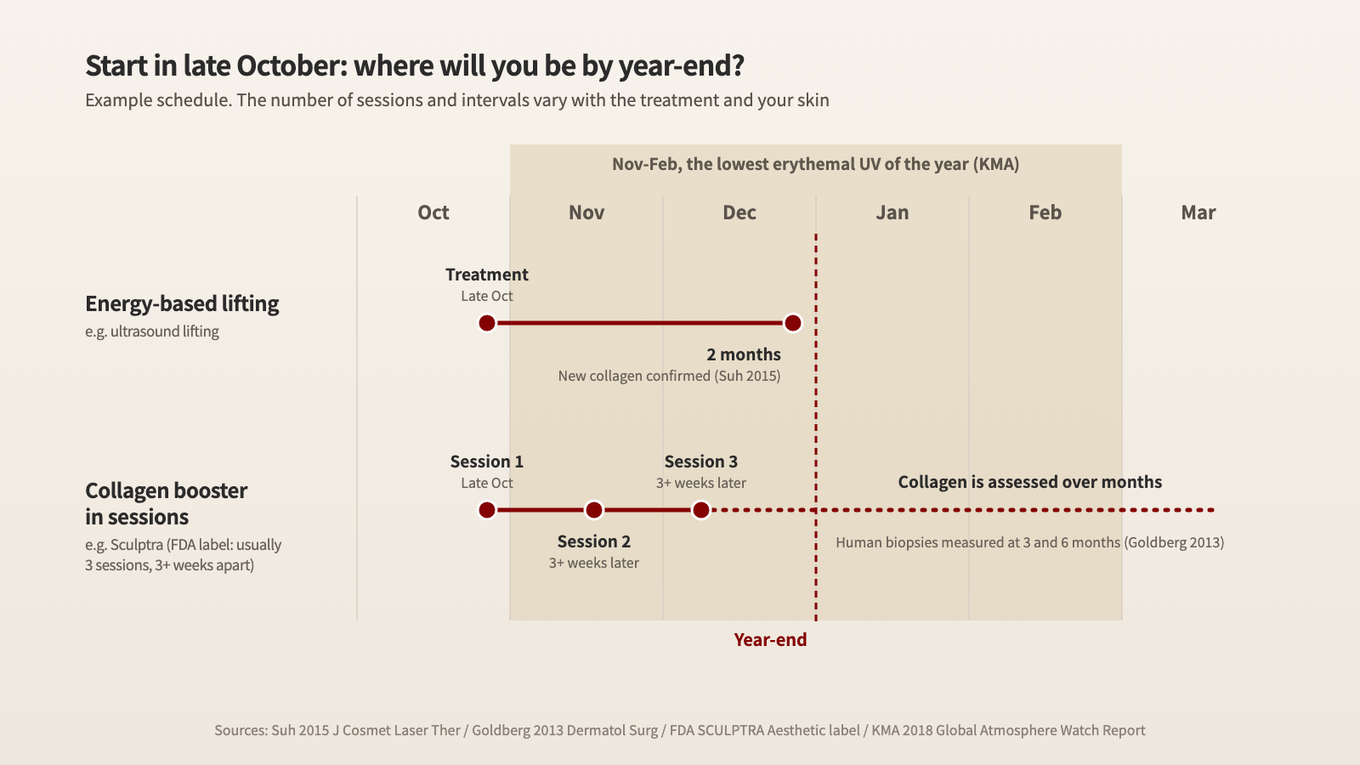
An example schedule. The number of sessions and intervals vary with the treatment and your skin.
⚠️ Good to know - I don't recommend booking an injectable treatment in the week right before an event. Swelling or bruising can happen, and how long it lasts depends on the treatment and the person. If you have a target date, counting back from it is the most reliable way to plan. Side effects and limits also differ by treatment (PLLA, for example, can cause delayed nodules), so check the treatment-specific articles, such as How Sculptra (PLLA) Builds Collagen, and discuss them at your consultation.
It applies if you spend a lot of daytime outdoors, and it shrinks if you have high-exposure plans in winter. When you weigh the seasonal benefit, look at your winter schedule first. A few days at a ski resort can eat into it quite a bit, in my view.
The front of the neck and under the jaw in late-autumn window light. The face and neck stay exposed whatever the season.
Conditions are a little better in one respect: the early part of the 2 to 6 months after treatment, when new collagen was measured, overlaps with low-UV months. But no study has directly compared whether the season changes results, so managing your exposure and planning the treatment matter more.
That's not the case. There's no evidence that the season decides the result. In summer, though, UV and heat exposure are higher, so you need to be more careful with sun protection and heat after treatment.
Yes. In Seoul, total UV including part of UVA is still about a third of June levels in December (KMA). On snow, UV exposure nearly doubles, according to the WHO.
In Seoul, erythemal UV is lowest in December, and November through February is the low period. If you start between late October and November, the first few months after treatment overlap with it. Season alone still doesn't decide the outcome.
The case for autumn and winter rests on one finding: UV reduces collagen synthesis and increases its breakdown. New collagen is measured 2 to 6 months after treatment, and with a late-October start, the early part of that window lines up with November to February, when UV in Seoul is at its weakest.
Before the season, check three things: when your target date is, whether you have ski trips or holidays planned for winter, and whether your skin needs calming first. Answer those, and the start date usually falls into place.
#CollagenTreatments #RegenerativeTreatments #AutumnSkinTreatment #WinterSkinTreatment #CollagenBooster #Photoaging #UVandCollagen #TreatmentTiming #SkinClinicSeoul #ForeverClinicMyeongdong


